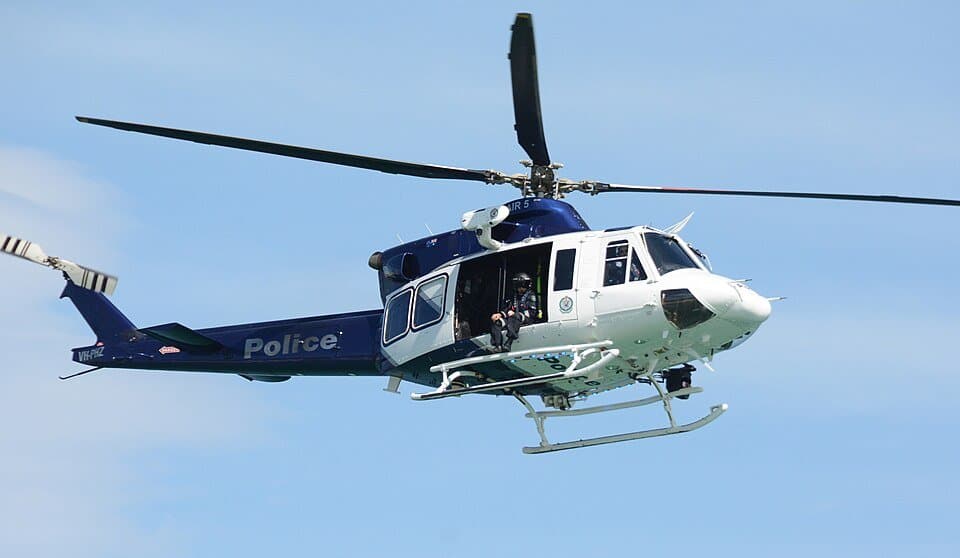


Credit
Sardaka · CC BY-SA 4.0 · Resized · CC BY-SA 4.0 · Source ↗ · Modified


Preparing your view.
At a glance
Measured figures
Bell 412EP · including rotors
Single source56 ft 1 in (17.09 m) including rotors[source]
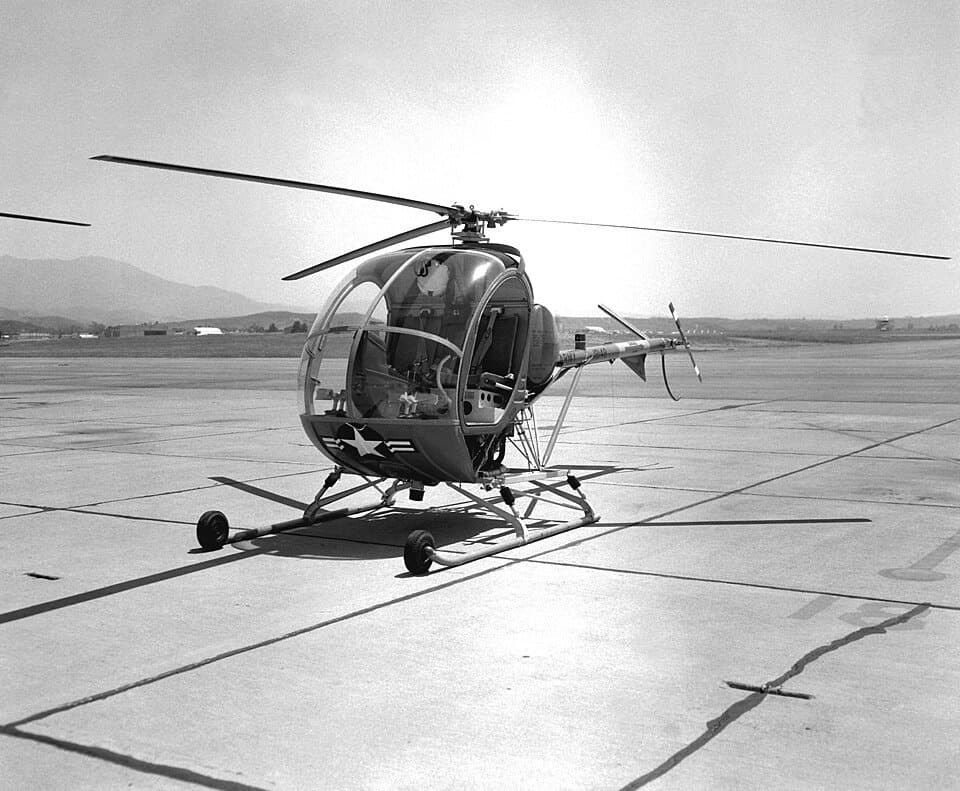
Hughes 300 · Length
Configuration
| Specification | Bell 412 | Hughes TH-55 Osage |
|---|---|---|
| Type | Multipurpose utility helicopter[source] | Light utility and trainer helicopter[source] |
| National origin | United States / Canada[source] | — |
| Manufacturer | Bell Helicopter[source] | Hughes Helicopters[source] |
| Primary users | Japan Ground Self Defence Force See Operators for others[source] | — |
| Number built | 1,300+ |
28 ft 10.75 in (8.81 m)[source]
Bell 412EP · 1 × Pratt & Whitney Canada PT6T-3D Twin-Pac or PT6T-3DF Twin-Pac coupled turboshaft engine - each, 1,250 shp (
Single source1 × Pratt & Whitney Canada PT6T-3D Twin-Pac or PT6T-3DF Twin-Pac coupled turboshaft engine - each, 1,250 shp (930 kW)[source]
Hughes 300 · 1 × Lycoming HIO-360-A1A four-cylinder air-cooled horizontally-opposed piston engine
Single source1 × Lycoming HIO-360-A1A four-cylinder air-cooled horizontally-opposed piston engine., 180 hp (130 kW)[source]
Hughes 300 · three hours and with maximum fuel
Single sourcethree hours and 30 minutes with maximum fuel.[source]
Bars compare reported quantities only. A larger figure does not make a system better; configurations and test conditions differ.
2,800[source] |
| Manufactured | 1979–present[source] | 1961–1983[source] |
|---|
| Introduction date | 1981 ( 1981 )[source] | — |
|---|
| First flight | August 1979 ( 1979-08 )[source] | 2 October 1956[source] |
|---|
| Developed from | Bell 212[source] | — |
|---|
| Variant | Bell CH-146 Griffon[source] | Schweizer S300[source] |
|---|
| Capacity | up to 13 passengers, maximum external load of almost 6,614 lb (3,000 kg)[source] | — |
|---|
| Fuselage length | 43 ft (13 m)[source] | — |
|---|
| Blade sections | root: Boeing VR-7; tip: Wortmann FX 71-H-080[source] | — |
|---|
| Main rotor area | 1,662 sq ft (154.4 m 2 )[source] | 503 sq ft (46.7 m 2 )[source] |
|---|
| Power/mass | 0.2663 hp/lb (0.4378 kW/kg)[source] | 0.107 hp/lb (0.176 kW/kg)[source] |
|---|
| Primary user | — | United States Army[source] |
|---|
| Fuel capacity | — | 30 US gal (25 imp gal; 110 L) in external mounted tank with provision for a 10 US gal (8.3 imp gal; 38 L) auxiliary tank.[source] |
|---|
| Blade section | — | NACA 0015[source] |
|---|
| Never exceed speed | — | 87 mph (140 km/h, 76 kn)[source] |
|---|
| Maximum water contact speed (on floats) | — | 20 mph (17 kn; 32 km/h)[source] |
|---|
| Maximum water taxi speed (on floats) | — | 10 mph (9 kn; 16 km/h)[source] |
|---|
| Hover ceiling IGE | — | 7,700 ft (2,300 m)[source] |
|---|
| Hover ceiling OGE | — | 5,800 ft (1,800 m)[source] |
|---|
| Disk loading | — | 3.3 lb/sq ft (16 kg/m 2 )[source] |
|---|
| Role | — | piston-powered light training helicopter[source] |
|---|
| Source measurement | — | In 1955, Hughes Tool Company's Aircraft Division carried out a market survey which showed that there was a demand for a low-cost lightweight twin-seat helicopter. In response, the division launched development of the Model 269 in September 1955, initially being carried out as a private venture. It was a remarkably light rotorcraft, being half the weight of the smallest operational helicopter in the mid 1950s. In February 1957, a Hughes spokesperson claimed the type to possess a good rate of climb, modest fuel consumption and provide for ease of maintenance.[source]Hughes TH-55 Osage · Development; only the objects and conditions stated in this passage In 1964, Hughes introduced the slightly larger three-seat Model 269B, which was marketed as the Hughes 300 . That same year, the Hughes 269 set an endurance record of 101 hours. To set the record, two pilots took turns piloting the aircraft and hovered in ground-effect for fueling. To ensure no cheating, eggs were attached to the bottom of the skid gear to register any record-ending landing.[source]Hughes TH-55 Osage · Operational history; only the objects and conditions stated in this passage The Hughes 300 was followed in 1969 by the improved Hughes 300C (sometimes 269C), which first flew on March 6, 1969, and received FAA certification in May 1970. This new model introduced a more powerful 190 hp (140 kW) Lycoming HIO-360-D1A engine and an increased-diameter rotor, giving a payload increase of 45%, plus overall performance improvements. It was this model that Schweizer began building under license from Hughes in 1983. In 1986, Schweizer acquired all rights to the helicopter from McDonnell Douglas , who had purchased Hughes Helicopters in 1984, and renamed it McDonnell Douglas Helicopter Systems . For a few years after, Schweizer acquired the FAA Type Certificate known as the Schweizer-Hughes 300 . While Schweizer made over 250 minor improvements, the basic design remained unchanged.[source]Hughes TH-55 Osage · Operational history; only the objects and conditions stated in this passage Between Hughes and Schweizer, and including foreign-licensed production civil and military training aircraft, nearly 3,000 copies of the Model 269/300 have been built and flown over the last 50 years. That would have been the end of the story, but Schweizer continued to develop the model 300 by adding a turbine and redesigning the body to create the model 330m, and then further developed the dynamic components to take greater advantage of the power of the turbine engine; this led to the development of the Model 333.[source]Hughes TH-55 Osage · Operational history; only the objects and conditions stated in this passage Two prototype aircraft powered by a 180 hp Lycoming O-360-A engine and had a truss tailboom. First flown on 2 October 1956.[source]Hughes TH-55 Osage · Variants / Model numbers; only the objects and conditions stated in this passage Replacing the prototype's truss tailboom with a simple aluminum tube as the tailboom, the 269A came with the option for several models of Lycoming O-360 engines: the carbureted O-360-C2D, restricted to 165 hp (123 kW) in the 269A, or the carbureted HO-360-B1A/B1B or fuel-injected HIO-360-B1A/B1B, all rated for 180 hp (134 kW) in the 269A. Customers also had the option for dual controls, and a 19 gal (72 liter) auxiliary tank. The maximum weight was 1,550 lb (703 kg); later this could be increased to 1,600 lb (726 kg) if certain modifications were performed.[source]Hughes TH-55 Osage · Variants / Model numbers; only the objects and conditions stated in this passage The 269A-1, which Hughes marketed as the Model 200 , was an improved version of the 269A certified by the FAA on August 23, 1963. Powered by the 180 hp (134 kW) fuel-injected Lycoming HIO-360-B1A or -B1B, and with its maximum weight increased to 1,670 lb (757 kg), the Model 200 also had the option for either a 30 gal (114 liter) or 25 gal (95 liter) main fuel tank. Hughes sold two versions of the Model 200: the ordinary Model 200 Utility and the Model 200 Deluxe with added custom interior decor and electrically operated trim for the cyclic control .[source]Hughes TH-55 Osage · Variants / Model numbers; only the objects and conditions stated in this passage Featuring a three-seat cockpit, the 269B was powered by a 190 hp (141 kW) Lycoming HIO-360-A1A engine and was marketed as the Hughes Model 300 . Optional floats were also available on the 300, the first time available on any 269-variant.[source]Hughes TH-55 Osage · Variants / Model numbers; only the objects and conditions stated in this passage 269B designed specifically for agricultural spraying with a 30 gal (114 liter) chemical tank on each side of the fuselage, and a 35 feet (10.67 m) spray boom.[source]Hughes TH-55 Osage · Variants / Model numbers; only the objects and conditions stated in this passage The 300C was powered by a 190 hp (141 kW) Lycoming HIO-360-D1A and had a larger diameter main rotor - 26 ft 10 in (8.18 m) compared to 25 ft 4 in (7.72 m). The larger rotor and engine giving it a 45% performance increase over previous 269-models. Hughes and Schweizer both marketed the 269C as the Model 300C .[source]Hughes TH-55 Osage · Variants / Model numbers; only the objects and conditions stated in this passage Military version of the 269A-1 (Model 200) built for the U.S. Army as its standard primary training helicopter and named after the Osage Native American tribe; student pilots nicknamed it the "Mattel Messerschmitt". Although basically the same as the Model 200, the TH-55A was fitted with military radio and instrumentation. 792 TH-55As were purchased by the Army between 1964 and 1967. An experimental TH-55A was fitted with an Allison 250-C18 turboshaft engine, and another would be fitted with a 185 hp (138 kW) Wankel RC 2-60 rotary engine .[source]Hughes TH-55 Osage · Variants / Military designations; only the objects and conditions stated in this passage Length: 28 ft 10.75 in (8.81 m)[source]Hughes TH-55 Osage · Specifications (Hughes 300); only the objects and conditions stated in this passage Height: 8 ft 2.75 in (2.51 m) overall[source]Hughes TH-55 Osage · Specifications (Hughes 300); only the objects and conditions stated in this passage Empty weight: 958 lb (435 kg)[source]Hughes TH-55 Osage · Specifications (Hughes 300); only the objects and conditions stated in this passage Gross weight: 1,550 lb (703 kg)[source]Hughes TH-55 Osage · Specifications (Hughes 300); only the objects and conditions stated in this passage Max takeoff weight: 1,670 lb (757 kg) certificated[source]Hughes TH-55 Osage · Specifications (Hughes 300); only the objects and conditions stated in this passage 1,850 lb (839 kg) maximum weight with restricted operations[source]Hughes TH-55 Osage · Specifications (Hughes 300); only the objects and conditions stated in this passage Powerplant: 1 × Lycoming HIO-360-A1A four-cylinder air-cooled horizontally-opposed piston engine., 180 hp (130 kW)[source]Hughes TH-55 Osage · Specifications (Hughes 300); only the objects and conditions stated in this passage Main rotor diameter: 25 ft 3.5 in (7.71 m)[source]Hughes TH-55 Osage · Specifications (Hughes 300); only the objects and conditions stated in this passage Main rotor area: 503 sq ft (46.7 m 2 )[source]Hughes TH-55 Osage · Specifications (Hughes 300); only the objects and conditions stated in this passage Maximum speed: 87 mph (140 km/h, 76 kn)[source]Hughes TH-55 Osage · Specifications (Hughes 300); only the objects and conditions stated in this passage Cruise speed: 80 mph (130 km/h, 70 kn) maximum[source]Hughes TH-55 Osage · Specifications (Hughes 300); only the objects and conditions stated in this passage 66 mph (57 kn; 106 km/h) economical.[source]Hughes TH-55 Osage · Specifications (Hughes 300); only the objects and conditions stated in this passage Never exceed speed : 87 mph (140 km/h, 76 kn)[source]Hughes TH-55 Osage · Specifications (Hughes 300); only the objects and conditions stated in this passage Maximum water contact speed (on floats): 20 mph (17 kn; 32 km/h)[source]Hughes TH-55 Osage · Specifications (Hughes 300); only the objects and conditions stated in this passage Maximum water taxi speed (on floats): 10 mph (9 kn; 16 km/h)[source]Hughes TH-55 Osage · Specifications (Hughes 300); only the objects and conditions stated in this passage Range: 300 mi (480 km, 260 nmi) with maximum fuel and no reserve.[source]Hughes TH-55 Osage · Specifications (Hughes 300); only the objects and conditions stated in this passage Endurance: three hours and 30 minutes with maximum fuel.[source]Hughes TH-55 Osage · Specifications (Hughes 300); only the objects and conditions stated in this passage Service ceiling: 13,000 ft (4,000 m)[source]Hughes TH-55 Osage · Specifications (Hughes 300); only the objects and conditions stated in this passage Hover ceiling IGE: 7,700 ft (2,300 m)[source]Hughes TH-55 Osage · Specifications (Hughes 300); only the objects and conditions stated in this passage Hover ceiling OGE: 5,800 ft (1,800 m)[source]Hughes TH-55 Osage · Specifications (Hughes 300); only the objects and conditions stated in this passage Rate of climb: 1,140 ft/min (5.8 m/s)[source]Hughes TH-55 Osage · Specifications (Hughes 300); only the objects and conditions stated in this passage |
|---|
| Country of origin | — | United States[source]Inventory Origin column; table 1, row 17, cell 2; revision 1354808718; retrieved 2026-10-01 |
|---|
Maximum take-off; Hughes 300 · certificated
Single source