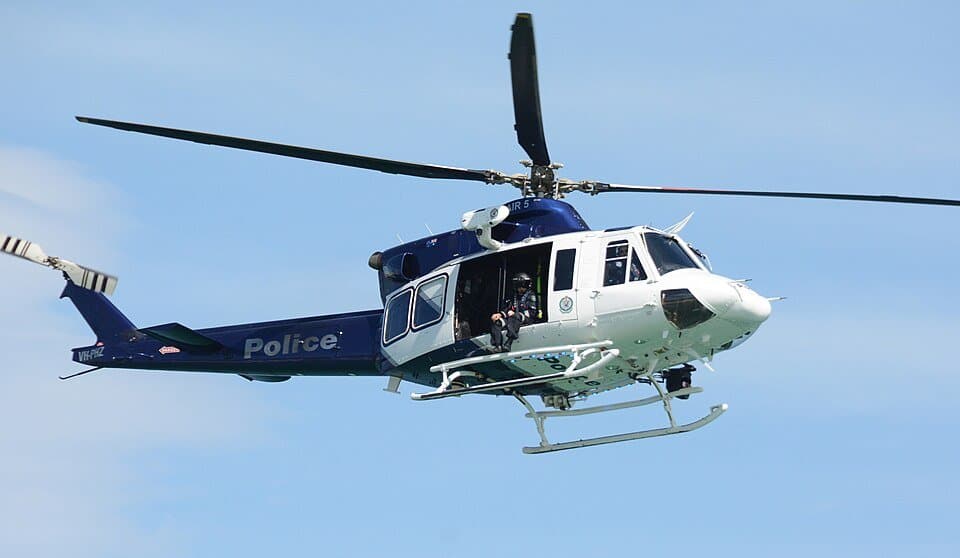

Credit
Sardaka · CC BY-SA 4.0 · Resized · CC BY-SA 4.0 · Source ↗ · Modified


Preparing your view.
At a glance
Measured figures
Bell 412EP · including rotors
Single source56 ft 1 in (17.09 m) including rotors[source]
Bell 412EP · Main rotor diameter
Single source46 ft 0 in (14.02 m)[source]
one-two pilots[source]
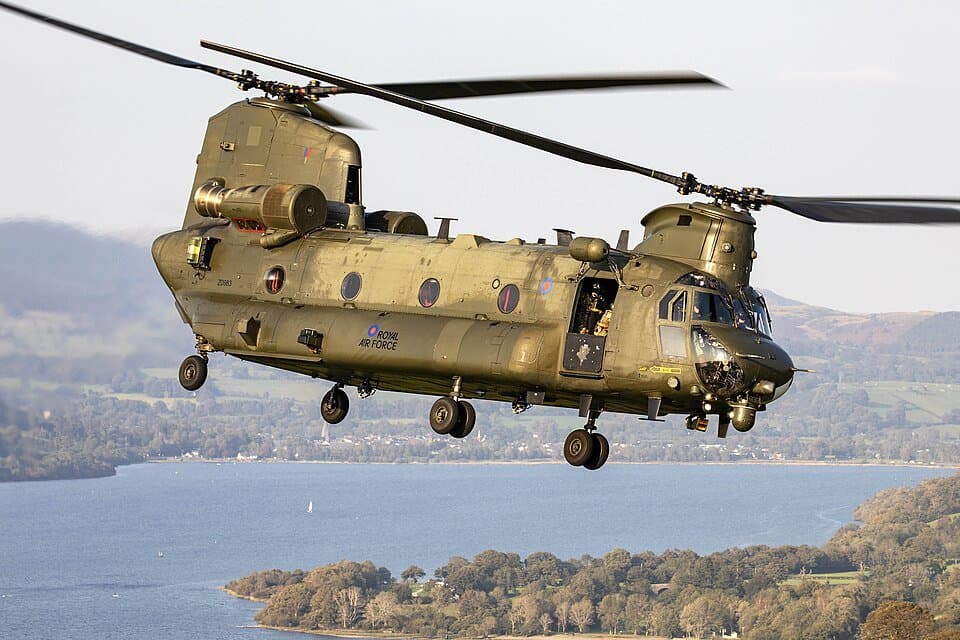
Chinook HC6A · pilot, copilot, two weapon system operators/loadmasters
Single source4 (pilot, copilot, two weapon system operators/loadmasters)[source]
2 Pilots, 2 Weapon System Operators[source]Chinook / RAF specification (variant not stated) · AircrewSource text · numeric interpretation needs review
Bell 412EP · 1 × Pratt & Whitney Canada PT6T-3D Twin-Pac or PT6T-3DF Twin-Pac coupled turboshaft engine - each, 1,250 shp (
Single source1 × Pratt & Whitney Canada PT6T-3D Twin-Pac or PT6T-3DF Twin-Pac coupled turboshaft engine - each, 1,250 shp (930 kW)[source]
Chinook HC6A · 2 × Honeywell T55-GA-714A turboshaft free-turbine engines, 3,750 shp ( ) each
Single source2 × Honeywell T55-GA-714A turboshaft free-turbine engines, 3,750 shp (2,800 kW) each[source]
Bars compare reported quantities only. A larger figure does not make a system better; configurations and test conditions differ.
Configuration
| Specification | Bell 412 | Boeing Chinook (UK variants) |
|---|---|---|
| Type | Multipurpose utility helicopter[source] | Transport helicopter[source] |
| National origin | United States / Canada[source] | — |
| Manufacturer | Bell Helicopter[source] | Boeing Defense, Space & Security[source] |
| Primary users | Japan Ground Self Defence Force See Operators for others[source] | — |
| Number built | 1,300+[source] | 72 (all RAF models)[source] |
| Manufactured | 1979–present[source] | — |
| Introduction date | 1981 ( 1981 )[source] | 22 November 1980 (with RAF)[source] |
| First flight | August 1979 ( 1979-08 )[source] | 23 March 1980 (HC1)[source] |
| Developed from | Bell 212[source] | Boeing CH-47 Chinook[source] |
| Variant | Bell CH-146 Griffon[source] | — |
| Capacity | up to 13 passengers, maximum external load of almost 6,614 lb (3,000 kg)[source] | 55 soldiers and up to 10 tonnes of freight or equipment[source] |
| Fuselage length | 43 ft (13 m)[source] | — |
| Blade sections | root: Boeing VR-7; tip: Wortmann FX 71-H-080[source] | — |
| Main rotor area | 1,662 sq ft (154.4 m 2 )[source] | 5,655.2 sq ft (525.39 m 2 )[source] |
| Power/mass | 0.2663 hp/lb (0.4378 kW/kg)[source] | — |
| Designer | — | Boeing-Vertol[source] |
| Status | — | In service[source] |
| Primary user | — | Royal Air Force[source] |
| Variants | — | HC1, HC1B, HC2, HC3, HC4, HC5, HC6, HC6A, HC7[source] |
| Guns | — | 2× M134 Miniguns and 1× M60 machine gun[source] 2 x M134 Miniguns, 1 x M60 Machine Gun[source]Chinook / RAF specification (variant not stated) · Guns |
| Blade section | — | - root: Boeing VR-7; tip: Boeing VR-8[source] |
| Cockpit Avionics | — | Glass cockpit with a BAE Systems Digital Advanced Flight Control System (DAFCS), includes automatic modes such as auto-hover and auto-descend to ease pilot workload.[source] |
| Sensors | — | Electro-Optical Sensor Turret (EOST) with two infrared cameras and a low-light TV function .[source] EOST turret including two infrared cameras and a low-light TV function[source]Chinook / RAF specification (variant not stated) · Electro optics |
| Defensive Aids | — | Missile Warning Receiver, Infrared Warning Receiver, Radar Warning Receiver, Counter-measure dispensing system (flares).[source] |
| Country of origin | — | United States[source]Boeing Chinook (UK variants) · origin explicitly stated in the linked current national-inventory row; no inference from operator or shipyard |
| Powerplant | — | Two Honeywell 55-L-714A Free-Turbine engines[source]Chinook / RAF specification (variant not stated) · Powerplant |
| Reported engine rating | — | 4,168shp each[source]Chinook / RAF specification (variant not stated) · ThrustSource text · numeric interpretation needs review |
| Flight altitude | — | 15,000ft[source]Chinook / RAF specification (variant not stated) · Maximum altitude |