
Credit
RightCowLeftCoast · CC BY-SA 4.0 · Resized · CC BY-SA 4.0 · Source ↗ · Modified


Preparing your view.
At a glance
Measured figures
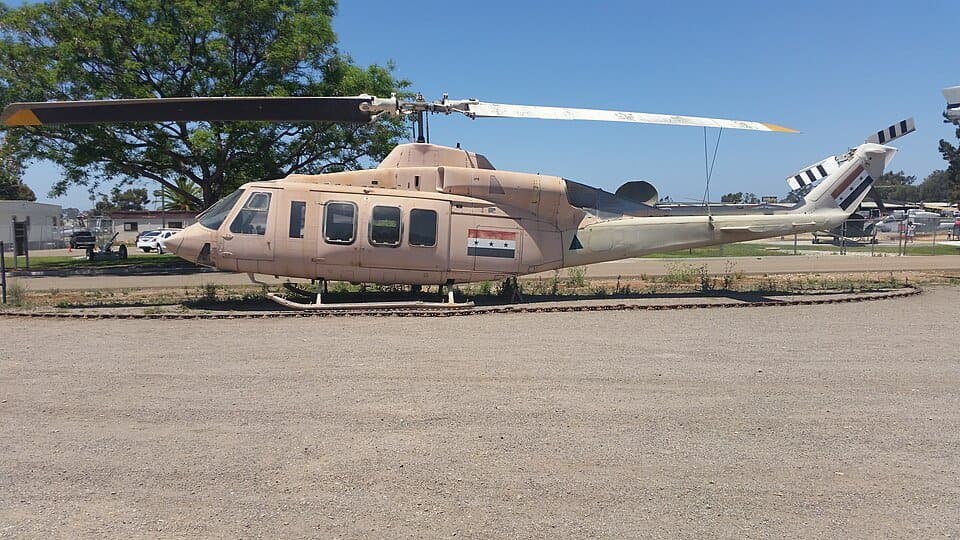
214ST · Length
Single source49 ft 4 in (15.03 m)[source]
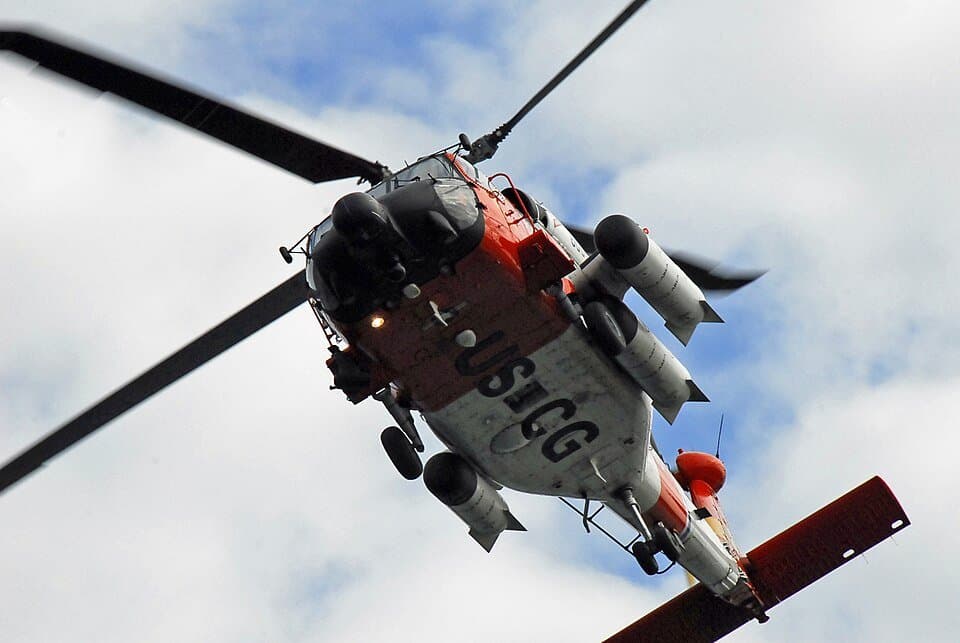
HH-60J · Length
Configuration
| Specification | Bell 214ST | Sikorsky MH-60 Jayhawk |
|---|---|---|
| Crew | 1 or 2[source] | four (pilot, co-pilot, two flight crew)[source] |
| Type | Medium-lift helicopter[source] | Medium-range recovery helicopter[source] |
| National origin | United States[source] | — |
| Manufacturer | Bell Helicopter[source] | Sikorsky Aircraft[source] |
64 ft 10 in (19.76 m)[source]
Bell 214ST · main rotor diameter only; not tail rotor and not unrelated Bell214 BigLifter · Bell 214ST · main rotor diameter only; not tail rotor and not unrelated Bell214 BigLifter · source measurement 1
Single sourceBell 214ST · main rotor diameter only; not tail rotor and not unrelated Bell214 BigLifter · Bell 214ST · main rotor diameter only; not tail rotor and not unrelated Bell214 BigLifter · source measurement 2
Single source15,85 m 52 ft 0 in[source]Bell 214ST · main rotor diameter only; not tail rotor and not unrelated Bell214 BigLifter
Rotor diameter
Single source16,36 m[source]
214ST · 2 × General Electric CT7-2A turboshaft , 1,625 shp ( ) each
Single source2 × General Electric CT7-2A turboshaft , 1,625 shp (1,215 kW) each[source]
HH-60J · 2 × General Electric T700 -GE-401C gas turbines, 1,890 shp ( ) each
Single source2 × General Electric T700 -GE-401C gas turbines, 1,890 shp (1,410 kW) each[source]
214ST · Wing area
Single source2,124 sq ft (107.3 m 2 )[source]
214ST · 1,780 ft/min (
Single source1,780 ft/min (9.04 m/s)[source]
Bars compare reported quantities only. A larger figure does not make a system better; configurations and test conditions differ.
| Status | Production completed[source] | In service[source] |
|---|
| Primary users | Peruvian Air Force Royal Brunei Air Force Royal Thai Navy Iraqi Air Force (historical)[source] | — |
|---|
| Number built | 96[source] | 42 (+ 6 conversions)[source] |
|---|
| Manufactured | 1979–1993[source] | 1990–1996[source] |
|---|
| Introduction date | 1982[source] | — |
|---|
| First flight | 21 July 1979[source] | 8 August 1989[source] |
|---|
| Developed from | Bell 214[source] | Sikorsky SH-60 Seahawk[source] |
|---|
| Capacity | Internal: 16 or 17 passengers or equivalent cargo; External: 8,000 lb (3,630 kg) sling load[source] | — |
|---|
| Role | medium-lift, twin-engine helicopter descended[source] | multi-mission, twin-engine, medium-range helicopter[source] |
|---|
| Source measurement | The Bell 214ST was originally developed during the 1970s and early 1980s as a military project from the Bell 214B BigLifter, specifically for production in Iran and the development by Bell was funded by the Iranian government. The fundamental difference was the replacement of the Model 214's single Lycoming LTC-4 turboshaft engine with two 1,625 shp (1,212 kW) General Electric T700 engines, to improve the helicopter's hot and high performance and improve safety. An interim twin-engine conversion of a Model 214 flew on 15 February 1977 in Texas , Testing was successful, and Bell decided to press forward with a definitive twin-engine Bell 214ST, with a fuselage stretched by 30 in (76 cm) and a revised main rotor of greater diameter. Iran changed its production plans, with 50 Bell 214A and 350 Bell 214STs to be built at the new production plant to be set up at Isfahan , Iran.[source]Bell 214ST · Design and development; only the objects and conditions stated in this passage The Bell 214ST included major design changes from the Bell 214. The Bell 214ST has a larger, stretched fuselage with seating for 16-18 passengers, and two 1,625 shp (1,212 kW) GE CT7-2A engines. The helicopter introduced some ground-breaking innovations for Bell, including a one-hour run-dry transmission, fiberglass rotor blades, elastomeric rotorhead bearings, and the option of either skid or wheeled landing gear. The helicopter has a cockpit door and a large cabin door on each side. The 214ST has a fuel capacity of 435 US gallons (1,650 L). An auxiliary fuel system could be added.[source]Bell 214ST · Design and development; only the objects and conditions stated in this passage Capacity: Internal: 16 or 17 passengers or equivalent cargo; External: 8,000 lb (3,630 kg) sling load[source]Bell 214ST · Specifications (214ST); only the objects and conditions stated in this passage Length: 49 ft 4 in (15.03 m)[source]Bell 214ST · Specifications (214ST); only the objects and conditions stated in this passage Wingspan: 52 ft 0 in (15.85 m)[source]Bell 214ST · Specifications (214ST); only the objects and conditions stated in this passage Height: 15 ft 11 in (4.84 m)[source]Bell 214ST · Specifications (214ST); only the objects and conditions stated in this passage Wing area: 2,124 sq ft (107.3 m 2 )[source]Bell 214ST · Specifications (214ST); only the objects and conditions stated in this passage Empty weight: 9,481 lb (4,300 kg)[source]Bell 214ST · Specifications (214ST); only the objects and conditions stated in this passage Max takeoff weight: 17,500 lb (7,938 kg)[source]Bell 214ST · Specifications (214ST); only the objects and conditions stated in this passage Powerplant: 2 × General Electric CT7-2A turboshaft , 1,625 shp (1,215 kW) each[source]Bell 214ST · Specifications (214ST); only the objects and conditions stated in this passage Maximum speed: 143 kn (165 mph, 264 km/h)[source]Bell 214ST · Specifications (214ST); only the objects and conditions stated in this passage Cruise speed: 140 kn (161 mph, 259 km/h)[source]Bell 214ST · Specifications (214ST); only the objects and conditions stated in this passage Range: 435 nmi (500 mi, 858 km)[source]Bell 214ST · Specifications (214ST); only the objects and conditions stated in this passage Service ceiling: 10,400 ft (3,170 m) ; ceiling for hover in ground effect[source]Bell 214ST · Specifications (214ST); only the objects and conditions stated in this passage Rate of climb: 1,780 ft/min (9.04 m/s)[source]Bell 214ST · Specifications (214ST); only the objects and conditions stated in this passage | Chosen to replace the HH-3F Pelican , the HH-60J was based on the United States Navy's SH-60 Seahawk and a member of the Sikorsky S-70 helicopter family. Compared to its predecessor the HH-3F, the HH-60J is lighter, faster, and equipped with more sophisticated electronics and more powerful engines. The HH-60J was developed in conjunction with the U.S. Navy's HH-60H Rescue Hawk .[source]Sikorsky MH-60 Jayhawk · Development; only the objects and conditions stated in this passage The normal cruising speed of the MH-60T is 135 to 140 kn (155 to 161 mph; 250 to 259 km/h) and the aircraft is capable of reaching 180 kn (207 mph; 333 km/h) for short durations. It can fly at 140 kn (161 mph; 259 km/h) for six to seven hours. With a fuel capacity of 6,460 lb (2,930 kg), the helicopter is designed to fly a crew of four up to 260 nmi (482 km) offshore, hoist up to six additional people on board while remaining on-scene for up to 45 minutes and return to base while maintaining an adequate fuel reserve.[source]Sikorsky MH-60 Jayhawk · Design; only the objects and conditions stated in this passage The Jayhawk has a radar for search/weather that gives its nose a distinctive look. A forward looking infrared (FLIR) sensor turret can be mounted below its nose. It can carry three 120 US gal (454 L) fuel tanks with two on the port side rack and one on the starboard side rack. The starboard side also carries a 600 lbf (2.67 kN) capacity rescue hoist mounted above the door. The hoist has 200 ft (61.0 m) of cable. The helicopter is normally based on land but can be based on 270 foot medium endurance Coast Guard Cutters (WMEC) or 418 foot Legend-Class National Security Cutters (WMSL) .[source]Sikorsky MH-60 Jayhawk · Design; only the objects and conditions stated in this passage The MH-60T is equipped with a 7.62 mm M240H medium machine gun and a .50 in Barrett M82 semi-automatic rifle for firing warning and disabling shots. These weapons also serve as defensive armament.[source] |
|---|
| Primary user | — | United States Coast Guard[source] |
|---|
| Country of origin | — | United States[source] United States[source] United States[source] United States[source] United States[source] |
|---|
In 1990, HH-60J Jayhawks began replacing HH-3F Pelican and CH-3E Sea King helicopters in service with the US Coast Guard. HH-60Js perform search and rescue missions, along with other missions such as maritime patrol and drug interdiction. Coast Guard cutters with their HH-60Js and other helicopters performed security and interdiction in the Persian Gulf in 1991 in support of Operation Desert Storm and also in 2003 for Operation Enduring Freedom .[source]Sikorsky MH-60 Jayhawk · Operational history; only the objects and conditions stated in this passage
Medium range recovery helicopter. Thirty-nine surviving HH-60J airframes received upgraded avionics and operational capabilities, including armament, from 2007 to 2014. Six SH-60Fs have also been converted to MH-60T specifications. Forty-five were active as of March 2024. A Service Life Extension Program began in 2017 to provide 12,000 to 20,000 hours of available service life to each aircraft. In 2023, the Coast Guard received approval to transition to an all MH-60T rotary fleet and grow that fleet to 127 aircraft.[source]Sikorsky MH-60 Jayhawk · Variants; only the objects and conditions stated in this passage
Length: 64 ft 10 in (19.76 m)[source]Sikorsky MH-60 Jayhawk · Specifications (HH-60J); only the objects and conditions stated in this passage
Wingspan: 53 ft 8 in (16.36 m)[source]Sikorsky MH-60 Jayhawk · Specifications (HH-60J); only the objects and conditions stated in this passage
Height: 17 ft 0 in (5.18 m)[source]Sikorsky MH-60 Jayhawk · Specifications (HH-60J); only the objects and conditions stated in this passage
Empty weight: 14,500 lb (6,580 kg)[source]Sikorsky MH-60 Jayhawk · Specifications (HH-60J); only the objects and conditions stated in this passage
Max takeoff weight: 21,884 lb (9,926 kg)[source]Sikorsky MH-60 Jayhawk · Specifications (HH-60J); only the objects and conditions stated in this passage
Powerplant: 2 × General Electric T700 -GE-401C gas turbines, 1,890 shp (1,410 kW) each[source]Sikorsky MH-60 Jayhawk · Specifications (HH-60J); only the objects and conditions stated in this passage
Maximum speed: 205 mph (333 km/h, 180 kn)[source]Sikorsky MH-60 Jayhawk · Specifications (HH-60J); only the objects and conditions stated in this passage
Cruise speed: 160 mph (260 km/h, 140 kn)[source]Sikorsky MH-60 Jayhawk · Specifications (HH-60J); only the objects and conditions stated in this passage
Range: 802 mi (1,300 km, 700 nmi)[source]Sikorsky MH-60 Jayhawk · Specifications (HH-60J); only the objects and conditions stated in this passage
Service ceiling: 5,000 ft (1,520 m) hovering[source]Sikorsky MH-60 Jayhawk · Specifications (HH-60J); only the objects and conditions stated in this passage
1 × 0.308 in ( 7.62×51 mm ) M240H medium machine gun in starboard door (MH-60T)[source]Sikorsky MH-60 Jayhawk · Specifications (HH-60J); only the objects and conditions stated in this passage
1 × 0.50 in (12.7×99 mm) Barrett M82 semi-automatic rifle (MH-60T)[source]Sikorsky MH-60 Jayhawk · Specifications (HH-60J); only the objects and conditions stated in this passage