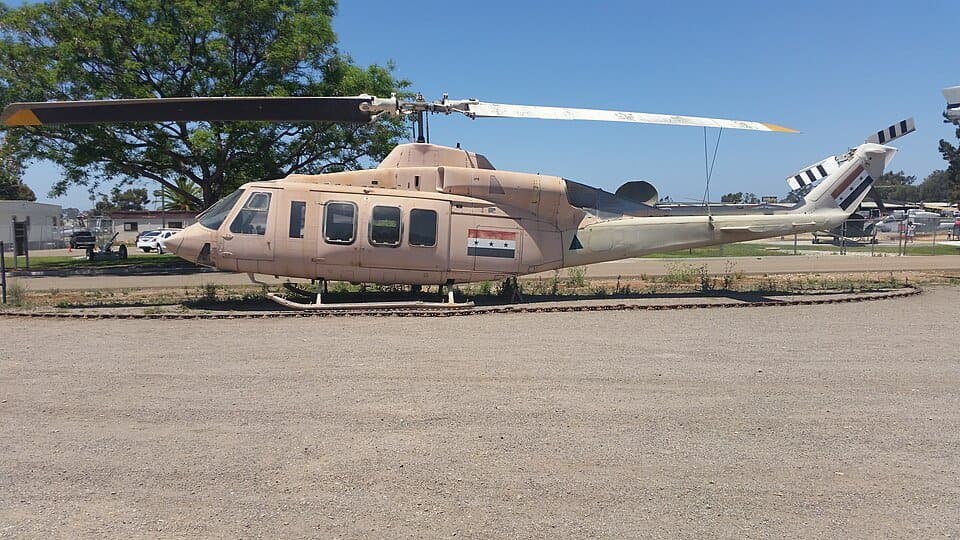

Credit
RightCowLeftCoast · CC BY-SA 4.0 · Resized · CC BY-SA 4.0 · Source ↗ · Modified


Preparing your view.
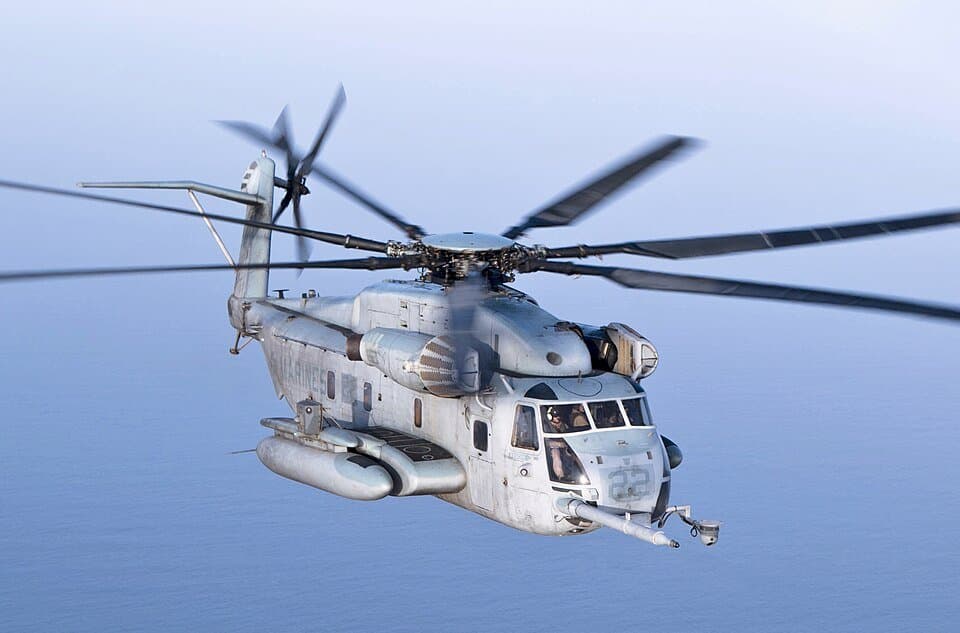
At a glance
True scale
Side by side. From every angle. A human reference for perspective.
3.18 MB · Loads when you open it| Model | Length | Width / span | Height |
|---|---|---|---|
| Bell 214ST | ≈ 15.03 m | ≈ 4.44 m (Width) | ≈ 5.68 m |
| Sikorsky CH-53E Super Stallion | ≈ 30.18 m | ≈ 23.25 m (Width) | ≈ 10.49 m |
Scaled uniformly to the sourced length of 15.03 m. The shape was turned square to the axes. Not an official model or a measured survey.
ForceTally · All rights reserved
Scaled uniformly to the sourced length of 30.188 m. Not an official model or a measured survey.
ForceTally · All rights reserved
The human reference is a generic 1.75 m figure. Models describe external size, not combat performance.
Measured figures
214ST · Length
Single source49 ft 4 in (15.03 m)[source]
Configuration
| Specification | Bell 214ST | Sikorsky CH-53E Super Stallion |
|---|---|---|
| Crew | 1 or 2[source] | 5: 2 pilots, 1 crew chief/right gunner, 1 left gunner, 1 tail gunner (combat crew)[source] |
| Type | Medium-lift helicopter[source] | Heavy-lift cargo helicopter[source] |
| National origin | United States[source] | United States[source] |
| Manufacturer | Bell Helicopter[source] |
CH-53E · Length
99 ft 0.5 in (30.188 m)[source]
214ST · Wingspan
Single source52 ft 0 in (15.85 m)[source]
Bell 214ST · main rotor diameter only; not tail rotor and not unrelated Bell214 BigLifter · Bell 214ST · main rotor diameter only; not tail rotor and not unrelated Bell214 BigLifter · source measurement 1
Single sourceBell 214ST · main rotor diameter only; not tail rotor and not unrelated Bell214 BigLifter · Bell 214ST · main rotor diameter only; not tail rotor and not unrelated Bell214 BigLifter · source measurement 2
Single source15,85 m 52 ft 0 in[source]Bell 214ST · main rotor diameter only; not tail rotor and not unrelated Bell214 BigLifter
CH-53E · Main rotor diameter
Single source79 ft 0 in (24.08 m)[source]
CH-53E · Combat range
Single source180 nmi (210 mi, 330 km)[source]
214ST · 2 × General Electric CT7-2A turboshaft , 1,625 shp ( ) each
Single source2 × General Electric CT7-2A turboshaft , 1,625 shp (1,215 kW) each[source]
CH-53E · 3 × General Electric T64-GE-416 / GE-416A / GE-419 turboshaft engines, 4,380 shp ( ) each
Single source3 × General Electric T64-GE-416 / GE-416A / GE-419 turboshaft engines, 4,380 shp (3,270 kW) each[source]
214ST · Wing area
Single source2,124 sq ft (107.3 m 2 )[source]
Bars compare reported quantities only. A larger figure does not make a system better; configurations and test conditions differ.
Sikorsky Aircraft[source] |
| Status | Production completed[source] | In service[source] |
|---|
| Primary users | Peruvian Air Force Royal Brunei Air Force Royal Thai Navy Iraqi Air Force (historical)[source] | United States Marine Corps United States Navy Japan Maritime Self-Defense Force (historical)[source] |
|---|
| Number built | 96[source] | 172[source] |
|---|
| Manufactured | 1979–1993[source] | 1978–1980s[source] |
|---|
| Introduction date | 1982[source] | 1981[source] |
|---|
| First flight | 21 July 1979[source] | 1 March 1974[source] |
|---|
| Developed from | Bell 214[source] | Sikorsky CH-53 Sea Stallion[source] |
|---|
| Capacity | Internal: 16 or 17 passengers or equivalent cargo; External: 8,000 lb (3,630 kg) sling load[source] | 37 troops with default folding canvas seats, 55 troops with center row added, and 31 with new crash attenuating seats. Internal payload: 32,000 lb (14,515 kg); External payload: 36,000 lb (16,329 kg)[source] |
|---|
| Role | medium-lift, twin-engine helicopter descended[source] | — |
|---|
| Source measurement | The Bell 214ST was originally developed during the 1970s and early 1980s as a military project from the Bell 214B BigLifter, specifically for production in Iran and the development by Bell was funded by the Iranian government. The fundamental difference was the replacement of the Model 214's single Lycoming LTC-4 turboshaft engine with two 1,625 shp (1,212 kW) General Electric T700 engines, to improve the helicopter's hot and high performance and improve safety. An interim twin-engine conversion of a Model 214 flew on 15 February 1977 in Texas , Testing was successful, and Bell decided to press forward with a definitive twin-engine Bell 214ST, with a fuselage stretched by 30 in (76 cm) and a revised main rotor of greater diameter. Iran changed its production plans, with 50 Bell 214A and 350 Bell 214STs to be built at the new production plant to be set up at Isfahan , Iran.[source]Bell 214ST · Design and development; only the objects and conditions stated in this passage The Bell 214ST included major design changes from the Bell 214. The Bell 214ST has a larger, stretched fuselage with seating for 16-18 passengers, and two 1,625 shp (1,212 kW) GE CT7-2A engines. The helicopter introduced some ground-breaking innovations for Bell, including a one-hour run-dry transmission, fiberglass rotor blades, elastomeric rotorhead bearings, and the option of either skid or wheeled landing gear. The helicopter has a cockpit door and a large cabin door on each side. The 214ST has a fuel capacity of 435 US gallons (1,650 L). An auxiliary fuel system could be added.[source]Bell 214ST · Design and development; only the objects and conditions stated in this passage Capacity: Internal: 16 or 17 passengers or equivalent cargo; External: 8,000 lb (3,630 kg) sling load[source]Bell 214ST · Specifications (214ST); only the objects and conditions stated in this passage Length: 49 ft 4 in (15.03 m)[source]Bell 214ST · Specifications (214ST); only the objects and conditions stated in this passage Wingspan: 52 ft 0 in (15.85 m)[source]Bell 214ST · Specifications (214ST); only the objects and conditions stated in this passage Height: 15 ft 11 in (4.84 m)[source]Bell 214ST · Specifications (214ST); only the objects and conditions stated in this passage Wing area: 2,124 sq ft (107.3 m 2 )[source]Bell 214ST · Specifications (214ST); only the objects and conditions stated in this passage Empty weight: 9,481 lb (4,300 kg)[source]Bell 214ST · Specifications (214ST); only the objects and conditions stated in this passage Max takeoff weight: 17,500 lb (7,938 kg)[source]Bell 214ST · Specifications (214ST); only the objects and conditions stated in this passage Powerplant: 2 × General Electric CT7-2A turboshaft , 1,625 shp (1,215 kW) each[source]Bell 214ST · Specifications (214ST); only the objects and conditions stated in this passage Maximum speed: 143 kn (165 mph, 264 km/h)[source]Bell 214ST · Specifications (214ST); only the objects and conditions stated in this passage Cruise speed: 140 kn (161 mph, 259 km/h)[source]Bell 214ST · Specifications (214ST); only the objects and conditions stated in this passage Range: 435 nmi (500 mi, 858 km)[source]Bell 214ST · Specifications (214ST); only the objects and conditions stated in this passage Service ceiling: 10,400 ft (3,170 m) ; ceiling for hover in ground effect[source]Bell 214ST · Specifications (214ST); only the objects and conditions stated in this passage Rate of climb: 1,780 ft/min (9.04 m/s)[source]Bell 214ST · Specifications (214ST); only the objects and conditions stated in this passage | — |
|---|
| Developed into | — | Sikorsky CH-53K King Stallion[source] |
|---|
| Guns | — | 2 × .50 BMG (12.7 × 99 mm) window-mounted GAU-21 machine guns 1 × .50 BMG (12.7 × 99 mm) ramp-mounted weapons system, GAU-21 (M3M mounted machine gun)[source] |
|---|
| Main rotor area | — | 4,900 sq ft (460 m 2 ) Sikorsky SC1095[source] |
|---|
| Never exceed speed | — | 170 kn (200 mph, 310 km/h)[source] |
|---|
| Other | — | Chaff and flare dispensers[source] |
|---|