
Credit
RightCowLeftCoast · CC BY-SA 4.0 · Resized · CC BY-SA 4.0 · Source ↗ · Modified


Preparing your view.
At a glance
Measured figures
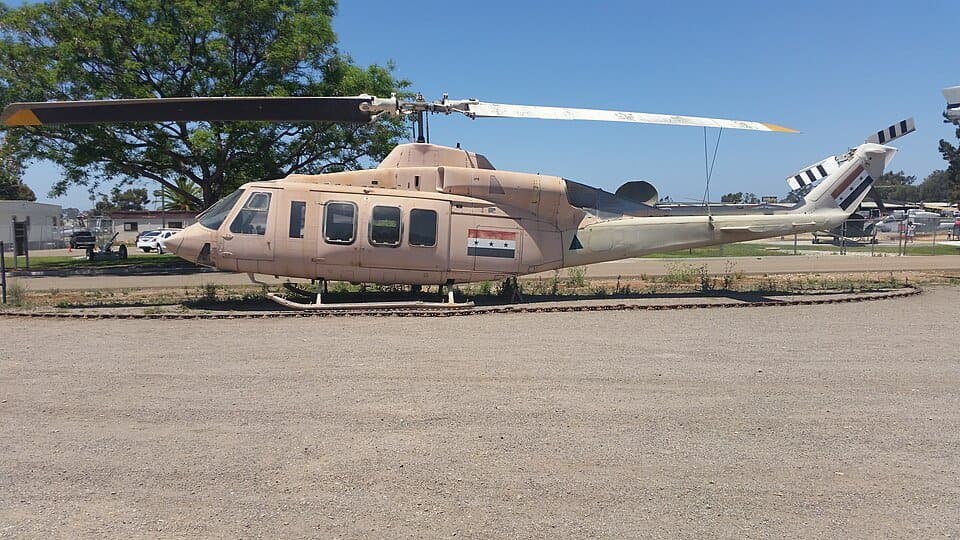
214ST · Length
Single source49 ft 4 in (15.03 m)[source]
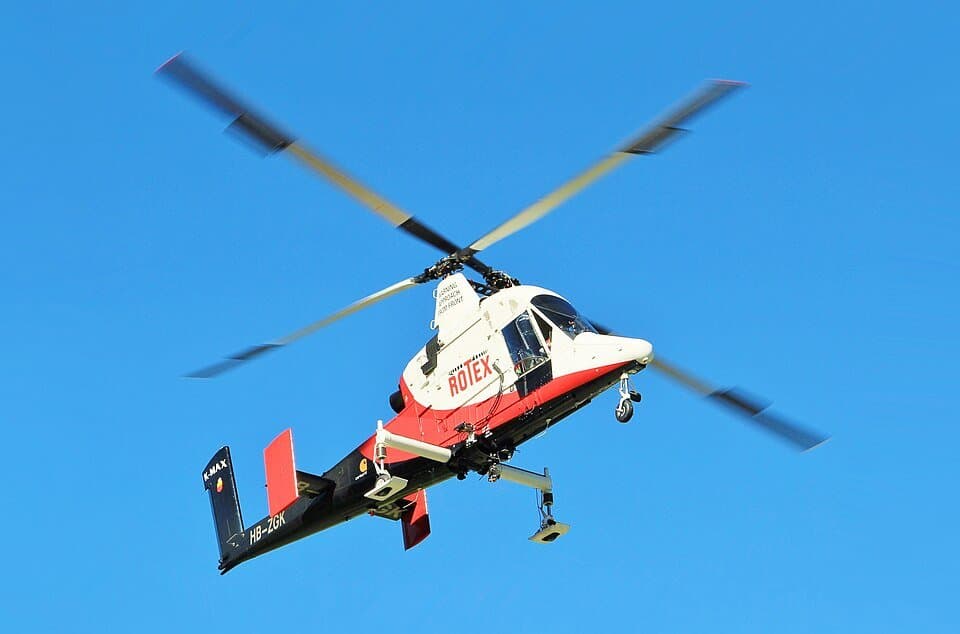
K-MAX · rotors running
Configuration
| Specification | Bell 214ST | Kaman K-MAX |
|---|---|---|
| Type | Medium-lift helicopter[source] | Medium lift helicopter[source] |
| National origin | United States[source] | — |
| Manufacturer | Bell Helicopter[source] | Kaman Aircraft[source] |
| Status | Production completed[source] | Production ended, in service[source] |
52 ft (16 m) rotors running[source]
K-MAX · with rotors running
Single source51 ft 5 in (15.67 m) with rotors running[source]
214ST · Wingspan
Single source52 ft 0 in (15.85 m)[source]
Bell 214ST · main rotor diameter only; not tail rotor and not unrelated Bell214 BigLifter · Bell 214ST · main rotor diameter only; not tail rotor and not unrelated Bell214 BigLifter · source measurement 1
Single sourceBell 214ST · main rotor diameter only; not tail rotor and not unrelated Bell214 BigLifter · Bell 214ST · main rotor diameter only; not tail rotor and not unrelated Bell214 BigLifter · source measurement 2
Single source15,85 m 52 ft 0 in[source]Bell 214ST · main rotor diameter only; not tail rotor and not unrelated Bell214 BigLifter
K-MAX · 2 ×
Single source2 × 48 ft 4 in (14.73 m)[source]
Cruise; 214ST · Cruise speed
Single sourceMaximum; 214ST · Maximum speed
Single source143 kn (165 mph, 264 km/h)[source]
140 kn (161 mph, 259 km/h)[source]
Maximum; K-MAX commercial · With external load · 148.2 kph · MAXIMUM AIRSPEED · With external load
Manufacturer claimMaximum; K-MAX commercial · Without external load · 185.2 kph · MAXIMUM AIRSPEED · Without external load
Manufacturer claim214ST · 2 × General Electric CT7-2A turboshaft , 1,625 shp ( ) each
Single source2 × General Electric CT7-2A turboshaft , 1,625 shp (1,215 kW) each[source]
K-MAX · 1 × Honeywell T5317A-1 turboshaft engine, 1,350 shp ( ) flat rated for take-off up to ~29,000 ft (8,839 m) to increase transmission life
Single source1 × Honeywell T5317A-1 turboshaft engine, 1,350 shp (1,010 kW) flat rated for take-off up to ~29,000 ft (8,839 m) to increase transmission life[source]
214ST · Wing area
Single source2,124 sq ft (107.3 m 2 )[source]
Bars compare reported quantities only. A larger figure does not make a system better; configurations and test conditions differ.
| Primary users |
|---|
Peruvian Air Force Royal Brunei Air Force Royal Thai Navy Iraqi Air Force (historical)[source] |
| — |
| Number built | 96[source] | — |
|---|
| Manufactured | 1979–1993[source] | 1991–2003, 2015–2023[source] |
|---|
| Introduction date | 1982[source] | — |
|---|
| First flight | 21 July 1979[source] | December 23, 1991[source] |
|---|
| Developed from | Bell 214[source] | — |
|---|
| Capacity | Internal: 16 or 17 passengers or equivalent cargo; External: 8,000 lb (3,630 kg) sling load[source] | 6,000 lb (2,722 kg) external load at ISA +15 °C (59.0 °F) at sea level 5,663 lb (2,569 kg) external load at ISA +15 °C (59.0 °F) at 5,000 ft (1,524 m) 5,163 lb (2,342 kg) external load at ISA +15 °C (59.0 °F) at 10,000 ft (3,048 m) 5,013 lb (2,274 kg) external load at ISA +15 °C (59.0 °F) at 12,100 ft (3,688 m) 4,313 lb (1,956 kg) external load at ISA +15 °C (59.0 °F) at 15,000 ft (4,572 m)[source] |
|---|
| Role | medium-lift, twin-engine helicopter descended[source] | helicopter[source] |
|---|
| Source measurement | The Bell 214ST was originally developed during the 1970s and early 1980s as a military project from the Bell 214B BigLifter, specifically for production in Iran and the development by Bell was funded by the Iranian government. The fundamental difference was the replacement of the Model 214's single Lycoming LTC-4 turboshaft engine with two 1,625 shp (1,212 kW) General Electric T700 engines, to improve the helicopter's hot and high performance and improve safety. An interim twin-engine conversion of a Model 214 flew on 15 February 1977 in Texas , Testing was successful, and Bell decided to press forward with a definitive twin-engine Bell 214ST, with a fuselage stretched by 30 in (76 cm) and a revised main rotor of greater diameter. Iran changed its production plans, with 50 Bell 214A and 350 Bell 214STs to be built at the new production plant to be set up at Isfahan , Iran.[source]Bell 214ST · Design and development; only the objects and conditions stated in this passage The Bell 214ST included major design changes from the Bell 214. The Bell 214ST has a larger, stretched fuselage with seating for 16-18 passengers, and two 1,625 shp (1,212 kW) GE CT7-2A engines. The helicopter introduced some ground-breaking innovations for Bell, including a one-hour run-dry transmission, fiberglass rotor blades, elastomeric rotorhead bearings, and the option of either skid or wheeled landing gear. The helicopter has a cockpit door and a large cabin door on each side. The 214ST has a fuel capacity of 435 US gallons (1,650 L). An auxiliary fuel system could be added.[source]Bell 214ST · Design and development; only the objects and conditions stated in this passage Capacity: Internal: 16 or 17 passengers or equivalent cargo; External: 8,000 lb (3,630 kg) sling load[source]Bell 214ST · Specifications (214ST); only the objects and conditions stated in this passage Length: 49 ft 4 in (15.03 m)[source]Bell 214ST · Specifications (214ST); only the objects and conditions stated in this passage Wingspan: 52 ft 0 in (15.85 m)[source]Bell 214ST · Specifications (214ST); only the objects and conditions stated in this passage Height: 15 ft 11 in (4.84 m)[source]Bell 214ST · Specifications (214ST); only the objects and conditions stated in this passage Wing area: 2,124 sq ft (107.3 m 2 )[source]Bell 214ST · Specifications (214ST); only the objects and conditions stated in this passage Empty weight: 9,481 lb (4,300 kg)[source]Bell 214ST · Specifications (214ST); only the objects and conditions stated in this passage Max takeoff weight: 17,500 lb (7,938 kg)[source]Bell 214ST · Specifications (214ST); only the objects and conditions stated in this passage Powerplant: 2 × General Electric CT7-2A turboshaft , 1,625 shp (1,215 kW) each[source]Bell 214ST · Specifications (214ST); only the objects and conditions stated in this passage Maximum speed: 143 kn (165 mph, 264 km/h)[source]Bell 214ST · Specifications (214ST); only the objects and conditions stated in this passage Cruise speed: 140 kn (161 mph, 259 km/h)[source]Bell 214ST · Specifications (214ST); only the objects and conditions stated in this passage Range: 435 nmi (500 mi, 858 km)[source]Bell 214ST · Specifications (214ST); only the objects and conditions stated in this passage Service ceiling: 10,400 ft (3,170 m) ; ceiling for hover in ground effect[source]Bell 214ST · Specifications (214ST); only the objects and conditions stated in this passage Rate of climb: 1,780 ft/min (9.04 m/s)[source]Bell 214ST · Specifications (214ST); only the objects and conditions stated in this passage | Developed in the 1980s and 1990s, the K-MAX builds on the work of the German aeronautical engineer Anton Flettner . It was designed for external cargo load operations; later configurations supported aerial firefighting and casualty evacuation . It can lift more than 6,000 pounds (2,700 kg), which is greater than the helicopter's empty weight and almost twice as much as the competing Bell 205 despite sharing a similar engine.[source]Kaman K-MAX · Lead; only the objects and conditions stated in this passage The K-MAX can lift 6,000 lb (2,700 kg), almost twice as much as the Bell 205 using a different version of the same engine. The aircraft's narrow, wedge-shaped profile and bulging side windows give the pilot a good view of the load looking down&out from either side of the aircraft, with the most important flight instruments duplicated on the outside of the aircraft, near the pilot's line of sight straight down to the load. The cargo hook slides freely on a curved bearing under the helicopter's center of gravity , improving cargo handling during flight. The seat is FAA crashworthiness approved.[source]Kaman K-MAX · Development / Design; only the objects and conditions stated in this passage The transmission has a reduction ratio of 24.3:1 in three stages, and is designed for unlimited life. The two rotor masts are set at an angle of 25 degrees apart to allow the rotors to intermesh with each other. The masts transfer rotation from the transmission to the rotor blades. The rotor blades (which turn in opposite directions at 250—270 rpm) are built with a Sitka spruce wooden spar and Nomex honeycomb trailing edge sections. Wood was chosen for its damage tolerance and fatigue resistance; and to take advantage of field experience and qualification data amassed from a similar spar on the HH-43 Huskie helicopter, built for the U.S. Air Force in the 1950s and 1960s. The pilot controls the blade pitch via steel tubes running inside the mast and rotor blades to move servo flaps that pitch the blades, reducing required force and avoiding the added weight, cost and maintenance of hydraulic controls . Due to the rotor principle, the helicopter is operated slightly differently compared to regular helicopters, and pilots go through a flight training program in an HH-43 Huskie.[source] |
|---|
| Fuel capacity | — | 1,541 lb (699 kg) / 228.5 US gal (190 imp gal; 865 L)[source] |
|---|
| Length of fuselage | — | 41 ft 9 in (12.73 m)[source] |
|---|
| Main rotor area | — | 3,669 sq ft (340.9 m 2 )[source] |
|---|
| Blade section | — | - root: NACA 23012 ; tip: NACA 23011[source] |
|---|
| Never exceed speed | — | 100 kn (120 mph, 190 km/h) clean[source] |
|---|
| Hover ceiling IGE | — | 26,300 ft (8,016 m) at 6,000 lb (2,722 kg) AUW, ISA[source] |
|---|
| Disk loading | — | 3.52 lb/sq ft (17.2 kg/m 2 )[source] |
|---|
| Power/mass | — | 0.1045 hp/lb (0.1718 kW/kg)[source] |
|---|
| Fuel consumption | — | 85 gal/h (71 imp gal/h; 322 L/h)[source] |
|---|
| Country of origin | — | American[source]Kaman K-MAX — original design/development; separate from operator or construction location |
|---|
100 kt 185.2 kph[source]K-MAX commercial · Without external load
80 kt 148.2 kph[source]K-MAX commercial · With external load
During February 2014, Kaman stated that it was looking into resuming K-MAX production, having recently received over 20 inquiries for firefighting, logging and industry transport requirements as well as requests for the military unmanned version. Ten firm orders convinced Kaman to put the design back into production again. By 2014, the K-MAX fleet had cumulatively flown 300,000 hours and cost $1,200 per flight hour to operate.[source]Kaman K-MAX · Development / Second production run; only the objects and conditions stated in this passage
At Heli-Expo 2015 in Orlando, Kaman reported it was continuing to progress towards reopening the production line. Following the receipt of multiple customer deposits, the assembly line was restarted in January 2017. On 12 May 2017, Kaman test flew the first K-MAX to be produced since 2003; on 13 July 2017, it was delivered to Kaman's Chinese sales agent Lectern Aviation, which delivered it onwards to Guangdong Juxiang General Aviation, Guangdong Province for firefighting with the second to be delivered the following week.[source]Kaman K-MAX · Development / Second production run; only the objects and conditions stated in this passage
During 2008, a single K-MAX was used for demolition work, having been outfitted with a 1,400 kg (3,000 lb) wrecking ball as a slung load .[source]Kaman K-MAX · Operational history; only the objects and conditions stated in this passage
In December 2011, an unmanned K-MAX was reported to be at work in Afghanistan. On 17 December 2011, the U. S. Marine Corps conducted the first unmanned aerial system cargo delivery in a combat zone using the unmanned K-MAX, moving about 3,500 pounds (1,600 kg) of food and supplies to troops at Combat Outpost Payne. A third unmanned K-MAX in the U.S. was tested in 2012 to deliver cargo to a small homing beacon to achieve three-meter precision. By February 2013, the K-MAX had delivered two million pounds (910 metric tons) of cargo across 600 unmanned missions, during which in excess of 700 flight hours had been recorded.[source]Kaman K-MAX · Operational history; only the objects and conditions stated in this passage
On July 31, 2012, Lockheed announced a second service extension for the K-MAX in Afghanistan to support the Marine Corps; on 18 March 2013, the Marine Corps announced the indefinite extension of its use of the unmanned K-MAX helicopters, stating that it would keep the two aircraft in use "until otherwise directed". At the time of the announcement, they had flown over 1,000 missions and hauled over three million pounds (1,400 metric tons) of supplies; assessments for their use after the deployment were also being studied. The unmanned K-MAX has won awards from Popular Science and Aviation Week & Space Technology , and was nominated for the 2012 Collier Trophy .[source]Kaman K-MAX · Operational history; only the objects and conditions stated in this passage
Operators employed a weathervane effect to try to regain control, but its 2,000 lb (910 kg) load began to swing, which exacerbated the effect and caused it to contact the ground.[source]Kaman K-MAX · Operational history; only the objects and conditions stated in this passage
In theater, the rotorcraft performed most missions at night and successfully lifted loads of up to 4,500 lb (2,000 kg).[source]Kaman K-MAX · Operational history; only the objects and conditions stated in this passage
The unmanned K-MAX was successfully able to deliver 30,000 lb (14,000 kg) of cargo in one day over the course of six missions (average 5,000 lb (2,300 kg) transported cargo per mission).[source]Kaman K-MAX · Operational history; only the objects and conditions stated in this passage
After deploying in December 2011, originally planned for six months, they operated in the region for almost three years and lifted 2,250 tons of cargo.[source]Kaman K-MAX · Operational history; only the objects and conditions stated in this passage
During November 2014, Lockheed Martin demonstrated a fire fighting version, another demonstration was performed in October 2015, in which the K-MAX delivered over 24,000 pounds (11,000 kg) of water in one hour. In March 2015, a casualty evacuation exercise was performed in coordination with an unmanned ground vehicle (UGV) and mission planning system. A medic launched the UGV to evaluate the casualty, used a tablet to call in and automatically land the K-MAX, then strapped a mannequin to a seat aboard the helicopter.[source]Kaman K-MAX · Operational history; only the objects and conditions stated in this passage
By January 2015, 11 K-MAX helicopters were reportedly no longer airworthy, some of which had been written off in accidents. Furthermore, an additional five were in storage at Kaman. By March 2015, the number of operational K-MAXs was reportedly 21, having flown a total of 315,000 hours among 250 pilots. Despite production of the type having been discontinued in 2023, Kaman pledged that it would continued to support the existing K-Max fleet in operation, which includes the provision of spare parts, servicing, training, and repairs to operators for the foreseeable future.[source]Kaman K-MAX · Operational history; only the objects and conditions stated in this passage
Length: 52 ft (16 m) rotors running[source]Kaman K-MAX · Specifications (K-MAX); only the objects and conditions stated in this passage
Length of fuselage: 41 ft 9 in (12.73 m)[source]Kaman K-MAX · Specifications (K-MAX); only the objects and conditions stated in this passage
Width: 51 ft 5 in (15.67 m) with rotors running[source]Kaman K-MAX · Specifications (K-MAX); only the objects and conditions stated in this passage
Height: 13 ft 7 in (4.14 m) to centreof hubs[source]Kaman K-MAX · Specifications (K-MAX); only the objects and conditions stated in this passage
Empty weight: 5,145 lb (2,334 kg)[source]Kaman K-MAX · Specifications (K-MAX); only the objects and conditions stated in this passage
Max takeoff weight: 6,500 lb (2,948 kg) without slung load[source]Kaman K-MAX · Specifications (K-MAX); only the objects and conditions stated in this passage
12,000 lb (5,443 kg) with jettisonable slung load[source]Kaman K-MAX · Specifications (K-MAX); only the objects and conditions stated in this passage
Fuel capacity: 1,541 lb (699 kg) / 228.5 US gal (190 imp gal; 865 L)[source]Kaman K-MAX · Specifications (K-MAX); only the objects and conditions stated in this passage
Powerplant: 1 × Honeywell T5317A-1 turboshaft engine, 1,350 shp (1,010 kW) flat rated for take-off up to ~29,000 ft (8,839 m) to increase transmission life[source]Kaman K-MAX · Specifications (K-MAX); only the objects and conditions stated in this passage
Transmission rated to 1,500 shp (1,119 kW)[source]Kaman K-MAX · Specifications (K-MAX); only the objects and conditions stated in this passage
Main rotor diameter: 2 × 48 ft 4 in (14.73 m)[source]Kaman K-MAX · Specifications (K-MAX); only the objects and conditions stated in this passage
Main rotor area: 3,669 sq ft (340.9 m 2 )[source]Kaman K-MAX · Specifications (K-MAX); only the objects and conditions stated in this passage
Never exceed speed : 100 kn (120 mph, 190 km/h) clean[source]Kaman K-MAX · Specifications (K-MAX); only the objects and conditions stated in this passage
80 kn (92 mph; 148 km/h) with external load[source]Kaman K-MAX · Specifications (K-MAX); only the objects and conditions stated in this passage
Range: 300 nmi (350 mi, 560 km) with max load[source]Kaman K-MAX · Specifications (K-MAX); only the objects and conditions stated in this passage
Service ceiling: 15,000 ft (4,600 m)[source]Kaman K-MAX · Specifications (K-MAX); only the objects and conditions stated in this passage
Hover ceiling IGE: 26,300 ft (8,016 m) at 6,000 lb (2,722 kg) AUW, ISA[source]Kaman K-MAX · Specifications (K-MAX); only the objects and conditions stated in this passage
Rate of climb: 2,500 ft/min (13 m/s) at Sea Level with flat-rated torque[source]Kaman K-MAX · Specifications (K-MAX); only the objects and conditions stated in this passage