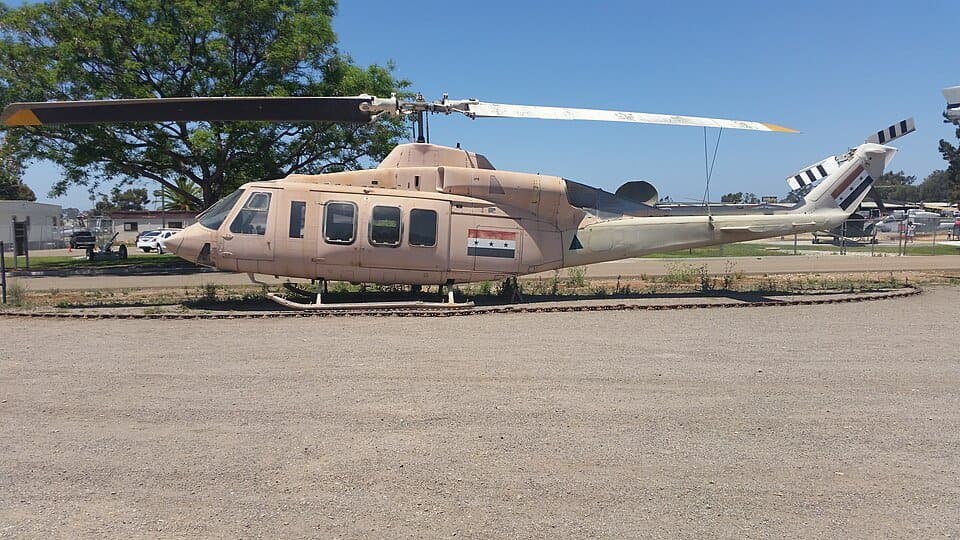

Credit
RightCowLeftCoast · CC BY-SA 4.0 · Resized · CC BY-SA 4.0 · Source ↗ · Modified


Preparing your view.

At a glance
True scale
Side by side. From every angle. A human reference for perspective.
3.12 MB · Loads when you open it| Model | Length | Width / span | Height |
|---|---|---|---|
| Bell 214ST | ≈ 15.03 m | ≈ 4.44 m (Width) | ≈ 5.68 m |
| Harbin Z-20 | ≈ 20 m | ≈ 16.71 m (Width) | ≈ 5.3 m |
Scaled uniformly to the sourced length of 15.03 m. The shape was turned square to the axes. Not an official model or a measured survey.
ForceTally · All rights reserved
Scaled uniformly to the sourced length of 20 m. The height was fitted to the sourced 5.3 m. Not an official model or a measured survey.
ForceTally · All rights reserved
The human reference is a generic 1.75 m figure. Models describe external size, not combat performance.
Measured figures
214ST · Length
Single source49 ft 4 in (15.03 m)[source]
Z-20 · Length
Configuration
| Specification | Bell 214ST | Harbin Z-20 |
|---|---|---|
| Type | Medium-lift helicopter[source] | Medium lift helicopter[source] |
| National origin | United States[source] | China[source] |
| Manufacturer | Bell Helicopter[source] | Harbin Aircraft Industry Group[source] |
| Status | Production completed[source] | In service, in production |
20 m (65 ft 7 in)[source]
214ST · Wingspan
Single source52 ft 0 in (15.85 m)[source]
Bell 214ST · main rotor diameter only; not tail rotor and not unrelated Bell214 BigLifter · Bell 214ST · main rotor diameter only; not tail rotor and not unrelated Bell214 BigLifter · source measurement 1
Single sourceBell 214ST · main rotor diameter only; not tail rotor and not unrelated Bell214 BigLifter · Bell 214ST · main rotor diameter only; not tail rotor and not unrelated Bell214 BigLifter · source measurement 2
Single source15,85 m 52 ft 0 in[source]Bell 214ST · main rotor diameter only; not tail rotor and not unrelated Bell214 BigLifter
Z-20 · ×
Single source× 16 m (52 ft 6 in)[source]
214ST · Range
Single source435 nmi (500 mi, 858 km)[source]
Z-20 · Combat range
Single source560 km (350 mi, 300 nmi)[source]
214ST · 2 × General Electric CT7-2A turboshaft , 1,625 shp ( ) each
Single source2 × General Electric CT7-2A turboshaft , 1,625 shp (1,215 kW) each[source]
Z-20 · 2 × WZ-10 turboshaft engines each
Single source2 × WZ-10 turboshaft engines, 1,600–2,000 kW (2,100–2,700 hp) each[source]
214ST · Wing area
Single source2,124 sq ft (107.3 m 2 )[source]
Bars compare reported quantities only. A larger figure does not make a system better; configurations and test conditions differ.
| Primary users | Peruvian Air Force Royal Brunei Air Force Royal Thai Navy Iraqi Air Force (historical)[source] | People's Liberation Army Ground Force People's Liberation Army Naval Air Force People's Armed Police[source] |
|---|
| Number built | 96[source] | 230+[source] |
|---|
| Manufactured | 1979–1993[source] | — |
|---|
| Introduction date | 1982[source] | 1 October 2019[source] |
|---|
| First flight | 21 July 1979[source] | 23 December 2013[source] |
|---|
| Developed from | Bell 214[source] | — |
|---|
| Capacity | Internal: 16 or 17 passengers or equivalent cargo; External: 8,000 lb (3,630 kg) sling load[source] | 12-15 passengers, 1,500 kg (3,300 lb) of cargo internally, 4,000 kg (8,800 lb) of cargo externally[source] |
|---|
| Role | medium-lift, twin-engine helicopter descended[source] | — |
|---|
| Source measurement | The Bell 214ST was originally developed during the 1970s and early 1980s as a military project from the Bell 214B BigLifter, specifically for production in Iran and the development by Bell was funded by the Iranian government. The fundamental difference was the replacement of the Model 214's single Lycoming LTC-4 turboshaft engine with two 1,625 shp (1,212 kW) General Electric T700 engines, to improve the helicopter's hot and high performance and improve safety. An interim twin-engine conversion of a Model 214 flew on 15 February 1977 in Texas , Testing was successful, and Bell decided to press forward with a definitive twin-engine Bell 214ST, with a fuselage stretched by 30 in (76 cm) and a revised main rotor of greater diameter. Iran changed its production plans, with 50 Bell 214A and 350 Bell 214STs to be built at the new production plant to be set up at Isfahan , Iran.[source]Bell 214ST · Design and development; only the objects and conditions stated in this passage The Bell 214ST included major design changes from the Bell 214. The Bell 214ST has a larger, stretched fuselage with seating for 16-18 passengers, and two 1,625 shp (1,212 kW) GE CT7-2A engines. The helicopter introduced some ground-breaking innovations for Bell, including a one-hour run-dry transmission, fiberglass rotor blades, elastomeric rotorhead bearings, and the option of either skid or wheeled landing gear. The helicopter has a cockpit door and a large cabin door on each side. The 214ST has a fuel capacity of 435 US gallons (1,650 L). An auxiliary fuel system could be added.[source]Bell 214ST · Design and development; only the objects and conditions stated in this passage Capacity: Internal: 16 or 17 passengers or equivalent cargo; External: 8,000 lb (3,630 kg) sling load[source]Bell 214ST · Specifications (214ST); only the objects and conditions stated in this passage Length: 49 ft 4 in (15.03 m)[source]Bell 214ST · Specifications (214ST); only the objects and conditions stated in this passage Wingspan: 52 ft 0 in (15.85 m)[source]Bell 214ST · Specifications (214ST); only the objects and conditions stated in this passage Height: 15 ft 11 in (4.84 m)[source]Bell 214ST · Specifications (214ST); only the objects and conditions stated in this passage Wing area: 2,124 sq ft (107.3 m 2 )[source]Bell 214ST · Specifications (214ST); only the objects and conditions stated in this passage Empty weight: 9,481 lb (4,300 kg)[source]Bell 214ST · Specifications (214ST); only the objects and conditions stated in this passage Max takeoff weight: 17,500 lb (7,938 kg)[source]Bell 214ST · Specifications (214ST); only the objects and conditions stated in this passage Powerplant: 2 × General Electric CT7-2A turboshaft , 1,625 shp (1,215 kW) each[source]Bell 214ST · Specifications (214ST); only the objects and conditions stated in this passage Maximum speed: 143 kn (165 mph, 264 km/h)[source]Bell 214ST · Specifications (214ST); only the objects and conditions stated in this passage Cruise speed: 140 kn (161 mph, 259 km/h)[source]Bell 214ST · Specifications (214ST); only the objects and conditions stated in this passage Range: 435 nmi (500 mi, 858 km)[source]Bell 214ST · Specifications (214ST); only the objects and conditions stated in this passage Service ceiling: 10,400 ft (3,170 m) ; ceiling for hover in ground effect[source]Bell 214ST · Specifications (214ST); only the objects and conditions stated in this passage Rate of climb: 1,780 ft/min (9.04 m/s)[source]Bell 214ST · Specifications (214ST); only the objects and conditions stated in this passage | — |
|---|
| Developed into | — | Harbin Z-21[source] |
|---|
| Guns | — | Provision for machine guns and autocannons[source] |
|---|
| Hardpoints | — | 4 hardpoints on two stub wings , with provisions to carry combinations of: Rockets: Various rocket pods Missiles: AKD-9 laser-guided air-to-surface missile AKD-10 laser-guided air-to-surface missile CM-502KG or CM-502V NLOS air-to-surface missile CM-501G A NLOS air-to-surface missile CM-501XA loitering munition TY-90 air-to-air missile YJ-9 anti-ship missile[source] |
|---|
| Rockets | — | Various rocket pods[source] |
|---|
| Missiles | — | AKD-9 laser-guided air-to-surface missile AKD-10 laser-guided air-to-surface missile CM-502KG or CM-502V NLOS air-to-surface missile CM-501G A NLOS air-to-surface missile CM-501XA loitering munition TY-90 air-to-air missile YJ-9 anti-ship missile[source] |
|---|