



Preparing your view.
At a glance
Measured figures
206B Jetranger II · including rotors
Single source38 ft 9.5 in (11.824 m) including rotors[source]
Configuration
| Specification | Bell 206 | Hiller OH-23 Raven |
|---|---|---|
| Type | Multipurpose utility helicopter[source] | Multipurpose light helicopter[source] |
| National origin | United States / Canada[source] | — |
| Manufacturer | Bell Helicopter[source] | United Helicopters Hiller Aircraft[source] |
| Status | In service[source] | Retired[source] |
Length
8.45 metre[source]Source text · numeric interpretation needs review
8.69 metre[source]Source text · numeric interpretation needs review
8,46 m[source]
8.45 metre[source]Source text · numeric interpretation needs review
8.69 metre[source]Source text · numeric interpretation needs review
8.45 metre[source]Source text · numeric interpretation needs review
8.69 metre[source]Source text · numeric interpretation needs review
8.45 metre[source]Source text · numeric interpretation needs review
8.69 metre[source]Source text · numeric interpretation needs review
8.45 metre[source]Source text · numeric interpretation needs review
8.69 metre[source]Source text · numeric interpretation needs review
Cruise; 206B Jetranger II · at MTOW, 5,000 feet
Single sourceMaximum; 206B Jetranger II · at MTOW (sea level)
Single source122 kn (140 mph, 226 km/h) at MTOW (sea level)[source]
120 kn (140 mph, 220 km/h) at MTOW, 5,000 feet[source]
Cruise; H-23D · Cruise speed
Single sourceMaximum; H-23D · Maximum speed
Single source206B Jetranger II · 1 × Allison 250-C20 turboshaft engine
Single source1 × Allison 250-C20 turboshaft engine, 400 hp (298 kW)[source]
H-23D · 1 × Lycoming VO-435-23B 6-cylinder air-cooled horizontally-opposed piston engine
Single source1 × Lycoming VO-435-23B 6-cylinder air-cooled horizontally-opposed piston engine, 250 hp (190 kW)[source]
Bars compare reported quantities only. A larger figure does not make a system better; configurations and test conditions differ.
| Number built | 7,300[source] | 2,000+[source] |
|---|
| Manufactured | 1962–2017[source] | 1948–1965[source] |
|---|
| Introduction date | 1967[source] | 1948[source] |
|---|
| First flight | December 8, 1962 (206) January 10, 1966 (206A)[source] | 1948[source] |
|---|
| Developed from | Bell YOH-4[source] | — |
|---|
| Variants | Bell OH-58 Kiowa Bell 407[source] | — |
|---|
| Developed into | Bell 400 TwinRanger[source] | — |
|---|
| Capacity | 4 passengers[source] | — |
|---|
| Fuselage length | 31 ft 2 in (9.50 m)[source] | — |
|---|
| Interior dimensions | 7 ft 2 in (2.18 m) length, by 4 ft 2 in (1.27 m) width, by 4 ft 3 in (1.30 m) height, plus 16 ft 3 (453 L) baggage compartment[source] | — |
|---|
| Main rotor area | 873 sq ft (81.1 m 2 )[source] | 985 sq ft (91.5 m 2 )[source] |
|---|
| Blade section | – NACA 0012 mod (11.3%)[source] | NACA 0012[source] |
|---|
| Maximum speed at 5,000 ft | 116 kn (133 mph; 215 km/h) at MTOW[source] | — |
|---|
| Disk loading | 4 lb/sq ft (20 kg/m 2 )[source] | — |
|---|
| Power/mass | 0.09 hp/lb (0.15 kW/kg)[source] | — |
|---|
| Role | family of two-bladed, single- and twin-engined helicopters ,[source] | two, three, or four-place, military light observation helicopter[source] |
|---|
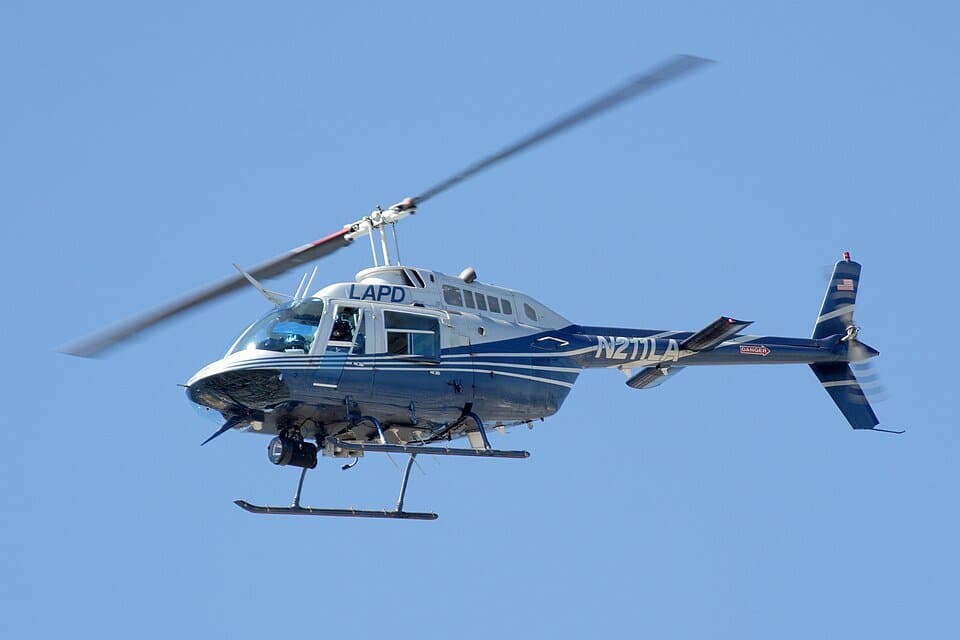
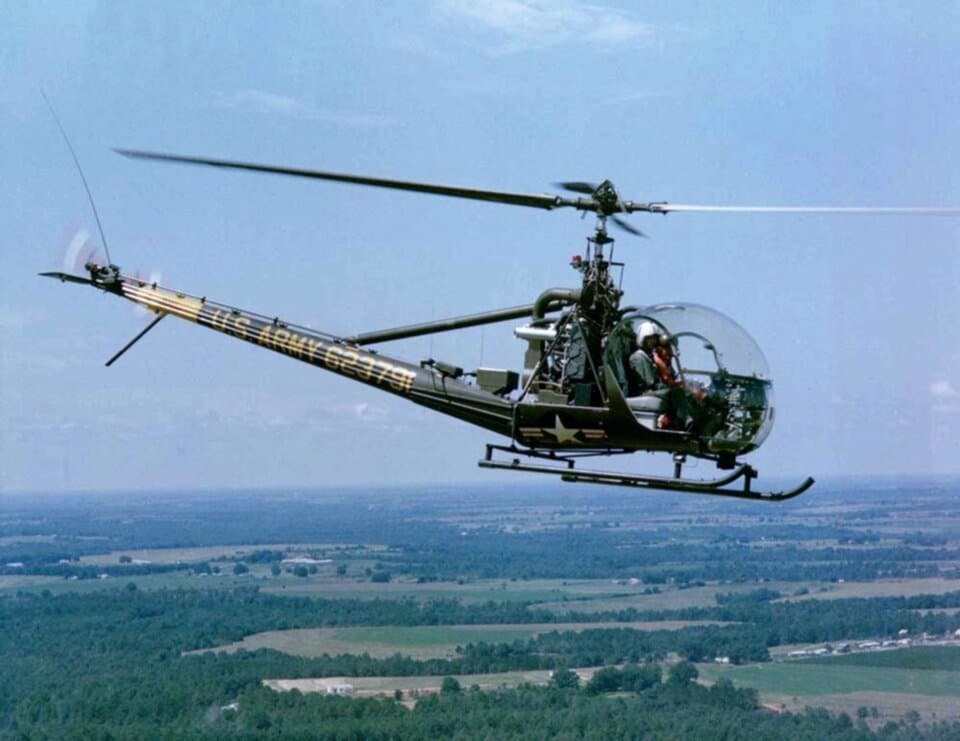
| Source measurement | When the YOH-4A was eliminated by the Army, Bell went about marketing the aircraft. In addition to the image problem, the helicopter lacked cargo space and only provided cramped seating for three passengers. The solution was a redesigned fuselage, sleeker and aesthetically appealing, adding 16 ft 3 (0.45 m 3 ) of cargo space in the process. A Bell executive contributed to the redesign by drawing two lines on a sketch extending the fuselage to where it meets the tail. The redesign was designated Bell 206A, and Bell President Edwin J. Ducayet named it the JetRanger , denoting an evolution from the popular Model 47J Ranger .[source]Bell 206 · Development / JetRanger; only the objects and conditions stated in this passage The 206L LongRanger is a stretched variant with seating for seven. The fuselage, stretched a total of 30 inches (760 mm), adds two rear-facing seats between the front and rear seats. Since 1975, Bell has produced more than 1,700 LongRangers across all variants. In 1981, a military version, the 206L TexasRanger was released. The original 206L used an Allison 250 -C20R engine, and a series of model upgrades replaced this engine with more powerful versions; the 206L-1 used a 250-C28, and the 206L-3 and 206L-4 used the 250-C30P.[source]Bell 206 · Development / LongRanger; only the objects and conditions stated in this passage In both applications, the 250-C30P is derated from 650 hp for takeoff and 501 hp continuous. The 206L-3 is transmission-limited to 435 hp for take-off, and the 206L-4 is transmission-limited to 495 hp. The derating of the C30P produces an advantage in hot-day and high-altitude operations, as it can produce the rated horsepower at higher altitudes and temperatures where applications that use the maximum rating of the engine at sea level suffer accelerated performance deterioration with increases in temperature and altitude. The 206L-3 and L-4 have not been offered in a twin configuration under those model designations.[source]Bell 206 · Development / LongRanger; only the objects and conditions stated in this passage In 2007, Bell announced an upgrade program for the 206L-1 and 206L-3 designed to modify the aircraft to the 206L-4 configuration; modified aircraft are designated 206L-1+ and 206L-3+. Modifications include strengthened structural components (including a new tailboom), improved transmission, upgraded engine for the L-1, all of which result in a maximum gross weight increase of 300 pounds and increased performance.[source]Bell 206 · Development / LongRanger; only the objects and conditions stated in this passage The basic shape and design of the JetRanger remained unchanged since 1967, but Bell introduced the 206B JetRanger II in 1971. In 1977, the 206B-3 JetRanger III was introduced with its modified tail rotor and more powerful engine. The JetRanger is popular with news media for traffic and news reporting. The LongRanger is commonly used as an air ambulance and as a corporate transport. On September 1, 1982, pilots H. Ross Perot, Jr. and Jay Coburn departed Dallas, Texas in the " Spirit of Texas ", a Bell 206L-1 (N3911Z). They returned on 30 September, 29 days and 3 hours later, completing the first around-the-world helicopter flight.[source]Bell 206 · Operational history; only the objects and conditions stated in this passage On July 22, 1994, Ron Bower landed his 206B-3 (N206AJ) at Hurst, Texas , setting a new record for around-the-world flight by a helicopter. Bower had departed on June 24 and returned 24 days, 4 hours, 36 minutes and 24 seconds later, averaging 35.62 knots (40.99 mph; 65.97 km/h). Bower had added a 91-US-gallon (340 L) auxiliary fuel tank, which doubled the JetRanger III's range.[source]Bell 206 · Operational history; only the objects and conditions stated in this passage Upgraded Allison 250-C20J engine and added 2 inches (51 mm) to tail rotor diameter for yaw control.[source]Bell 206 · Variants / Civilian; only the objects and conditions stated in this passage 137 commercial Bell 206B-3s purchased in 1993 as the primary and instrument helicopter trainer for the US Army at Fort Rucker , Alabama. 35 in VFR configuration and 102 in IFR configuration. The US Army has 181 units as of 2026, of which 121 are in VFR configuration and 60 are in IFR configuration. All TH-67s display US registrations ("N" numbers) and are operated as public use aircraft.[source]Bell 206 · Variants / Military; only the objects and conditions stated in this passage Capacity: 4 passengers[source]Bell 206 · Specifications (206B Jetranger II); only the objects and conditions stated in this passage Length: 38 ft 9.5 in (11.824 m) including rotors[source]Bell 206 · Specifications (206B Jetranger II); only the objects and conditions stated in this passage Fuselage length: 31 ft 2 in (9.50 m)[source]Bell 206 · Specifications (206B Jetranger II); only the objects and conditions stated in this passage Height: 9 ft 6.5 in (2.908 m)[source]Bell 206 · Specifications (206B Jetranger II); only the objects and conditions stated in this passage Interior dimensions: 7 ft 2 in (2.18 m) length, by 4 ft 2 in (1.27 m) width, by 4 ft 3 in (1.30 m) height, plus 16 ft 3 (453 L) baggage compartment[source]Bell 206 · Specifications (206B Jetranger II); only the objects and conditions stated in this passage Empty weight: 1,455 lb (660 kg)[source]Bell 206 · Specifications (206B Jetranger II); only the objects and conditions stated in this passage Max takeoff weight: 3,200 lb (1,451 kg)[source]Bell 206 · Specifications (206B Jetranger II); only the objects and conditions stated in this passage Powerplant: 1 × Allison 250-C20 turboshaft engine, 400 hp (298 kW)[source]Bell 206 · Specifications (206B Jetranger II); only the objects and conditions stated in this passage Main rotor diameter: 33 ft 4 in (10.16 m)[source]Bell 206 · Specifications (206B Jetranger II); only the objects and conditions stated in this passage Main rotor area: 873 sq ft (81.1 m 2 )[source]Bell 206 · Specifications (206B Jetranger II); only the objects and conditions stated in this passage Maximum speed: 122 kn (140 mph, 226 km/h) at MTOW (sea level)[source]Bell 206 · Specifications (206B Jetranger II); only the objects and conditions stated in this passage Maximum speed at 5,000 ft: 116 kn (133 mph; 215 km/h) at MTOW[source]Bell 206 · Specifications (206B Jetranger II); only the objects and conditions stated in this passage Cruise speed: 120 kn (140 mph, 220 km/h) at MTOW, 5,000 feet[source]Bell 206 · Specifications (206B Jetranger II); only the objects and conditions stated in this passage Range: 337 nmi (388 mi, 624 km) at MTOW, 5,000 feet, cruise speed, no reserves[source]Bell 206 · Specifications (206B Jetranger II); only the objects and conditions stated in this passage Service ceiling: 20,000 ft (6,100 m) at MTOW[source]Bell 206 · Specifications (206B Jetranger II); only the objects and conditions stated in this passage Rate of climb: 1,350 ft/min (6.9 m/s)[source]Bell 206 · Specifications (206B Jetranger II); only the objects and conditions stated in this passage | The Raven used Hiller's "Rotor-Matic" cyclic control system, with two small servo rotor paddles offset 90 degrees to the main rotor blades. The paddles were attached to the control column, so that movement of the column would cause the pitch of the servo paddles to change, loading the main rotor blade so that the desired cyclic changes to the rotor occurred. The OH-23 had a top speed of 97 mph (156 km/h; 84 kn). The Raven had a two-bladed main rotor, a metal two-bladed tail rotor. Both the OH-23B and the OH-23C were powered by one Franklin O-335 -5D engine.[source]Hiller OH-23 Raven · Operational history; only the objects and conditions stated in this passage The OH-23D was a purely military version with a Lycoming O-435-23C engine and a more reliable transmission. Most OH-23Ds were replaced by the OH-23G , the most common version of the Raven, with a more powerful Lycoming O-540 -9A six-cylinder, horizontally opposed, air-cooled 305 hp (227 kW) engine. The OH-23G could seat three. The MEDEVAC version carried two external skid-mounted litters or pods. The Raven saw service as a scout during the early part of the Vietnam War before being replaced by the Hughes OH-6A Cayuse in early 1968. A Raven piloted by Hugh Thompson, Jr. played a crucial role in curtailing the My Lai Massacre . When a Raven of the 59th Aviation Company strayed north of the Korean DMZ in August 1969 it was shot down and the crew were kept prisoner until released on December 2.[source]Hiller OH-23 Raven · Operational history; only the objects and conditions stated in this passage The Raven could be armed with twin M37C .30-caliber machine guns on the XM1 armament subsystem or twin M60C 7.62 mm machine guns on the M2 armament subsystem. The XM76 sighting system was used for aiming the guns.[source]Hiller OH-23 Raven · Operational history; only the objects and conditions stated in this passage One Model UH-12A, modified with two-seat cabin and 178 hp Franklin engine for U.S. Army evaluation.[source] |
|---|
| Primary users | — | United States Army Colombian Air Force Royal Navy[source] |
|---|
| Country of origin | — | United States[source] |
|---|
Initial production version with 178 hp (133 kW) Franklin O-335 -4 piston engine and two-seat cockpit, 100 built for the U.S. Army and 5 for evaluation by the U.S. Air Force.[source]Hiller OH-23 Raven · Variants / Military; only the objects and conditions stated in this passage
H-23A with skid/wheel undercarriage and 200 hp (149 kW) O-335-6 engine (some later re-engined with a 250 hp VO-435-23B), re-designated OH-23B in 1962, 273 built for the U.S. Army and 81 for military export.[source]Hiller OH-23 Raven · Variants / Military; only the objects and conditions stated in this passage
H-23C with new rotor, transmission and 250 hp (187 kW) Lycoming VO-435-23B engine, 348 built for U.S. Army. Re-designated OH-23D in 1962.[source]Hiller OH-23 Raven · Variants / Military; only the objects and conditions stated in this passage
Model UH-12E-4, four-seat model with 25-inch cabin extension and a 305 hp VO-540-A1B engine, redesignated OH-23F in 1962, 22 built for U.S. Army.[source]Hiller OH-23 Raven · Variants / Military; only the objects and conditions stated in this passage
H-23G[source]Hiller OH-23 Raven · Variants / Military; only the objects and conditions stated in this passage
Three-seat dual control version of H-23F, redesignated OH-23G in 1962, 793 built.[source]Hiller OH-23 Raven · Variants / Military; only the objects and conditions stated in this passage
Original production model for the U.S. Army, powered by a six cylinder fan-cooled Franklin 6V4-178-B33 engine with a maximal power of 178hp at 3000 rpm. The main rotor blades (produced by the Parsons Industries Inc.) are of solid wood laminations. The body of the blade is in fact essentially made up of numerous strip and block wooden laminations designed to provide a strong but highly flexible blade. The entire blade surface is covered with fiberglass cloth with the leading edge covered with an additional stainless steel sheet. The tail rotor is of all metal construction.[source]Hiller OH-23 Raven · Variants / Civilian; only the objects and conditions stated in this passage
Four-seat civilian version (pilot in front, with back seat for three passengers). United States Army designation H-23F . VO-540 powered. Conversion kit available for E-12 models.[source]Hiller OH-23 Raven · Variants / Civilian; only the objects and conditions stated in this passage
Height: 9 ft 9.5 in (2.985 m)[source]Hiller OH-23 Raven · Specifications (H-23D); only the objects and conditions stated in this passage
Empty weight: 1,816 lb (824 kg)[source]Hiller OH-23 Raven · Specifications (H-23D); only the objects and conditions stated in this passage
Max takeoff weight: 2,700 lb (1,225 kg)[source]Hiller OH-23 Raven · Specifications (H-23D); only the objects and conditions stated in this passage
Powerplant: 1 × Lycoming VO-435-23B 6-cylinder air-cooled horizontally-opposed piston engine, 250 hp (190 kW)[source]Hiller OH-23 Raven · Specifications (H-23D); only the objects and conditions stated in this passage
Main rotor diameter: 35 ft 5 in (10.80 m)[source]Hiller OH-23 Raven · Specifications (H-23D); only the objects and conditions stated in this passage
Main rotor area: 985 sq ft (91.5 m 2 )[source]Hiller OH-23 Raven · Specifications (H-23D); only the objects and conditions stated in this passage
Maximum speed: 95 mph (153 km/h, 83 kn)[source]Hiller OH-23 Raven · Specifications (H-23D); only the objects and conditions stated in this passage
Cruise speed: 82 mph (132 km/h, 71 kn)[source]Hiller OH-23 Raven · Specifications (H-23D); only the objects and conditions stated in this passage
Range: 197 mi (317 km, 171 nmi)[source]Hiller OH-23 Raven · Specifications (H-23D); only the objects and conditions stated in this passage
Service ceiling: 13,200 ft (4,000 m)[source]Hiller OH-23 Raven · Specifications (H-23D); only the objects and conditions stated in this passage
Rate of climb: 1,050 ft/min (5.3 m/s)[source]Hiller OH-23 Raven · Specifications (H-23D); only the objects and conditions stated in this passage