ARadar & sensors
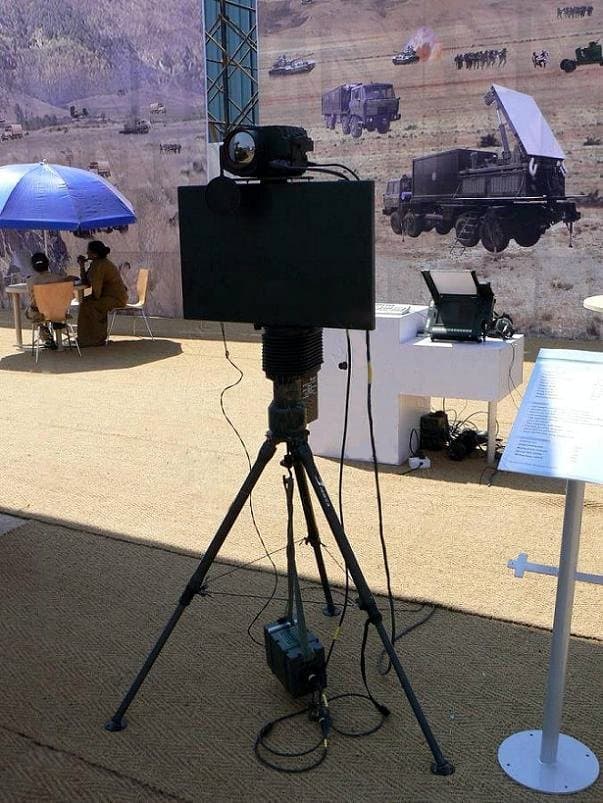
BEL Battle Field Surveillance Radar
Credit
Arun Vishwakarma, Webmaster, www.Bharat-Rakshak.com ( en ). Uploaded by User:Sniperz11 · CC BY 2.5 in · Resized · CC BY 2.5 in · Source ↗ · Modified


Preparing your view.
ARadar & sensors

Measured figures
BEL Battle Field Surveillance Radar · around
Single sourcearound 30 kg[source]
Crawling Man
Single sourceGroup of people
Single sourceHeavy Vehicles
Single sourceLight Vehicles
Single sourceWalking Man
Single sourceCrawling Man : 700 m (0.43 mi) Walking Man : 3 km (1.9 mi) Group of people : 7 km (4.3 mi) Light Vehicles : 10 km (6.2 mi) Heavy Vehicles : 14 km (8.7 mi)[source]
depending on variant
Single sourceBetween 10 and 470 kilometres (6.2 and 292.0 mi ), depending on variant[source]
Bars compare reported quantities only. A larger figure does not make a system better; configurations and test conditions differ.
Configuration
| Specification | BEL Battle Field Surveillance Radar | Giraffe radar |
|---|---|---|
| Speed | 0.9 m/s to 90 km/h[source]Source text · numeric interpretation needs review | — |
| Power | 80 W[source] | — |
| Country of origin | India[source] | Sweden[source] |
| Manufacturer | Bharat Electronics Limited[source] | — |
| Designer | Electronics and Radar Development Establishment ( DRDO )[source] | — |
| No. built | 1400+[source] | 450~[source] |
| Frequency | J band[source] | C band / S Band / X band[source] |
| Azimuth | 30-180°[source] | — |
| Elevation | -40 to +15°[source] | — |
| Precision | ±20 meters (66 ft)[source] | — |
| Other names | PJT-531[source] | — |
| Detection Range | Crawling man: 500 m Walking man: 2 km (1.2 mi) Group of people: 7 km (4.3 mi) Light vehicle: 10 km (6.2 mi) Heavy vehicle: 14 km (8.7 mi)[source] | — |
| Crawling man | 500 m[source] | — |
| Walking man | 2 km (1.2 mi)[source] | — |
| Group of people | 7 km (4.3 mi)[source] | — |
| Light vehicle | 10 km (6.2 mi)[source] | — |
| Heavy vehicle | 14 km (8.7 mi)[source] | — |
| Range accuracy | 20m rms[source] | — |
| Range resolution | 50 m[source] | — |
| Radar type | man portable 2D short-range battlefield and perimeter surveillance radar[source] | — |
| Introduced | — | 1977[source] |
| Type | — | Early-warning radar[source] |
| RPM | — | 60[source] |
| Altitude | — | Between 0 and 40,000 metres (0 and 131,234 ft ), depending on variant[source] |
| Role | — | family of land and naval two- or three-dimensional G/H-band (4 to 8 GHz) passive electronically scanned array radar -based surveillance and air defense command and control systems[source] |
| Source measurement | — | The Saab (formerly Ericsson Microwave Systems AB) Giraffe Radar is a family of land and naval two- or three-dimensional G/H-band (4 to 8 GHz) passive electronically scanned array radar -based surveillance and air defense command and control systems. It is tailored for operations with medium- and Short Range Air Defense (SHORAD) missile or gun systems, or for use as gap-fillers in a larger air defense system.[source]Giraffe radar · Lead; only the objects and conditions stated in this passage Giraffe uses Agile Multi-Beam (AMB), which includes an integrated Command, control and communication (C 3 ) system. This enables Giraffe to act as the command and control center in an air defense system. It can also be integrated into a sensor net for greater coverage. It is normally housed in a single 6m long shelter, mounted on an all-terrain vehicle for high mobility. The shelter can be augmented with Nuclear, Biological and Chemical protection and light layers of armor to protect against small arms and fragmentation threats.[source]Giraffe radar · Description; only the objects and conditions stated in this passage This is a short-range (40 kilometres (25 mi) instrumented) air defense radar with command and control capability. It employs a folding antenna mast that extends to a height of 13 metres (43 ft) when deployed and can be integrated with an Interrogation Friend or Foe (IFF) capability. Coverage is stated to be from ground level to 10,000 metres (33,000 ft) in altitude. In Swedish service, the radar is designated PS-70 and PS-701 . It provides target data to RBS-70 SHORADS missiles and 40 mm Bofors guns . A more powerful version with a 60 kW transmitter is known commercially as Super Giraffe , and is in Swedish service as the PS-707 . These radars are no longer marketed.[source]Giraffe radar · Variants / Passive electronically-scanned array / Giraffe 40; only the objects and conditions stated in this passage This is the model used in the Norwegian NALLADS air defense system. It combines the radar and RBS-70 missiles with 20 mm anti-aircraft guns to provide low-level air defense for the combat brigades of the Norwegian army. Mounted on a BV-206 all-terrain tracked vehicle, this version has an instrumented range of 50 km (31 mi). The antenna extends to a height of 7 metres (23 ft). The system can control up to 20 firing units of guns or missiles or a combination of both. The Command and Control system features fully automatic track initiation, target tracking, target identification (IFF), target classification and designation, hovering helicopter detection threat evaluation and handling of "pop-up" targets. It can exchange data with Giraffe 75 or AMB systems as part of a larger network.[source]Giraffe radar · Variants / Passive electronically-scanned array / Giraffe 50AT; only the objects and conditions stated in this passage This features a 13 metres (43 ft) antenna mast and is normally carried on a 6x6 5-ton cross-country truck which carries the radar and command and control shelter. The instrumented range is 75 km (47 mi) and altitude coverage extends from ground-level to 10,000 metres (33,000 ft). An optional add-on unit extends the radar's coastal defense capabilities. In Swedish service the radar is designated PS-90 . In the Greek Air Force, the Giraffe 75 is used in combination with Contraves (now Rheinmetall defense) Skyguard/Sparrow fire control systems. 1 Giraffe typically controls 2 Skyguard systems, each with 2 twin 35 mm GDF-005 guns and 2 Sparrow surface-to-air missile launchers.[source]Giraffe radar · Variants / Passive electronically-scanned array / Giraffe 75; only the objects and conditions stated in this passage Optimized as a mobile radar for uncrewed remote-controlled applications as a "gap-filler" in air defense early warning systems concentrating on small, low-flying targets over a long distance. It can be employed as a coastal surveillance radar where targets are small surface vessels and sea-skimming missiles or aircraft . A new antenna extends range coverage to 180 km (110 mi), with altitude coverage from ground level to 6,000 metres (20,000 ft). The antenna mast extends to 8 metres (26 ft).[source]Giraffe radar · Variants / Passive electronically-scanned array / Giraffe S; only the objects and conditions stated in this passage Giraffe Agile Multi Beam is a digital antenna array radar. It provides multi-beam 3-Dimensional air coverage at 5.4 to 5.9 GHz. It has instrumented ranges of 30 km (19 mi), 60 km (37 mi) and 100 km (62 mi). The altitude coverage is extended from ground-level to 20,000 metres (66,000 ft) with 70-degree elevation coverage. The data rate is 1-scan per-second. Its maintained pulse density suppresses high cluttering in adverse weather conditions. Ultra-low antenna side-lobes combined with pulse-to-pulse and burst-to-burst frequency agility provides some resistance to jamming.[source]Giraffe radar · Variants / Passive electronically-scanned array / Giraffe AMB; only the objects and conditions stated in this passage As in previous Giraffe radars, automatic hovering helicopter detection is provided, as is a rocket, artillery and mortar locating function, allowing the radar to detect incoming rounds and give 20 seconds or more of warning before impact. Giraffe AMB is the principal sensor of the Swedish RBS 23 BAMSE air defense missile system, and is available for many other applications. The Giraffe AMB can be delivered with ground surveillance options fitted. A skilled crew can deploy the radar in around 10 minutes and recover it in around 6 minutes.[source]Giraffe radar · Variants / Passive electronically-scanned array / Giraffe AMB; only the objects and conditions stated in this passage The latest version, the Giraffe AMB D, was unveiled for the first time at Eurosatory 2026; it uses an AESA antenna and has a range of 250 km and is said to be ready for deployment in 3 minutes.[source]Giraffe radar · Variants / Passive electronically-scanned array / Giraffe AMB; only the objects and conditions stated in this passage Saab's Sea Giraffe AMB is the naval variant of their Giraffe radar with 3D AMB technology. It can detect air and surface targets from the horizon, up to a height of 20,000 metres (66,000 ft) at elevations up to 70°. It can simultaneously handle multiple threats approaching from different directions and altitudes, including diving anti-ship missiles . It is specialized for rapidly detecting small, fast moving targets at all altitudes and small surface targets in severe clutter.[source]Giraffe radar · Variants / Passive electronically-scanned array / Sea Giraffe AMB; only the objects and conditions stated in this passage The radar has an instrumented range of 180 km (110 mi). Its roles include:[source]Giraffe radar · Variants / Passive electronically-scanned array / Sea Giraffe AMB; only the objects and conditions stated in this passage Intended primarily for remote operation as part of an integrated air defence network, Giraffe 8A can also be operated locally. It has an instrumented range of 470 km (290 mi) and an altitude capability of more than 40,000 m (130,000 ft), bringing true long-range air defence capability to the Saab radar family for the first time.[source]Giraffe radar · Variants / Active electronically-scanned array / Giraffe 8A; only the objects and conditions stated in this passage Giraffe 8A produces 15 stacked beams to provide elevation coverage from ground level to more than 65°. It can operate in a continuous 360° scan mode, rotating mechanically at 24 rpm, or can be steered electronically across an operator-specified sector of 40° to 100°. More than 1,000 air defence tracks can be maintained, and the system also has anti-ballistic missile capability, in which case more than 100 tracks can be followed.[source]Giraffe radar · Variants / Active electronically-scanned array / Giraffe 8A; only the objects and conditions stated in this passage While the Giraffe 8A occupies the high end of the family, Saab has introduced new radars in the medium-range category in the form of Giraffe 4A and Sea Giraffe 4A for naval use. Employing similar S-band technology to the larger radar, Giraffe 4A offers true 3D multirole capability, combining the air defence and weapon locating tasks in a single unit. Able to be airlifted in a single C-130 load, Giraffe 4A can be deployed by two people in less than 10 minutes. It can operate as a standalone.[source]Giraffe radar · Variants / Active electronically-scanned array / Giraffe 4A and Sea Giraffe 4A; only the objects and conditions stated in this passage Weighing less than 300 kg (660 lb), Giraffe 1X can be mounted on a small vehicle or vessel or in fixed installations such as on a building or a mast. The radar has a sense-and-warn function and can be optionally configured for weapon location.[source]Giraffe radar · Variants / Active electronically-scanned array / Giraffe 1X and Sea Giraffe 1X; only the objects and conditions stated in this passage |
| Reported operators |
|
|