

Credit
U.S. Air Force photo by Master Sgt. David Richards · Public domain · Resized · Public domain · Source ↗ · Modified


Preparing your view.

At a glance
True scale
Side by side. From every angle. A human reference for perspective.
3.24 MB · Loads when you open it| Model | Length | Width / span | Height |
|---|---|---|---|
| Beechcraft T-6 Texan II | ≈ 10.16 m | ≈ 10.19 m (Wingspan) | ≈ 4 m |
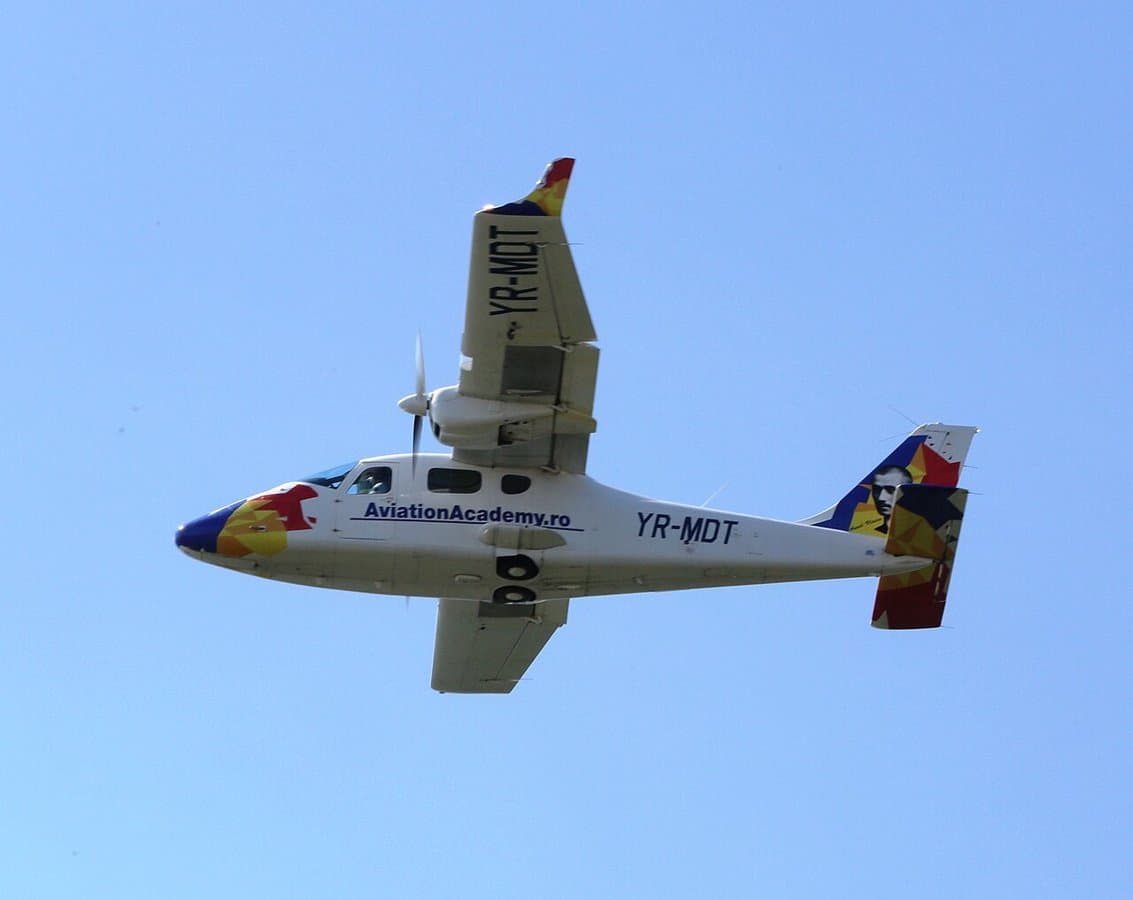
| Tecnam P2006T | ≈ 8.7 m | ≈ 11.4 m (Wingspan) | ≈ 2.9 m |
Scaled uniformly to the sourced length of 10.16 m. The shape was turned square to the axes; the width was fitted to the sourced 10.19 m wingspan. Not an official model or a measured survey.
ForceTally · All rights reserved
Scaled uniformly to the sourced length of 8.7 m. The shape was turned square to the axes; the height was fitted to the sourced 2.9 m; the width was fitted to the sourced 11.4 m wingspan. Not an official model or a measured survey.
ForceTally · All rights reserved
The human reference is a generic 1.75 m figure. Models describe external size, not combat performance.
Measured figures
T-6A · Length
Single source33 ft 4 in (10.16 m)[source]
Length
Configuration
| Specification | Beechcraft T-6 Texan II | Tecnam P2006T |
|---|---|---|
| Type | T-6: Trainer aircraft AT-6: Light attack aircraft[source] | — |
| National origin | United States[source] | Italy[source]P2006T |
| Manufacturer | Textron Aviation[source] Hawker Beechcraft[source] | Tecnam[source]P2006T |
| Status | In service[source] |
8.7 m (28 ft 7 in)[source]
Empty; T-6A · Empty weight
Single sourceGross; T-6A · Gross weight
Single sourceMaximum take-off; T-6A · Max takeoff weight
Single source4,707 lb (2,135 kg)[source]
6,300 lb (2,858 kg)[source]
6,500 lb (2,948 kg)[source]
Empty; Empty weight
Single sourceMaximum take-off; Max takeoff weight
Single sourceT-6A · 1 × Pratt & Whitney Canada PT6A-68 turboprop , 1,100 shp (
Single source1 × Pratt & Whitney Canada PT6A-68 turboprop , 1,100 shp (820 kW)[source]
2 × Rotax 912isc 3 Sport horizontally opposed four-cylinder geared piston engines each
Single source2 × Rotax 912isc 3 Sport horizontally opposed four-cylinder geared piston engines , 75 kW (100 hp) each[source]
930 ft/min
Single source4.7 m/s (930 ft/min)[source]
Bars compare reported quantities only. A larger figure does not make a system better; configurations and test conditions differ.
| — |
| Primary users | United States Air Force United States Navy Royal Canadian Air Force Hellenic Air Force[source] | — |
|---|
| Number built | 900 (August 2015)[source] | Over 400 (as of 2025)[source]P2006T |
|---|
| Manufactured | 2000–present[source] | 2007–present[source]P2006T |
|---|
| Introduction date | 2001[source] | June 2009[source]P2006T |
|---|
| First flight | 15 July 1998[source] | 13 September 2007[source]P2006T |
|---|
| Developed from | Pilatus PC-9[source] | — |
|---|
| Capacity | Two[source] | 3 passengers[source] |
|---|
| Fuel capacity | 149.0 Imp gal (677.5 liters, 1200 lb)[source] | 200 litres (44 imp gal; 53 US gal)[source] |
|---|
| Aspect ratio | 6.29:1[source] | 8.80[source] |
|---|
| Propellers | 4-bladed Hartzell HC-E4A-2 Hub with E9612 blades, 8 ft 1 in (2.46 m) diameter[source] | 2-bladed MT Propeller MTV-21, 1.78 m (5 ft 10 in) diameter constant-speed, fully feathering[source] |
|---|
| Never exceed speed | 364 mph (586 km/h, 316 kn)[source] | — |
|---|
| g limits | +7.0g/−3.5g[source] | — |
|---|
| Role | — | Light twin-engine utility aircraft / multi-engine trainer[source]P2006T |
|---|
| Designer | — | Luigi Pascale[source]P2006T |
|---|
| Developed into | — | NASA X-57 Maxwell[source]P2006T |
|---|
| Stall speed | — | 104 km/h (64 mph, 56 kn)[source] |
|---|