


Preparing your view.

At a glance
Measured figures
Length
Single source43 ft 10 in / 13.36 m[source]
Falcon 20F · Length
Single sourceConfiguration
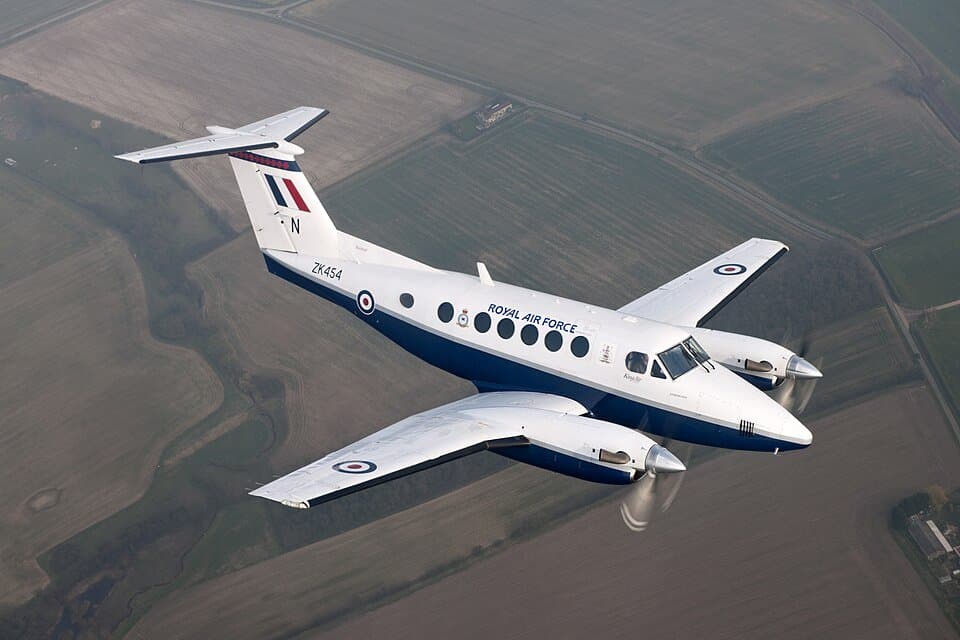
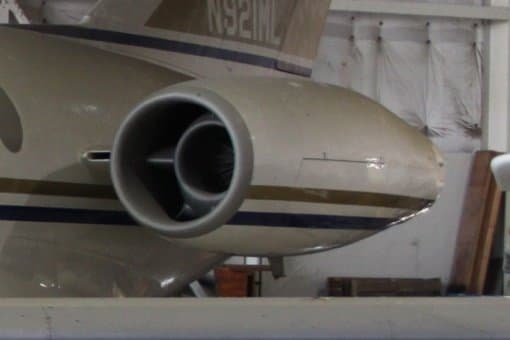
| Specification | Beechcraft Super King Air | Dassault Falcon 20 |
|---|---|---|
| Type | Civil utility aircraft[source] | Business jet[source] |
| Manufacturer | Beechcraft[source] | Dassault Aviation[source] |
| Status | Active service[source] | Out of production, in active service[source] |
| Primary users | United States Air Force United States Army Royal Flying Doctor Service Royal Australian Air Force |
17.15 m (56 ft 3 in)[source]
Cruise; Cruise speed
Single source310 kn / 574 km/h[source]
Cruise; Falcon 20F · at 12,200 m (40,000 ft) (econ. cruise)
Single sourceMaximum; Falcon 20F · at 7,620 m (25,000 ft) (max cruise)
Single source862 km/h (536 mph, 465 kn) at 7,620 m (25,000 ft) (max cruise)[source]
750 km/h (470 mph, 400 kn) at 12,200 m (40,000 ft) (econ. cruise)[source]
Falcon 20F · 2 × General Electric CF700 -2D-2 turbofans thrust each
Single source2 × General Electric CF700 -2D-2 turbofans , 20 kN (4,500 lbf) thrust each[source]
Falcon 20F · Wing area
Single source41.00 m 2 (441.3 sq ft)[source]
Bars compare reported quantities only. A larger figure does not make a system better; configurations and test conditions differ.
Federal Express (formerly) French Navy United States Coast Guard[source] |
| Number built | 4,442 (at end of 2025)[source] | 512[source] |
|---|
| Manufactured | 1972–present[source] | 1965–1991[source] |
|---|
| Introduction date | 1972 (military) February 1974 (civil)[source] | 3 June 1965[source] |
|---|
| First flight | October 27, 1972[source] | 4 May 1963[source] |
|---|
| Developed from | Beechcraft King Air[source] | — |
|---|
| Variant | Beechcraft C-12 Huron[source] | — |
|---|
| Developed into | Beechcraft 1900[source] | Dassault Falcon 10 Dassault Falcon 50[source] |
|---|
| Capacity | 10[source] | 8–14 passengers[source] |
|---|
| OEW | 8,830 lb / 4,005 kg[source] | — |
|---|
| Useful load | 3,760 lb / 1,706 kg[source] | — |
|---|
| Powerplant | PWC PT6A -52[source] | — |
|---|
| Source measurement | The Model 200 was originally conceived as the Model 101 in 1969, and was a development of the Model 100 King Air.[source]Beechcraft Super King Air · Development / Super King Air 200; only the objects and conditions stated in this passage Apart from the T-tail, other changes included Pratt & Whitney Canada PT6 A-41 engines rated at 850 shp (630 kW) instead of the 680 shp (510 kW) engines of the Model A100 then in production, and an increased wing span with extra fuel capacity.[source]Beechcraft Super King Air · Development / Super King Air 200; only the objects and conditions stated in this passage Overall, the 200 was 3 ft 10 in (117 cm) longer than the A100, with a wingspan 4 ft 3 in (130 cm) greater, containing 60 US gallons (230 L) more fuel.[source]Beechcraft Super King Air · Development / Super King Air 200; only the objects and conditions stated in this passage Maximum Take-Off Weight (MTOW) was increased by 1,000 lb (450 kg).[source]Beechcraft Super King Air · Development / Super King Air 200; only the objects and conditions stated in this passage After protracted development, including extensive wind tunnel testing of the design (especially of the T-tail which was wind tunnel-tested for 375 hours), the first prototype flew for the first time on October 27, 1972; a second prototype took to the air on December 15 the same year.[source]Beechcraft Super King Air · Development / Super King Air 200; only the objects and conditions stated in this passage The next model was the Model 200C in 1979, equipped with a large cargo door on the left-hand side of the rear fuselage with an airstair door similar to the Model 200's door built into it. The door opening was 4 ft 4 in (1.33 m) high and 4 ft 4 in (1.33 m) wide, allowing a larger range of items to be loaded into the cabin, and the new model was popularly outfitted as an air ambulance . The 200C fuselage was a new design and not a modification of the Model 200 fuselage. The Model A200C military version was developed concurrently. In 1981, a Model 200C (c/no. BL-24) was modified as the Model 200CT, fitted with the same wingtip fuel tanks as installed on Model 200Ts; there was only one 200CT, but it led to other aircraft after an updated version of the Model 200 entered production.[source]Beechcraft Super King Air · Development / Super King Air 200; only the objects and conditions stated in this passage Fitted with PT6A-42 engines, rated at 850 shp (630 kW), but with improvements that resulted in greater aircraft performance.[source]Beechcraft Super King Air · Development / Super King Air 200; only the objects and conditions stated in this passage A total of 14 B200s were produced in 1989 and 1990 in a 13-seat high density configuration with a belly cargo pod; these were marketed by Beechcraft as a commuter airliner under the designation Model 1300. Customers for this version included Mesa Airlines . The propeller installation changed again in 1992, when Beechcraft offered the option of having 4-bladed Hartzell or McCauley propellers, or 3-bladed Hartzell propellers; the 3-bladed McCauley propellers were no longer available. From October 1995 Beechcraft offered an updated B200 with Electronic Flight Instrument System (EFIS) avionics , marketed as the "B200SE Super King Air" (for Special Edition). The following year the "Super" name was dropped from all marketing and advertising. In October 2003, Beechcraft announced another avionics upgrade for the B200, the Rockwell Collins Pro Line 21 suite.[source]Beechcraft Super King Air · Development / Super King Air 200; only the objects and conditions stated in this passage The B200GT is fitted with a new model of PT6 engine developed specifically for it by Pratt & Whitney Canada ; while still rated at 850 shp (630 kW) the new PT6A-52 develops maximum power to an even higher altitude than the −42 it replaces, thus further improving aircraft performance.[source]Beechcraft Super King Air · Development / Super King Air 200; only the objects and conditions stated in this passage In 2014 Beechcraft announced the availability of an option (available at manufacture and for existing aircraft) to increase the MTOW of the B200GT from 12,500 pounds (5,700 kg) to 13,420 pounds (6,090 kg), marketed as the King Air 250EP (for E xtra P ayload). The upgrade puts the 250EP into the same weight class as the King Air 350, necessitating various system changes to meet certification requirements and a special rating for pilots. In 2019, the 250 unit cost was US$6.61M (~$7.98 million in 2024).[source]Beechcraft Super King Air · Development / Super King Air 200; only the objects and conditions stated in this passage On December 2, 2020, Textron updated the King Air 200 series with the 260, with deliveries expected in early 2021. The model has an improved autothrottle , a Multi-Scan weather radar , a range of 1,720 nmi (3,190 km) and a top cruise speed of 310 kn (360 mph; 570 km/h) with up to nine passengers. The type was FAA certified in March 2021, and European Aviation Safety Agency type certified in September 2021.[source]Beechcraft Super King Air · Development / Super King Air 200 / King Air 260; only the objects and conditions stated in this passage In 2023, its equipped price was $7.78M.[source]Beechcraft Super King Air · Development / Super King Air 200 / King Air 260; only the objects and conditions stated in this passage The Canadian Forces Air Command took delivery of two second-hand early-production Model 200 Super King Airs leased from Awood Air in 1990. These were given the designation CT-145 under the CF's identification system and were used as multi-engine trainers, replacing Douglas C-47s . One was subsequently returned to the lessor and a third Model 200 placed into service in order that the two aircraft used would have the same cockpit layout. The two aircraft were replaced by eight civilian-operated 90 Model King Airs in 1995. In 2025 the Royal Canadian Air Force announced the acquisition of 7 King Air 260 aircraft. Designated the CT-145E Expeditor II, the aircraft will be used as multi-engine trainers based at 3 Canadian Forces Flying Training School in Southport, Manitoba .[source]Beechcraft Super King Air · Development / Super King Air 200 / Model 200 military variants; only the objects and conditions stated in this passage The B200's airframe was "cleaned up" and more powerful engines (PT6A-60A, rated at 1,050 shp (780 kW)) were installed in redesigned cowlings (known as "pitot cowlings" due to the reshaped engine air intakes), with MTOW increased to 14,000 lb (6,400 kg).[source]Beechcraft Super King Air · Development / Super King Air 300/350; only the objects and conditions stated in this passage Because not all nations would then allow an aircraft of this type to be certified at an MTOW greater than 12,500 lb (5,700 kg), the Model 300LW was also developed at the same time, limited to the lower MTOW.[source]Beechcraft Super King Air · Development / Super King Air 300/350; only the objects and conditions stated in this passage The King Air 350 is based on the King Air 300 with a 3.4 ft (1.0 m) span increase and winglets , a 2.9 ft (0.88 m) fuselage stretch for an over 17 ft (5.2 m) main cabin, long enough for double club seating. By 1988, Beechcraft had begun work on the replacement for the 300, it was introduced in 1990 and initially marketed as the Super King Air 350. It has two extra cabin windows on each side and MTOW was increased again to 15,000 lb (6,800 kg); as the same regulatory situation that led to the development of the 300LW still existed, that model continued to be produced until 1994. Like the 200 and B200 before it, a version with a large cargo door was developed, the Model B300C marketed as the "Super King Air 350C". The first deliveries of this model also took place in 1990. In 1998, the UltraQuiet active noise canceling system, made by Elliott Aviation, was added as standard equipment on all B300s. In October 2003, Beechcraft announced that it would deliver future B300 and B300C King Airs with the Rockwell Collins Pro Line 21 avionics suite.[source]Beechcraft Super King Air · Development / Super King Air 300/350; only the objects and conditions stated in this passage On June 13, 2005, Beechcraft announced at the Paris Air Show that it was developing the King Air 350ER version of the B300, an equivalent to the earlier Model 200T and B200Ts of the 200 series. Changes include an increase of MTOW to 16,500 lb (7,430 kg), provision for surveillance equipment in a belly pod, the landing gear of the Beechcraft 1900 to handle the increased weight and provide ground clearance for the belly pod, and extra fuel capacity in the engine nacelles to increase range (because of the B300s winglets, it was unfeasible to fit wingtip fuel tanks as found on the 200T and B200T). On November 11, 2007, Hawker Beechcraft announced that the 350ER had been certified by the FAA.[source]Beechcraft Super King Air · Development / Super King Air 300/350; only the objects and conditions stated in this passage The cabin sound level is reduced by 4 dB to 78-dB due to better insulation. More than 440 350i have been delivered in less than ten years. On a one hour trip, it is 10-15 min slower than a jet while burning 700–900 lb (320–410 kg) less fuel. It cruises at 292 kn (336 mph; 541 km/h) TAS at FL350 while burning 503 lb (228 kg) per h, and can reach 312 kn (359 mph; 578 km/h) TAS at FL240. The $1.8 million Blackhawk PT6A-67A upgrade offers a 68 kn (78 mph; 126 km/h) TAS faster cruise and up to 60% shorter time to climb.[source]Beechcraft Super King Air · Development / Super King Air 300/350 / King Air 350i; only the objects and conditions stated in this passage Direct operating costs are around $1,300-1,500 per hour, including a 900 lb (410 kg) average fuel flow per h. At 3,600 h, the first pair of engine overhauls cost $500,000-550,000, but second overhauls can cost $800,000-1.2 million. By September 2019, second-hand aircraft were priced between $3 million for early models to more than $4 million for late models. In 2019, the King Air 350i price was US$7.755M, and US$8.8M for the King Air 350iER.[source]Beechcraft Super King Air · Development / Super King Air 300/350 / King Air 350i; only the objects and conditions stated in this passage The Model 350 ER is an extended-range, special-mission version for surveillance and reconnaissance operations; it was introduced at the Paris Air Show in June 2005. Features of this model include engine nacelle fuel tanks, heavy duty landing gear, and an increased maximum take-off weight of 7,484 kg (16,500 lb). The typical mission profile involves a 100 nautical mile (185 km; 115 mile) flight to on-station; a low-altitude surveillance sortie for 7 hours 20 minutes; and return to base with 45 minutes' fuel reserve.[source]Beechcraft Super King Air · Development / Super King Air 300/350 / Model 350ER (Extended Range); only the objects and conditions stated in this passage The King Air 360 and 360ER have a cockpit including an avionics upgrade, digital pressurisation control, autothrottle , and a modernized cabin featuring a 10% lower altitude pressure. The 360 has a maximum range of 1,806 nmi (3,345 km,) while the 360ER has a maximum range of 2,539 nmi (4,702 km). Both models were FAA type certified in October 2020 and European Aviation Safety Agency certified in September 2021.[source]Beechcraft Super King Air · Development / Super King Air 300/350 / King Air 360 and 360ER; only the objects and conditions stated in this passage In 2023, the equipped price was $9.255M for the 360 and $9.76M for the 360ER.[source]Beechcraft Super King Air · Development / Super King Air 300/350 / King Air 360 and 360ER; only the objects and conditions stated in this passage More than 1,800 King Air 200 series have been delivered during more than 40 years of production. In early 2017 a used 2011 model King Air 250 was worth US$ 3 million and a late 2015 to early 2016 model was worth US$5 million, with an annual utilization estimated at 240 hours and 216 cycles, while a King Air 350i is US$800,000 to US$1 million more.[source]Beechcraft Super King Air · Operational history; only the objects and conditions stated in this passage By April 2017 sales of the King Air series were in decline with just 12 examples delivered in the first quarter of the year, compared to 26 in the same period of 2016, due to a weak international market for the design. The company expected the annual sales to be about the same as 2016, though, which totaled 106 in that year.[source]Beechcraft Super King Air · Operational history; only the objects and conditions stated in this passage Two versions, the standard Model 300 with increased MTOW of 14,000 lb (6,300 kg) and the Model 300LW with MTOW limited to 12,500 lb (5,700 kg) to meet the aviation regulatory requirements of various countries; 247 built including 35 Model 300LW and including two Model 300s modified and another 17 built specifically for the FAA for use in navaid calibration. The 300LW has a lower certified Take-Off Gross Weight of 12,500 lb for the European market related to tax.[source]Beechcraft Super King Air · Variants; only the objects and conditions stated in this passage B200 configured as a regional airliner, with room for two crew and 13 passengers, fitted with two overwing emergency exits instead of the standard model's single overwing exit and an optional 455 lb (206 kg) belly cargo pod; a nose baggage compartment provided by relocating avionics from the nose to elsewhere in the aircraft. A total of 14 were built.[source]Beechcraft Super King Air · Variants; only the objects and conditions stated in this passage Re-engined with PT6A-67As and five-blade composite propellers instead of the PT6A-60A engines with unit power increasing from 1,050 to 1,200 hp (780 to 890 kW), boosting the maximum cruise speed by 50 kn (58 mph; 93 km/h) to 340 kn (390 mph; 630 km/h) and capable of climbing to 35,000ft in 19min; Blackhawk targets 30% of the 850 King Air 300 globally.[source]Beechcraft Super King Air · Variants; only the objects and conditions stated in this passage February 21, 1980: A Model 200 operating as Advance Airlines Flight 4210 crashed adjacent to the runway at Sydney Airport, killing 13 people in the worst civil aviation accident in Australia since 1968.[source]Beechcraft Super King Air · Accidents and incidents; only the objects and conditions stated in this passage September 4, 2000: After departing Perth, Western Australia, the pilot of a Model 200 Super King Air failed to respond to ATC after the aircraft climbed above its assigned altitude. It continued to fly across Australia for five hours before crashing near Burketown in northwestern Queensland, killing all eight on board. Dubbed the " Ghost Flight " by the media, an investigation concluded that the occupants likely became incapacitated due to hypoxia .[source]Beechcraft Super King Air · Accidents and incidents; only the objects and conditions stated in this passage October 30, 2014: A B200 King Air crashed at Wichita, Kansas . The pilot and three people on the ground were killed; six people were injured.[source]Beechcraft Super King Air · Accidents and incidents; only the objects and conditions stated in this passage December 22, 2015: A B200 King Air crashed at Indira Gandhi International Airport in Delhi, India. All ten occupants were killed; one person on the ground was injured.[source]Beechcraft Super King Air · Accidents and incidents; only the objects and conditions stated in this passage September 1, 2019: A B300 King Air crashed into a resort in Calamba, Philippines. All nine occupants aboard were killed; two people on the ground were injured.[source]Beechcraft Super King Air · Accidents and incidents; only the objects and conditions stated in this passage | During the 1950s and 1960s, the French government, which had taken a significant interest in the re-establishment and growth of its national aviation industries in the aftermath of the Second World War , developed a detailed request for a combined liaison / trainer aircraft, to be equipped with twin-turbofan engines. Among those companies that took interest in the government request was French aircraft manufacturer Dassault Aviation . In December 1961, French aircraft designer and head of Dassault Aviation, Marcel Dassault , gave the go-ahead to proceed with work towards the production of an eight- to 10-seat executive jet /military liaison aircraft, which was initially named as the Dassault-Breguet Mystère 20 . The emerging design was of a low-wing monoplane, which drew upon the aerodynamics of the transonic Dassault Mystère IV fighter-bomber , and was equipped with a pair of rear-mounted 14.68 kN (3,300 lbf) Pratt & Whitney JT12A-8 turbojet engines.[source]Dassault Falcon 20 · Development / Origins; only the objects and conditions stated in this passage Progress between Dassault and Pan Am was rapid, moving from engineering evaluations of the type to the formation of general agreements between the two companies. In response to feedback received from Pan American, the aircraft was re-engined with a pair of General Electric CF700 engines and several dimensions were increased. Accordingly, Pan American formed an agreement with Dassault to distribute the Mystère 20 in the western hemisphere; the firm placed an initial order for 40 aircraft along with options for a further 120. On 10 July 1964, the re-engined aircraft made its first flight. On 1 January 1965, the first production aircraft performed its maiden flight; in June 1965, both French and American type certifications were awarded. On 10 June 1965, French aviator Jacqueline Auriol achieved the women's world speed record using the first Mystère 20 prototype, having flown at an average recorded speed of 859 km/h over a distance of 1000 km.[source]Dassault Falcon 20 · Development / Origins; only the objects and conditions stated in this passage In 1973, FedEx's Falcons, designation FA-20-DC, cost $1.2 million each and were modified with a 55-by-74.5-inch forward cargo door with independent power supply, higher mtow, reinforced floor, plugged windows, and bigger brakes.[source] |
|---|
| Country of origin | United States[source]Country/countries explicitly given in the equipment row Origin column; not the country operating the row. Super King Air United States[source]Inventory Origin column; table 1, row 35, cell 2; revision 1377921935; retrieved 2026-10-02 | France[source]Inventory Origin column; table 1, row 54, cell 4; revision 1377423821; retrieved 2026-10-02 |
|---|
| Aspect ratio | — | 6.4:1[source] |
|---|
| Fuel capacity | — | 5,200 L (1,100 imp gal; 1,400 US gal)[source] |
|---|
| Stall speed | — | 152 km/h (94 mph, 82 kn)[source] |
|---|
| Role | — | French business jet[source] |
|---|
| National origin | — | France[source] |
|---|
An improved model of the aircraft, designated the Falcon 200 , was developed, which featured more advanced jet engines and other major improvements to increase range, capacity, and comfort. The Falcon 200, along with the Falcon 20G and HU-25 models, were powered by a pair of Garrett ATF3 engines. According to the magazine Flying , the Falcon 200 variant was more comparable to the newer Falcon 50 trijet than the original Falcon 20 model.[source]Dassault Falcon 20 · Development / Further development; only the objects and conditions stated in this passage
During 2013, the FAA modified 14 CFR part 91 rules to prohibit the operation of jets weighing 75,000 pounds or less that were not Stage 3 noise compliant after 31 December 2015. The Falcon 20 was listed explicitly in Federal Register 78 FR 39576 . Any examples of the type that had not been modified, either by the installation of Stage 3 noise-compliant engines or have had hush kits installed upon noncompliant engines, were no longer permitted to fly anywhere in the contiguous 48 states after 31 December 2015. However, 14 CFR §91.883 Special flight authorizations for jet airplanes weighing 75,000 pounds or less – lists special flight authorizations that may be granted for operation after 31 December 2015.[source]Dassault Falcon 20 · Development / Further development; only the objects and conditions stated in this passage
Prototype, one built. F-WLKB, initially powered by two 14.68 kN (3,300 lbf) Pratt & Whitney JT12A-8 turbojet engines. Now stored at Musée Air et Espace Aéroport Paris – Le Bourget.[source]Dassault Falcon 20 · Variants; only the objects and conditions stated in this passage
Initial production version, with lengthened fuselage compared to first prototype and with 10–12 seats. Powered by 4,200 lbf (19 kN) CF700-2B engines.[source]Dassault Falcon 20 · Variants; only the objects and conditions stated in this passage
Falcon 20CC (s/n 073)[source]Dassault Falcon 20 · Variants; only the objects and conditions stated in this passage
Falcon 20G[source]Dassault Falcon 20 · Variants; only the objects and conditions stated in this passage
Falcon 20H[source]Dassault Falcon 20 · Variants; only the objects and conditions stated in this passage
Improved variant, powered by two 2360-kg (5,200-lb) Garrett ATF3-6A-4C turbofan engines and with more fuel. First flown on 30 April 1980.[source]Dassault Falcon 20 · Variants; only the objects and conditions stated in this passage
United States Coast Guard version of the Falcon 20G. 41 built. Equipped with two Garrett AiResearch Garrett ATF3-6-2C turbofan engines.[source]Dassault Falcon 20 · Variants; only the objects and conditions stated in this passage
Enlarged, 30-passenger commuter airliner derivative of Falcon 20, powered by two 27.0 kN (6,070 lbf) Lycoming ALF 502 D turbofans. One prototype built, first flying on 11 May 1973. No further production of Falcon 30 or proposed 40-passenger, shorter-range Mystére 40-100 .[source]Dassault Falcon 20 · Variants; only the objects and conditions stated in this passage
Pakistan Air Force – 3 in service, including 2 DA-20s in EW , ECM , ESM roles[source]Dassault Falcon 20 · Operators / Current military operators; only the objects and conditions stated in this passage
Royal Australian Air Force – Three in service from 1967 to 1989. No. 34 Squadron RAAF[source]Dassault Falcon 20 · Operators / Former military operators; only the objects and conditions stated in this passage
Capacity: 8–14 passengers[source]Dassault Falcon 20 · Specifications (Falcon 20F); only the objects and conditions stated in this passage
Length: 17.15 m (56 ft 3 in)[source]Dassault Falcon 20 · Specifications (Falcon 20F); only the objects and conditions stated in this passage
Wingspan: 16.30 m (53 ft 6 in)[source]Dassault Falcon 20 · Specifications (Falcon 20F); only the objects and conditions stated in this passage
Height: 5.32 m (17 ft 5 in)[source]Dassault Falcon 20 · Specifications (Falcon 20F); only the objects and conditions stated in this passage
Wing area: 41.00 m 2 (441.3 sq ft)[source]Dassault Falcon 20 · Specifications (Falcon 20F); only the objects and conditions stated in this passage
Empty weight: 7,530 kg (16,601 lb)[source]Dassault Falcon 20 · Specifications (Falcon 20F); only the objects and conditions stated in this passage
Max takeoff weight: 13,000 kg (28,660 lb)[source]Dassault Falcon 20 · Specifications (Falcon 20F); only the objects and conditions stated in this passage
Powerplant: 2 × General Electric CF700 -2D-2 turbofans , 20 kN (4,500 lbf) thrust each[source]Dassault Falcon 20 · Specifications (Falcon 20F); only the objects and conditions stated in this passage
Maximum speed: 862 km/h (536 mph, 465 kn) at 7,620 m (25,000 ft) (max cruise)[source]Dassault Falcon 20 · Specifications (Falcon 20F); only the objects and conditions stated in this passage
Cruise speed: 750 km/h (470 mph, 400 kn) at 12,200 m (40,000 ft) (econ. cruise)[source]Dassault Falcon 20 · Specifications (Falcon 20F); only the objects and conditions stated in this passage
Stall speed: 152 km/h (94 mph, 82 kn)[source]Dassault Falcon 20 · Specifications (Falcon 20F); only the objects and conditions stated in this passage
Range: 3,350 km (2,080 mi, 1,810 nmi)[source]Dassault Falcon 20 · Specifications (Falcon 20F); only the objects and conditions stated in this passage
Service ceiling: 12,800 m (42,000 ft) (absolute ceiling)[source]Dassault Falcon 20 · Specifications (Falcon 20F); only the objects and conditions stated in this passage