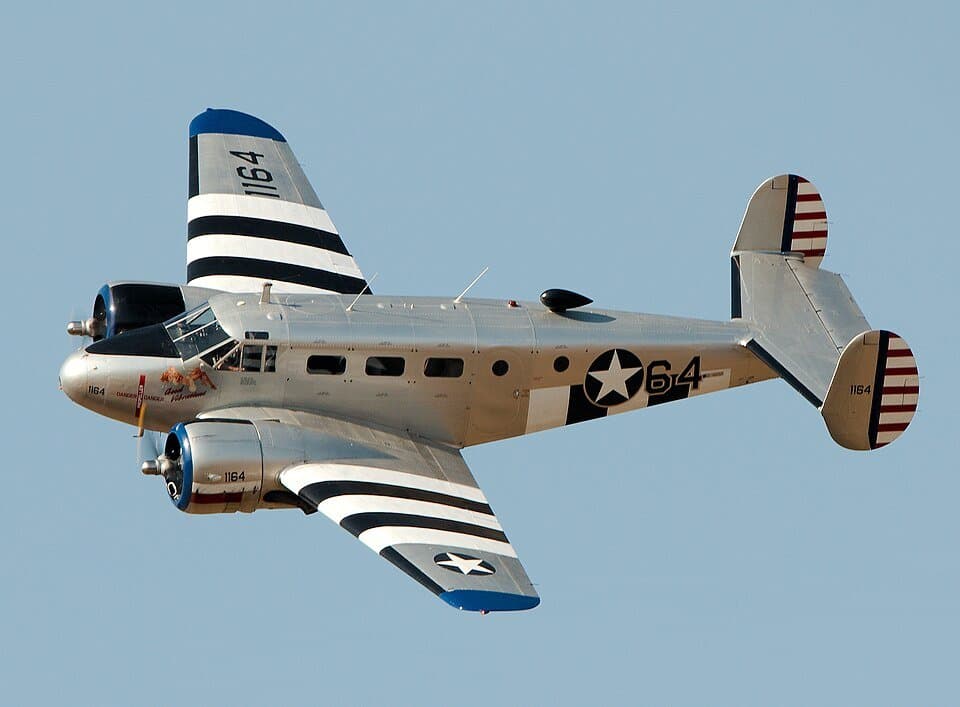

Credit
Airwolfhound · CC BY-SA 2.0 · Resized · CC BY-SA 2.0 · Source ↗ · Modified


Preparing your view.
At a glance
Measured figures
UC-45 Expeditor · Length
Single source34 ft 3 in (10.44 m)[source]
Configuration
| Specification | Beechcraft Model 18 | De Havilland Dragon |
|---|---|---|
| Type | Trainer , transport aircraft and utility aircraft[source] | Passenger and military transport / trainer[source] |
| National origin | United States[source] | — |
| Manufacturer | Beech Aircraft Corporation[source] | de Havilland[source] |
| Status | In service[source] | — |
| Primary users | United States Army Air Forces United States Navy Royal Air Force Royal Canadian Air Force |
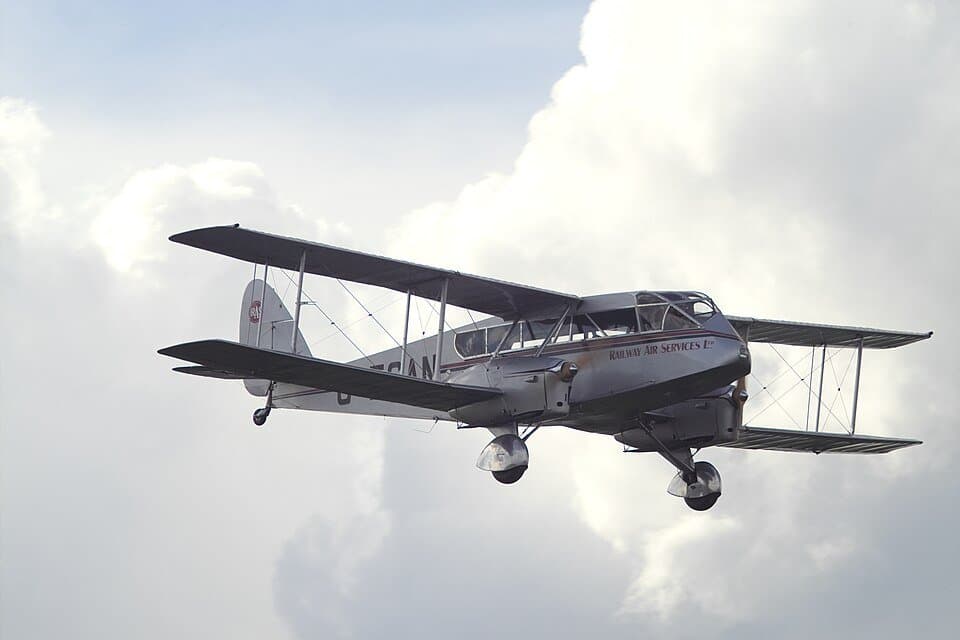
DH.84 Dragon 1 · Length
Length
Single source34 ft 6 in (10.52 m)[source]
10,5 m (34,5 ft )[source]
10,52 m (34 ft 6 in )[source]
10.52 מטר[source]DH.84 דראגון de Havilland DH.84 Dragon
10,52 m (34,5 ft )[source]
UC-45 Expeditor · Wingspan
Single source47 ft 8 in (14.53 m)[source]
Empty; UC-45 Expeditor · Empty weight
Single sourceGross; UC-45 Expeditor · Gross weight
Single sourceMaximum take-off; Beechcraft Model 18 · Conrad Ten-Twos · stated modified aircraft maximum takeoff weight
Single sourceMaximum take-off; Beechcraft Model 18 · Model 18A · maximum takeoff weight exactly as stated
Single sourceMaximum take-off; Beechcraft Model 18 · Model 18D · maximum takeoff weight exactly as stated
Single sourceMaximum take-off; Beechcraft Model 18 · Model A18A · maximum takeoff weight exactly as stated
Single sourceMaximum take-off; Beechcraft Model 18 · Model A18D · maximum takeoff weight exactly as stated
Single sourceMaximum take-off; Beechcraft Model 18 · Model D18C · maximum takeoff weight exactly as stated
Single sourceMaximum take-off; Beechcraft Model 18 · Model D18S · maximum takeoff weight exactly as stated
Single sourceMaximum take-off; Beechcraft Model 18 · Model E18S-9700 · maximum takeoff weight exactly as stated
Single sourceMaximum take-off; Beechcraft Model 18 · Model E18S · maximum takeoff weight exactly as stated
Single sourceMaximum take-off; Beechcraft Model 18 · Model G18S-9150 · maximum takeoff weight exactly as stated
Single sourceMaximum take-off; Beechcraft Model 18 · Model G18S · maximum takeoff weight exactly as stated
Single sourceMaximum take-off; Beechcraft Model 18 · Model H18 · maximum takeoff weight exactly as stated
Single sourceMaximum take-off; Beechcraft Model 18 · Model S18A · maximum takeoff weight exactly as stated
Single sourceMaximum take-off; Beechcraft Model 18 · Model S18D · maximum takeoff weight exactly as stated
Single sourceMaximum take-off; Beechcraft Model 18 · Model SA18A · maximum takeoff weight exactly as stated
Single sourceMaximum take-off; Beechcraft Model 18 · Volpar Turbo Beeches · stated modified aircraft maximum takeoff weight
Single source5,420 lb (2,458 kg)[source]
7,500 lb (3,402 kg)[source]
6,700 lb (3,000 kg)[source]Beechcraft Model 18 · Model 18A · maximum takeoff weight exactly as stated
7,200 lb (3,300 kg)[source]Beechcraft Model 18 · Model S18A · maximum takeoff weight exactly as stated
7,500 lb (3,400 kg)[source]Beechcraft Model 18 · Model A18A · maximum takeoff weight exactly as stated
7,170 lb (3,250 kg)[source]Beechcraft Model 18 · Model SA18A · maximum takeoff weight exactly as stated
7,200 lb (3,300 kg)[source]Beechcraft Model 18 · Model 18D · maximum takeoff weight exactly as stated
7,170 lb (3,250 kg)[source]
Empty; DH.84 Dragon 1 · Empty weight
Single sourceEmpty; Empty weight
Single sourceMaximum; UC-45 Expeditor · Maximum speed
Single source225 mph (362 km/h, 196 kn)[source]
Cruise; DH.84 Dragon 1 · Cruise speed
Single sourceMaximum; DH.84 Dragon 1 · Maximum speed
Single sourceMaximum; Maximum speed
Single source128 mph (206 km/h, 111 kn)[source]
109 mph (175 km/h, 95 kn)[source]
206 קמ"ש[source]DH.84 דראגון de Havilland DH.84 Dragon
206 km/h (111 kn )[source]
UC-45 Expeditor · at 160 mph (260 km/h; 140 kn) and 5,000 ft (1,500 m)
Single source1,200 mi (1,900 km, 1,000 nmi) at 160 mph (260 km/h; 140 kn) and 5,000 ft (1,500 m)[source]
UC-45 Expeditor · 2 × Pratt & Whitney R-985-AN-1 "Wasp Junior" radial engines each
Single source2 × Pratt & Whitney R-985-AN-1 "Wasp Junior" radial engines , 450 hp (340 kW) each[source]
DH.84 Dragon 1 · 2 × de Havilland Gipsy Major I 4-cylinder air-cooled inverted in-line piston engine each
Single source2 × de Havilland Gipsy Major I 4-cylinder air-cooled inverted in-line piston engine, 130 hp (97 kW) each[source]
Bars compare reported quantities only. A larger figure does not make a system better; configurations and test conditions differ.
| — |
| Number built | 9,000+[source] | 202[source] |
|---|
| Manufactured | 1937–1970[source] | — |
|---|
| Introduction date | 1937[source] | April 1933[source] |
|---|
| First flight | 15 January 1937[source] | 12 November 1932[source] |
|---|
| Capacity | 6 passengers[source] | 6–10 passengers[source] |
|---|
| Role | 6- to 11-seat, twin-engined, low-wing, tailwheel light aircraft[source] | — |
|---|
| Source measurement | During the mid 1930s, Beechcraft management speculated that sufficient demand would exist for a new design, referred to as the Model 18 . It was envisioned as a twin-engine transport aircraft, capable of seating between six and eight passengers dependent upon configuration, that would be suitable both as a business aircraft and a small regional airliner , the latter being viewed as a relatively small niche of the market due to few feeder lines existing at that time. Furthermore, the Model 18 would be designed so that it could be readily converted to be used for several military applications as well as to haul cargo. The decisions to proceed was issued in late 1935 and preliminary works commenced thereafter, which was headed by aeronautical engineer Theodore Wells. To accommodate the anticipated volume, the company's main production facilities were expanded around this time.[source]Beechcraft Model 18 · Design and development; only the objects and conditions stated in this passage Early production aircraft were powered either by a pair of 330-hp (250-kW) Jacobs L-6s or 350-hp (260-kW) Wright R-760 Es; at the time, these were the only engines available that satisfied the designer's requirements. Many aircraft, such as the D18S variant, were powered by two 450-hp (336-kW) Pratt & Whitney R-985 "Wasp Junior" nine-cylinder radial engines , paired with Hamilton Standard constant speed propellers . The Model 18 has used a variety of engines and has been subject to a number of airframe modifications to increase both gross weight and speed. At least one aircraft was modified to use 600-hp (447-kW) Pratt & Whitney R-1340 "Wasp" powerplants. With the added weight of about 200 lb (91 kg) per engine, the concept of a Model 18 fitted with R-1340 engines was deemed unsatisfactory due to the weakest structural area of the aircraft being the engine mounts.[source]Beechcraft Model 18 · Design and development; only the objects and conditions stated in this passage On 10 December 1953, the prototype of the improved Super 18 made its first flight. In 1955, deliveries of the Model E18S commenced; the E18S featured a fuselage that was extended 6 in (150 mm) higher for more headroom in the passenger cabin. All later Beech 18s (sometimes called Super 18s) featured this taller fuselage, and some earlier models (including one AT-11) have had this modification. The Model H18, introduced in 1963, featured optional tricycle undercarriage . Unusually, the undercarriage was developed for earlier-model aircraft under an supplemental type certificate by Volpar , and installed in H18s at the factory during manufacture. A total of 109 H18s was built with tricycle undercarriage, and another 240 earlier-model aircraft were modified with this.[source]Beechcraft Model 18 · Design and development; only the objects and conditions stated in this passage Existing naval Twin Beeches were subsequently modified into the SNB-2H air ambulance, SNB-2P reconnaissance trainer, and SNB-3Q electronic countermeasures trainer.[source]Beechcraft Model 18 · Operational history; only the objects and conditions stated in this passage Beech 18s were used extensively by Air America during the Vietnam War ; initially more-or-less standard ex-military C-45 examples were used, but then the airline had 12 aircraft modified by Conrad Conversions in 1963 and 1964 to increase performance and payload. The modified aircraft were known as Conrad Ten-Twos, as the maximum takeoff weight (MTOW) was increased to 10,200 lb (4,600 kg). The increase was achieved by several airframe modifications, including increased horizontal stabilizer angle-of-incidence, redesigned undercarriage doors, and aerodynamically improved wingtips. Air America then had Volpar convert 14 aircraft to turboprop power, fitted with Garrett AiResearch TPE-331 engines; modified aircraft were called Volpar Turbo Beeches, and also had a further increase in MTOW to 10,286 lb (4,666 kg).[source]Beechcraft Model 18 · Operational history; only the objects and conditions stated in this passage First production model with seating for two pilots and seven or eight passengers, fitted with Wright R-760 E-2 engines of 350 horsepower (260 kW), MTOW: 6,700 lb (3,000 kg) Four built.[source]Beechcraft Model 18 · Variants / Manufacturer models; only the objects and conditions stated in this passage Version of Model 18A capable of being fitted with skis or Edo 55-7170 floats ; MTOW: 7,200 lb (3,300 kg)[source]Beechcraft Model 18 · Variants / Manufacturer models; only the objects and conditions stated in this passage Version fitted with Wright R-760E-2 engines, MTOW: 7,500 lb (3,400 kg)[source]Beechcraft Model 18 · Variants / Manufacturer models; only the objects and conditions stated in this passage Seaplane version of Model A18A, MTOW: 7,170 lb (3,250 kg)[source]Beechcraft Model 18 · Variants / Manufacturer models; only the objects and conditions stated in this passage Version powered with 285 hp (213 kW) Jacobs L-5 engines. Four built.[source]Beechcraft Model 18 · Variants / Manufacturer models; only the objects and conditions stated in this passage Variant with seating for two pilots and nine passengers, fitted with Jacobs L-6 engines of 330 horsepower (250 kW), MTOW: 7,200 lb (3,300 kg). Twelve aircraft built.[source]Beechcraft Model 18 · Variants / Manufacturer models; only the objects and conditions stated in this passage Version of Model 18D capable of being fitted with skis or Edo 55-7170 floats , MTOW: 7,170 lb (3,250 kg)[source]Beechcraft Model 18 · Variants / Manufacturer models; only the objects and conditions stated in this passage Variant of 18D with MTOW increased by 300 lb (140 kg) to 7,500 lb (3,400 kg).[source]Beechcraft Model 18 · Variants / Manufacturer models; only the objects and conditions stated in this passage Model with Pratt and Whitney R-985 -A1 engines with dual-stage blower for increased power at higher operating altitudes , 420 horsepower (310 kW), seven built, one to Sweden as an air ambulance , six to Nationalist China as M18R light bombers[source]Beechcraft Model 18 · Variants / Manufacturer models; only the objects and conditions stated in this passage Nine-passenger pre-World War II civil variant, powered by 450 hp (340 kW) served as basis for USAAF C-45C[source]Beechcraft Model 18 · Variants / Manufacturer models; only the objects and conditions stated in this passage Variant of B18S with seating for eight passengers, and equipment and minor structural changes[source]Beechcraft Model 18 · Variants / Manufacturer models; only the objects and conditions stated in this passage First post-World War II variant introduced in 1945, with seating for eight passengers and MTOW of 8,750 lb (3,970 kg), 1,035 built[source]Beechcraft Model 18 · Variants / Manufacturer models; only the objects and conditions stated in this passage Variant with Continental R9-A engines of 525 horsepower (391 kW) and MTOW of 9,000 lb (4,100 kg), introduced in 1947, 31 built.[source]Beechcraft Model 18 · Variants / Manufacturer models; only the objects and conditions stated in this passage Variant with redesigned wing and MTOW of 9,300 lb (4,200 kg); 403 built[source]Beechcraft Model 18 · Variants / Manufacturer models; only the objects and conditions stated in this passage Variant of E18S with MTOW of 9,700 lb (4,400 kg); 57 built[source]Beechcraft Model 18 · Variants / Manufacturer models; only the objects and conditions stated in this passage Superseded E18S, MTOW of 9,700 lb (4,400 kg); 155 built[source]Beechcraft Model 18 · Variants / Manufacturer models; only the objects and conditions stated in this passage Lightweight version of G18, MTOW of 9,150 lb (4,150 kg); one built[source]Beechcraft Model 18 · Variants / Manufacturer models; only the objects and conditions stated in this passage Last production version, fitted with optional tricycle undercarriage developed by Volpar and MTOW of 9,900 lb (4,500 kg); 149 built, of which 109 were manufactured with tricycle undercarriage[source]Beechcraft Model 18 · Variants / Manufacturer models; only the objects and conditions stated in this passage C-45G[source]Beechcraft Model 18 · Variants / Military versions / USAAC/USAAF designations; only the objects and conditions stated in this passage TC-45G[source]Beechcraft Model 18 · Variants / Military versions / USAAC/USAAF designations; only the objects and conditions stated in this passage Multiengine crew trainer variant of C-45G; AT-7s and AT-11s remanufactured in the early 1950s for the USAF to similar standard as civil D18S, 96 aircraft rebuilt[source]Beechcraft Model 18 · Variants / Military versions / USAAC/USAAF designations; only the objects and conditions stated in this passage C-45H[source]Beechcraft Model 18 · Variants / Military versions / USAAC/USAAF designations; only the objects and conditions stated in this passage TC-45H[source]Beechcraft Model 18 · Variants / Military versions / USAAC/USAAF designations; only the objects and conditions stated in this passage In 1962, all surviving U.S. Navy SNB-5Ps were redesignated RC-45J[source]Beechcraft Model 18 · Variants / Military versions / USAAC/USAAF designations; only the objects and conditions stated in this passage Navigation trainer based on C18S, with an astrodome and positions for three students, powered by 450-hp Pratt & Whitney R-985-25 engines; 577 built[source]Beechcraft Model 18 · Variants / Military versions / USAAC/USAAF designations; only the objects and conditions stated in this passage SNB-2H[source]Beechcraft Model 18 · Variants / Military versions / US Navy designations; only the objects and conditions stated in this passage Modification increasing the gross weight to 9,800 pounds with a single piece windshield[source]Beechcraft Model 18 · Variants / Conversions; only the objects and conditions stated in this passage Stretched airliner conversion. Similar to Dumod I but with forward fuselage stretched by 6 feet 3 inches (1.91 m), allowing up to 15 passengers to be carried. Originally named Infinité II .[source]Beechcraft Model 18 · Variants / Conversions; only the objects and conditions stated in this passage Stretched conversion powered by two 840-hp PT6As , and with accommodation for up to 17 passengers[source]Beechcraft Model 18 · Variants / Conversions; only the objects and conditions stated in this passage two 579-hp PT6A-20s or 630-hp PT6A-27s or 630-hp Lycoming LTS101s .[source]Beechcraft Model 18 · Variants / Conversions; only the objects and conditions stated in this passage two 570-hp Lycoming LTP101s or 680-hp PT6A-28s or 750-hp PT6A-34s or 1020-hp PT6A-45s[source]Beechcraft Model 18 · Variants / Conversions; only the objects and conditions stated in this passage Built as C-45F 44-47231, this aircraft was re-manufactured at Wichita by Beech in 1952, to become TC-45G 51-11544. From 1959 Rausch Engineering Inc. of South San Francisco, California, converted N8186H to tricycle undercarriage, using forward retracting main gear from a P-51 and rearward-retracting nose-leg from a T-28, adding a 3 ft (0.91 m) nose extension, 4 ft (1.22 m) rear fuselage extension, re-roofed fuselage for increased headroom and enlarged cabin windows. The modifications did not obtain FAA certification despite 58 hours of flight testing, with the aircraft eventually being broken up at Antioch, CA, in 1978.[source]Beechcraft Model 18 · Variants / Conversions; only the objects and conditions stated in this passage Beech Model 18s fitted with the Volpar MkIV tricycle undercarriage and powered by two 705-hp Garrett TPE331-1-101B turboprop engines, flat-rated to 605 hp (451 kW), driving Hartzell HC-B3TN-5 three-bladed, reversible-pitch, constant-speed feathering propellers[source]Beechcraft Model 18 · Variants / Conversions; only the objects and conditions stated in this passage 2x 705 hp (526 kW) Garrett TPE331[source]Beechcraft Model 18 · Variants / Conversions; only the objects and conditions stated in this passage Volpar (Beechcraft) C-45G[source]Beechcraft Model 18 · Variants / Conversions; only the objects and conditions stated in this passage C-45G aircraft modified with tricycle undercarriage[source]Beechcraft Model 18 · Variants / Conversions; only the objects and conditions stated in this passage 15-passenger version of the Turbo 18 with extended fuselage, powered by 2 705-hp Garrett TPE331-1-101Bs[source]Beechcraft Model 18 · Variants / Conversions; only the objects and conditions stated in this passage 25 April 1951: Cubana de Aviación Flight 493 , a Douglas DC-4 bound from Miami to Havana, registration CU-T188 , collided with a U.S. Navy SNB-1, bureau number 39939 , which was performing a practice instrument approach to Naval Air Station Key West . The collision and ensuing crashes killed all 34 passengers and five crew aboard the DC-4 and all five crew aboard the SNB. The accident occurred at midday, weather was clear with unlimited visibility, and both flight crews had been cleared to fly under visual flight rules , being expected to "see and avoid" other aircraft; the student flying the SNB was wearing view-limiting goggles, but the other SNB crew were not, and were expected to keep watch. Ground witnesses said that neither aircraft took evasive action prior to the collision, and the Civil Aeronautics Board attributed the accident to the failure of both flight crews to see and avoid conflicting air traffic.[source]Beechcraft Model 18 · Accidents and incidents; only the objects and conditions stated in this passage 19 September 1965: During the India–Pakistan war of 1965 , eight people including Chief Minister Balwantrai Mehta of Gujarat, India, were killed when their civilian-registered Beechcraft 18 was shot down southwest of Bhuj by an F-86 Sabre of the Pakistan Air Force , which had concluded that the Indian Army had been conducting reconnaissance of a nearby conflict zone using civil aircraft.[source]Beechcraft Model 18 · Accidents and incidents; only the objects and conditions stated in this passage 1967: Mohammed bin Awad bin Laden was killed in the crash of a Beechcraft 18 in Saudi Arabia.[source]Beechcraft Model 18 · Accidents and incidents; only the objects and conditions stated in this passage 20 September 1973: American folk rock singer-songwriter Jim Croce , four members of his entourage, and the pilot were killed when their chartered E18S, registration N50JR , crashed into a tree shortly after takeoff from Natchitoches Regional Airport in Louisiana. The NTSB attributed the accident to reduced visibility due to fog, and to physical impairment of the pilot, who had severe coronary artery disease and had run 3 mi (4.8 km) to the airport. An investigation conducted for a lawsuit against the charter company attributed the accident solely to pilot error , citing his downwind takeoff into a "black hole" of severe darkness, causing him to experience spatial disorientation .[source]Beechcraft Model 18 · Accidents and incidents; only the objects and conditions stated in this passage 26 September 1978: Air Caribbean Flight 309 , an air taxi flight by a D18S, registration N500L , crashed on approach to Isla Verde International Airport in Puerto Rico, killing the pilot and the five passengers aboard the aircraft and causing substantial property damage and injuries to bystanders on the ground. The pilot could not communicate with approach control and was following directions relayed by local tower controllers, who told the pilot to make a turn and maintain separation from a Lockheed L-1011 that was overtaking the flight, but the pilot did not turn, and the D18S passed underneath and very close to the L-1011. Both the NTSB and a U.S. District Court ruling attributed the crash to the D18S pilot's failure to correctly follow visual flight rules and air traffic control instructions to maintain separation from the much larger L-1011, causing a loss of aircraft control due to wake turbulence . A contributing factor was the pilot's difficulties in communication with controllers.[source]Beechcraft Model 18 · Accidents and incidents; only the objects and conditions stated in this passage 4 July 1987: Ten people, including all then-current members of The Montana Band , were killed when the pilot of their chartered D18S, N132E , failed to clear a hillside near Lakeside, Montana , while performing a flypast of the venue where the band had performed earlier. The pilot performed an "abrupt" climb and performed a " hammerhead stall " maneuver, reversing direction and entering a dive. The accident was attributed to the pilot's poor judgment and failure to maintain altitude during unauthorized attempted aerobatics .[source]Beechcraft Model 18 · Accidents and incidents; only the objects and conditions stated in this passage 5621 – C-45H at the Museo Nacional de Aeronáutica de Argentina in Buenos Aires.[source]Beechcraft Model 18 · Aircraft on display / Argentina; only the objects and conditions stated in this passage AF-555 – C-45H at the Museo Nacional de Aeronáutica de Argentina in Buenos Aires.[source]Beechcraft Model 18 · Aircraft on display / Argentina; only the objects and conditions stated in this passage 459 – C-45H at the Canadian Bushplane Heritage Centre in Sault Ste. Marie, Ontario . Tail code CF-MJY[source]Beechcraft Model 18 · Aircraft on display / Canada; only the objects and conditions stated in this passage 8304 – C-45H under restoration at the Malta Aviation Museum in Ta' Qali, Malta .[source]Beechcraft Model 18 · Aircraft on display / Malta; only the objects and conditions stated in this passage 51-11665 – C-45G at the Aviodrome in Lelystad, Netherlands .[source]Beechcraft Model 18 · Aircraft on display / Netherlands; only the objects and conditions stated in this passage AF-752 – C-45H at Fundación Infante de Orleans in Madrid, Spain .[source]Beechcraft Model 18 · Aircraft on display / Spain; only the objects and conditions stated in this passage 51-11467 – C-45G at the EAA Chapter 1241 Air Museum at the Florida Keys Marathon Airport in Marathon, Florida .[source]Beechcraft Model 18 · Aircraft on display / United States; only the objects and conditions stated in this passage 51-11529 – TC-45H at the Tri-State Warbird Museum in Batavia, Ohio .[source]Beechcraft Model 18 · Aircraft on display / United States; only the objects and conditions stated in this passage 51-11696 – C-45H at the Museum of Flight in Seattle, Washington .[source]Beechcraft Model 18 · Aircraft on display / United States; only the objects and conditions stated in this passage 51-11795 – C-45G at the Air Mobility Command Museum in Dover, Delaware .[source]Beechcraft Model 18 · Aircraft on display / United States; only the objects and conditions stated in this passage 51-11897 – C-45G at the Castle Air Museum in Atwater, California .[source]Beechcraft Model 18 · Aircraft on display / United States; only the objects and conditions stated in this passage 52-10539 – C-45H at the 1941 Historical Aircraft Group Museum in Geneseo, New York .[source]Beechcraft Model 18 · Aircraft on display / United States; only the objects and conditions stated in this passage 52-10865 – C-45H at the Travis Air Force Base Heritage Center at Travis AFB, California.[source]Beechcraft Model 18 · Aircraft on display / United States; only the objects and conditions stated in this passage 52-10893 – C-45H at the National Museum of the United States Air Force in Dayton, Ohio .[source]Beechcraft Model 18 · Aircraft on display / United States; only the objects and conditions stated in this passage AF-824 – C-45H at the Beechcraft Heritage Museum in Tullahoma, Tennessee.[source]Beechcraft Model 18 · Aircraft on display / United States; only the objects and conditions stated in this passage Capacity: 6 passengers[source]Beechcraft Model 18 · Specifications (UC-45 Expeditor); only the objects and conditions stated in this passage Length: 34 ft 3 in (10.44 m)[source]Beechcraft Model 18 · Specifications (UC-45 Expeditor); only the objects and conditions stated in this passage Wingspan: 47 ft 8 in (14.53 m)[source]Beechcraft Model 18 · Specifications (UC-45 Expeditor); only the objects and conditions stated in this passage Height: 9 ft 9 in (2.97 m)[source]Beechcraft Model 18 · Specifications (UC-45 Expeditor); only the objects and conditions stated in this passage Wing area: 349 sq ft (32.4 m 2 )[source]Beechcraft Model 18 · Specifications (UC-45 Expeditor); only the objects and conditions stated in this passage Empty weight: 5,420 lb (2,458 kg)[source]Beechcraft Model 18 · Specifications (UC-45 Expeditor); only the objects and conditions stated in this passage Gross weight: 7,500 lb (3,402 kg)[source]Beechcraft Model 18 · Specifications (UC-45 Expeditor); only the objects and conditions stated in this passage Powerplant: 2 × Pratt & Whitney R-985-AN-1 "Wasp Junior" radial engines , 450 hp (340 kW) each[source]Beechcraft Model 18 · Specifications (UC-45 Expeditor); only the objects and conditions stated in this passage Maximum speed: 225 mph (362 km/h, 196 kn)[source]Beechcraft Model 18 · Specifications (UC-45 Expeditor); only the objects and conditions stated in this passage Range: 1,200 mi (1,900 km, 1,000 nmi) at 160 mph (260 km/h; 140 kn) and 5,000 ft (1,500 m)[source]Beechcraft Model 18 · Specifications (UC-45 Expeditor); only the objects and conditions stated in this passage Service ceiling: 26,000 ft (7,900 m)[source]Beechcraft Model 18 · Specifications (UC-45 Expeditor); only the objects and conditions stated in this passage Rate of climb: 1,850 ft/min (9.4 m/s)[source]Beechcraft Model 18 · Specifications (UC-45 Expeditor); only the objects and conditions stated in this passage | Following the commercial success of its single-engined de Havilland Fox Moth that had first flown in March 1932, that aircraft's original commercial operator Hillman's Airways requested that a larger twin-engined version be built. The Dragon was a simple, light design with a plywood box fuselage using the same type of engine and similar outer wing sections of the earlier single-engined aircraft. It was originally designated the DH.84 "Dragon Moth" but marketed as the "Dragon". A prototype, which first flew at Stag Lane Aerodrome on 12 November 1932, and the next four aircraft were delivered to Hillman's which started a commercial service in April 1933. It could carry six passengers, each with 45 lb (20 kg) of luggage on the London - Paris route on a fuel consumption of just 13 gal (49 L) per hour. The wing panels outboard of the engines could be folded for storage.[source]De Havilland Dragon · Design and construction; only the objects and conditions stated in this passage The Dragon proved very attractive as a short-haul low capacity airliner and was soon in service worldwide. From the 63rd aircraft late in 1933, the Dragon 2, with improvements including individually framed windows and faired undercarriage struts, was produced. Even though these changes were largely cosmetic the streamlining improved the aircraft's speed by about 5 mph (8 km/h), allowed 250 lb (113 kg) more payload to be carried and added 85 mi (137 km) of range.[source]De Havilland Dragon · Operational service; only the objects and conditions stated in this passage A special aircraft named Seafarer was built for Amy Johnson (a pioneering English aviator) and her husband Jim Mollison (a famous Scottish pioneer aviator) to make an attempt at the world long distance record. It had a strengthened landing gear and the cabin had extra fuel tanks. It was intended to fly from New York City to Baghdad , Iraq, but at their first attempt at a transatlantic flight from Croydon Airport in South London to the United States on 8 June 1933 the landing gear collapsed. After repairs Seafarer left Pendine Sands in South Wales and arrived at Bridgeport, Connecticut , in the United States 39 hours later. However, on landing the aircraft turned over and was damaged.[source] |
|---|
| Airfoil | — | RAF 15[source] |
|---|
| Propellers | — | 2-bladed fixed-pitch propellers[source] |
|---|
| Engine | — | 2 de Havilland Gipsy Major[source] |
|---|
7,500 lb (3,400 kg)[source]Beechcraft Model 18 · Model A18D · maximum takeoff weight exactly as stated
Seaplane version of Model A18D, but same MTOW as S18D[source]Beechcraft Model 18 · Model SA18D · literal source cross-reference; no quantity inferred
8,750 lb (3,970 kg)[source]Beechcraft Model 18 · Model D18S · maximum takeoff weight exactly as stated
9,000 lb (4,100 kg)[source]Beechcraft Model 18 · Model D18C · maximum takeoff weight exactly as stated
9,300 lb (4,200 kg)[source]Beechcraft Model 18 · Model E18S · maximum takeoff weight exactly as stated
9,700 lb (4,400 kg)[source]Beechcraft Model 18 · Model E18S-9700 · maximum takeoff weight exactly as stated
9,700 lb (4,400 kg)[source]Beechcraft Model 18 · Model G18S · maximum takeoff weight exactly as stated
9,150 lb (4,150 kg)[source]Beechcraft Model 18 · Model G18S-9150 · maximum takeoff weight exactly as stated
9,900 lb (4,500 kg)[source]Beechcraft Model 18 · Model H18 · maximum takeoff weight exactly as stated
10,200 lb (4,600 kg)[source]Beechcraft Model 18 · Conrad Ten-Twos · stated modified aircraft maximum takeoff weight
10,286 lb (4,666 kg)[source]Beechcraft Model 18 · Volpar Turbo Beeches · stated modified aircraft maximum takeoff weight
Gross; DH.84 Dragon 1 · Gross weight
Single source2,300 lb (1,043 kg)[source]
4,200 lb (1,905 kg)[source]
1043 kg (2298,8 lb )[source]
1 045 kg (2 300 lb )[source]
The engines and fuel tanks were recovered from Seafarer and used in another Dragon named Seafarer II . After three attempts to take off from Wasaga Beach, Ontario , Canada, for Baghdad , Iraq, the attempt was abandoned and the aircraft was sold. On 8 August 1934, the new owners, James Ayling and Leonard Reid, took off in the Dragon, renamed Trail of the Caribou , from Wasaga Beach in another attempt at the distance record. Although the intended target was Baghdad, throttle problems forced the attempt to be abandoned, and Trail of the Caribou landed at Heston Aerodrome , an airfield west of London, in Middlesex, England, after 30 hours 55 minutes, making the first non-stop flight between the Canadian mainland and Britain.[source]De Havilland Dragon · Operational service; only the objects and conditions stated in this passage
On 1 July 1935, G-ADED of Railway Air Services crashed on take-off from Ronaldsway Airport , Isle of Man injuring all seven people on board. The aircraft, was operating a scheduled passenger flight from Ronaldsway to Ringway Airport , Manchester , Lancashire via Squires Gate Airport , Blackpool and Speke Airport , Liverpool; it was destroyed in the subsequent fire.[source]De Havilland Dragon · Accidents and incidents; only the objects and conditions stated in this passage
On 22 July 1935, G-ACMP of Jersey Airways, operating a domestic flight from Bristol to Cardiff , with a pilot and two passengers on board, crashed while approaching Cardiff Airport . The aircraft spun and dived into the Bristol Channel about two miles off the Welsh coast, near Rumney, Cardiff killing all three on board.[source]De Havilland Dragon · Accidents and incidents; only the objects and conditions stated in this passage
On 29 August 1938, VH-UXK Cairns of North Queensland Airways , crashed at Innisfail , Queensland killing the pilot and four passengers.[source]De Havilland Dragon · Accidents and incidents; only the objects and conditions stated in this passage
21 September 1951 – Pilot First Officer Frederick George Barlogie of Bondi, New South Wales , was killed when his Qantas DH-84 Dragon crashed into mountainous country 11 kilometres (6.8 mi) southeast of Arona in the central highlands of New Guinea .[source]De Havilland Dragon · Accidents and incidents; only the objects and conditions stated in this passage
On 13 December 1951 – The pilot and two passengers were killed when a Qantas Dragon crashed in mountainous country near Mount Hagen in the central highlands of New Guinea , Qantas's third fatal crash in four months, and most recent fatal accident to date.[source]De Havilland Dragon · Accidents and incidents; only the objects and conditions stated in this passage
DH.84M Dragon : Military transport version. The DH.84M was armed with two machine guns, and it could carry up to sixteen 20 lb (9 kg) bombs. Exported to Denmark , Iraq and Portugal .[source]De Havilland Dragon · Variants; only the objects and conditions stated in this passage
Capacity: 6–10 passengers[source]De Havilland Dragon · Specifications (DH.84 Dragon 1); only the objects and conditions stated in this passage
Length: 34 ft 6 in (10.52 m)[source]De Havilland Dragon · Specifications (DH.84 Dragon 1); only the objects and conditions stated in this passage
Wingspan: 47 ft 4 in (14.43 m)[source]De Havilland Dragon · Specifications (DH.84 Dragon 1); only the objects and conditions stated in this passage
Height: 10 ft 1 in (3.07 m)[source]De Havilland Dragon · Specifications (DH.84 Dragon 1); only the objects and conditions stated in this passage
Wing area: 376 sq ft (34.9 m 2 )[source]De Havilland Dragon · Specifications (DH.84 Dragon 1); only the objects and conditions stated in this passage
Empty weight: 2,300 lb (1,043 kg)[source]De Havilland Dragon · Specifications (DH.84 Dragon 1); only the objects and conditions stated in this passage
Gross weight: 4,200 lb (1,905 kg)[source]De Havilland Dragon · Specifications (DH.84 Dragon 1); only the objects and conditions stated in this passage
Powerplant: 2 × de Havilland Gipsy Major I 4-cylinder air-cooled inverted in-line piston engine, 130 hp (97 kW) each[source]De Havilland Dragon · Specifications (DH.84 Dragon 1); only the objects and conditions stated in this passage
Maximum speed: 128 mph (206 km/h, 111 kn)[source]De Havilland Dragon · Specifications (DH.84 Dragon 1); only the objects and conditions stated in this passage
Cruise speed: 109 mph (175 km/h, 95 kn)[source]De Havilland Dragon · Specifications (DH.84 Dragon 1); only the objects and conditions stated in this passage
Range: 460 mi (740 km, 400 nmi)[source]De Havilland Dragon · Specifications (DH.84 Dragon 1); only the objects and conditions stated in this passage
Service ceiling: 12,500 ft (3,800 m)[source]De Havilland Dragon · Specifications (DH.84 Dragon 1); only the objects and conditions stated in this passage
Rate of climb: 612 ft/min (3.11 m/s)[source]De Havilland Dragon · Specifications (DH.84 Dragon 1); only the objects and conditions stated in this passage