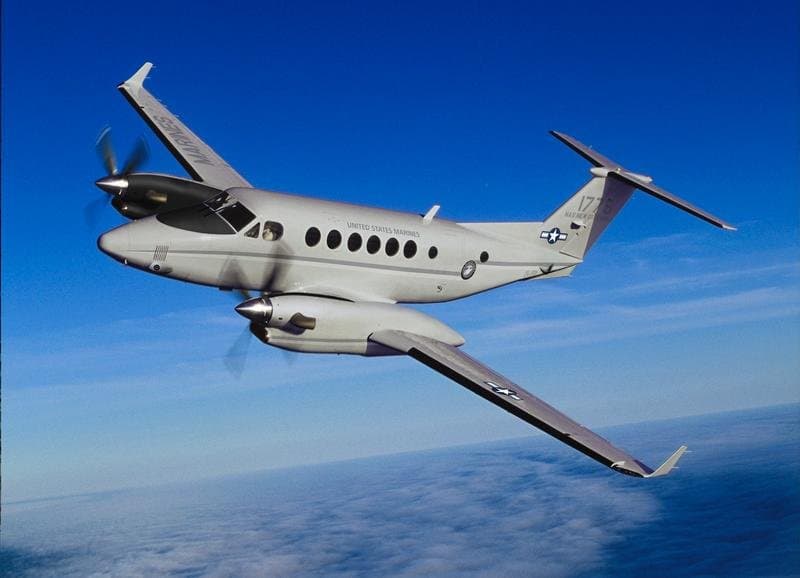

Credit
US Navy · Public domain · Resized · Public domain · Source ↗ · Modified


Preparing your view.
At a glance
True scale
Side by side. From every angle. A human reference for perspective.
3.11 MB · Loads when you open it| Model | Length | Width / span | Height |
|---|---|---|---|
| Beechcraft C-12 Huron | ≈ 13.34 m | ≈ 16.61 m (Width) | ≈ 4.6 m |
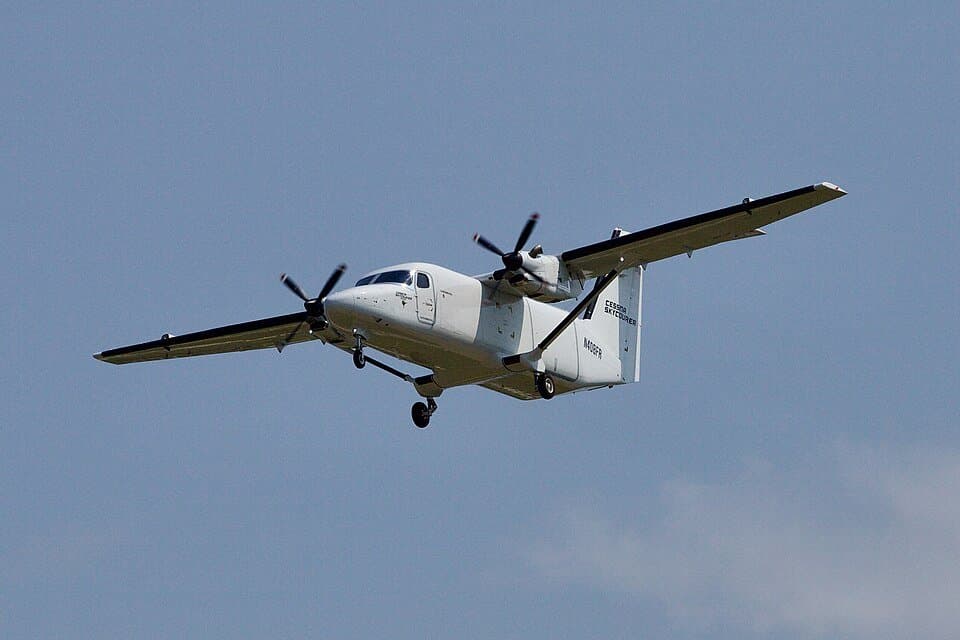
| Cessna 408 SkyCourier | ≈ 16.8 m | ≈ 22.02 m (Width) | ≈ 6.3 m |
Scaled uniformly to the sourced length of 13.34 m. The shape was turned square to the axes; the height was fitted to the sourced 4.6 m; the width was fitted to the sourced 16.61 m. Not an official model or a measured survey.
ForceTally · All rights reserved
Scaled uniformly to the sourced length of 16.8 m. The shape was turned square to the axes; the height was fitted to the sourced 6.3 m; the width was fitted to the sourced 22.02 m. Not an official model or a measured survey.
ForceTally · All rights reserved
The human reference is a generic 1.75 m figure. Models describe external size, not combat performance.
Measured figures
Beechcraft C-12 Huron · Length
Single source43 ft 9 in (13.34 m)[source]
Configuration
| Specification | Beechcraft C-12 Huron | Cessna 408 SkyCourier |
|---|---|---|
| Type | Military utility aircraft[source] | Utility aircraft[source] |
| Manufacturer | Beechcraft[source] | Cessna ( Textron Aviation )[source] |
| Status | Active service[source] | In production[source] |
| Primary users | United States Air Force United States Army United States Marine Corps United States Navy[source] |
Length
Beechcraft C-12 Huron · C-12J
Single sourceFerry; Beechcraft C-12 Huron · C-12J with maximum fuel and 45-minute reserve
Single source1,450 nmi (1,670 mi, 2,690 km) C-12J[source]
1,800 nmi (2,100 mi, 3,300 km) C-12J with maximum fuel and 45-minute reserve[source]
Ferry; Ferry range
Single sourceIFR reserves, FL100
Single sourceBeechcraft C-12 Huron · 2 × Pratt & Whitney Canada PT6A-42 turboprop engines, 850 shp ( ) each
Single source2 × Pratt & Whitney Canada PT6A-42 turboprop engines, 850 shp (630 kW) each[source]
2 × Pratt & Whitney Canada PT6A -65SC turboprop each
Single source2 × Pratt & Whitney Canada PT6A -65SC turboprop , 1,110 hp (830 kW) each[source]
Beechcraft C-12 Huron · 2,450 ft/min (
Single source2,450 ft/min (12.4 m/s)[source]
Bars compare reported quantities only. A larger figure does not make a system better; configurations and test conditions differ.
| — |
| Manufactured | 1974–present[source] | — |
|---|
| Introduction date | 1974[source] | May 9, 2022[source] |
|---|
| Developed from | Beechcraft Super King Air[source] | — |
|---|
| Variant | Beechcraft RC-12 Guardrail[source] | — |
|---|
| Capacity | 13 passengers[source] | 19 passengers/5,000 lb (2,268 kg) payload (commuter) or 3× LD3s /6,000 lb (2,722 kg) payload (cargo)[source] |
|---|
| Airfoil | root: NACA 23018 ; tip: NACA 23012[source] | — |
|---|
| Fuel capacity | 675.2 US gal (562.2 imp gal; 2,556 L) ; 1,035.2 US gal (862.0 imp gal; 3,919 L) with ferry tanks[source] | 4,826 lb (2,189 kg) / 720 gal (2,725 L)[source] |
|---|
| Propellers | 4-bladed constant-speed propellers[source] | 4-bladed McCauley Blackmac aluminum, auto feathering, reverse[source] |
|---|
| Wing loading | 41.3 lb/sq ft (202 kg/m 2 )[source] | — |
|---|
| Power/mass | 0.14 hp/lb (0.23 kW/kg)[source] | — |
|---|
| Status (TC-12B) | The Navy retired the TC-12B aircraft on 16 May 2017 after the USAF ceased sending student pilots eliminating the need for the TC-12B as the Navy's fleet of T-44C aircraft was sufficient to meet the USN, USMC and USCG multi engine pilot training need.[source]TC-12B · source-literal variant status | — |
|---|
| Source measurement | The U.S. Navy followed suit in 1979, ordering a version of the Super King Air A200C (modified with a 1.32 m by 1.32 m; 52 inch by 52 inch cargo door from the Super King Air 200C), designating it the UC-12B, for logistics support between Naval and Marine Corps air stations, air facilities, and other activities, both in CONUS and overseas. The cabin can readily accommodate cargo, passengers or both. It is also equipped to accept litter patients in medical evacuation missions. Through 1982, the Navy ordered 64 of these aircraft.[source]Beechcraft C-12 Huron · Design and development; only the objects and conditions stated in this passage The UC-12F and UC-12M are light passenger and cargo airlift versions procured for the U.S. Navy and Marine Corps from 1986 and 1987 respectively. They are based on the Super King Air 200, use PT6A-42 engines, and have a maximum takeoff weight (MTOW) of 13,500 lb (6,100 kg). They are configured as combi aircraft and are also used for multi-engine training and testing.[source]Beechcraft C-12 Huron · Design and development / UC-12F/M; only the objects and conditions stated in this passage The UC-12W is an improved version of the UC-12F/M for the Marine Corps procured from 2010 for the same missions. It is based on the Super King Air 350, uses PT6A-60A engines, and has an MTOW of 16,500 lb (7,500 kg). According to its 2022 Marine Aviation Plan, United States Marine Corps Aviation plans to phase out the Model 200-based UC-12F and UC-12M along with the Cessna UC-35D and replace them with new UC-12Ws by 2032.[source]Beechcraft C-12 Huron · Design and development / UC-12W; only the objects and conditions stated in this passage Used by the U.S. Army and U.S. Air Force for liaison and attache transport. Based on the King Air A200, with 750 shp (560 kW) PT6A-38 engines driving three-bladed propellers, and normally seating for eight passengers. 60 delivered to US Army and 30 to USAF, with one to Greek Air Force. Survivors later upgraded to C-12C standard.[source]Beechcraft C-12 Huron · Variants / King Air 200-based variants; only the objects and conditions stated in this passage U.S. Navy / U.S. Marine Corps version with an additional cargo door and powered by 850 shp (630 kW) PT6A-41 engines. Based on the King Air A200C. 66 built.[source]Beechcraft C-12 Huron · Variants / King Air 200-based variants; only the objects and conditions stated in this passage Based on C-12A but with 850 shp (630 kW) PT6A-41 engines. 14 new build aircraft for U.S. Army together with converted C-12As.[source]Beechcraft C-12 Huron · Variants / King Air 200-based variants; only the objects and conditions stated in this passage RC-12G[source]Beechcraft C-12 Huron · Variants / King Air 200-based variants; only the objects and conditions stated in this passage RC-12H[source]Beechcraft C-12 Huron · Variants / King Air 200-based variants; only the objects and conditions stated in this passage UC-12M[source]Beechcraft C-12 Huron · Variants / King Air 200-based variants; only the objects and conditions stated in this passage RC-12M[source]Beechcraft C-12 Huron · Variants / King Air 200-based variants; only the objects and conditions stated in this passage Conversion of UC-12M for range surveillance duties with AN/APS-140/504 surface search radar. Two converted.[source]Beechcraft C-12 Huron · Variants / King Air 200-based variants; only the objects and conditions stated in this passage Support aircraft for US Army based on King Air B200C, powered by 850 shp (630 kW) PT6A-42 engines driving 4-bladed propellers and with EFIS glass cockpit instrumentation. 29 built. Modifications for Global air-traffic management given designation C-12R-1 .[source]Beechcraft C-12 Huron · Variants / King Air 200-based variants; only the objects and conditions stated in this passage U.S. Army version based on the King Air 350, with seating for 8 to 15 passengers and quick cargo conversion capability.[source]Beechcraft C-12 Huron · Variants / King Air 350-based variants; only the objects and conditions stated in this passage USAF version modified for the Intelligence, Surveillance & Reconnaissance (ISR) role; originally 8 King Air 350s and 29 King Air 350ERs and ending with 42 350ERs (including one combat loss). In service since June 2009 in Iraq and Afghanistan and globally for USSOCOM. All aircraft were transferred to USSOCOM, US Army, and other US government agencies by 2015. The last MC-12W Liberty under U.S. Air Force Special Operations Command was retired in September 2025. The Royal Canadian Air Force ordered 3 similar, if not exact, variants.[source]Beechcraft C-12 Huron · Variants / King Air 350-based variants; only the objects and conditions stated in this passage Used by the U.S. Air Force's Pacific Air Forces , and Air Force Materiel Command . It carries 2 crew and 19 passengers. The C-12J is based on the Beechcraft 1900 C and carries the serials UD-1 through UD-6.[source]Beechcraft C-12 Huron · Variants / Beechcraft 1900-based variant; only the objects and conditions stated in this passage SIGINT aircraft for US Army based on King Air A200CT, with 1,200 shp (890 kW) PT-6A-67 engines driving four-bladed propellers and with increased (16,000 lb (7,260 kg) max take-off weight. Fitted with Guardrail/Common Sensor System 4 system. Nine built.[source]Beechcraft C-12 Huron · Variants / Special military variants; only the objects and conditions stated in this passage SIGINT aircraft for US Army based on King Air A200CT/C-12F airframe with 1,200 shp (890 kW) PT-6A-67 engines driving four-bladed propellers and 16,200 lb (7,350 kg) max take-off weight. Fitted with Guardrail/Common Sensor System 1 system. 15 C-12Fs converted to this standard.[source]Beechcraft C-12 Huron · Variants / Special military variants; only the objects and conditions stated in this passage SIGINT aircraft for US Army based on King Air A200CT/C-12F airframe with 1,200 shp (890 kW) PT-6A-67 engines driving four-bladed propellers and 16,200 lb (7,350 kg) max take-off weight. Fitted with Guardrail/Common Sensor System 2 system. 9 built.[source]Beechcraft C-12 Huron · Variants / Special military variants; only the objects and conditions stated in this passage Capacity: 13 passengers[source]Beechcraft C-12 Huron · Specifications (Beechcraft C-12 Huron); only the objects and conditions stated in this passage Length: 43 ft 9 in (13.34 m)[source]Beechcraft C-12 Huron · Specifications (Beechcraft C-12 Huron); only the objects and conditions stated in this passage Wingspan: 54 ft 6 in (16.61 m)[source]Beechcraft C-12 Huron · Specifications (Beechcraft C-12 Huron); only the objects and conditions stated in this passage Height: 15 ft (4.6 m)[source]Beechcraft C-12 Huron · Specifications (Beechcraft C-12 Huron); only the objects and conditions stated in this passage Wing area: 303 sq ft (28.1 m 2 )[source]Beechcraft C-12 Huron · Specifications (Beechcraft C-12 Huron); only the objects and conditions stated in this passage Empty weight: 7,755 lb (3,518 kg)[source]Beechcraft C-12 Huron · Specifications (Beechcraft C-12 Huron); only the objects and conditions stated in this passage Max takeoff weight: 12,500 lb (5,670 kg)[source]Beechcraft C-12 Huron · Specifications (Beechcraft C-12 Huron); only the objects and conditions stated in this passage Powerplant: 2 × Pratt & Whitney Canada PT6A-42 turboprop engines, 850 shp (630 kW) each[source]Beechcraft C-12 Huron · Specifications (Beechcraft C-12 Huron); only the objects and conditions stated in this passage Maximum speed: 289 kn (333 mph, 535 km/h) at 15,000 ft (4,572 m)[source]Beechcraft C-12 Huron · Specifications (Beechcraft C-12 Huron); only the objects and conditions stated in this passage Range: 1,450 nmi (1,670 mi, 2,690 km) C-12J[source]Beechcraft C-12 Huron · Specifications (Beechcraft C-12 Huron); only the objects and conditions stated in this passage Ferry range: 1,800 nmi (2,100 mi, 3,300 km) C-12J with maximum fuel and 45-minute reserve[source]Beechcraft C-12 Huron · Specifications (Beechcraft C-12 Huron); only the objects and conditions stated in this passage Service ceiling: 35,000 ft (11,000 m)[source]Beechcraft C-12 Huron · Specifications (Beechcraft C-12 Huron); only the objects and conditions stated in this passage Rate of climb: 2,450 ft/min (12.4 m/s)[source]Beechcraft C-12 Huron · Specifications (Beechcraft C-12 Huron); only the objects and conditions stated in this passage | The non- pressurized design is built from aluminium and is equipped with Pratt & Whitney Canada PT6A engines and fixed landing gear . The 19,000-pound (8,600 kg) MTOW airplane can cruise up to 210 knots (390 km/h; 240 mph), with a range of 386 nautical miles (715 km; 444 mi) with 19 passengers.[source]Cessna 408 SkyCourier · Lead; only the objects and conditions stated in this passage The Model 408 was launched on November 28, 2017, by Textron Aviation , with an introduction planned for 2020, as a FAR Part 23 type certified design. Like the earlier Cessna 208 Caravan , the 408's design was developed with FedEx Express to match the needs of FedEx Feeder service; FedEx requested an aircraft that could haul 6,000 lb (2,700 kg), twice the payload of the 208, and could accommodate entire LD3 sized unit load devices .[source]Cessna 408 SkyCourier · Development; only the objects and conditions stated in this passage The mating of the wing and fuselage of the first aircraft was completed in December 2019. By March 2020, initial ground testing was completed, checking the fuel system, engines, avionics interfaces and electrical systems. The first flight was completed on May 17, 2020, operating from Beech Factory Airport for a 2-hour and 15-minute flight. The prototype aircraft, a passenger version, along with five additional flight and ground test articles, was used for testing leading to certification. The second prototype, a freighter version which first flew in August 2020, was the first production-conforming aircraft and was used for testing the engines, propellers, environmental controls and avionics . A third test aircraft first flew in September 2020.[source]Cessna 408 SkyCourier · Development; only the objects and conditions stated in this passage By early 2022, the three test aircraft had accumulated over 2,100 flight hours as the first production aircraft for FedEx was rolled out on February 3, 2022. Cessna was aiming for certification in the first half of the year before first delivery later in 2022. Federal Aviation Administration type certification was granted on March 11, 2022, after 2,100 hours of flight tests. Certification by the National Civil Aviation Agency of Brazil was granted on August 8, 2023. Certification was awarded by the Civil Aviation Authority of the Philippines (CAAP) in August 2024, and Transport Canada Civil Aviation granted certification of the type in December 2024. |
|---|
| Country of origin | United States[source] United States[source] | — |
|---|
| National origin | — | United States[source] |
|---|
| Primary user | — | FedEx Feeder[source] |
|---|
| Number built | — | 61(February 2026)[source] |
|---|
| First flight | — | May 17, 2020[source] |
|---|
| Aspect ratio | — | 11.8[source] |
|---|
| Takeoff Distance | — | 3,660 ft (1,116 m)[source] |
|---|
| Role | — | American utility aircraft[source] |
|---|
Maximum take-off; Max takeoff weight
Single source12,325 lb (5,591 kg) , Freighter: 11,000 lb (4,990 kg)[source]
19,000 lb (8,618 kg)[source]
8,618 kg[source]
with 19 passengers, LRC
Single source386 nmi (444 mi, 715 km) with 19 passengers, LRC, 100nmi IFR reserves, FL100[source]
920 nmi (1,060 mi, 1,700 km)[source]
In February 2023, a gravel runway operations kit was approved for the aircraft. In 2023, its equipped price was $7.195M for the freighter and $7.745M for the passenger version.[source]Cessna 408 SkyCourier · Development; only the objects and conditions stated in this passage
In 2024, the price was $8.35M for the passenger variant and $7.75M for the cargo variant.[source]Cessna 408 SkyCourier · Development; only the objects and conditions stated in this passage
The SkyCourier is a twin- turboprop , high-wing, utility aircraft . It is available in a 19-passenger variant with large cabin windows and separate crew and passenger doors, or in a cargo variant sized for three LD3s and 6,000 lb (2,700 kg) of payload, featuring a "large cargo door and a flat floor cabin". Its cruise speed is up to 200 kn (370 km/h; 230 mph), with a maximum range of 900 nmi (1,700 km; 1,000 mi). It also includes a single-point refueling system which reduces turnaround times.[source]Cessna 408 SkyCourier · Design; only the objects and conditions stated in this passage
The airframe consists of traditional aluminum materials and is equipped with Pratt & Whitney Canada PT6A -65 engines, fixed landing gear and Garmin G1000 avionics. The non- pressurized cabin is 70 in (178 cm) tall and wide, with a flat floor and an 87 in (221 cm) cargo door. The cabin of the passenger version is designed for quick conversion to a freight configuration; using patented quick-release fixtures, two people can remove the passenger seats and interior bulkheads in about one hour.[source]Cessna 408 SkyCourier · Design; only the objects and conditions stated in this passage
This is an option for the passenger version which enables nine passengers to be accommodated at the front of the cabin and freight to be loaded at the rear. A freighter option allows for all-freight operation as well. It gained US FAA certification in May 2024 and the first example was delivered to Everts Air two months later.[source]Cessna 408 SkyCourier · Variants; only the objects and conditions stated in this passage
Capacity: 19 passengers/5,000 lb (2,268 kg) payload (commuter) or 3× LD3s /6,000 lb (2,722 kg) payload (cargo)[source]Cessna 408 SkyCourier · Specifications; only the objects and conditions stated in this passage
Length: 55 ft 1 in (16.80 m)[source]Cessna 408 SkyCourier · Specifications; only the objects and conditions stated in this passage
Wingspan: 72 ft 3 in (22.02 m)[source]Cessna 408 SkyCourier · Specifications; only the objects and conditions stated in this passage
Height: 20 ft 8 in (6.30 m)[source]Cessna 408 SkyCourier · Specifications; only the objects and conditions stated in this passage
Wing area: 441.0 sq ft (40.97 m 2 )[source]Cessna 408 SkyCourier · Specifications; only the objects and conditions stated in this passage
Empty weight: 12,325 lb (5,591 kg) , Freighter: 11,000 lb (4,990 kg)[source]Cessna 408 SkyCourier · Specifications; only the objects and conditions stated in this passage
Max takeoff weight: 19,000 lb (8,618 kg)[source]Cessna 408 SkyCourier · Specifications; only the objects and conditions stated in this passage
Fuel capacity: 4,826 lb (2,189 kg) / 720 gal (2,725 L)[source]Cessna 408 SkyCourier · Specifications; only the objects and conditions stated in this passage
Powerplant: 2 × Pratt & Whitney Canada PT6A -65SC turboprop , 1,110 hp (830 kW) each[source]Cessna 408 SkyCourier · Specifications; only the objects and conditions stated in this passage
Cruise speed: 210 kn (240 mph, 390 km/h) maximum[source]Cessna 408 SkyCourier · Specifications; only the objects and conditions stated in this passage
Range: 386 nmi (444 mi, 715 km) with 19 passengers, LRC, 100nmi IFR reserves, FL100[source]Cessna 408 SkyCourier · Specifications; only the objects and conditions stated in this passage
Ferry range: 920 nmi (1,060 mi, 1,700 km)[source]Cessna 408 SkyCourier · Specifications; only the objects and conditions stated in this passage
Service ceiling: 25,000 ft (7,600 m)[source]Cessna 408 SkyCourier · Specifications; only the objects and conditions stated in this passage
Takeoff Distance : 3,660 ft (1,116 m)[source]Cessna 408 SkyCourier · Specifications; only the objects and conditions stated in this passage