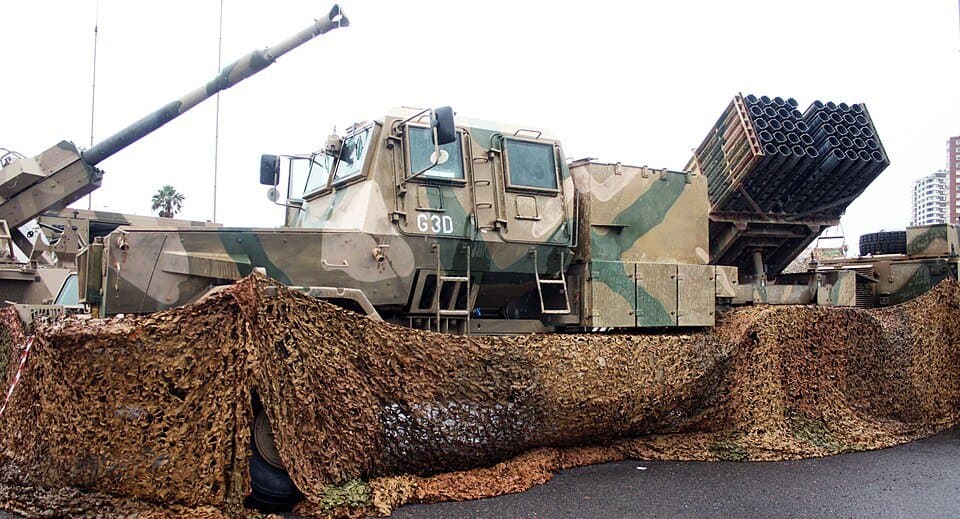

Credit
Bob Adams from Amanzimtoti, South Africa · CC BY-SA 2.0 · Resized · CC BY-SA 2.0 · Source ↗ · Modified


Preparing your view.

At a glance
Bateleur FV2larger figure on 3 of 7
Measured figures
Configuration
| Specification | Bateleur FV2 | BM-30 Smerch |
|---|---|---|
| Type | Multiple rocket launcher[source] | Multiple rocket launcher[source] |
| Place of origin | South Africa[source] | Soviet Union , Russia[source] |
| In service | 1979–present[source] | 1989–present[source] |
| Used by | South African National Defence Force[source] | See Operators[source] |
BM-30 Smerchlarger figure on 4 of 7
Counts only measures both sources give with the same scope. A larger figure is not a better system.
Length
Single source12 m (39 ft 4 in)[source]
Bars compare reported quantities only. A larger figure does not make a system better; configurations and test conditions differ.
| Designer | Denel , Somchem[source] | Splav State Research and Production Enterprise[source] |
|---|
| Cartridge | HE-Fragmentation: 2.68 m (8 ft 10 in)[source] | — |
|---|
| Barrels | 40[source] | 12[source] |
|---|
| Rate of fire | 1 per sec[source] | — |
|---|
| Transmission | ZF 56-65 Synchromesh[source] | — |
|---|
| Suspension | Kwêvoël 100 10-ton 6x6 truck[source] | 8×8 wheeled[source] |
|---|
| Role | South African self-propelled multiple rocket launcher[source] | — |
|---|
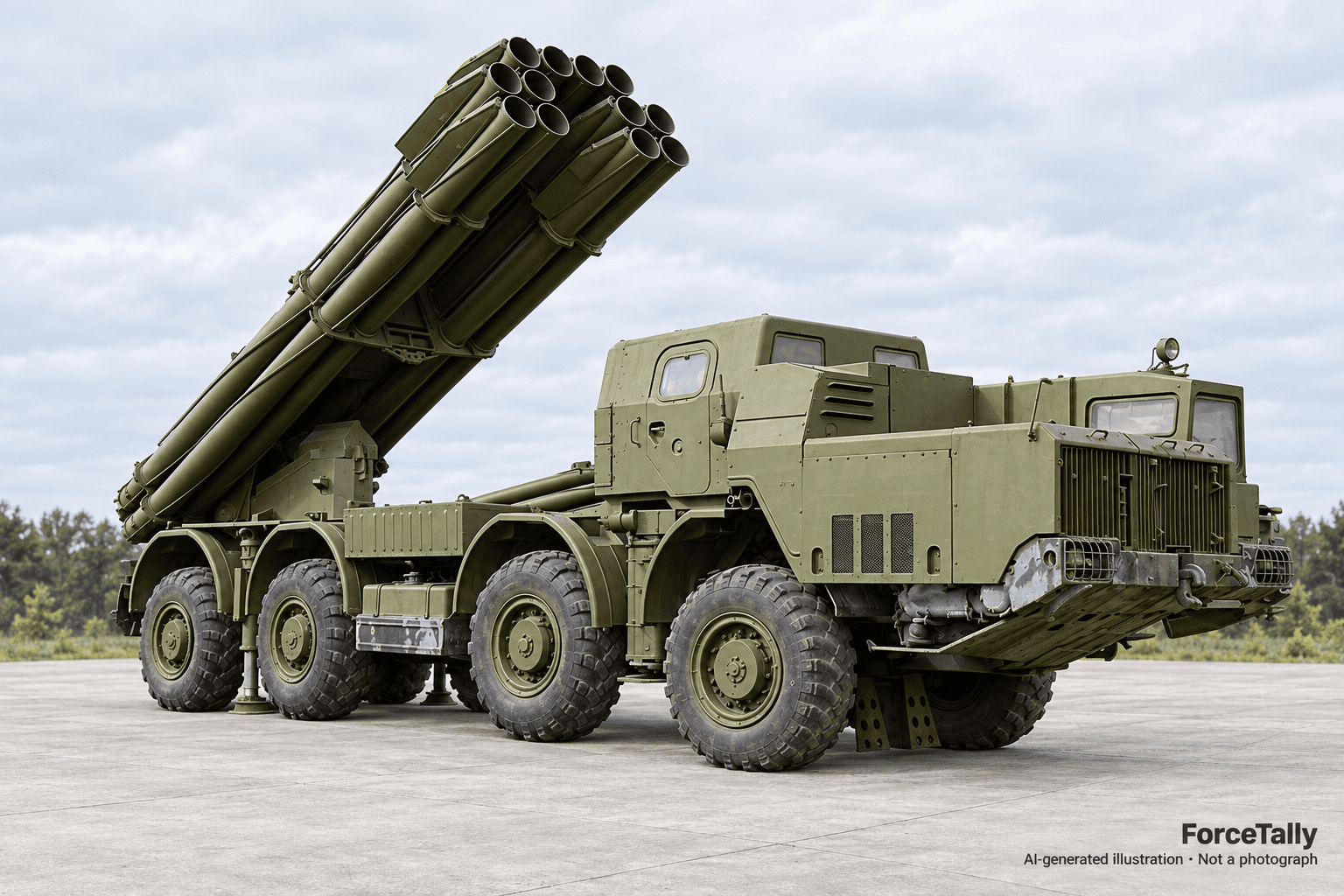
| Source measurement | The Bateleur is a South African self-propelled multiple rocket launcher . It is a 127mm system with a wheeled launcher vehicle, disposable pods, and fire control equipment developed by Denel Land Systems . Based on a mine protected Kwêvoël 100 10 ton 6x6 carrier. Its mission is to engage in counter-battery strikes against hostile artillery and air defences as far as 36 km (22 mi) away. Other potential warheads include cluster and an anti-tank mine dispenser. The weapon can fire up to 40 127mm pre-fragmented high explosive warheads to ranges of 7.5 km to 36 km at sea level singly or using ripple fire, firing up to 1 rocket per second. Reload can take less than 10 minutes and in/out-of-action time is one and two minutes respectively. The system is supported by a Kwêvoël 100 ammunition truck carrying 96 rockets and crew who help with the reloading.[source]Bateleur FV2 · Lead; only the objects and conditions stated in this passage Modified version to fire 122mm rockets[source]Bateleur FV2 · Variants; only the objects and conditions stated in this passage | The BM-30 Smerch ( Russian : Смерч , lit. ' tornado ' , 'whirlwind'), 9K58 Smerch or 9A52-2 Smerch-M is a heavy self-propelled 300 mm multiple rocket launcher designed in the Soviet Union to fire a full load of 12 solid-fuelled projectiles. The system is intended to defeat personnel, armored, and soft targets in concentration areas, artillery batteries, command posts and ammunition depots . It was designed in the early 1980s and entered service in the Soviet Army in 1989. When first observed by the West in 1983, it received the code MRL 280mm M1983 . It continues in use by Russia; a program to replace it with the Tornado-S began in 2018.[source]BM-30 Smerch · Lead; only the objects and conditions stated in this passage The first confirmed combat uses of the Smerch were in two war zones in 2014. Syrian military forces used the system against rebel forces during the Syrian civil war , including in fighting in Jobar . It was also used by Russia-backed militants to deliver explosive and cluster munitions to Ukrainian military positions and likewise by the Ukrainian Army. Several have been seen in use by pro-Russian rebels. The Russian Ground Forces used the BM-30 in Syria in October 2015 during the Russian intervention in Syria .[source]BM-30 Smerch · Operational history; only the objects and conditions stated in this passage TZM 9T234-2 Transloader with an 850 kg crane and 12 spare rockets[source]BM-30 Smerch · Components; only the objects and conditions stated in this passage 300mm rockets with a firing range of 70 and 90 km and various warheads have been developed for the Smerch MLRS.[source]BM-30 Smerch · Components; only the objects and conditions stated in this passage Chassis: MAZ-543M or MAZ-79111[source]BM-30 Smerch · General characteristics; only the objects and conditions stated in this passage Launch Rate Salvo Time: 12 rounds in 38 seconds[source]BM-30 Smerch · General characteristics; only the objects and conditions stated in this passage 9A52-2 – Modified variant on MAZ-543M truck.[source]BM-30 Smerch · Variants; only the objects and conditions stated in this passage PHL-03 – Chinese development of the PHL96 with 150 km range. The PHL03 is a highly digitized PHL96 with a computerized fire control system (FCS) incorporating GPS/GLONASS, similar to that of the Type 90A SPMRL , with a four-man crew (compared with three for the BM-30/PHL96), which entered service around 2004–2005, only a year or two after its predecessor, the PHL96. As with the PHL96, the PHL03 is not exactly a guided SPMRL because it is the submunitions that are guided, not the rockets themselves.[source]BM-30 Smerch · Similar systems; only the objects and conditions stated in this passage |
|---|
| Manufacturer | Denel (rocket launcher), Truckmakers (chassis).[source]Fact file: Denel FV2 Bateleur Multiple Launch Rocket System (MLRS) | Splav State Research and Production Enterprise[source] |
|---|
| Armament | 40 barrel MLRS. Fires up to 40 127mm pre-fragmented high explosive warheads from 7.5km to 36km at sea level singly or using ripple fire, firing 1 rocket per second, reload less than 10mins. In/out action: 1 and 2 minutes.[source]Fact file: Denel FV2 Bateleur Multiple Launch Rocket System (MLRS) | — |
|---|
| Main armament | 40×127 mm-Raketen[source] | 9M55 or 9M528 rockets[source] |
|---|
| Wars | — | Second Chechen War War in Donbas Syrian Civil War Second Nagorno-Karabakh War Russo-Ukrainian war[source] |
|---|
| Designed | — | 1980s[source] |
|---|
| Produced | — | 1989–present[source] |
|---|
| Variants | — | See Variants[source] |
|---|
| Former operator · Soviet Union | — | Soviet Union[source] |
|---|
| Reported operators |
|---|
Maximum; 9M544 rocket
Single source