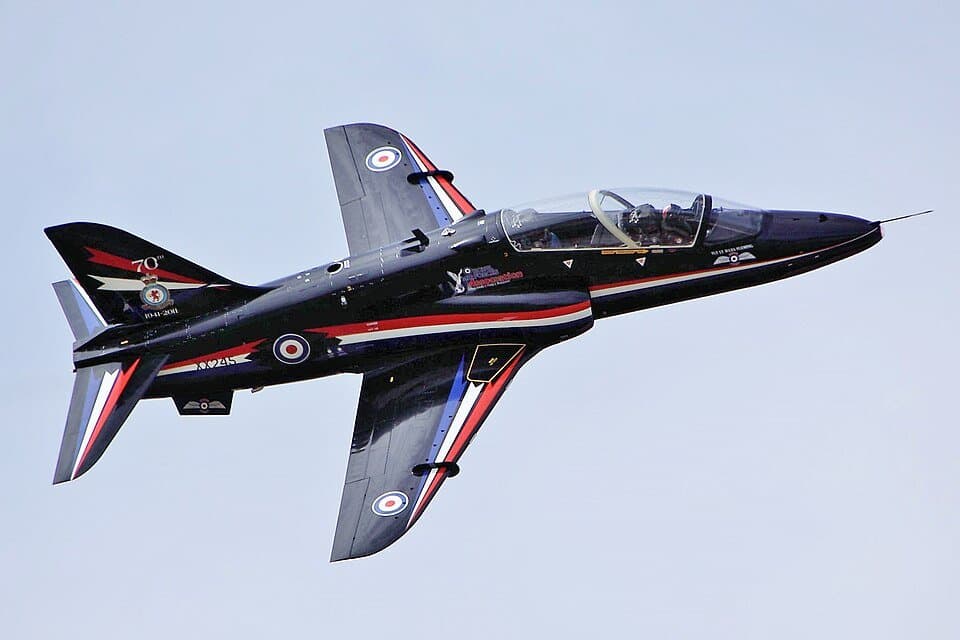

Credit
Tim Felce (Airwolfhound) · CC BY-SA 2.0 · Resized · CC BY-SA 2.0 · Source ↗ · Modified


Preparing your view.

At a glance
True scale
Side by side. From every angle. A human reference for perspective.
3.23 MB · Loads when you open it| Model | Length | Width / span | Height |
|---|---|---|---|
| BAE Systems Hawk | ≈ 12.43 m | ≈ 9.94 m (Wingspan) | ≈ 4.53 m |
| Pilatus PC-9 | ≈ 10.14 m | ≈ 10.12 m (Wingspan) | ≈ 3.26 m |
Scaled uniformly to the sourced length of 12.43 m. The width was fitted to the sourced 9.94 m wingspan. Not an official model or a measured survey.
ForceTally · All rights reserved
Scaled uniformly to the sourced length of 10.14 m. The shape was turned square to the axes; the height was fitted to the sourced 3.26 m; the width was fitted to the sourced 10.125 m wingspan. Not an official model or a measured survey.
ForceTally · All rights reserved
The human reference is a generic 1.75 m figure. Models describe external size, not combat performance.
Measured figures
Hawk 128 · Length
Single source12.43 m (40 ft 9 in)[source]
Configuration
| Specification | BAE Systems Hawk | Pilatus PC-9 |
|---|---|---|
| Crew | 2: student, instructor[source] | one or two pilots[source] |
| Type | Advanced trainer aircraft[source] | Basic/advanced trainer aircraft[source] |
| National origin | United Kingdom[source] | Switzerland[source] |
| Manufacturer | Hawker Siddeley (1974–1977) British Aerospace (1977–1999) BAE Systems MAI division (1999–2022) Hindustan Aeronautics Limited (2008–present)[source] |
PC-9M · Length
10.14 m (33 ft 3 in)[source]
Maximum; Hawk 128 · ) at altitude
Single sourceMaximum; Hawk 128 · Mach 0.84 (
Single sourceMaximum; Hawk 128 · Maximum speed
Single sourceMach 0.84 (1,028 km/h, 639 mph, 555 kn) at altitude[source]
Cruise; PC-9M · at 7,620 m (25,000 ft)
Single sourceMaximum; PC-9M · Maximum speed
Single sourcePC-9M · 1 × Pratt & Whitney Canada PT6A -62 turboprop flat-rated at
Single sourcePC-9M · 950 shp
Single source1 × Pratt & Whitney Canada PT6A -62 turboprop, 857 kW (1,149 hp) flat-rated at 708 kW (950 shp)[source]
Hawk 128 · 1× Rolls-Royce Turbomeca Adour Mk. 951 turbofan with FADEC
Single sourceHawk 128 · Powerplant
Single source1× Rolls-Royce Turbomeca Adour Mk. 951 turbofan with FADEC , 29 kN (6,500 lbf ) 29 kN[source]
Hawk 128 · Up to of weapons on five hardpoints, including
Single sourceUp to 6,800 lb (3,085 kg) of weapons on five hardpoints, including:[source]
PC-9M · four hours and
Single sourcefour hours and 30 minutes[source]
Bars compare reported quantities only. A larger figure does not make a system better; configurations and test conditions differ.
Pilatus Aircraft[source] |
| Status | In service[source] | Active service[source] |
|---|
| Primary users | Royal Air Force Indian Air Force Royal Saudi Air Force Royal Australian Air Force South African Air Force[source] | Swiss Air Force Slovenian Air Force and Air Defence Royal Saudi Air Force Royal Thai Air Force Irish Air Corps[source] |
|---|
| Number built | 1,000+[source] | 265[source] |
|---|
| Manufactured | 1974–present[source] | 1984–present[source] |
|---|
| Introduction date | 1976[source] | — |
|---|
| First flight | 21 August 1974[source] | 7 May 1984[source] |
|---|
| Developed into | British Aerospace Hawk 200 McDonnell Douglas T-45 Goshawk[source] | T-6 Texan II[source] |
|---|
| Useful load | 3,000 kg (6,600 lb)[source] | — |
|---|
| Never exceed speed | Mach 1.2 (in dive)[source] | — |
|---|
| Thrust/weight | 0.65[source] | — |
|---|
| Hardpoints | Up to 6,800 lb (3,085 kg) of weapons on five hardpoints, including:[source] | seven hardpoints, 3 under each wing, inner two rated at 250 kg (550 lb), outer rated at 110 kg (240 lb)[source] |
|---|
| Role | British single-engine, subsonic, jet-powered advanced trainer aircraft[source] | — |
|---|
| Source measurement | Operators of the Hawk include the Royal Air Force (notably the Red Arrows display team) and several foreign military operators. The Hawk was produced at BAE Brough until 2020 in the UK, and continues to be produced under licence in India by Hindustan Aeronautics Limited (HAL), with over 1000 Hawks sold to 18 operators around the world.[source]BAE Systems Hawk · Lead; only the objects and conditions stated in this passage The prototype aircraft XX154 first flew on 21 August 1974 from Dunsfold piloted by Duncan Simpson , Chief Test Pilot of HSA (Kingston), reaching 20,000 ft in a flight lasting 53 minutes. All development aircraft were built on production jigs; the program remained on time and to budget throughout. The Hawk T1 entered RAF service in late 1976. The first export Hawk 50 flew on 17 May 1976. This variant had been specifically designed for the dual role of lightweight fighter and advanced trainer; it had a greater weapons capacity than the T.1.[source]BAE Systems Hawk · Development / Origins; only the objects and conditions stated in this passage The Hawk was designed to be manoeuvrable and can reach Mach 0.88 in level flight and Mach 1.15 in a dive, thus allowing trainees to experience transonic flight before advancing to a supersonic trainer. The airframe is very durable and strong, stressed for +9 g ; the normal limit in RAF service is +7.5/-4 g. A dual hydraulic system supplies power to operate systems such as the aircraft's flaps, airbrakes and landing gear, together with the flight controls. A ram air turbine is fitted in front of the single tail fin to provide backup hydraulic power for the flight controls in the event of an engine failure; additionally, a gas turbine auxiliary power unit is housed directly above the engine.[source]BAE Systems Hawk · Design; only the objects and conditions stated in this passage The Hawk is designed to carry a centreline gun pod, such as the 30 mm ADEN cannon , two under-wing pylons, and up to four hardpoints for fitting armaments and equipment. In RAF service, Hawks have been equipped to operate the Sidewinder air-to-air missiles . In the early 1990s, British Aerospace investigated the possibility of arming the Hawk with the Sea Eagle anti-ship missile for export customers. In 2016, BAE Systems was developing the so-called 'Advanced Hawk' with a new wing using leading-edge slats , and potentially additional sensors and weapons, a head-mounted display , and a single large-screen display in the forward cockpit.[source]BAE Systems Hawk · Design; only the objects and conditions stated in this passage From 1983 to 1986, some Hawks were equipped as short-range interceptor aircraft . 88 T1s were modified to carry two AIM-9L Sidewinder air-to-air missiles in addition to a 30 mm ADEN cannon gun pod ; these aircraft were redesignated as Hawk T1A . In a wartime scenario, they would have worked in collaboration with the RAF's Tornado F3 interceptors, which would use their Foxhunter search radars and more sophisticated navigation systems to vector the Hawks against enemy targets.[source]BAE Systems Hawk · Operational history / United Kingdom; only the objects and conditions stated in this passage Seven additional Mk. 51As were delivered in 1993–94 to make up for losses. In June 2007, Finland arranged to purchase 18 used Hawk Mk. 66s from the Swiss Air Force for 41 million euros; they were delivered in 2009–2010. Finnish Hawks have reportedly been armed with Soviet Molniya R-60 /AA-8 as well as with AIM-9J and AIM-9M air-to-air missiles, Matra Type 155 SNEB rocket pods, unspecified British general-purpose bombs of multiple types, VKT 12.7 mm machine gun pods and Royal Small Arms Factory 30 mm ADEN autocannon pods. The Finnish Air Force aerobatics team, the Midnight Hawks , also uses the aircraft.[source]BAE Systems Hawk · Operational history / Finland; only the objects and conditions stated in this passage Due to rising levels of metal fatigue, a major structural reinforcement program was carried out to extend the operational life of Finland's Hawks during the 1990s. Due to lifespan limitations, 41 out of 67 in Finland's total Hawk fleet were taken out of service between 2012 and 2016; the remaining aircraft are younger and thus are expected to be flying into the 2030s. In 2011, Finnish Mk. 51s and Mk. 66s underwent a series of upgrades performed by Patria , these included the adoption of a new Cockpit 4000 glass cockpit , new software, and other life-extending modifications. This upgrade program was completed in 2013.[source]BAE Systems Hawk · Operational history / Finland; only the objects and conditions stated in this passage The Hawk fleet is based at IAF's Bidar Air Force Station in north Karnataka, about 700 km from Bangalore. As of 2015, a total of 123 aircraft were on order by the Indian Air Force and 17 by the Indian Navy, with an additional order of 20 aircraft were under negotiation.[source]BAE Systems Hawk · Operational history / India; only the objects and conditions stated in this passage Hawk 53 – Export version for the Indonesian Air Force . Eight ordered 4 April 1978, with five more ordered in May 1981, a further three in October 1981 and four in November 1982, giving a total of 20 delivered between 1980 and 1984. Five repurchased by BAE Systems in 1999.[source]BAE Systems Hawk · Variants / Hawk 50; only the objects and conditions stated in this passage Another export version, replacing the Hawk 50, intended for conversion and weapons training. Weapons carriage is increased. It is a two-seater, has uprated Rolls-Royce Adour 861 engines, and is capable of a level speed at altitude of 555 knots (1028 km/h) or Mach 0.84. The T-45 Goshawk was derived from this version.[source]BAE Systems Hawk · Variants / Hawk 60; only the objects and conditions stated in this passage The Royal Australian Air Force ordered 33 Hawk 127 Lead-in Fighter Trainers (LIFTs) in June 1997, 12 of which were produced in the UK and 21 in Australia. This variant is also powered by the Adour 871. The Hawk 127 is operated by the RAAF's No. 76 Squadron and No. 79 Squadron , which are based at RAAF Base Williamtown and RAAF Base Pearce respectively. Work to upgrade the RAAF's Hawks to a standard similar to the Hawk 128 standard began in 2014, and it is planned that the two squadrons will begin operations with these aircraft in 2017. The RAAF's Hawk fleet has been upgraded to Hawk 128 standard under the Lead-In Fighter Capability Assurance Program (LIFCAP).[source]BAE Systems Hawk · Variants / Hawk 127; only the objects and conditions stated in this passage The Advanced Hawk is a joint venture by BAE Systems and Hindustan Aeronautics Limited (HAL) to upgrade the IAF's existing Hawk 132 AJT into an Advanced Transonic Fighter Trainer, which can be used for combat operations. A single prototype of the aircraft was unveiled at Aero India 2017 in Bangalore , from 14-18 February 2017. It made its first flight with the IAF in June 2017.[source]BAE Systems Hawk · Variants / Advanced Hawk (Hawk-i); only the objects and conditions stated in this passage On 1 April 2018, a BAE Hawk Mk 166 crashed on landing at RAFO Masirah , Oman, killing the student pilot and one person on the ground; only the flight instructor survived with serious injuries.[source]BAE Systems Hawk · Accidents and incidents; only the objects and conditions stated in this passage Length: 12.43 m (40 ft 9 in)[source]BAE Systems Hawk · Specifications (Hawk 128); only the objects and conditions stated in this passage Wingspan : 9.94 m (32 ft 7 in)[source]BAE Systems Hawk · Specifications (Hawk 128); only the objects and conditions stated in this passage Height: 3.98 m (13 ft 1 in)[source]BAE Systems Hawk · Specifications (Hawk 128); only the objects and conditions stated in this passage Wing area: 16.70 m 2 (179.64 ft 2 )[source]BAE Systems Hawk · Specifications (Hawk 128); only the objects and conditions stated in this passage Empty weight: 4,480 kg (9,880 lb)[source]BAE Systems Hawk · Specifications (Hawk 128); only the objects and conditions stated in this passage Useful load: 3,000 kg (6,600 lb)[source]BAE Systems Hawk · Specifications (Hawk 128); only the objects and conditions stated in this passage Max takeoff weight : 9,100 kg (20,000 lb)[source]BAE Systems Hawk · Specifications (Hawk 128); only the objects and conditions stated in this passage Powerplant: 1× Rolls-Royce Turbomeca Adour Mk. 951 turbofan with FADEC , 29 kN (6,500 lbf ) 29 kN[source]BAE Systems Hawk · Specifications (Hawk 128); only the objects and conditions stated in this passage Maximum speed : Mach 0.84 (1,028 km/h, 639 mph, 555 kn) at altitude[source]BAE Systems Hawk · Specifications (Hawk 128); only the objects and conditions stated in this passage Range : 2,520 km (1,360 nmi , 1,565 mi)[source]BAE Systems Hawk · Specifications (Hawk 128); only the objects and conditions stated in this passage Service ceiling : 13,565 m (44,500 ft)[source]BAE Systems Hawk · Specifications (Hawk 128); only the objects and conditions stated in this passage Rate of climb : 47 m/s (9,300 ft/min)[source]BAE Systems Hawk · Specifications (Hawk 128); only the objects and conditions stated in this passage 1× 30 mm ADEN cannon , in centreline pod[source]BAE Systems Hawk · Specifications (Hawk 128); only the objects and conditions stated in this passage Up to 6,800 lb (3,085 kg) of weapons on five hardpoints, including: 4× AIM-9 Sidewinder or ASRAAM or A-Darter on wing pylons and wingtip rails 2x Umbani or Al Tariq Smart Anti-Airfield Weapon[source]BAE Systems Hawk · Specifications (Hawk 128); only the objects and conditions stated in this passage 1,500 lb (680 kg), limited to one centreline and two wing pylons (Hawk T1)[source]BAE Systems Hawk · Specifications (Hawk 128); only the objects and conditions stated in this passage | — |
|---|
| Developed from | — | Pilatus PC-7[source] |
|---|
| Stall speed | — | 143 km/h (89 mph, 77 kn) EAS flaps and gear up, 128 km/h (80 mph; 69 kn) flaps and gear down[source] |
|---|
| g limits | — | + 7.0 g to −3.5 g[source] |
|---|
| Take-off distance over 50 ft (15 m) obstacle at sea level | — | 1,280 ft (391 m)[source] |
|---|
| Landing distance over 50 ft (15 m) obstacle at sea level | — | 2,295 ft (700 m)[source] |
|---|
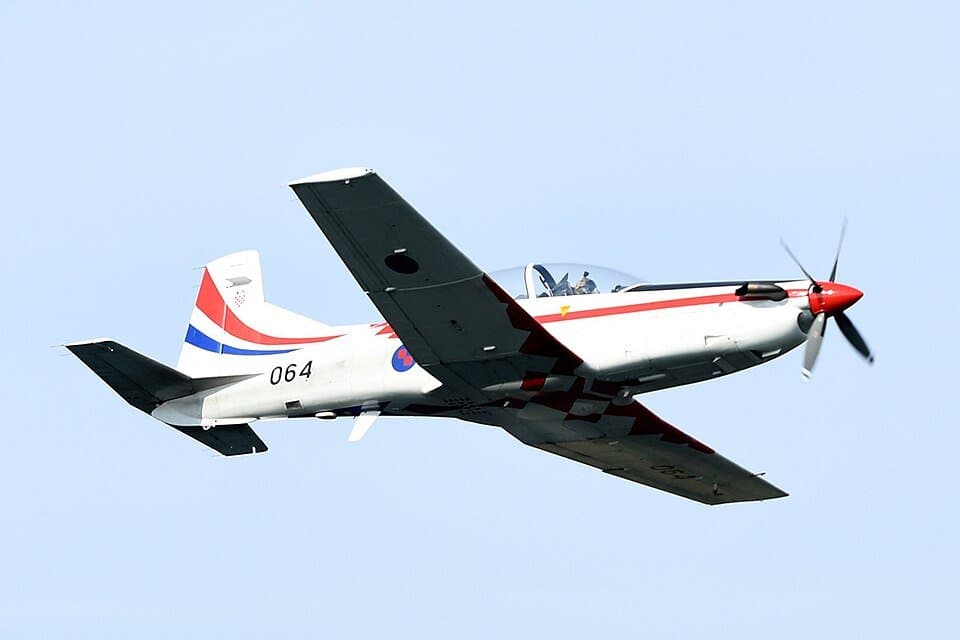
Maximum take-off; PC-9M · A view of the interior of the cockpit of a Pilatus PC-9 aircraft
Single source