
FORCETALLY
Loading the evidence…
Preparing your view.


Preparing your view.


BCruise & anti-ship missiles
long-range fire-and-forget surface-to-surface and air-to-surface anti-ship missile
At a glance
Babur (cruise missile)larger figure on 3 of 3
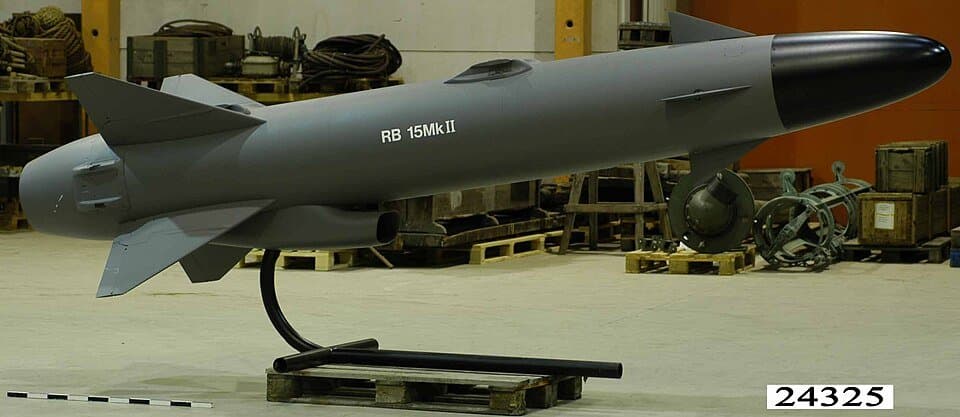
RBS 15larger figure on 0 of 3
Counts only measures both sources give with the same scope. A larger figure is not a better system.
Measured figures
Length
Single source6.2 m (20 ft)[source]
Length
Single sourceConfiguration
| Specification | Babur (cruise missile) | RBS 15 |
|---|---|---|
| Type | GLCM / SLCM / AshM[source] | RBS 15 Mk1: Anti-ship cruise missile ( air-launched and ship-launched ) RBS 15 Mk2: Anti-ship cruise missile ( ship-launched and coastal defence truck-launched ) RBS 15 Mk3: Anti-ship cruise missile and land-attack cruise missile ( ship-launched and coastal defence truck-launched ) RBS 15 Mk4: Anti-ship cruise missile and land-attack cruise missile ( air-launched , ship-launched and coastal defence truck-launched )[source] |
| In service | 2010 –Present[source] | 1984–present[source] |
| Used by | Pakistan Army ( Army Strategic Forces ) Pakistan Navy ( Navy Strategic Forces )[source] | See Operators[source] |
| Designer | National Defence Complex |
4,350 mm (14 ft 3 in)[source]
Mass
Single source1,500 kg (3,300 lb)[source]
RBS 15 Mk1 in flight
Single sourceRBS 15 Mk1 with boosters
Single sourceRBS 15 Mk2 in flight
Single sourceRBS 15 Mk2 with boosters
Single sourceRBS 15 Mk3 in flight
Single sourceRBS 15 Mk3 with boosters
Single sourceRBS 15 Mk4 in flight
Single sourceRBS 15 Mk4 with boosters
Single sourceRBS 15 Mk1: 746 kg (1,645 lb) (with boosters) 568 kg (1,252 lb) (in flight) RBS 15 Mk2: 755 kg (1,664 lb) (with boosters) 577 kg (1,272 lb) (in flight) RBS 15 Mk3: 820 kg (1,810 lb) (with boosters) 660 kg (1,460 lb) (in flight) RBS 15 Mk4: 810 kg (1,790 lb) (with boosters) 650 kg (1,430 lb) (in flight)[source]
Maximum; Maximum firing range
Single sourceOperational; Babur-I
Single sourceOperational; Babur-IA
Single sourceOperational; Babur-IB
Single sourceOperational; Babur-II
Single sourceOperational; Babur-III
Single sourceOperational; Harbah
Single sourceOperational; Harbah export variant
Single source900 km (560 mi)[source]
Babur-I: 700 km (430 mi) Babur-IA: 450 km Babur-II: 750 km (470 mi) Babur-III: 450 km (280 mi; 240 nmi) Harbah: 700 km (430 mi; 380 nmi) Babur-IB: 900 km (560 mi) Harbah export variant: 290 km (180 mi; 160 nmi)[source]
Operational; RBS 15 Mk1
Single sourceOperational; RBS 15 Mk2
Single sourceWarhead weight
Single source450 kg (990 lb) – 500 kg (1,100 lb)[source]
Bars compare reported quantities only. A larger figure does not make a system better; configurations and test conditions differ.
| — |
| Designed | 1998–2008 (GLCM) 2001–2018 (SLCM)[source] | — |
|---|
| Manufacturer | National Defence Complex[source] | Saab Bofors Dynamics , Diehl Defence[source] |
|---|
| Developed from | BGM-109 Tomahawk[source] | — |
|---|
| Variants | See variants[source] | — |
|---|
| Warhead | HE / NE[source] | 200 kg (440 lb) HE blast and pre-fragmented warhead[source] |
|---|
| Blast yield | 5 kilotons of TNT (21 TJ) – 12 kilotons of TNT (50 TJ)[source] | — |
|---|
| Engine | Turbojet[source] | Turbojet[source] |
|---|
| Transmission | Automatic[source] | — |
|---|
| Suspension | WS2500 10WD[source] | — |
|---|
| Propellant | Liquid-propellant (jet engine) Solid-propellant (booster)[source] | — |
|---|
| Flight altitude | Terrain-following[source] | Sea skimming[source] |
|---|
| Guidance system | INS , TERCOM / DSMAC , GPS , GLONASS , Terminal ,[source] | RBS 15 Mk1: 70 km (43 mi) Navigation: INS Target homing: J-band pulse radar RBS 15 Mk2: 100 km (62 mi) Navigation: INS Target homing: J-band pulse radar RBS 15 Mk3: > 200 km (120 mi) Navigation: INS + GPS , multiple 3D waypoints Target homing: J-band active radar homing with ECCM + RBS 15 Mk4: > 300 km (190 mi) Navigation: INS + anti-jam GPS , multiple 3D waypoints Target homing: J-band active digital radar homing[source] |
|---|
| Accuracy | 20 m (66 ft) CEP[source] | — |
|---|
| Launch platform | Transporter erector launcher Cruise-missile submarine[source] | Naval ships , aircraft and land-based missile launchers[source] |
|---|
| Transport | TEL , Horizontal launch tube (HLT)[source] | — |
|---|
| Country of origin | Pakistan[source] | — |
|---|
| Place of origin | — | Sweden Germany[source] |
|---|
| Detonation mechanism | — | Impact or proximity[source] |
|---|
| Role | — | long-range fire-and-forget surface-to-surface and air-to-surface anti-ship missile[source] |
|---|
| Source measurement | — | The Swedish Navy earlier made the RB 08 anti-ship missiles with the Halland-class destroyers in the early 1960s. The main effect of Sweden's defence resolution of 1958 for the Swedish navy was restructuring into a lighter force consisting of fast attack craft (FAC) vessels - mainly the Norrköping-class missile boat - and a halt to destroyer procurement. This posed a problem as the existing RB 08 missile required launch rails and a missile magazine in the destroyers, taking up space that was not available in smaller ships. Adding to the problems, each missile had to be individually prepared for launch and only two missiles could be on the launch rails at the same time. In comparison, the P-15 Termit (NATO codename Styx) missile used by the Soviet Union from the late 1950s (which was the expected adversary of RBS 15) stored the missiles in individual containers on deck with the missiles immediately available for launch. Tests were carried out on Plejad class FACs with a single bow-mounted RB 08 in the late 1960s, but they came to nothing.[source]RBS 15 · History; only the objects and conditions stated in this passage Development of the RBS 15 Mk. III began in the mid-1990s. It is produced by Saab in co-operation with Diehl Defence of Germany. Emphasis was put on increased range (due to larger fuel capacity and new fuel the range has been increased to some 200 km), improved accuracy (integrated GPS) and selectable priority targeting, which improved the weapon system's flexibility. The Mk. III was selected for the German Navy 's Braunschweig -class corvettes . Finnish truck maker Sisu produces missile launch trucks for RBS 15. The Mk. III has been in production since 2004.[source]RBS 15 · History; only the objects and conditions stated in this passage Propulsion: Turbojet engine: Microturbo TRI 60-2 077 , with a 3.7 kN (830 lbf) thrust. 2 × solid-fuel rocket boosters (for surface launched variants)[source]RBS 15 · Variants / RBS15 - first generation; only the objects and conditions stated in this passage Propulsion: Turbojet engine: Microturbo TRI 60-2 277 , with a 3.7 kN (830 lbf) thrust. 2 × solid-fuel rocket boosters (for surface launched variants)[source]RBS 15 · Variants / RBS15 - second generation; only the objects and conditions stated in this passage Coastal defence: RBS-15 SF-3 MTO 85M ( Meritorjuntaohjus 1985M, Finland), modernised variant of the coastal defence system, equipped with the RBS-15 SF-3 missile. They use new missile and refurbished Mk2 missiles. Saab CDMS (Coastal Defence Missile System) , using the same missile as the ship-launched RBS15 Mk3, and will be able to launch the future RBS15 generation.[source]RBS 15 · Variants / RBS15 - third generation; only the objects and conditions stated in this passage Propulsion: Turbojet engine: Microturbo TRI 60-5 , with a 4.4 kN (990 lbf) thrust. 2 × solid-fuel rocket boosters (for surface launched variants)[source]RBS 15 · Variants / RBS15 - third generation; only the objects and conditions stated in this passage Primary weapon of the Croatian Navy for its five guided missile boats and three coastal systems mounted on Tatra trucks. In total, 48 Mk.I units are in service. Plans for upgrading 21 missiles to a standard incorporating elements from both the Mk.II and the Mk.III versions was cancelled in 2009 due to budget restraints but light software upgrades were continuously executed and have improved the missiles' navigation, precision and electronic defence. The latest of this upgrades was conducted in 2010 as part of usual service works. Unexpectedly though, in August 2014 the Croatian government decided to send at least 20 Croatian RBS 15 missiles through an overhaul program so as to keep them operational and current for another 10 years. The missiles are to receive upgrades to increase their range to about 90–100 km as well as to improve their guidance, precision and survivability against jamming. The missiles were successfully launched and destroyed their targets in live fire naval exercises in 2015, 2016 and 2018.[source]RBS 15 · Operators / Current operators / Ship-launched missiles; only the objects and conditions stated in this passage MTO 85M coastal defence command vehicle Finnish MTO-85M launch vehicle The Finnish Navy purchased the RBS15 Mk2 in the ship-launched version, and the RBS15 SF, the coastal defence variant. The missile was ordered in 1983, and locally designed as the MTO 85 ( Meritorjuntaohjus 1985, Finland). It succeeded to the MTO-66 (P-15 Termit) .[source]RBS 15 · Operators / Current operators / Ship-launched missiles; only the objects and conditions stated in this passage In 2001, Finland ordered the RBS15 Mk3 to Saab (also known as the MTO 85M, or the RBS15 SF3), for a contract worth SEK 500 million. This contract includes the modernisation of existing missiles and the purchase of new ones.[source]RBS 15 · Operators / Current operators / Ship-launched missiles; only the objects and conditions stated in this passage In 2003, Finland selected this MTO 85M missile to equip its new Hamina -class missile boat .[source]RBS 15 · Operators / Current operators / Ship-launched missiles; only the objects and conditions stated in this passage The Finnish Navy is progressively retiring RBS15 missiles and missile systems. The MTO 85M will remain in service with the Rauma -class missile boats until their retirement, when replaced by the Pohjanmaa -class corvettes .[source]RBS 15 · Operators / Current operators / Ship-launched missiles; only the objects and conditions stated in this passage The MTO 85 and MTO 85M are partially phased out in Finland.[source]RBS 15 · Operators / Current operators / Ship-launched missiles; only the objects and conditions stated in this passage Ships: Hamina -class missile boat : MLU on the ship, it includes the replacement of the 6 × RBS-15 SF III (MTO 85M) with the Gabriel V missile (PTO2020) missiles.[source]RBS 15 · Operators / Current operators / Ship-launched missiles; only the objects and conditions stated in this passage |
|---|
Operational; RBS 15 Mk2 RBS 15 Mk3: >
Single sourceOperational; RBS 15 Mk2 RBS 15 Mk4: >
Single sourceRBS 15 Mk1: 70 km (43 mi) RBS 15 Mk2: 100 km (62 mi) RBS 15 Mk3: > 200 km (120 mi) RBS 15 Mk4: > 300 km (190 mi)[source]