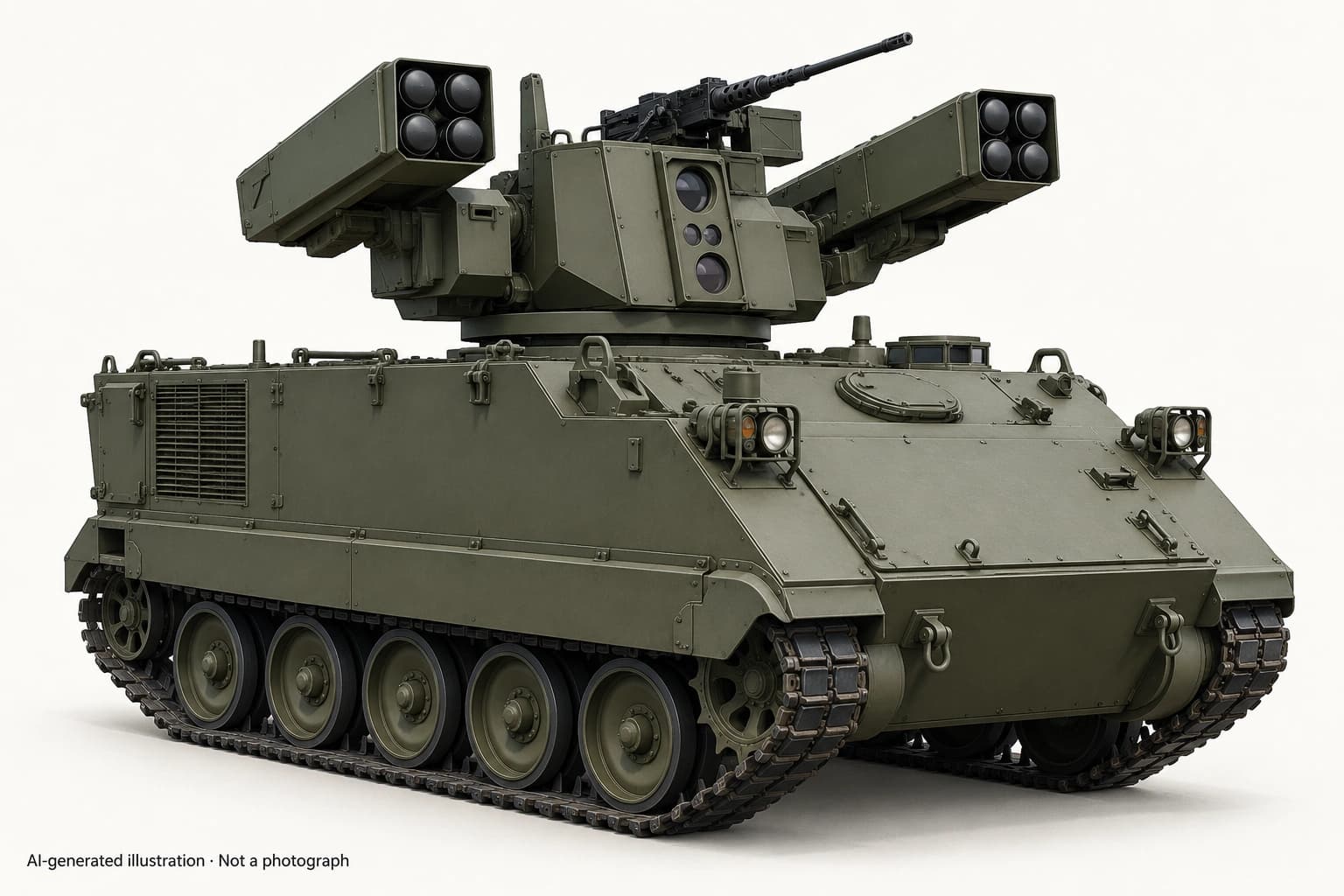
Development began in 1963 as a study by Nord Aviation of France and Bölkow of Germany with the system then called SABA in France and P-250 in Germany.[source]Roland (missile) · Development; only the objects and conditions stated in this passage The Roland SAM system was designed to engage enemy air targets flying at speeds of up to Mach 1.3 at altitudes between 20 meters and 5,500 meters with a minimum effective range of 500 meters and a maximum of 6,300 meters. The system can operate in optical or radar mode and can switch between these modes during an engagement. A pulse-doppler search radar with a range of 15–18 km detects the target which can then be tracked either by the tracking radar or an optical tracker. The optical channel would normally be employed only in daylight against very low-level targets or in a heavy jamming environment.[source]Roland (missile) · Variants; only the objects and conditions stated in this passage The Roland missile is a two-stage solid propellant unit 2.4 meters long with a weight of 66.5 kg including the 6.5 kg multiple hollow-charge fragmentation warhead which contains 3.5 kg of explosive detonated by impact or proximity fuses. The 65 projectile charges have a lethal radius of 6 meters. Cruising speed is Mach 1.6. The missile is delivered in a sealed container which is also the launch tube. Each launcher carries two launch tubes with 8 more inside the vehicle or shelter with automatic reloading in 10 seconds.[source]Roland (missile) · Variants; only the objects and conditions stated in this passage The initial missile for the Roland system, entering production in 1977. Roland has a speed of 550 m/s and a range of 6.2 km. Roland 1 and 2 missiles have identical statistics but differ in tracking modes, Roland 1 being optically tracked, while Roland 2 missiles incorporate a continuous wave beacon to allow automatic radar tracking.[source]Roland (missile) · Variants / Missile variants; only the objects and conditions stated in this passage An upgraded missile which entered production in 1988 with speed increased from 550 m/s to 620 m/s and range increased from 6.3 to 8.5 km with maximum effective altitude increased to 6,000 m. Warhead size is also increased to 9.1 kg with 84 hollow-charges. Response time for the first target is quoted as 6–8 seconds with 2–6 seconds for subsequent targets. The Roland 3 missile can be used by all Roland systems.[source]Roland (missile) · Variants / Missile variants; only the objects and conditions stated in this passage This was a joint project between the then Matra and Aerospatiale of France and MBB of Germany begun in 1987 for a missile with increased speed and range. RM5 was designed to achieve speeds of 1,600 m/s (Mach 5.0) with the range increased to 10 km. The RM5 warhead had an 11 kg warhead with dual detonation modes, able to produce either large, high energy fragments for use against armoured targets, or larger numbers of smaller fragments for use against small targets. The companies had committed to only the preliminary design phase and when Germany and France opted not to fund full scale development in 1991 development of RM-5 ceased.[source]Roland (missile) · Variants / Missile variants; only the objects and conditions stated in this passage In September 1991 Euromissile and the then Thomson-CSF agreed to integrate the VT1 missile of the Crotale NG system into the Roland 3 system with retrofitting of French and German Roland fire units from 1996. Thales subsequently revoked the Euromissile license, but was ordered to pay Euromissile $109m in a subsequent court case.[source]Roland (missile) · Variants / Missile variants; only the objects and conditions stated in this passage HFK/KV was a BGT proposed alternative to VT1. It was a hypersonic missile with a speed of over Mach 5, intended to reach maximum range of 12 km in only 60% of the time taken by VT1. Guidance was to be inertial with terminal infra-red homing.[source]Roland (missile) · Variants / Missile variants; only the objects and conditions stated in this passage Germany was to buy 12,200 missiles and 340 Roland 2 fire units to fully replace the towed Bofors 40 mm guns systems and Contraves Super Fledermaus fire control systems.[source]Roland (missile) · Users; only the objects and conditions stated in this passage Argentina purchased 4 Roland shelter-mounted systems for static defense of fixed installations and one of these was deployed to defend Stanley airfield during the Falklands War with Britain in 1982. This system fired 8 out of the 10 missiles it was deployed with and is credited with shooting down one Royal Navy Sea Harrier and two 1,000 lb (450 kg) general-purpose bombs (although the British used air burst 1,000 lb (450 kg) bomb in the conflict). This system was captured intact by the British and taken back to Britain.[source]Roland (missile) · Users; only the objects and conditions stated in this passage France pointed out that it had never sold weapons to Iraq after July 1990 in violation of the embargo.[source]Roland (missile) · Rolandgate; only the objects and conditions stated in this passage |