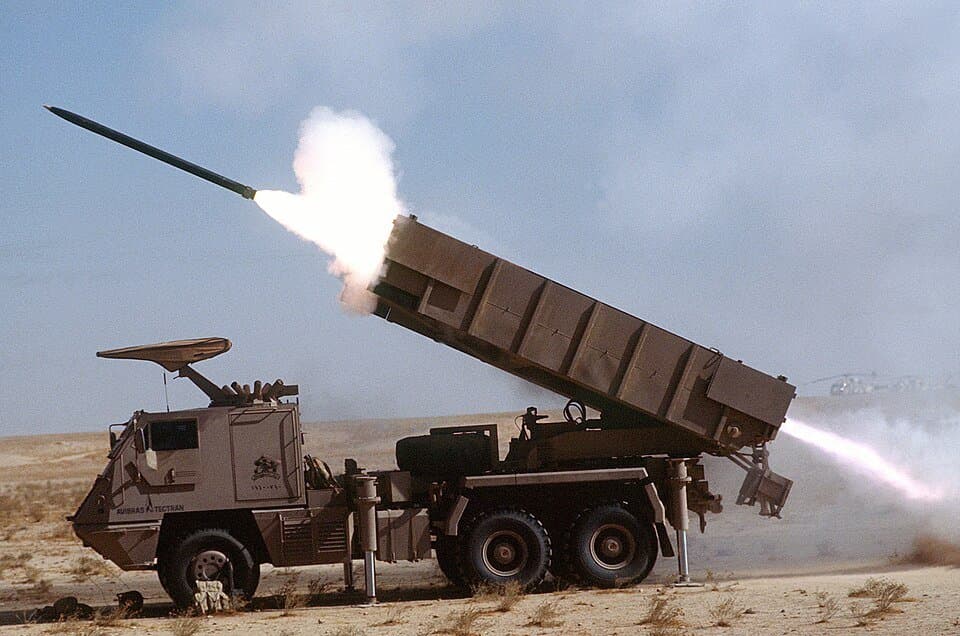

Credit
DoD photo by: TECH. SGT. H. H. DEFFNER · Public domain · Resized · Public domain · Source ↗ · Modified


Preparing your view.

At a glance
Astros IIlarger figure on 2 of 7
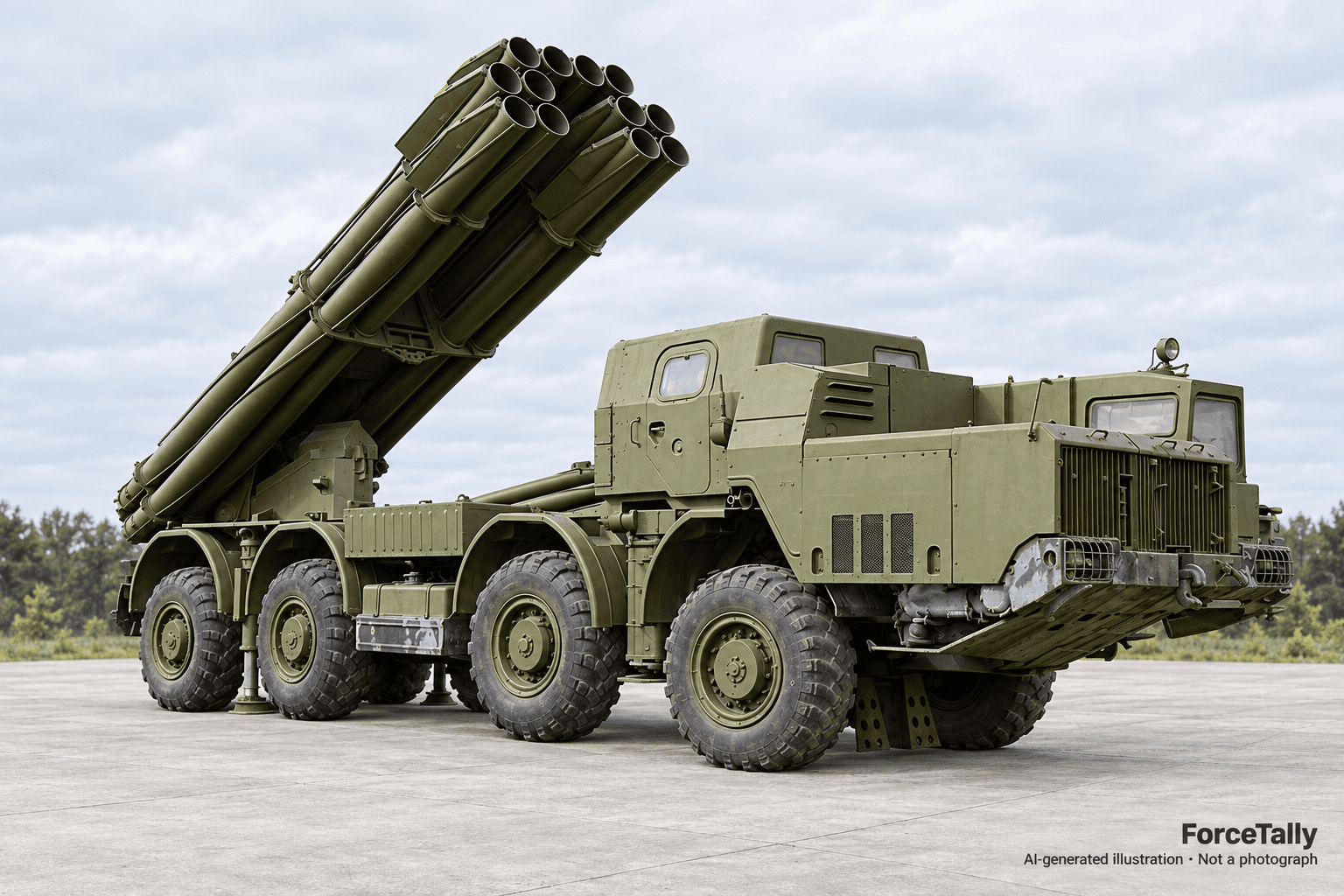
BM-30 Smerch
True scale
Side by side. From every angle. A human reference for perspective.
3.42 MB · Loads when you open it| Model | Length | Width / span | Height |
|---|---|---|---|
| Astros II | ≈ 7 m | ≈ 2.74 m (Width) | ≈ 2.68 m |
| BM-30 Smerch | ≈ 12 m | ≈ 3.9 m (Width) | ≈ 3.6 m |
Scaled uniformly to the sourced length of 7 m. The shape was turned square to the axes. Not an official model or a measured survey.
ForceTally · All rights reserved
Scaled uniformly to the sourced length of 12 m. Not an official model or a measured survey.
ForceTally · All rights reserved
The human reference is a generic 1.75 m figure. Models describe external size, not combat performance.
Measured figures
Length
Single source7 m (20 ft)[source]
Length
Single sourceConfiguration
| Specification | Astros II | BM-30 Smerch |
|---|---|---|
| Type | Multiple rocket launcher[source] | Multiple rocket launcher[source] |
| Place of origin | Brazil[source] | Soviet Union , Russia[source] |
| In service | 1983-present[source] | 1989–present[source] |
| Used by | See Operators[source] | See Operators[source] |
Counts only measures both sources give with the same scope. A larger figure is not a better system.
12 m (39 ft 4 in)[source]
Bars compare reported quantities only. A larger figure does not make a system better; configurations and test conditions differ.
| Wars | Iran–Iraq War Gulf War Angolan Civil War Yemeni Civil War (2015–present) Military Intervention in Yemen[source] | Second Chechen War War in Donbas Syrian Civil War Second Nagorno-Karabakh War Russo-Ukrainian war[source] |
|---|
| Manufacturer | Avibras[source] | Splav State Research and Production Enterprise[source] |
|---|
| No. built | 270+[source] | — |
|---|
| Shell | Rocket length: 4.20 m (13 ft 9 in) Rocket weight: 152 kg (335 lb)[source] | — |
|---|
| Main armament | Universal Multiple Launcher Module 127–450 mm[source] | 9M55 or 9M528 rockets[source] |
|---|
| Secondary armament | 1 × 12.7 mm M2 Browning machine gun[source] | — |
|---|
| Suspension | 6×6[source] | 8×8 wheeled[source] |
|---|
| Armament | one battery of 2, 4, 16 or 32 rocket-launcher tubes[source] | — |
|---|
| Role | self-propelled multiple rocket launcher[source] | — |
|---|
| Source measurement | Astros II ( A rtillery S a T uration RO cket S ystem) is a self-propelled multiple rocket launcher produced in Brazil by the Avibras company. It features modular design and employs rockets with calibers ranging from 127 to 450 mm (5–17.72 inches). It was developed on the basis of a Tectran VBT-2028 6×6 all-terrain vehicle for enhanced mobility based on Mercedes-Benz 2028 truck chassis while later versions use Tatra 815-7 chassis.[source]Astros II · Lead; only the objects and conditions stated in this passage In the 1980s and early 1990s, Avibrás manufactured almost exclusively rockets and multiple-launch rocket systems (MLRS), such as the Astros II, in addition to developing antitank and antiship missiles. At its peak, Avibrás employed 6,000 people; later it would be reduced to 900 people in the early 1990s as the arms industry demand fell. Even so, in the first Gulf War in 1991, the Astros II was successfully used by Saudi Arabia against Iraq. The Astros II system was also procured by Angola during the 1990s, for use against UNITA guerillas.[source]Astros II · Service history; only the objects and conditions stated in this passage It will be integrated with the cruise missile AVMT-300 with 300-km range during the stage of testing and certification.[source]Astros II · New generation; only the objects and conditions stated in this passage The Astros 2020 will also be equipped with a 180 mm GPS -guided rocket called the SS-AV-40G with a range of 40 km (25 mi) and SS-150 newly developed rockets with a claimed maximum range of 150 km.[source]Astros II · New generation; only the objects and conditions stated in this passage SS-09TS – fires 70 mm rockets – Loads 40[source]Astros II · Rocket variants; only the objects and conditions stated in this passage SS-30 – fires 127 mm rockets – Loads 32[source]Astros II · Rocket variants; only the objects and conditions stated in this passage SS-40 – fires 180 mm rockets – Loads 16[source]Astros II · Rocket variants; only the objects and conditions stated in this passage SS-40G – fires 180 mm rockets – Loads 16 (GPS Guided)[source]Astros II · Rocket variants; only the objects and conditions stated in this passage SS-60 – fires 300 mm rockets – Loads 4[source]Astros II · Rocket variants; only the objects and conditions stated in this passage SS-80 – fires 300 mm rockets – Loads 4[source]Astros II · Rocket variants; only the objects and conditions stated in this passage SS-80G – fires 300 mm rockets – Loads 4 (GPS Guided)[source]Astros II · Rocket variants; only the objects and conditions stated in this passage SS-150 – fires 450 mm rockets – Loads 4 (GPS Guided)[source]Astros II · Rocket variants; only the objects and conditions stated in this passage MANSUP – fires 330 mm anti-ship missile – Loads 2[source]Astros II · Rocket variants; only the objects and conditions stated in this passage AV-TM 300 – fires 450 mm cruise missile – Loads 2[source]Astros II · Rocket variants; only the objects and conditions stated in this passage Range in indirect fire mode (first figure is minimum range): SS-09TS: 4–10 km SS-30: 9–30 km SS-40: 15–40 km SS-40G: 15–40 km SS-60: 20–60 km SS-80: 22–90 km SS-80G: 22–90 km SS-150: 29–150 km MANSUP : 70–200 km AV-TM 300 : 30–300 km FOG MPM: 5–60 km[source]Astros II · Specifications; only the objects and conditions stated in this passage Performance: fording 1.1 m vertical obstacle 1 m trench 2.29 m[source]Astros II · Specifications; only the objects and conditions stated in this passage | The BM-30 Smerch ( Russian : Смерч , lit. ' tornado ' , 'whirlwind'), 9K58 Smerch or 9A52-2 Smerch-M is a heavy self-propelled 300 mm multiple rocket launcher designed in the Soviet Union to fire a full load of 12 solid-fuelled projectiles. The system is intended to defeat personnel, armored, and soft targets in concentration areas, artillery batteries, command posts and ammunition depots . It was designed in the early 1980s and entered service in the Soviet Army in 1989. When first observed by the West in 1983, it received the code MRL 280mm M1983 . It continues in use by Russia; a program to replace it with the Tornado-S began in 2018.[source]BM-30 Smerch · Lead; only the objects and conditions stated in this passage The first confirmed combat uses of the Smerch were in two war zones in 2014. Syrian military forces used the system against rebel forces during the Syrian civil war , including in fighting in Jobar . It was also used by Russia-backed militants to deliver explosive and cluster munitions to Ukrainian military positions and likewise by the Ukrainian Army. Several have been seen in use by pro-Russian rebels. The Russian Ground Forces used the BM-30 in Syria in October 2015 during the Russian intervention in Syria .[source]BM-30 Smerch · Operational history; only the objects and conditions stated in this passage TZM 9T234-2 Transloader with an 850 kg crane and 12 spare rockets[source]BM-30 Smerch · Components; only the objects and conditions stated in this passage 300mm rockets with a firing range of 70 and 90 km and various warheads have been developed for the Smerch MLRS.[source]BM-30 Smerch · Components; only the objects and conditions stated in this passage Chassis: MAZ-543M or MAZ-79111[source] |
|---|
| Designer | — | Splav State Research and Production Enterprise[source] |
|---|
| Designed | — | 1980s[source] |
|---|
| Produced | — | 1989–present[source] |
|---|
| Variants | — | See Variants[source] |
|---|
| Barrels | — | 12[source] |
|---|
| Former operator · Soviet Union | — | Soviet Union[source] |
|---|
| Reported operators |
|
|---|
Maximum; 9M544 rocket
Single sourceLaunch Rate Salvo Time: 12 rounds in 38 seconds[source]BM-30 Smerch · General characteristics; only the objects and conditions stated in this passage
9A52-2 – Modified variant on MAZ-543M truck.[source]BM-30 Smerch · Variants; only the objects and conditions stated in this passage
PHL-03 – Chinese development of the PHL96 with 150 km range. The PHL03 is a highly digitized PHL96 with a computerized fire control system (FCS) incorporating GPS/GLONASS, similar to that of the Type 90A SPMRL , with a four-man crew (compared with three for the BM-30/PHL96), which entered service around 2004–2005, only a year or two after its predecessor, the PHL96. As with the PHL96, the PHL03 is not exactly a guided SPMRL because it is the submunitions that are guided, not the rockets themselves.[source]BM-30 Smerch · Similar systems; only the objects and conditions stated in this passage