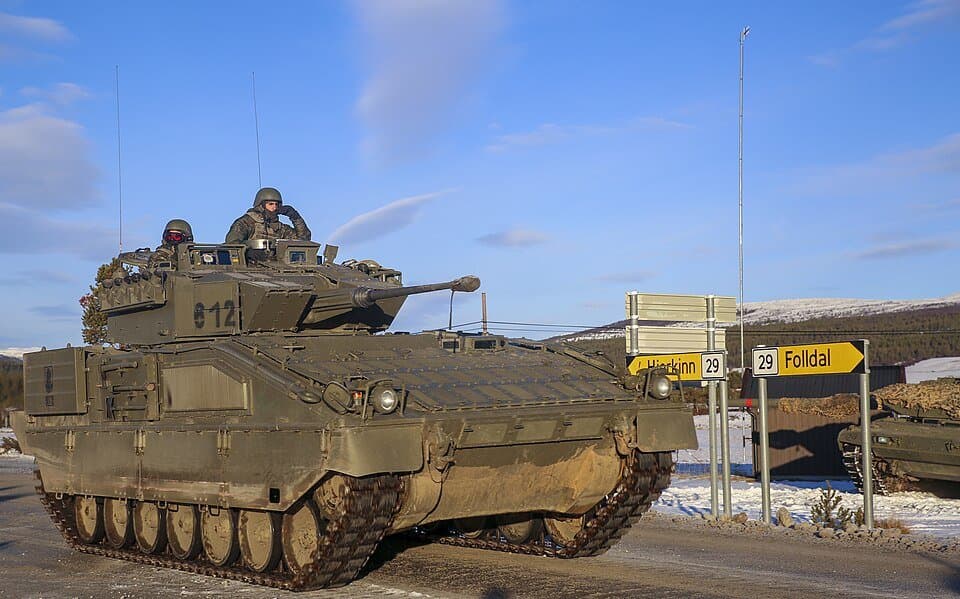


Credit
Sgt. Averi Coppa · Public domain · Resized · Public domain · Source ↗ · Modified


Preparing your view.

At a glance
ASCODlarger figure on 1 of 2
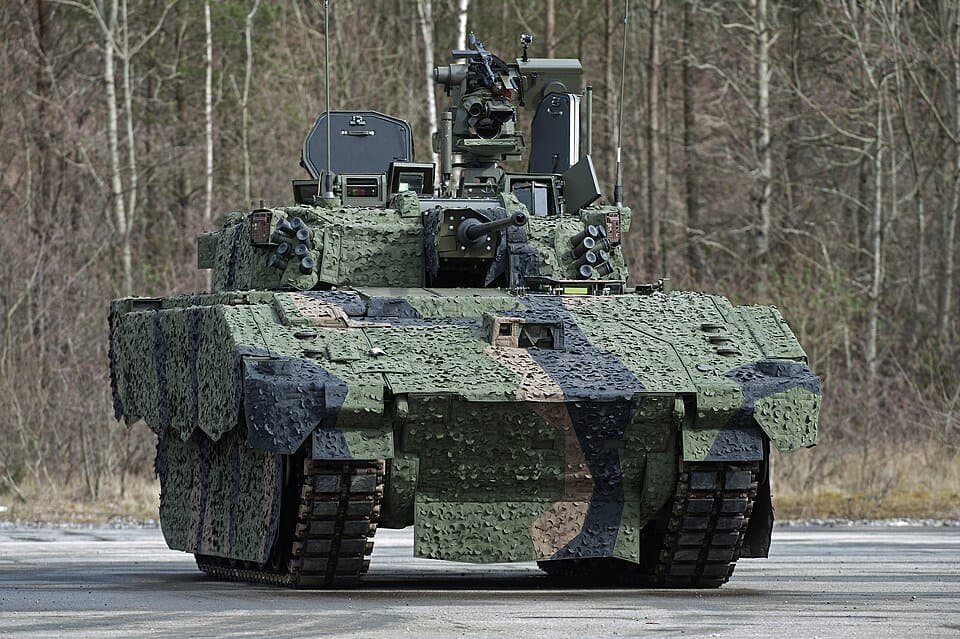
General Dynamics Ajaxlarger figure on 1 of 2
Counts only measures both sources give with the same scope. A larger figure is not a better system.
Measured figures
ASCOD
Single sourcePizarro/Ulan
Single sourceConfiguration
| Specification | ASCOD | General Dynamics Ajax |
|---|---|---|
| Type | Armoured fighting vehicle (ASCOD Ulan/Pizarro)[source] | Armoured fighting vehicle[source] |
| Place of origin | Austria and Spain[source] | United Kingdom[source] |
| In service | 2002–present[source] | — |
| Used by | See Operators[source] | — |
| Developed into | ASCOD 2 (ASCOD SV) Sabrah light tank GD Ajax GD Griffin M10 Booker Vehículo de Apoyo de Cadenas |
6.83 m (22 ft) (Pizarro/Ulan), 9.5 m (31.16 ft) (ASCOD)[source]
Length
Single source7.62 m (25 ft 0 in)[source]
ASCOD Pizarro
Single sourceASCOD Ulan
Single source26.3 tonnes (26,300 kg) (ASCOD Pizarro) 28 tonnes (31 short tons) (ASCOD Ulan)[source]
Mass
Single sourcewith growth potential to
Single sourceASCOD Pizarro / Ulan · vehicle autonomy
Single source3000 metros[source]ASCOD · native armament reach, not mobility autonomySource text · numeric interpretation needs review
500 km[source]ASCOD Pizarro / Ulan · vehicle autonomy
General Dynamics Ajax
Single source500 km[source]General Dynamics Ajax
Bars compare reported quantities only. A larger figure does not make a system better; configurations and test conditions differ.
| — |
| Armor | rolled steel armor options for explosive reactive armor and composite armor[source] | — |
|---|
| Main armament | 30 mm Mauser MK 30/2 (ASCOD Ulan/Pizarro)[source] | 40 mm (1.6 in) CTA International CTAS40 cannon[source] |
|---|
| Secondary armament | MG3 7.62×51mm NATO (Pizarro) FN MAG 7.62×51mm NATO (Ulan/ASCOD 2)[source] | 7.62 mm L94A1 coaxial chain gun Kongsberg Protector Remote Weapon Station (UK testing with 7.62 mm L7 General-purpose machine gun and Javelin ATGM )[source] |
|---|
| Suspension | torsion bar and Piedrafita rotary dampers models AR01 and AR02.[source] | Torsion bar[source] |
|---|
| Source measurement | The ASCOD ( Austrian Spanish Cooperation Development ) armoured fighting vehicle family is the product of a cooperation agreement between Austrian Steyr-Daimler-Puch AG and Spanish General Dynamics Santa Bárbara Sistemas . Both companies are now divisions of a unit of General Dynamics . The ASCOD family includes the LT 105 light tank equipped with a 105 mm gun, a surface-to-air missile launcher, an anti-tank guided missile launcher, mortar carrier , R&R vehicle, command-and-control vehicle, ambulance , artillery observer, and the AIFV model.[source]ASCOD · Lead; only the objects and conditions stated in this passage Therefore, in 1988, a cooperation with the Spanish company Empresa National Santa Barbara S. A. was signed, which resulted in the development being renamed to ASCOD (Austrian Spanish Cooperative Development). Following this, the development of the ASCOD started. The hulls were manufactured in Spain. The ASCOD turrets were made by Steyr in Austria, based on the SP-30 turret design used on the scout version of the Pandur . In 1991, the first prototype was presented in 1991 in Sevilla. It was tested in 1992. Production began in 1996.[source]ASCOD · History; only the objects and conditions stated in this passage Following the numerous changed requirements during the ASCOD's conception and development phases, the weight increased from the original 18.8 t to 25.2 t and finally 29.0 tonnes. The first prototype was trialled in Norway in 1993/94, but Norway decided to purchase the Swedish CV9030 instead. Following these trials, a slightly updated third prototype was built, essentially equalling the version offered as ASCOD to Austria, Spain and other countries. In 1994, Spain decided to order four pre-series vehicles after successful trials of the prototype. In 1996, Spain ordered 144 vehicles with the designation "Pizarro".[source]ASCOD · History; only the objects and conditions stated in this passage In 2004, the Spanish Ministry of Defence ordered another 212 Pizarros (170 IFV, 5 C2V, 28 artillery observation, 8 recovery, 1 engineering vehicle) for €707.5 million Euros, with up to 356 units total planned. By 2010 the cost of this second batch had increased to €845m.[source]ASCOD · History; only the objects and conditions stated in this passage The ASCOD mounts a 30 mm Mauser MK 30 autocannon in a fully traversable electro-mechanical turret. The dual belt-fed 30 mm cannon, electrically stabilized on two planes, is able to fire at a rate of up to 770 rounds per minute and accurately engage targets on the move. As secondary armament, the ASCOD carries a 7.62 mm machine gun. The Spanish Pizarro is fitted with an MG-3 machine gun. The Ulan is fitted with an FN MAG . The Ulan carries 200 rounds of 30 mm and 600 rounds of 7.62 mm in the turret. A further 205 rounds for the 30 mm gun and up to 1,290 for the 7.62 mm machine gun are stored inside the hull. The Pizarro carries 300 rounds of main-gun ammunition.[source]ASCOD · Design / Armament; only the objects and conditions stated in this passage The ASCOD is constructed of several rolled steel armour plates. The armour provides protection against 14.5 mm armour-piercing ammunition fired from distances of 500 meters or more along the frontal 60° arc, with all-round protection against 7.62 mm ammunition. The turret is fitted with two banks of 76 mm Wegmann multi-purpose grenade launchers . These can fire smoke grenades for self-protection, or high-explosive grenades with fragmentation warhead to a maximum range of 50 metres (160 ft).[source]ASCOD · Design / Protection; only the objects and conditions stated in this passage The Pizarro is additionally fitted with limited amounts of SABBLIR explosive reactive armour along the frontal arc and might be upgraded with more later. The SABBLIR reactive armour increases protection against shaped-charge warheads as used on rocket-propelled grenades . The Ulan has been fitted with MEXAS composite armour, which increases ballistic protection against up to 30 mm APFSDS rounds fired from a 1,000 m range over the forward 30° arc, and all-round protection against 14.5 mm armour piercing incendiary (API) rounds from a range of 500 m. The Ulan is fitted with spall-liners to minimise casualties in case of armour penetration.[source]ASCOD · Design / Protection; only the objects and conditions stated in this passage In terms of mobility, the Spanish Pizarro is fitted with a 600 horsepower (450 kW) MTU SV-183 TE22 engine, while the Austrian Ulan includes a 720 horsepower (540 kW) MTU 8V-199-TE20 engine. These have power-to-weight ratios of 21 and 25, respectively, offering both vehicles excellent mobility. Both versions use a Renk HSWL 106C hydro-mechanical transmission, and suspension — based on torsion bars and rotary dampers — designed and manufactured by "Piedrafita" .[source]ASCOD · Design / Mobility; only the objects and conditions stated in this passage The ASCOD uses Diehl type-129 tracks. The Pizarro has a maximum speed of 70 km/h, and a maximum reverse speed of 35 km/h. The ASCOD has a ground-clearance of 450 millimetres (18 in). The Ulan can accelerate from 0 to 50 kilometres per hour (31 mph) in 14 seconds. It can cross ditches of 2.3 metres (7 ft 7 in), climb walls of 950 millimetres (37 in) and ford rivers of 1.2 metres (3 ft 11 in) depth. It is able to drive at 75% gradient and 40% side slope.[source]ASCOD · Design / Mobility; only the objects and conditions stated in this passage The ASCOD chassis has been used for a number of vehicles in Spanish service and numerous private ventures developed for the export market. Aside from the IFV version, the ASCOD has been offered as light tank and scout vehicle. The ASCOD Direct Fire light tank can mount a number of different commercial turrets with 105 or 120 mm tank guns. It is expected to weigh about 30 tonnes.[source]ASCOD · Variants and derivatives / ASCOD; only the objects and conditions stated in this passage LT-105 Light Tank (ASCOD Direct Fire) – A light tank, designed for the export market, with a 105 mm or 120 mm gun. There are multiple turret options available, made by a different manufacturers: Oto Melara , Cockerill, General Dynamics, and Denel Land Systems (formerly known as LIW).[source]ASCOD · Variants and derivatives / ASCOD; only the objects and conditions stated in this passage ASCOD Ulan is built by Steyr-Daimler-Puch Spezialfahrzeuge. It includes a more powerful 530 kW engine, and a different fire control system built by Kollsman.[source]ASCOD · Variants and derivatives / Austrian variant - Ulan; only the objects and conditions stated in this passage | Initially, the Ajax was to be procured in a number of blocks totalling 1,010 vehicles. The first order of Block 1 vehicles encompassed Scout Reconnaissance, PMRS APC, and Repair and Recovery variants, with a following order of Block 2 to consist of Reconnaissance, C2, and Ambulance variants. There was a possibility for a third Block of vehicles encompassing a "Direct Fire" vehicle with a 120mm main gun, "Manoeuvre Support", and a "Joint Fires" variant equipped to succeed the FV102 Striker in the anti-tank role. However, in September 2014, Block 3 vehicles were dropped and the Ministry of Defence had "no plans" to order any Block 2 vehicles.[source]General Dynamics Ajax · Development; only the objects and conditions stated in this passage The turret ring is 1.7 m (5 ft 7 in) in diameter, allowing for much more work-space than comparable AFVs. The Scout SV is also equipped with a state of the art Intelligence, surveillance, target acquisition, and reconnaissance (ISTAR) package with advanced sensors and space for further future growth. This advanced ISTAR package allows for automated search, tracking and detection, more than doubling stand-off range at which targets can be identified and tracked.[source]General Dynamics Ajax · Design; only the objects and conditions stated in this passage The main armament for the Ajax variants is the innovative Anglo-French 40CT cannon which uses 40 mm telescoped ammunition with the warhead seated inside the propellant casing; the smaller size enables a much greater ammunition load. A linkless carousel magazine allows the crew to quickly change ammunition type, which includes high explosive with an impact fuze or timed for airburst, and solid shot or tungsten dart kinetic energy rounds , capable of penetrating 14 cm of armour at up to 1,500 metres. The rate of fire is 200 rounds per minute (RPM), compared to 90 RPM for the RARDEN gun which it replaces. The barrel can be elevated to 80°, allowing it to engage helicopters or unmanned aerial vehicles .[source]General Dynamics Ajax · Design; only the objects and conditions stated in this passage Ordered in 2014, the first delivery was scheduled for 2017, while it was stated that the first British Army squadron "will be equipped by mid-2019" so that they could be deployed by the end of 2020. This was delayed due to design and testing problems. Test crews were required to wear noise cancelling headphones and be checked for hearing loss at the end of operations and the vehicles were unable to reverse over obstacles more than 20 centimetres high. |
|---|
| Manufacturer | Santa Bárbara Sistemas[source] | General Dynamics UK[source] |
|---|
| Designer | — | General Dynamics UK[source] |
|---|
| Developed from | — | ASCOD 2[source] |
|---|
| Transmission | — | RENK 6 speed HSWL 256B[source] |
|---|
38 tonnes with growth potential to 42 tonnes[source]
Test crews were then limited to 105 minutes inside and 20 miles per hour (32 km/h).[source]General Dynamics Ajax · Project progress / 2021: Problems get worse; only the objects and conditions stated in this passage
Limited User Validation Trials recommenced in October 2022, with a view to commencing Reliability Growth Trials in January 2023. On 21 December 2022, the Minister of State for the Ministry of Defence, Alex Chalk , stated that these trials could last from 18 to 24 months—a period which would mean that the results of the trials would not be available until after the next UK general election. Trials eventually included vehicles being tested over 42,000 kilometres (26,000 mi) of varying terrains, and the firing of 20,000 rounds from the 40 mm main armament.[source]General Dynamics Ajax · Project progress / 2022: Try to fix the problems; only the objects and conditions stated in this passage
On 26th November 2025, it was reported in the British media that the Army had halted the use of Ajax vehicles "after soldiers left vomiting". According to reports, around 30 soldiers became ill during training with the vehicles. An MoD spokesman said "This weekend, a small number of soldiers reported symptoms of noise and vibration, having taken part in an exercise involving the Ajax armoured fighting vehicle. Out of an abundance of caution, the minister for defence readiness and industry has asked the Army to pause all use of Ajax for training and exercising for two weeks, while a safety investigation is carried out into the events this weekend."[source]General Dynamics Ajax · Project progress / 2025: Problems still exist; only the objects and conditions stated in this passage