



Preparing your view.
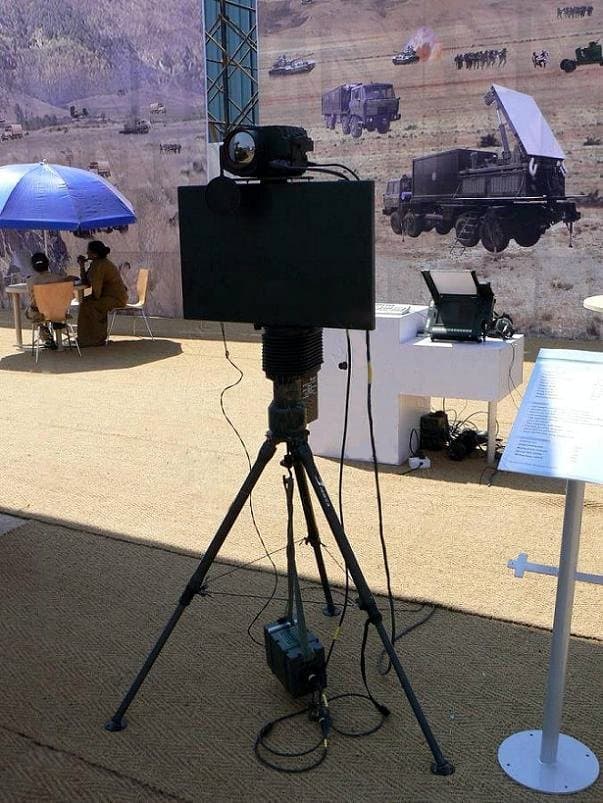

BRadar & sensors
Measured figures
BEL Battle Field Surveillance Radar · around
Single sourcearound 30 kg[source]
Configuration
| Specification | ARTHUR | BEL Battle Field Surveillance Radar |
|---|---|---|
| Speed | — | 0.9 m/s to 90 km/h[source]Source text · numeric interpretation needs review |
| Power | — | 80 W[source] |
| Type | Passive electronically scanned array[source] | — |
| Place of origin | Sweden / Norway[source] | — |
| In service | 1994–present[source] | — |
| Used by | See Operators |
Crew
Single sourceMod C Mod D
Single sourceRange
Single sourceMod C, 60 kilometres (37 mi) Mod D, 100 kilometres (62 mi)[source]
Crawling Man
Single sourceGroup of people
Single sourceBars compare reported quantities only. A larger figure does not make a system better; configurations and test conditions differ.
| — |
| Wars | War in Afghanistan, Iraq War Russian invasion of Ukraine[source] | — |
|---|
| Manufacturer | Saab AB[source] | Bharat Electronics Limited[source] |
|---|
| Unit cost | SEK 27 million (1996)[source] | — |
|---|
| No. built | 80 (by 2020)[source] | 1400+[source] |
|---|
| Variants | Mod A, Mod B, Mod C, Mod D[source] | — |
|---|
| Country of origin | Sweden / Norway[source] | India[source] |
|---|
| Frequency | C (G/H)-band[source] | J band[source] |
|---|
| Precision | 60 m (200 ft)[source] | ±20 meters (66 ft)[source] |
|---|
| Other names | MAMBA TAIPAN[source] | PJT-531[source] |
|---|
| Role | counter-battery radar system originally[source] | — |
|---|
| Source measurement | The ARTHUR detects hostile artillery by tracking projectiles in flight. The original ARTHUR Mod A can locate guns at 15–20 km and 120 mm mortars at 30–35 km with a circular error probable of 0.45% of range. This is accurate enough for effective counter-battery fire by friendly artillery batteries . ARTHUR can operate as a stand-alone, medium-range weapons locating radar or a long-range weapon locating system, consisting of two to four radars working in coordination. This flexibility enables the system to maintain a constant surveillance of an area of interest.[source]ARTHUR · Role; only the objects and conditions stated in this passage The upgraded ARTHUR Mod B met the British Army 's MAMBA requirement for locating guns, mortars or rockets. It can locate guns at 20–25 km and 120 mm mortars at 35–40 km with a circular probable error of 0.35% of range. MAMBA was successfully used by the British Army in Iraq and Afghanistan, with an availability of 90%.[source]ARTHUR · Role; only the objects and conditions stated in this passage ARTHUR Mod C has a larger antenna and can detect guns at 31 km, mortars at 55 km and rockets at 50–60 km depending on their size, and locate targets at a rate of 100 per minute with CEP 0.2% of range for guns and rockets and 0.1% for mortars.[source]ARTHUR · Role; only the objects and conditions stated in this passage ARTHUR WLR Mod D has several improvements, including an instrumented range of up to 100 km, an accuracy of 0.15% of range, and the ability to cover an arc of 120°. The detection range is between 0.8 and 100 km and could possibly increase to 200 km. More than 100 targets can be tracked at the same time. It was delivered to the British Army in 2024, under the designation TAIPAN .[source]ARTHUR · Role; only the objects and conditions stated in this passage | — |
|---|
| Designer | — | Electronics and Radar Development Establishment ( DRDO )[source] |
|---|
| Azimuth | — | 30-180°[source] |
|---|
| Elevation | — | -40 to +15°[source] |
|---|
| Detection Range | — | Crawling man: 500 m Walking man: 2 km (1.2 mi) Group of people: 7 km (4.3 mi) Light vehicle: 10 km (6.2 mi) Heavy vehicle: 14 km (8.7 mi)[source] |
|---|
| Crawling man | — | 500 m[source] |
|---|
| Walking man | — | 2 km (1.2 mi)[source] |
|---|
| Group of people | — | 7 km (4.3 mi)[source] |
|---|
| Light vehicle | — | 10 km (6.2 mi)[source] |
|---|
| Heavy vehicle | — | 14 km (8.7 mi)[source] |
|---|
| Range accuracy | — | 20m rms[source] |
|---|
| Range resolution | — | 50 m[source] |
|---|
| Radar type | — | man portable 2D short-range battlefield and perimeter surveillance radar[source] |
|---|
| Reported operators |
|
|
|---|
Heavy Vehicles
Single sourceLight Vehicles
Single sourceWalking Man
Single sourceCrawling Man : 700 m (0.43 mi) Walking Man : 3 km (1.9 mi) Group of people : 7 km (4.3 mi) Light Vehicles : 10 km (6.2 mi) Heavy Vehicles : 14 km (8.7 mi)[source]