


Preparing your view.

At a glance
Arietelarger figure on 2 of 3
Centurion (tank)larger figure on 1 of 3
Counts only measures both sources give with the same scope. A larger figure is not a better system.
True scale
Side by side. From every angle. A human reference for perspective.
3.27 MB · Loads when you open it| Model | Length | Width / span | Height |
|---|---|---|---|
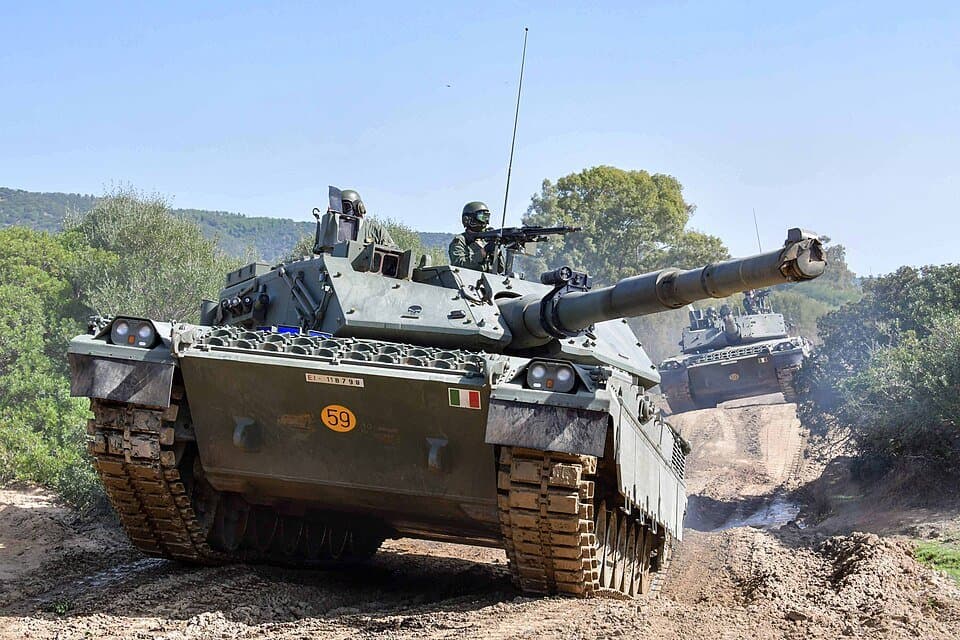
| Ariete | ≈ 9.52 m | ≈ 3.61 m (Width) | ≈ 2.45 m |
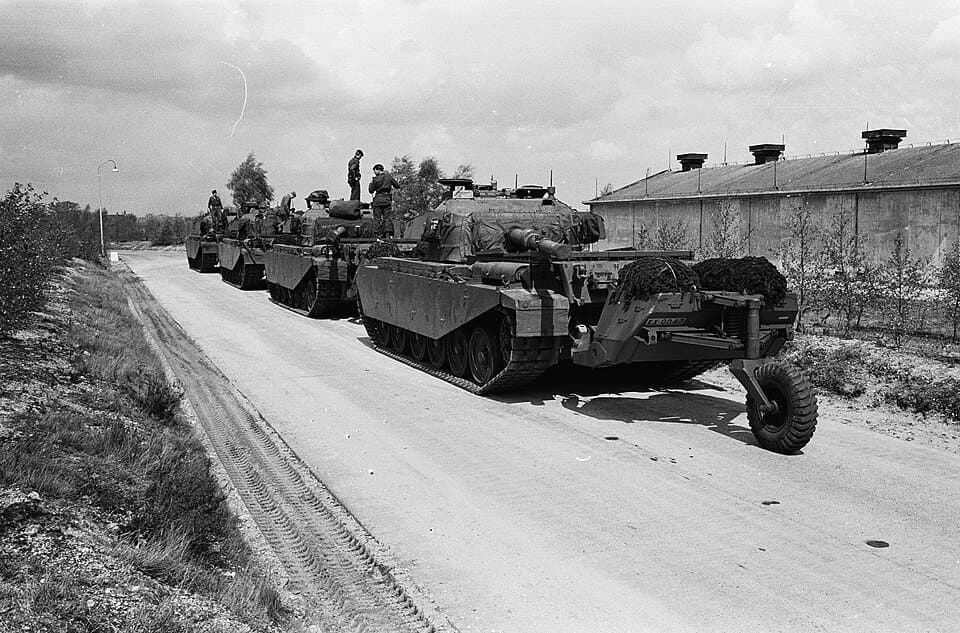
| Centurion (tank) | ≈ 9.97 m | ≈ 3.38 m (Width) | ≈ 3.18 m |
Scaled uniformly to the sourced length of 9.52 m. Thin antennas or poles standing above the body were pressed down to it, so they do not set the height; the height was fitted to the sourced 2.45 m; the width was fitted to the sourced 3.61 m. Not an official model or a measured survey.
ForceTally · All rights reserved
Scaled uniformly so that the hull matches the sourced 7.557 m hull length. The width was fitted to the sourced 3.38 m. Not an official model or a measured survey.
ForceTally · All rights reserved
The human reference is a generic 1.75 m figure. Models describe external size, not combat performance.
Measured figures
Length
Single source9.52 m (31.2 ft)[source]
Gun forward
Single sourceConfiguration
| Specification | Ariete | Centurion (tank) |
|---|---|---|
| Type | Main battle tank[source] | Main battle tank[source] |
| Place of origin | Italy[source] | United Kingdom[source] |
| In service | 1995–present[source] | 1945–present (derivatives still in service)[source] |
| Manufacturer | Consorzio Iveco Oto Melara (CIO), a consortium formed by Iveco and OTO Melara[source] | Leyland Motors , Lancashire the Royal Ordnance Factories ROF Leeds and Royal Arsenal , and Vickers at Elswick |
Hull
Single sourceHull only 24 ft 9.5 in (7.557 m) With gun forward 32 ft 3 in (9.83 m)[source]
Bars compare reported quantities only. A larger figure does not make a system better; configurations and test conditions differ.
| Produced | 1995–2002[source] | — |
|---|
| No. built | 200[source] | 4,423[source] |
|---|
| Armor | steel and composite[source] | — |
|---|
| Main armament | 120 mm OTO Breda L/44 smoothbore gun 42 rounds (15 ready-rounds in the turret basket with additional 27 rounds in the hull rack)[source] | 105 mm L7 rifled gun 20 pdr (84 mm) rifled gun 17 pdr (76.2mm) rifled gun[source] |
|---|
| Secondary armament | 7.62 mm MG 42/59 coaxial machine-gun, 7.62 mm MG 42/59 AA machine-gun 2,500 rounds[source] | Co-axial Besa machine gun (Mark 3) .30 cal Browning machine gun (Mark 5 onwards)[source] |
|---|
| Power/weight | 17.5 kW/t (23.5 hp/t)[source] | 13 hp/t (9.2 kW/t)[source] |
|---|
| Transmission | ZF Friedrichshafen LSG 3000 (4 gears forward, 2 backwards)[source] | 5-speed Merrit-Brown Z51R Mk. F gearbox[source] |
|---|
| Suspension | torsion bar[source] | Modified Horstmann[source] |
|---|
| Ground clearance | 0.44 m (1.4 ft)[source] | 1 ft 8 in (0.51 m)[source] |
|---|
| Role | 3rd generation main battle tank of the Italian Army ,[source] | primary main battle tank of the British Army during the post- World War II period[source] |
|---|
| Source measurement | The C1 Ariete (English: battering ram , ram ) is a 3rd generation main battle tank of the Italian Army , developed by Consorzio Iveco Oto Melara (CIO), a consortium formed by Iveco and OTO Melara . The chassis and engine were produced by Iveco, while the turret and fire-control system were supplied by OTO Melara. The vehicle carries the latest optical and digital-imaging and fire-control systems, enabling it to fight day and night and to fire on the move. Six prototypes were developed by 1988, which were subject to intensive testing. The following year the vehicles travelled a combined 16,000 km. Deliveries were first planned for 1993, and took place in 1994 due to delays. The final tank was delivered seven years later, in August 2002.[source]Ariete · Lead; only the objects and conditions stated in this passage The Ariete's main armament is 120 mm smoothbore gun, designed by OTO Breda , similar to the Rheinmetall L/44 . The gun fires most NATO-standard rounds of the same calibre. It carries 42 rounds; 15 ready rounds are stored vertically on the left side of the main gun breech. The other 27 rounds are stowed in a hull rack to the left of the driver's station. The gun barrel has a thermal insulating sleeve and a fume extractor ; it is fully stabilized in both azimuth and elevation by an electro-hydraulic drive system.[source]Ariete · Design / Armament; only the objects and conditions stated in this passage Secondary armament consists of a 7.62 mm MG 42/59 coaxial machine gun operated by the tank gunner or commander and an additional 7.62 mm MG 42/59 configured as an anti-aircraft weapon operated by the main-gun loader from his hatch.[source]Ariete · Design / Armament; only the objects and conditions stated in this passage This computer is also a component of the tank's navigation system and allows for the exchange of tactical information between vehicles in a network. The Ariete has a "hunter-killer" capability in which the commander spots and designates targets for the gunner in a 360° field of vision around the vehicle without changing his position or having to open the turret hatch for visual identification of targets. The commander's sight also has a vertical traverse from –10° to +60° from the horizontal, which allows the tank to engage low-flying airborne threats—primarily helicopters. During night fighting, the commander and gunner both share the thermal sight which is able to resolve a 2.3×x2.3 m target from a distance of 1,500 m.[source]Ariete · Design / Fire control and target acquisition; only the objects and conditions stated in this passage The Ariete features two side-mounted, electronically fired GALIX 80mm grenade launchers. Each launcher consists of four 80 mm barrels which can be intermixed with either smoke or chaff grenades. The smoke grenades are capable of shrouding the tank from visual or thermal detection, while the chaff grenades disperse the tank's radar cross section . The tank is fully NBC protected .[source]Ariete · Design / Crew and tank protection; only the objects and conditions stated in this passage The Ariete is powered by a 25.8-litre Fiat-Iveco MTCA turbo-diesel V12 rated at 937 kW (1,257 hp) at 2,300 rpm, with a maximum torque of 4,615 N⋅m (3,404 lbf⋅ft) at 1,600 rpm driving through a ZF LSG3000 automatic transmission , with four forward gears and two reverse, allowing for a top cruising speed of 65 km/h and a 0–32 km/h acceleration in 6 seconds. The computer-controlled transmission allows it to climb grades rated up to 60%, and can ford waterways of up to 1.25 m on-the-fly. The entire engine and transmission assembly can be replaced in under 1 hour.[source]Ariete · Design / Powerplant and drivetrain; only the objects and conditions stated in this passage During the first years of adoption, the Ariete MBT showed some deficiencies regarding the powerplant. While the original V12 1,250 hp FIAT-Iveco MTCA (Modular Turbo-Charged Aftercooler) was a coupling of two of the V6 engines used by several Italian Army vehicles such as the B1 Centauro tank destroyer and the Dardo IFV , it produced less power than the most advanced contemporary western designs. The Ariete's engine had to run at a high RPM to perform well, thus reducing the operating time between failures.[source]Ariete · History / Further development; only the objects and conditions stated in this passage Moreover, to retain a good power-to-weight ratio , the total weight of the tank had to be kept below 60 tonnes. The relatively light weight of the Ariete helped lower consumption and facilitated the transport and mobility of the MBT (especially over bridges). This was obtained partially at the expense of the thickness of the armour that, only partially compensated by the good ballistic shape of the vehicle, raised some doubt about its ability to survive in the harshest environments.[source]Ariete · History / Further development; only the objects and conditions stated in this passage As an improvement, Iveco developed a new version of the MTCA engine. The stroke was lengthened, increasing displacement to 30 litres, with a new common rail direct fuel injection system along a new double turbocharger, increasing power output to 1,200 kW (1,600 hp) at 1,800 rpm (with an electronically reduced torque of 5,500 N·m, maintained from 1,100 to 1,800 rpm to reduce damage to the transmission) and further reducing fuel consumption. The new engine had to be adopted during the first general revision of the existing vehicles, but seems to have been blocked by technical and financial problems. As for the armour, Oto Melara developed two different sets (with different thickness levels, depending upon mission nature) of adjunctive armour, shown for the first time at Eurosatory 2002.[source]Ariete · History / Further development; only the objects and conditions stated in this passage Mobility: New engine: 30.1-litre Iveco Vector 12 with a power of 1,500 hp (1,100 kW) and a torque of 5,800 N⋅m (4,300 ft⋅lb) This engine shares parts with the Iveco Vector 8V engine of the Centauro 2 , which will improve the logistics of the Italian Army. Transmission LSG-3000 updated to take the added power Widened tracks for higher mobility[source]Ariete · History / Ariete C2; only the objects and conditions stated in this passage CIO-Oto Melara planned to offer the opening of a production line in Brazil at its Sete Lagoas plant, where the LMV is already produced and the Centauro 2 will be produced for the Brazilian Army. However, the Army Strategic Program Armored Forces , which would provide 65 MBTs for the Brazilian Army, limits contenders to a maximum weight of 50 tonnes, which rules out the Ariete unless changes were made to Brazilian technical requirements.[source]Ariete · Export / Brazil; only the objects and conditions stated in this passage | Development of the Centurion began in 1943 with manufacture beginning in January 1945. Six prototypes arrived in Belgium less than a month after the war in Europe ended in May 1945. It entered combat with the British Army in the Korean War in 1950 in support of the UN forces. The Centurion later served on the Indian side in the Indo-Pakistani War of 1965 , where it fought against US-supplied M47 and M48 Patton tanks, and it served with the Royal Australian Armoured Corps in the Vietnam War .[source]Centurion (tank) · Lead; only the objects and conditions stated in this passage After a series of fairly mediocre designs in the A series in the past, and bearing in mind the threat posed by the German 88 mm gun , the War Office demanded a major revision of the design requirements, specifically: increased durability and reliability, the ability to withstand a direct hit from the German 88 mm gun and providing greater protection against mines.[source]Centurion (tank) · Development; only the objects and conditions stated in this passage Initially in September 1943 the A41 tank was to weigh no more than 40 long tons (45 short tons; 41 t), the limit for existing Mark I and Mark II transport trailers and for a Bailey bridge of 80 ft (24 m) span.[source]Centurion (tank) · Development; only the objects and conditions stated in this passage The British railway loading gauge required that the width should not exceed 10 ft 8 in (3.25 m) and the optimum width was 10 ft 3 in (3.12 m), but, critically, for the new tank this restriction had been lifted by the War Office under pressure from the Department of Tank Design.[source]Centurion (tank) · Development; only the objects and conditions stated in this passage The Department produced a larger hull by replacing the long-travel five-wheel Christie suspension used on the Comet with a six-wheel Horstmann suspension , and extending the spacing between the second and third wheels. The Christie suspension, with vertical spring coils between side armour plates, was replaced by a Horstmann suspension with three horizontally sprung, externally mounted two-wheel bogies on each side. The Horstmann design did not offer the same ride quality as the Christie system, but took up less room and was easier to maintain. In case of damage by mines , individual suspension and wheel units could be replaced relatively easily. The hull was redesigned with welded, sloped armour and featured a partially cast turret with the highly regarded 17-pounder (76.2 mm/3-inch) as the main gun and a 20 mm Polsten cannon in an independent mounting to its left. With a Rover -built Rolls-Royce Meteor engine, as used on the Comet and Cromwell , the new design would have excellent performance. |
|---|
| Used by | — | see Operators[source] |
|---|
| Wars | — | Korean War Suez Crisis Indo-Pakistani War of 1965 Six-Day War Black September Indo-Pakistani War of 1971 War of Attrition Yom Kippur War Vietnam War South African Border War Operation Motorman ( AVRE ) 1978 South Lebanon conflict BARV 1982 Lebanon War Somali Civil War Gulf War (AVRE) 2006 Lebanon War First Libyan Civil War[source] |
|---|
| Unit cost | — | £35,000 (1950), £38,000 (1952)[source] |
|---|
| Armour | — | 51–152 mm (2.0–6.0 in)[source] |
|---|
| Fuel capacity | — | 120 imperial gallons (546 L; 144 US gal)[source] |
|---|
| Former operator · Australia | — | Australia[source] |
|---|
| Former operator · Austria | — | Austria[source] |
|---|
| Former operator · Canada | — | Canada[source] |
|---|
| Former operator · Denmark | — | Denmark[source] |
|---|
| Former operator · Egypt | — | Egypt[source] |
|---|
| Former operator · India | — | India[source] |
|---|
| Former operator · Iraq | — | Iraq[source] |
|---|
| Former operator · Kuwait | — | Kuwait[source] |
|---|
| Former operator · Netherlands | — | Netherlands[source] |
|---|
| Former operator · New Zealand | — | New Zealand[source] |
|---|
| Former operator · Socialist Republic of Romania | — | Socialist Republic of Romania[source] |
|---|
| Former operator · Singapore | — | Singapore[source] |
|---|
| Former operator · Somalia | — | Somalia[source] |
|---|
| Former operator · Sweden | — | Sweden[source] |
|---|
| Former operator · Switzerland | — | Switzerland[source] |
|---|
| Former operator · United Kingdom | — | United Kingdom[source] |
|---|
| Reported operators | — |
|---|
But even before the Outline Specification of the A41 was released in October 1943, these limits were removed, and the weight was increased from 40 tons to 45 long tons (50 short tons; 46 t), because of the need for heavier armour and a wider turret (too wide for the tank to be transported by rail) with a more powerful gun. The new version carried armour equal to the heaviest infantry tanks , while improved suspension and engines provided cross-country performance superior to even the early cruiser tanks. The War Office decided it would be wiser to build new trailers, rather than hamper what appeared to be a superb design. The design mockup, built by AEC Ltd , was viewed in May 1944. Subsequently, twenty pilot models were ordered with various armament combinations: ten with a 17-pounder and a 20 mm Polsten gun (of which half had a Besa machine gun in the turret rear and half an escape door), five with a 17-pounder, a forward Besa machine gun and an escape door, and five with a QF 77 mm gun and a driver-operated hull machine gun.[source]Centurion (tank) · Development; only the objects and conditions stated in this passage
Prototypes of the original 40-ton design, the Centurion Mark I, had 76 mm of armour in the front glacis , which was thinner than that on the then current infantry tanks (the Churchill ), which had 101 mm or 152 mm on the Churchill Mk VII and VIII being produced at the time.[source]Centurion (tank) · Development; only the objects and conditions stated in this passage
The turret was well armoured at 152 mm.[source]Centurion (tank) · Development; only the objects and conditions stated in this passage
The uparmoured Centurion Mark II soon arrived; it had a new 118 mm-thick glacis and the side and rear armour had been increased from 38 mm to 51 mm.[source]Centurion (tank) · Development; only the objects and conditions stated in this passage
Soon after the Centurion's introduction, Royal Ordnance finished work on the 84 mm calibre Ordnance QF 20 pounder tank gun.[source]Centurion (tank) · Development / Continued development; only the objects and conditions stated in this passage
By this point, the usefulness of the 20 mm Polsten had been called into question, it being unnecessarily large for use against troops, so it was replaced with a Besa machine gun in a completely cast turret.[source]Centurion (tank) · Development / Continued development; only the objects and conditions stated in this passage
The 20-pounder gun was used until the Royal Ordnance Factories introduced the 105 mm L7 gun in 1959. All later variants of the Centurion, from Mark 5/2 on, used the L7.[source]Centurion (tank) · Development / Continued development; only the objects and conditions stated in this passage
Design work for the Mk 7 was completed in 1953, with production beginning soon afterwards. One disadvantage of earlier versions was the limited range, initially just 65 miles (105 km) on hard roads, hence external auxiliary tanks and then a "monowheel" trailer were used. But the Mk7 had a third fuel tank inside the hull, giving a range of 101 miles (163 km). Additionally, it was found possible to put the Centurion on some European rail routes with their larger loading gauges.[source]Centurion (tank) · Development / Continued development; only the objects and conditions stated in this passage
The Centurion was used as the basis for a range of specialist equipment, including combat engineering variants with a 165 mm demolition gun Armoured Vehicle Royal Engineers (AVRE). It is one of the longest-serving designs of all time, serving as a battle tank for the British and Australian armies from the Korean War (1950–1953) to the Vietnam War (1961–1972), and as an AVRE during Operation Desert Storm in January–February 1991.[source]Centurion (tank) · Development / Continued development; only the objects and conditions stated in this passage
The development cost of Centurion did not exceed £5 million. The cost of a Centurion tank was £35,000 in 1950, but had risen to £38,000 in 1952. Of this, "the gun control equipment costs £1,600, and the actual gadget that works the stabiliser only £100." By comparison, during World War II a Covenanter tank cost the British Government £12,000, a Crusader tank cost £13,700, a Matilda tank cost £18,000, and a Valentine tank £14,900; in 1967 a Chieftain tank cost between £90,000 and £95,000, and in 1984 a Challenger 1 tank cost £1.5 million. In 1955, Sir Edward Boyle (the Parliamentary Secretary to the Minister of Supply ) told the House of Commons that "the cost of the Centurion tank has been coming down recently as production has settled into its stride."[source]Centurion (tank) · Development / Production; only the objects and conditions stated in this passage
Colonel Donald Dunstan , later to be governor of South Australia , was the deputy task force commander of the 1st Australian Task Force (1 ATF) in South Vietnam. Dunstan had quite possibly been the last Australian to use tanks and infantry in a combined operation during the Second World War (as part of the Bougainville campaign ), and the first since the war to command Australia's tanks and infantry in combat. When he temporarily took over command during Brigadier Ronald Hughes 's absence, he directed that the Centurions be brought up from Nui Dat to reinforce firebases Coral and Balmoral , believing that they were a strong element that were not being used. Besides adding a great deal of firepower, Dunstan stated, he "couldn't see any reason why they [the Centurions] shouldn't be there". His foresight enabled 1 ATF to kill approximately 267 soldiers from the 141st and 165th North Vietnamese Army Regiments during the six-week-long Battle of Coral–Balmoral in May 1968, as well as capturing 11 prisoners, 36 crew-served weapons, 112 small arms, and other miscellaneous enemy weapons.[source]Centurion (tank) · Service history / Vietnam War; only the objects and conditions stated in this passage
After the Battle of Coral-Balmoral, a third Centurion troop, which included two tankdozers, was formed. By September 1968, 'C' Squadron was brought to its full strength of four troops, each equipped with four Centurion tanks. By 1969, 'B' Squadron, 3rd Cavalry; 'A' Squadron, 1st Armoured Regiment; 'B' Squadron, 1st Armoured Regiment; and 'C' Squadron, 1st Armoured Regiment, had all made rotations through South Vietnam. Originally deployed as 26 Centurion tanks, after three and a half years of combat operations, 58 Centurions had served in country; 42 had suffered battle damage with six beyond repair and two crewmen had been killed in action.[source]Centurion (tank) · Service history / Vietnam War; only the objects and conditions stated in this passage
The offensive of Pakistan's 1st Armoured Division was blunted at the Battle of Asal Uttar on 10 September. Six Pakistani armoured regiments were opposed by three Indian armoured regiments. One of these regiments, 3 Cavalry, fielded 45 Centurion tanks. The Centurion, with its 20-pounder gun and heavy armour, proved to be more than a match for the M47 and M48 Pattons . On the other side, when Pakistani Army armoured division primary composed of M47 and M48 Pattons, they proved to be able to penetrate only a few of the Centurion tanks, as witnessed in the Battle of Chawinda in the Sialkot sector. A post-war US study of the tank battles in South Asia concluded that the Patton's armour could be penetrated by the 20-pounder tank gun (84 mm) of the Centurion (later replaced by the even more successful L7 105 mm gun on the Mk. 7 version which India also possessed) as well as the 75 mm tank gun of the AMX-13 light tank.[source]Centurion (tank) · Service history / Indo-Pakistani wars; only the objects and conditions stated in this passage
The first country which bought Centurion tanks was Egypt. The first tanks were received in 1950. Israel's formerly British Centurions were first delivered in 1959. Differing varieties of the Centurion were bought by Israel over the years from many different countries or captured in combat. Following their acquisition the Israelis quickly upgraded the tanks with British 105 mm L7 instead of the original 20-pounder main gun and renamed them Sho't ("scourge" or "whip").[source]Centurion (tank) · Service history / Middle East; only the objects and conditions stated in this passage
When the Six-Day War broke out in 1967, the Israel Defense Forces (IDF) had 293 Centurion / Sho't tanks that were ready for combat out of a total of 385 tanks. In Sinai, Egypt had 30 Centurion tanks. All 30 Egyptian tanks were destroyed or captured by Israel during the conflict. Israel also captured about 30 Jordanian Centurion tanks from a total of 90 in Jordanian service. 25 tanks were abandoned in Hebron by the 10th Jordanian Independent Tank Regiment.[source]Centurion (tank) · Service history / Middle East; only the objects and conditions stated in this passage
All Sho't tanks were upgraded with the more efficient Continental AVDS-1790-2A diesel engine (also used in the M48 and the M60 tanks) and an Allison CD-850-6 transmission from 1970 to 1974. The upgraded version was named Sho't Kal Alef, and was later followed by three additional sub-variants called Bet, Gimel and Dalet according to the upgrades added. The upgrades included thicker armour, new turret rotating mechanism, new gun stabiliser, improved ammunition layout with more rounds, and increased fuel capacity. A modern fire control system , an improved fire extinguisher system, better electrical system and brakes, and the capability of installing reactive armour completed the modifications. They had American radios and either the original 7.62 mm calibre MG on the commander's cupola or a 12.7 mm calibre HMG . The Sho't Kal could be distinguished from the Centurion by its raised rear deck, to accommodate the bigger engine.[source]Centurion (tank) · Service history / Middle East; only the objects and conditions stated in this passage
In 1972, Centurion tanks were reequipped with 105 mm guns. During the Yom Kippur War, the Jordanian 40th Armoured Brigade was deployed in the Golan front to support Syrian troops and show King Hussein 's concern for Arab solidarity. The 40th Armoured Brigade moved northward towards Sheikh Meskin, but its counterattack was uncoordinated and largely ineffective as the Israelis were in prepared defensive positions.[source]Centurion (tank) · Service history / Jordan; only the objects and conditions stated in this passage
In 1972 during Operation Motorman in Northern Ireland, 165mm-armed Armoured Vehicle Royal Engineers (AVREs) with dozer blades were used to destroy barricades set up by the IRA in Northern Ireland. The 165mm demolition guns were pointed to the rear and covered up.[source]Centurion (tank) · Service history / British use of Centurion AVREs; only the objects and conditions stated in this passage
OMC upgraded each Centurion with a 29-litre Continental turbocharged diesel engine and a new transmission adopted from the M60 Patton .[source]Centurion (tank) · Service history / South Africa; only the objects and conditions stated in this passage
The refurbished Centurions were also armed with a South African variant of the Royal Ordnance L7 105 mm main gun.[source]Centurion (tank) · Service history / South Africa; only the objects and conditions stated in this passage
The collapse of the Lusaka Accords and the subsequent launch of Operation Moduler in late 1987 led to the Olifant squadron being reactivated on the direct orders of South African State President P.W. Botha . On 9 November 1987 the Olifants destroyed two Angolan T-55s during a heated nine-minute skirmish. This marked the first occasion South African tanks had been sent into battle since World War II. Throughout Operation Moduler, South African forces typically dispersed into an "arrowhead" formation, with Olifants in the lead, Ratel-90 armoured cars on the flanks, and the remainder of the mechanised infantry to the rear and centre. Three Olifants were abandoned in a minefield during Operation Packer and subsequently captured by FAPLA, while another two were damaged beyond immediate repair by mines but successfully recovered. A number of others suffered varying degrees of track and suspension damage due to mines or Angolan tank fire, but were able to keep moving after field repairs.[source]Centurion (tank) · Service history / South Africa; only the objects and conditions stated in this passage
The British stance altered in early December 1952, due to the economic necessity of increasing exports to earn scarce foreign currency. Britain offered to sell the desired Centurions immediately. Minister of Defence Torsten Nilsson arbitrarily placed an order of 80 Mk 3, with Swedish Army designation Stridsvagn 81 ( Strv 81 ), around new year 1952/1953, with the first delivery in April 1953. In 1955, Sweden ordered a batch of 160 Centurion Mk 5 (also designated Strv 81 ), followed by a batch of 110 Centurion Mk 10 around 1960 (designated Strv 101 ). The Centurions, together with the Stridsvagn 103 , formed the backbone of the Swedish armoured brigades for several decades. The Mk 3 and the Mk 5 were upgraded with a 105 mm gun in the 1960s, becoming Strv 102.[source]Centurion (tank) · Service history / Sweden; only the objects and conditions stated in this passage
An Australian Army Mk 3 Centurion Type K, Army Registration Number 169041, was involved in a small nuclear test at Emu Field in Australia in 1953 as part of Operation Totem 1 . Built as number 39/190 at the Royal Ordnance Factory, Barnbow in 1951 it was assigned the British Army number 06 BA 16 and supplied to the Australian Commonwealth Government under Contract 2843 in 1952.[source]Centurion (tank) · Service history / Nuclear tests; only the objects and conditions stated in this passage
It was placed less than 500 yards (460 m) from the 9.1 kt blast with its turret facing the epicentre, left with the engine running and a full ammunition load. Examination after detonation found that it had been pushed away from the blast point by about 5 feet (1.5 m), pushed slightly left and that its engine had stopped working, but only because it had run out of fuel. Antennae were missing, lights and periscopes were heavily sandblasted, the cloth mantlet cover was incinerated, and the armoured side plates had been blown off and carried up to 200 yards (180 m) from the tank. It could still be driven from the site. Had the tank been manned, the crew would most likely have been killed by the shock wave . The tank was driven back to Woomera three days after the nuclear test while it was still radioactive. All four members of the crew who drove the tank died in subsequent decades.[source]Centurion (tank) · Service history / Nuclear tests; only the objects and conditions stated in this passage
Australian records concerning two Meteor Mk. 4B engines illustrate the considerable variation in component life. Engine R48029 was removed from a Centurion in October 1966 after travelling only 100 km (62 mi), because of leaking coolant seals. Following rebuilding, it was installed in Centurion 169069, but suffered another coolant-seal failure after 197 km (122 mi). After a further rebuild and installation in Centurion 169108, the same engine subsequently completed approximately 1,700 km (1,100 mi) before being removed in March 1971. It was rebuilt several more times and was eventually reinstalled in Centurion 169069 in November 1976, eight years after it had previously been removed from that vehicle.[source]Centurion (tank) · Reliability and maintenance; only the objects and conditions stated in this passage
A second engine, R49655, was initially removed in August 1966 after 700 km (430 mi) because of excessive oil consumption. After being installed in Centurion 169069 in April 1968, it remained in service until coolant-seal failure in December of that year. It was subsequently fitted to Centurion 169080, in which it covered approximately 500 km (310 mi), and was later rebuilt and installed in Centurion 169027 in February 1973. It remained in that tank until the vehicle was withdrawn from active service in late 1976, having completed more than 1,600 km (990 mi) during its final installation. These examples also show that removal of an engine did not necessarily indicate the destruction of the complete unit. Most Meteor engine faults recorded in the account left the engine block and many other components suitable for rebuilding and reuse, although some engines suffered damage considered beyond economical repair.[source]Centurion (tank) · Reliability and maintenance; only the objects and conditions stated in this passage
The log book of Australian Centurion 169056 recorded 861 mi (1,386 km) of travel by June 1971, together with two engine changes, three gearbox changes and 132 separate modifications carried out at 4 Base Workshop Battalion at Bandiana.[source]Centurion (tank) · Reliability and maintenance; only the objects and conditions stated in this passage
The tank had originally been purchased as a new Centurion Mk. 3 in the early 1950s and was later converted first to Mk. 5 and then Mk. 5/1 standard before being deployed to South Vietnam in 1970.[source]Centurion (tank) · Reliability and maintenance; only the objects and conditions stated in this passage
20 built late 1944-early 1945. Vehicle weight 42 tons.[source]Centurion (tank) · Variants / UK variants / Centurion Pilot Vehicles; only the objects and conditions stated in this passage
Armed with 17 pdr with 20 mm Polsten cannon and 7.92 BESA in ball mounting at turret rear.[source]Centurion (tank) · Variants / UK variants / Centurion Pilot Vehicles; only the objects and conditions stated in this passage
17 pdr with linkage to 20 mm Polsten and turret rear escape hatch[source]Centurion (tank) · Variants / UK variants / Centurion Pilot Vehicles; only the objects and conditions stated in this passage
17 pdr with linkage to 7.92 mm BESA and turret rear escape hatch[source]Centurion (tank) · Variants / UK variants / Centurion Pilot Vehicles; only the objects and conditions stated in this passage
Armed with 77mm HV and driver-operated hull machine gun[source]Centurion (tank) · Variants / UK variants / Centurion Pilot Vehicles; only the objects and conditions stated in this passage
A41 [20 mm][source]Centurion (tank) · Variants / UK variants / Prototypes; only the objects and conditions stated in this passage
A41, armed with the 17pdr (76.2 mm) gun and Polsten cannon (or Besa machine gun). Fabricated turret with rear escape door, vehicle weight 47 tons. Six early vehicles sent to 5th Royal Inniskilling Dragoon Guards , 22nd Armoured Brigade at Gribbohm , in Germany, May 1945.[source]Centurion (tank) · Variants / UK variants / Centurion production mark numbers; only the objects and conditions stated in this passage
Upgunned to the 20pdr (84 mm) gun, slightly shorter hull, 2 stowage positions for track links on glacis, vehicle weight 49 tons. Fitted with a two-inch (51 mm) mortar , loaded and fired from within the turret. Entered full production in 1948, replaced earlier variants.[source]Centurion (tank) · Variants / UK variants / Centurion production mark numbers; only the objects and conditions stated in this passage
Projected close-support version with 95 mm CS howitzer , not built[source]Centurion (tank) · Variants / UK variants / Centurion production mark numbers; only the objects and conditions stated in this passage
Browning machine guns fitted to coaxial and commander's cupola mounts, turret rear escape door deleted, turret roof reshaped, deletion of 2" (51 mm) bomb thrower in turret roof, extra stowage bin on glacis, addition of guide roller in track run, vehicle weight 51 tons. Entered production in 1955.[source]Centurion (tank) · Variants / UK variants / Centurion production mark numbers; only the objects and conditions stated in this passage
Increased glacis armour, two coax machineguns: one .30 (7.62 mm) Browning & one .50 (12.7 mm) caliber Browning for ranging the 84 mm (20-pounder) main gun[source]Centurion (tank) · Variants / UK variants / Centurion production mark numbers; only the objects and conditions stated in this passage
Upgunned to the Royal Ordnance L7 105 mm gun[source]Centurion (tank) · Variants / UK variants / Centurion production mark numbers; only the objects and conditions stated in this passage
Revised engine decks, and added a third internal fuel tank. Armed with the 20pdr (84 mm) gun.[source]Centurion (tank) · Variants / UK variants / Centurion production mark numbers; only the objects and conditions stated in this passage
Resilient mantlet and new commanders cupola. Armed with the 20pdr (84 mm) gun.[source]Centurion (tank) · Variants / UK variants / Centurion production mark numbers; only the objects and conditions stated in this passage
Mk 10 fitted with IR equipment and .50 (12.7 mm) caliber Browning ranging gun.[source]Centurion (tank) · Variants / UK variants / Centurion production mark numbers; only the objects and conditions stated in this passage
Self-propelled 25-pdr (88 mm) artillery prototype based on the Centurion—engine at the rear as in the gun tank, but only five road wheels per side. The gun was fitted in a barbette with 45° traverse to each side. Accepted in principle in 1954, but abandoned in favour of FV3805 in 1956.[source]Centurion (tank) · Variants / UK variants / Fighting Vehicle numbers; only the objects and conditions stated in this passage
Self-propelled 5.5 in (140 mm) artillery prototype, again based on the Centurion—engine at the front and driver over the trackguard. Project stopped in 1960 in favour of the FV433 105 mm SP Abbot . The single surviving prototype of the FV3805, which had its 5.5-inch (140 mm) gun removed, is known to be located on the Isle of Wight on the south coast of England. This prototype was converted into an artillery observation vehicle. As of August 2015, there is currently a crowd-sourced restoration project in process, with the intent to restore the vehicle to fully operational and running capacity.[source]Centurion (tank) · Variants / UK variants / Fighting Vehicle numbers; only the objects and conditions stated in this passage
(1963) – Mk 5 chassis with a No 5 Tank Bridge. The 52 by 13 ft (15.8 by 4.0 m) bridge could be launched in less than two minutes, could span a gap of 45 ft (14 m) and with a height difference of up to 8 ft (2.4 m) and could bear up to 80 tons.[source]Centurion (tank) · Variants / UK variants / Fighting Vehicle numbers; only the objects and conditions stated in this passage
(1963) – AVRE (Armoured Vehicle Royal Engineers) vehicle with a 165 mm demolition gun with a range of about 2,000 yards (1,800 m) and firing a 60 lb (27 kg) HESH projectile for breaching obstacles. It was fitted with a hydraulically operated dozer blade or a mine plough and could carry a fascine bundle or a roll of metal Class 60 Trackway, tow the Viper mine-clearance equipment or a trailer. This variant had a five-man crew and was used in the 1972 Operation Motorman and in the 1991 Gulf War .[source]Centurion (tank) · Variants / UK variants / Fighting Vehicle numbers; only the objects and conditions stated in this passage
"FV 4004 Self-propelled gun, 120 mm, L1 gun, Mk 3" prototype based on a Centurion Mark 3 hull with a larger calibre 120 mm L1 gun in a turret designed by Auster and made by Chubb of rolled plate. Due to the long recoil of the gun, the gun had to mounted higher up to avoid striking the turret ring and had limited elevation and depression. It was intended to be an interim design until the Conqueror tank , which had the same gun, entered service. One was built before the project was cancelled in 1951.[source]Centurion (tank) · Variants / UK variants / Fighting Vehicle numbers; only the objects and conditions stated in this passage
An experimental tank destroyer with a 183 mm gun L4, which was a modified version of the BL 7.2-inch (183 mm) howitzer . The project started in 1951/52, as an effort to quickly put the gun on a Centurion hull alongside the intended FV215 Heavy Tank project, and developed in July 1955. The Stage 1 used an open mount fixed gun with a loader assistant device for firing trials, this was then developed into the Stage 2 with a lightly armoured, fully enclosed and traversable turret but with the loading assist removed. By August 1957, the tank destroyer was dismantled. It was later reassembled, replacing the original Centurion Mk.3 Hull with Mk.12 Hull, and put on display in the Bovington Tank Museum. In November 2023 the turret was removed from the Mk.12 Hull before being placed on an Mk.3 hull and restored to running condition.[source]Centurion (tank) · Variants / UK variants / Fighting Vehicle numbers; only the objects and conditions stated in this passage
(1956) – Mk 1 / Mk 2 / Mk 3 hull with the turret replaced by a superstructure housing a winch. The winch was powered by an auxiliary engine and was capable of pulling of up to 90 tons using a system of blocks. Armed with a single .30 in (7.62 mm) machine gun on the commander's cupola.[source]Centurion (tank) · Variants / UK variants / Fighting Vehicle numbers; only the objects and conditions stated in this passage
(1952) – Based on Mk 1 / Mk 2 hull. Turret replaced by a superstructure housing a winch driven by a 72 hp (54 kW) Bedford QL truck engine. About 180 units were built, some of them were used in the Korean War . After 1959, they were used solely as training vehicles.[source]Centurion (tank) · Variants / UK variants / Fighting Vehicle numbers; only the objects and conditions stated in this passage
(1963) – Armoured Ramp Carrier . Built on a Mark 5, the vehicle itself was part of the bridge. It could span a gap of up to 75 feet (23 m), and could bear up to 80 tons.[source]Centurion (tank) · Variants / UK variants / Fighting Vehicle numbers; only the objects and conditions stated in this passage
FV 4202 "40 ton Centurion"[source]Centurion (tank) · Variants / UK variants / Fighting Vehicle numbers; only the objects and conditions stated in this passage
Variant with Teledyne Low-profile Turret. It was armed with a 105mm gun, and the hull was up-armoured to an unknown extent.[source]Centurion (tank) · Variants / Specialist variants; only the objects and conditions stated in this passage
Combat Engineer Version armed with 105 mm gun[source]Centurion (tank) · Variants / Specialist variants; only the objects and conditions stated in this passage
Combat Engineer Version armed with 165mm L9 Demolition Gun[source]Centurion (tank) · Variants / Specialist variants; only the objects and conditions stated in this passage
A Mk V upgraded with the British 105 mm L7A1 gun and the Browning co-axial machine gun replaced by the German MG3 . 106 Mk Vs were upgraded from 1964.[source]Centurion (tank) · Variants / Non-UK variants / Denmark; only the objects and conditions stated in this passage
All Israeli Centurion 105-mm-gunned "Sho't" variants are an upgrade and advancement of the previous variant, and were produced after one another. Sho'ts were converted to armoured personnel carriers after their service.[source]Centurion (tank) · Variants / Non-UK variants / Israel; only the objects and conditions stated in this passage
A standard Israeli designation of the Centurion with a 105 mm L7 .[source]Centurion (tank) · Variants / Non-UK variants / Israel; only the objects and conditions stated in this passage
Centurion Mark 3, 5, and 8 tanks with the original Meteor engine, with new additions of a 105 mm L7 cannon, exterior rear fuel tank, .50 caliber M2 machine gun attached to commander's cupola, and more minor modifications. Entered service in 1963.[source]Centurion (tank) · Variants / Non-UK variants / Israel; only the objects and conditions stated in this passage
A quadruple tubular launcher for 290 mm ground-to-ground rockets mounted on Centurion tank chassis. The project was cancelled after a single prototype was built. Both this vehicle and an earlier version based on Sherman chassis are often referred to as MAR-290 .[source]Centurion (tank) · Variants / Non-UK variants / Israel; only the objects and conditions stated in this passage
(1974) 810 hp fuel-injected petrol engine, three-speed semi-automatic transmission.[source]Centurion (tank) · Variants / Non-UK variants / South Africa; only the objects and conditions stated in this passage
(1978) 750 hp diesel engine, semi-automatic transmission.[source]Centurion (tank) · Variants / Non-UK variants / South Africa; only the objects and conditions stated in this passage
(1985) Retains the fire control system of the original Centurion but has a hand-held laser rangefinder for the commander and image-intensifier for the gunner, while gaining a 105mm GT-3 Cannon.[source]Centurion (tank) · Variants / Non-UK variants / South Africa; only the objects and conditions stated in this passage
(1991) Torsion bar suspension, lengthened hull, additional armour on the glacis plate and turret, V-12 950 hp diesel engine, computerised fire control system, laser rangefinder and a new GT-3B 105mm Cannon.[source]Centurion (tank) · Variants / Non-UK variants / South Africa; only the objects and conditions stated in this passage
Redesigned turret, new fire control system. Can mount an LIW 105 mm GT-8 rifled gun or a 120 mm GT-9 smooth bore gun.[source]Centurion (tank) · Variants / Non-UK variants / South Africa; only the objects and conditions stated in this passage
The designations follows the pattern of main gun calibre in centimetres followed by the service order number. Hence the Strv 81 is read as the first tank with an 8 cm gun, while the Strv 101 is the first tank with a 10 cm gun that was accepted into service.[source]Centurion (tank) · Variants / Non-UK variants / Sweden; only the objects and conditions stated in this passage
Swedish Army designation for its 110 Mk 10 Centurions (105 mm gun) bought in 1958 with Swedish instrumentation and radios, etc.[source]Centurion (tank) · Variants / Non-UK variants / Sweden; only the objects and conditions stated in this passage
Swedish Army designation for Stridsvagn 81 upgunned in 1964–1966 to 105 mm main gun.[source]Centurion (tank) · Variants / Non-UK variants / Sweden; only the objects and conditions stated in this passage
150 of the vehicles were subsequently re-armed with the 105 mm L7.[source]Centurion (tank) · Variants / Non-UK variants / Switzerland; only the objects and conditions stated in this passage
Over the years 1960–72, 343 Mk 5 tanks were gradually upgunned with 105 mm guns to Mk 5/2 standard, as were 19 Mk 7s (to Mk 7/2) in 1966–68.[source]Centurion (tank) · Operators / Former operators; only the objects and conditions stated in this passage