Credit
U.S. Navy photo by Mass Communication Specialist 2nd Class Holly L. Herline · Public domain · Resized · Public domain · Source ↗ · Modified


Preparing your view.

At a glance
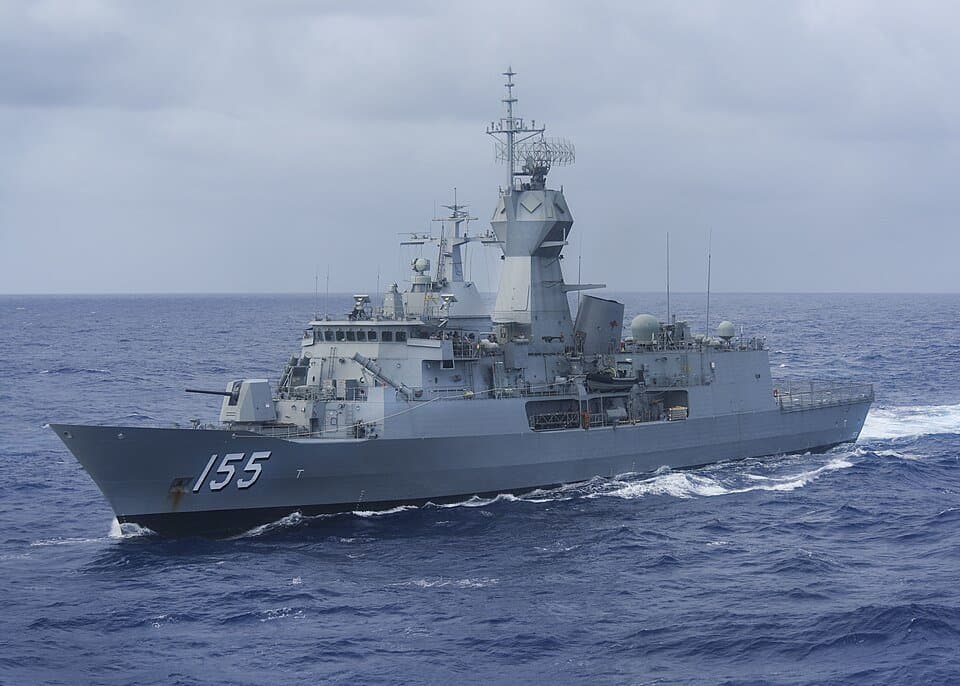
Anzac-class frigatelarger figure on 1 of 2
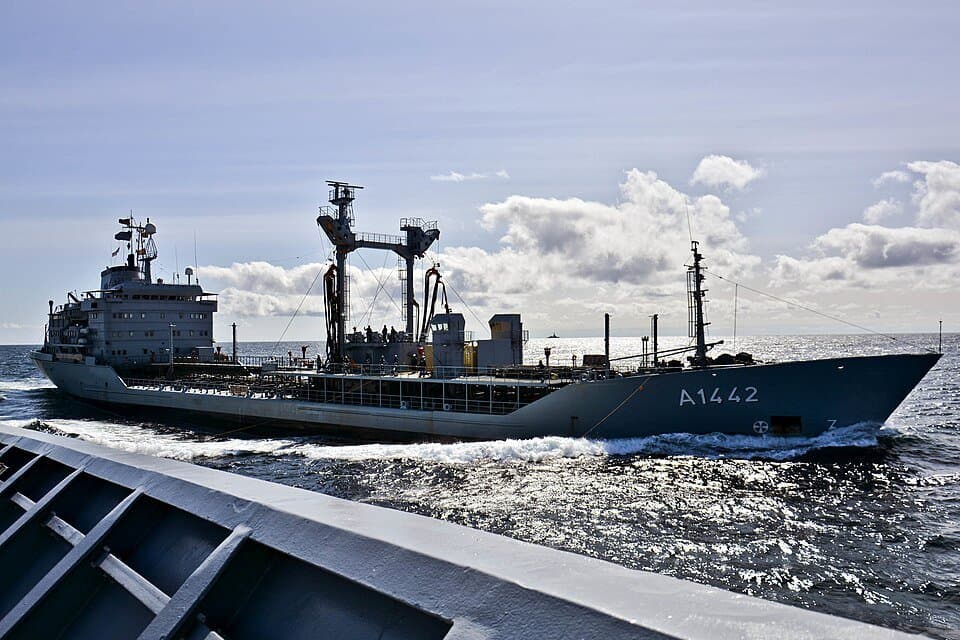
German tanker Spessartlarger figure on 1 of 2
Counts only measures both sources give with the same scope. A larger figure is not a better system.
Measured figures
length overall
Single sourcewaterline length
Single sourceConfiguration
| Specification | Anzac-class frigate | German tanker Spessart |
|---|---|---|
| Name | Anzac[source] | Spessart[source] |
| Builders | AMECON[source] | — |
| Operators | Royal Australian Navy (RAN) Royal New Zealand Navy (RNZN)[source] | — |
| Preceded by | River-class destroyer escort (RAN) Leander class (RNZN)[source] | — |
| Succeeded by | New FFM-class (RAN)[source] | — |
109 m (357 ft 7 in) waterline length 118 m (387 ft 2 in) length overall[source]
Length
Single source130.2 m (427 ft 2 in)[source]
Combined Diesel or Gas (CODOG): 1 × General Electric LM2500-30 gas turbine, 30,172 hp (22,499 kW) 2 × MTU 12V1163 TB83 diesel engines, 8,840 hp (6,590 kW) each 2 × controllable-pitch propellers[source]
1 MaK 12-cylinder diesel engine
Single source1 MaK 12-cylinder diesel engine 5,880 kW (7,890 hp )[source]
Bars compare reported quantities only. A larger figure does not make a system better; configurations and test conditions differ.
| Built | 1993–2006[source] | — |
|---|
| In commission | 1996–present (RAN) 1997–present (RNZN)[source] | — |
|---|
| Planned | 12[source] | — |
|---|
| Completed | 10[source] | — |
|---|
| Cancelled | — |
|---|
| Active | — |
|---|
| Retired | — |
|---|
| Type | Frigate[source] | Rhön -class tanker[source] |
|---|
| Boats & landing craft carried | 3 x 7.2 m Juliet 3 RHIBs (although only 2 are normally carried)[source] | — |
|---|
| Electronic warfare & decoys | Mark 36 SRBOC launchers SLQ-25A towed torpedo decoy Nulka decoy launchers Rascal Thorn modified Sceptre-A electronic support measures Telefunken PST-1720 Telegon 10 radar intercept unit[source] | — |
|---|
| Armament | Missiles: RAN 8-cell Tactical Mark 41 Vertical Launch System firing 32 quad-packed RIM-162 ESSM 2 × 4-canister Harpoon or NSM anti-ship missiles RNZN 20-cell GWS.35 VLS firing 20 Sea Ceptor surface-to-air missiles Torpedoes: 2 × Mark 32 triple torpedo launchers RAN: MU90 Impact torpedoes RNZN: Mark 46 torpedoes Guns: RAN and RNZN 1 × 5-inch/54 calibre Mark 45 mod 2 main gun 2 × .50 cal machine guns on Mini Typhoon mounts 6 x .50 cal machine guns crew served RNZN 1 × 20 mm Vulcan Phalanx close-in weapons system Fitted for but not with RAN 1 × close-in weapons system 2nd 8-cell Mark 41 VLS RNZN 2 × 4-canister anti-ship missiles[source] | — |
|---|
| Aircraft carried | 1 helicopter RAN : Sikorsky MH-60R Seahawk RNZN : Kaman SH-2G Super Seasprite[source] | — |
|---|
| Notes | For upgrades and current configurations, see the sections on "Australian modifications" and "New Zealand modifications" , or the individual ship articles[source] | — |
|---|
| Role | ship class of ten frigates ; eight[source] | — |
|---|
| Source measurement | In 1992, work started on the frigates; 3,600-tonne (3,500-long-ton) ships capable of a 27- knot (50 km/h; 31 mph) top speed, and a range of 6,000 nautical miles (11,000 km; 6,900 mi) at 18 knots (33 km/h; 21 mph). The armament initially consisted of a single 5-inch gun and a point-defence missile system, supported by a missile-armed helicopter. In addition, the ships were fitted for but not with a torpedo system, anti-ship missiles , and a close-in weapons system . The last ship of the class entered service in 2006; by this point, the RAN and RNZN had embarked on separate projects to improve the frigates' capabilities by fitting the additional weapons, along with updates to other systems and equipment.[source]Anzac-class frigate · Lead; only the objects and conditions stated in this passage The Anzac class originated from the RAN's New Surface Combatant (NSC) project, which began in the mid-1980s to find a replacement for the RAN's six River-class destroyer escorts . By 1985, various design briefs ranging from 1,200 to 5,000 tonnes (1,200 to 4,900 long tons ) displacement were under consideration, with the RAN emphasising anti-ship missile defence, damage control, and ship survivability based on Royal Navy experiences during the Falklands War . Eventually, the project settled on a ship of approximately 3,600 tonnes (3,500 long tons) displacement. At this time, it was also believed that Australia did not have the capability to design a major warship from scratch, so the decision was made to select a proven foreign design and fit it with an Australian-developed combat system. In early 1986, a review of policy regarding surface combatants saw the NSC classified into the middle of three tiers: a patrol frigate designed to operate on low- to mid-intensity operations in Australia's economic exclusion zone .[source]Anzac-class frigate · Planning and development; only the objects and conditions stated in this passage The proposed baseline characteristics called for a vessel capable of reaching speeds of 27 knots (50 km/h; 31 mph) and a range of 6,000 nautical miles (11,000 km; 6,900 mi) at 18 knots (33 km/h; 21 mph) based on a combined diesel or gas (CODOG) propulsion system, able to operate in Sea State 5, and capable of operating a Seahawk -size helicopter.[source]Anzac-class frigate · Planning and development; only the objects and conditions stated in this passage The ship was to be fitted with a 76 or 127 mm (3.0 or 5.0 in) main gun and an eight-cell launcher for a point-defence missile system, and fitted for but not with a torpedo system, anti-ship missiles, and a close-in weapons system .[source]Anzac-class frigate · Planning and development; only the objects and conditions stated in this passage After the election of the Lange Labour government, thinking on alternatives to frigates for the RNZN had moved towards purpose-built designs rather like the Irish Navy's Eithne patrol corvette, a sort of 1,800-ton high endurance corvette with Leander -like helicopter hangar and pad or small Meko 100–140 designs rather different from the Espora -class corvettes built for Argentina.[source]Anzac-class frigate · Planning and development / New Zealand controversy; only the objects and conditions stated in this passage The primary role foreseen for the RNZN was fisheries protection, particularly following the introduction of a 200- nautical-mile (370 km; 230 mi) exclusive economic zone by the 1982 United Nations Convention on the Law of the Sea ; this was thought to require a minimum of six vessels to effectively police.[source]Anzac-class frigate · Planning and development / New Zealand controversy; only the objects and conditions stated in this passage Each frigate has a 3,600-tonne (3,500-long-ton) full load displacement . The ships are 109 metres (357 ft 7 in) long at the waterline , and 118 metres (387 ft 2 in) long overall , with a beam of 14.8 metres (48 ft 7 in), and a draught at full load of 4.35 metres (14 ft 3 in). The hull and superstructure are of all-steel construction, and the ships are fitted with fin stabilisers .[source]Anzac-class frigate · Design at launch; only the objects and conditions stated in this passage The frigates use a combined diesel or gas (CODOG) propulsion machinery layout, with a single, 30,172-horsepower (22,499 kW) General Electric LM2500 -30 gas turbine and two 8,840-horsepower (6,590 kW) MTU 12V1163 TB83 diesel engines driving the ship's two controllable-pitch propellers . Maximum speed is 27 knots (50 km/h; 31 mph), and maximum range is over 6,000 nautical miles (11,000 km; 6,900 mi) at 18 knots (33 km/h; 21 mph). The frigates' range is about 50% greater than other MEKO-type frigates, due to an enhanced fuel supply. Originally, two gas turbines were to be fitted; this layout would have provided a top speed of 31.75 knots (58.80 km/h; 36.54 mph). The starboard turbine was cancelled to save costs.[source]Anzac-class frigate · Design at launch; only the objects and conditions stated in this passage The standard ship's company of an Anzac consists of 22 officers and 141 sailors. Onboard electricity requirements are met by four MTU diesel generators. Each ship can carry up to 29 cubic metres (1,000 cu ft) of dry provisions, 29 cubic metres (1,000 cu ft) of refrigerated provisions, and 54 tonnes (53 long tons; 60 short tons) of fresh water.[source]Anzac-class frigate · Design at launch; only the objects and conditions stated in this passage At the time of construction, the main weapon for the Anzac s was a United Defense 5-inch 54 calibre Mark 45 Mod 2 dual purpose gun . The forward-mounted gun is capable of firing 32-kilogram (71 lb) shells at a rate of 20 rounds per minute, to a distance of 23 kilometres (14 mi). The barrel can elevate to 65 degrees. This was supplemented by a Tactical-length eight-cell Lockheed Martin Mark 41 Mod 5 vertical launch system for RIM-7 Sea Sparrow missiles as a point-defence system. The Sea Sparrow is a semi-active radar homing missile, with a 39-kilogram (86 lb) warhead, a range of 14.6 kilometres (9.1 mi), and a top speed of Mach 2.5. Two 12.7-millimetre (0.50 in) machine guns were fitted for close defence.[source]Anzac-class frigate · Design at launch / Armament; only the objects and conditions stated in this passage Ships were fitted for but not with a close-in weapons system , two quad-canister Harpoon anti-ship missile launchers, and a second Mark 41 launcher. After the ships were completed, both navies fitted Mark 32 three-tube torpedo launchers to their frigates. These were taken from older ships where possible; for example, Te Kaha ' s launchers came from Southland . The launchers were configured to fire the Mark 46 Mod 5 torpedo , an active/passive homing torpedo with a range of 11 kilometres (6.8 mi) at 40 knots (74 km/h; 46 mph), and a 44-kilogram (97 lb) warhead.[source]Anzac-class frigate · Design at launch / Armament; only the objects and conditions stated in this passage Additional ballast was required to maintain stability, and the combined weight increase brought the ship's full load displacement to 3,810 tons.[source]Anzac-class frigate · Modifications and improvements / Australian modifications; only the objects and conditions stated in this passage The RAN commenced tendering for a helicopter design to replace the Seahawks aboard the Australian Anzac s in 1996, with a contract for 11 Kaman SH-2G Super Seasprite helicopters signed in 1997.[source]Anzac-class frigate · Modifications and improvements / Australian modifications; only the objects and conditions stated in this passage In 1997, the RNZN began steps to acquire five Kaman SH-2G Super Seasprite helicopters for the two frigates. Unlike the Australians, the New Zealand contract specified new-build helicopters. Kaman Aerospace loaned four SH-2F Seasprites to the RNZN while the new helicopters were constructed: the SH-2Fs operated from February 1998 to August 2001, when the first two SH-2Gs were accepted into service.[source]Anzac-class frigate · Modifications and improvements / New Zealand modifications; only the objects and conditions stated in this passage Propulsion changes are primarily focused on replacing the TB83 diesel engines with the TB93, providing an additional 1.4 megawatts (1,900 hp) and higher speeds during diesel-only sailing.[source]Anzac-class frigate · Modifications and improvements / New Zealand modifications; only the objects and conditions stated in this passage A series of austere upgrades were approved on 14 April 2014, at an original contract cost of NZ 446m under the ANZAC Frigate Systems Upgrade (FSU) programme. These include the replacement of the existing combat management system, with a system modelled on that of the RCN Halifax -class frigates awarded to Lockheed Martin , The British Sea Ceptor anti-air missile replaced the Sea Sparrow on 27 May 2014. Other changes included the Norwegian Penguin Mk 2 Mod 7 for the Seasprite helicopters and the fitting of a Sea Sentor Surface Ship Torpedo Defence, or SSTD system, as well as MASS (Multi Ammunition Softkill System). A new inertial navigation positioning system (Northrop Grumman) and navigation radar and SharpEye™ surveillance radars with an Agile Tracker has been fitted. The main radar will be the Thales SMART-S Mk2 3D radar. Other sensors and upgrades include Link 16, laser warning, and IFF. The Lockheed Martin Combat Management System 330 is also installed on the RNZN frigates, as it increases the eyes on each screen, covering lesser sensors and crew.[source]Anzac-class frigate · Modifications and improvements / New Zealand modifications; only the objects and conditions stated in this passage The frigates have been predicted to have a displacement of up to 7,000 tonnes (6,900 long tons; 7,700 short tons), and although they will be primarily oriented towards anti-submarine warfare , they are expected to be capable of also operating against air, sea-surface, and land targets.[source]Anzac-class frigate · Planned replacement; only the objects and conditions stated in this passage | — |
|---|
| Namesake | — | Spessart[source] |
|---|
| Owner | — | Deutsche Marine[source] |
|---|
| Port of registry | — | Hamburg , Germany[source] |
|---|
| Builder | — | Kröger , Rendsburg[source] |
|---|
| Launched | — | 13 February 1975[source] |
|---|
| Acquired | — | 1976[source] |
|---|
| Commissioned | — | 5 September 1977[source] |
|---|
| Renamed | — | Okapi[source] |
|---|
| Home port | — | Kiel , Germany[source] |
|---|
| Identification | — | IMO number : 7362079 MMSI number : 211211850 Callsign : DRKN Pennant number : A1442[source] |
|---|
| Status | — | Active[source] |
|---|
| Tonnage | — | 6,103 GRT 10,800 DWT[source] |
|---|
| Propulsion | — | 1 shaft, controllable pitch propeller[source] |
|---|
| Capacity | — | 11,000 m 3 (390,000 cu ft) (fuel) 400 m 3 (14,000 cu ft) (water)[source] |
|---|
| Country of origin | — | Germany[source]German tanker Spessart · literal inventory Origin field assigned to the exact named-ship row covered by the explicit shared Origin cell; no operator, manufacturer location or parent/sibling specification inference |
|---|
| Used by | — | German Navy[source]Current operator stated in the article; inventory date not specified |
|---|