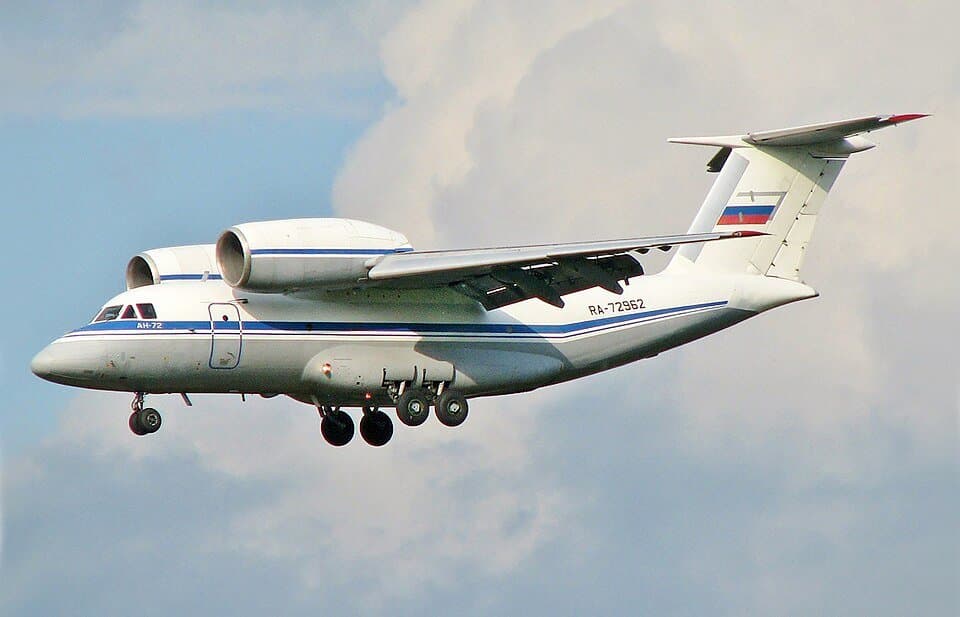
Credit
Kirill Naumenko - Moscow City Spotters · CC BY-SA 3.0 · Resized · CC BY-SA 3.0 · Source ↗ · Modified


Preparing your view.

At a glance
Measured figures
Maximum; An-72 · Maximum speed
Single source700 km/h (435 mph, 378 kn)[source]
Cruise; at 75% power at 10,000 ft (3,000 m)
Single sourceMaximum; at 10,000 ft (3,000 m)
Single sourceMaximum; Maximum speed
Single source359 km/h (223 mph, 194 kn) at 10,000 ft (3,000 m)[source]
319 km/h (198 mph, 172 kn) at 75% power at 10,000 ft (3,000 m)[source]
Maximum speed: 359 km/h (223 mph, 194 kn)[source]Tecnam P2012 Traveller · Specifications · Maximum speed: 359 km/h (223 mph, 194 kn) at 10,000 ft (3,000 m)
2 × Lycoming TEO-540C1A 6-cylinder air-cooled horizontally-opposed turbocharged piston engines each
Single source2 × Lycoming TEO-540C1A 6-cylinder air-cooled horizontally-opposed turbocharged piston engines, 280 kW (375 hp) each[source]
An-72 · 2 × Lotarev D-36 series 1A Turbofan thrust each
Single source2 × Lotarev D-36 series 1A Turbofan, 63.9 kN (14,330 lbf) thrust each[source]
1,140 ft/min
Single source(1,285 ft/min) on STOL variant
Single source5.8 m/s (1,140 ft/min) ; 6.53 m/s (1,285 ft/min) on STOL variant[source]
Bars compare reported quantities only. A larger figure does not make a system better; configurations and test conditions differ.
Configuration
| Specification | Antonov An-72 | Tecnam P2012 Traveller |
|---|---|---|
| Crew | five[source] | 1 or 2[source] |
| Type | Transport aircraft[source] | — |
| National origin | Soviet Union[source] | Italy[source] |
| Manufacturer | Antonov[source] | Tecnam[source] |
| Status | In service[source] | — |
| Primary users | Russian Aerospace Forces Russian Navy Angolan Air Force Soviet Air Force (historical)[source] | Cape Air FLN Frisia Luftverkehr APEX flight academy Pago Wings Pacific Air Charters[source] |
| Number built | 133[source] | 120[source] |
| Manufactured | 1977–2002[source] | — |
| First flight | 31 August 1977 ( 1977-08-31 )[source] | 21 July 2016[source] |
| Developed into | Antonov An-71 Antonov An-74[source] | — |
| Capacity | up to 52 passengers or 10 tonnes of cargo[source] | 9 passenger seats / 1,414 kg (3,117 lb) useful load including fuel[source] |
| Role | — | Utility aircraft[source] |
| Designer | — | Luigi Pascale[source] |
| Introduction date | — | 22 February 2020[source] |
| In service | — | 2020–present[source] |
| Aspect ratio | — | 7.7[source] |
| Fuel capacity | — | 880 L (230 US gal) usable fuel[source] |
| Propellers | — | 3 or 4-bladed MT-Propeller, 1.95 m (6 ft 5 in) diameter constant-speed fully-feathering propeller[source] |
| Stall speed | — | 120 km/h (75 mph, 65 kn) full flaps; 122 km/h (76 mph; 66 kn) full flaps on STOL variant[source] |
| Never exceed speed | — | 419 km/h (260 mph, 226 kn)[source] |
| Wing loading | — | 145 kg/m 2 (30 lb/sq ft)[source] |
| Power/mass | — | 6.6 kg/kW (10.8 lb/hp)[source] |
| Takeoff run | — | 564 m (1,850 ft); 445 m (1,460 ft) on STOL variant[source] |
| Takeoff distance | — | 791 m (2,595 ft); 682 m (2,238 ft) on STOL variant[source] |
| Landing run | — | 365 m (1,198 ft); 290 m (950 ft) on STOL variant[source] |
| Landing distance | — | 743 m (2,438 ft); 590 m (1,940 ft) on STOL variant[source] |
| Fuel Consumption | — | 117 L/h (31 US gal/h)[source] |
| Source measurement | — | The Tecnam P2012 Traveller is a twin-engine, shoulder-wing utility aircraft designed and manufactured by the Italian company Costruzioni Aeronautiche Tecnam , based in Capua , Italy , near Naples . Certified under EASA CS-23 and FAA FAR Part 23 , the aircraft is configured to carry up to nine passengers and one or two pilots, and is designed for commuter, charter, air taxi, cargo, medevac, and surveillance operations.[source]Tecnam P2012 Traveller · Lead; only the objects and conditions stated in this passage On 1 April 2016, the first completed prototype was rolled out. It conducted its maiden flight on 21 July 2016. By April 2017, the first prototype was flown more than 100 hours while the second was set to join during September, targeting a December 2018 certification. The nearly production standard second prototype seats up to nine passengers and conducted its first flight on 22 December 2017; by then the first prototype had flown more than 250 hours.[source]Tecnam P2012 Traveller · Development; only the objects and conditions stated in this passage By August 2018, certification was on track for the year end with 400 hours flown, while the backlog attained 130 and three aircraft were in production. In October 2018, testing was completed after 500 flight hours between the two prototypes. After 600 hours flown by the two prototypes, European type certification was awarded on 20 December 2018, including in icing conditions ; approval from the US authority was expected to follow shortly.[source]Tecnam P2012 Traveller · Development; only the objects and conditions stated in this passage In the following years, Tecnam expanded the P2012 family with several new variants. The P2012 STOL variant was publicly introduced in 2022 and received EASA certification in March 2024. This version, equipped with 375 hp Continental GTSIO-520-S engines and extended wings, was designed for operations on short and unprepared airstrips.[source]Tecnam P2012 Traveller · Development; only the objects and conditions stated in this passage Tecnam planned to build 15 aircraft during 2019; increasing to 25 in 2020 and to 35 during 2021.[source]Tecnam P2012 Traveller · Development / Market; only the objects and conditions stated in this passage Kenai Aviation, based in Alaska , added its first P2012 in 2022 and a third aircraft in April 2024. The operator cited the P2012’s reliability, short-field performance, and low operating cost as ideal for challenging Alaskan routes, having flown nearly 30,000 passengers and 29,000 lb of cargo within two years.[source]Tecnam P2012 Traveller · Development / Market; only the objects and conditions stated in this passage St. Barth Executive, based in the French Caribbean , became the launch customer and first operator to introduce the P2012 STOL into revenue service. The first passenger flight was conducted on 1 August 2024, connecting Pointe-à-Pitre ( Guadeloupe ) and Saint-Barthélemy , a route previously accessible only by sea. Operated under the Air Inter Iles brand, the service began with three daily flights, rising to six in high season. The STOL variant is particularly suited to the challenging conditions of Saint-Barthélemy’s short runway (646 meters) and steep approach. St. Barth Executive planned to operate three P2012 STOL aircraft to serve regional island routes and improve inter-island connectivity in the French Caribbean.[source]Tecnam P2012 Traveller · Development / Market; only the objects and conditions stated in this passage The Traveller is a twin piston-engined aircraft, powered by a pair of Lycoming TEO540 C1As, each producing 375 hp (280 kW), which give the type a maximum permissible speed (VNE) of 226 kn (419 km/h). In June 2023 the option of fitting twin 375 hp (280 kW) Continental GTSIO-520-S engines was added by Tecnam with a maximum permissible speed (VNE) of 228 kn (422 km/h). While the Lycoming engines use full authority digital engine control ( FADEC ) and a four-blade propeller, the Continental variant offers a more traditional throttle-propeller-mixture setup with three-blade propellers. The design complies with FAR Part 23 and EASA CS-23 regulations.[source]Tecnam P2012 Traveller · Design; only the objects and conditions stated in this passage Performance characteristics vary by configuration. The P2012 Traveller equipped with Continental engines offers a maximum range of up to 1,350 nautical miles (2,500 km) and a maximum endurance of 13 hours, while the Lycoming-powered version reaches up to 1,000 nautical miles (1,852 km) and 10 hours of endurance. The STOL variant, designed for operations on short and unprepared runways, has a maximum range of 1,100 nautical miles (2,037 km) and an endurance of up to 12 hours. The STOL variant is capable of taking off in 315 meters (1,033 ft) and landing in 225 meters (738 ft) at maximum landing weight.[source]Tecnam P2012 Traveller · Design; only the objects and conditions stated in this passage The cabin accommodates up to nine passengers in a standard commuter configuration, with individual seats arranged in a single-aisle layout. Each seat is positioned next to a rectangular window and is equipped with personal reading lights and dual USB charging ports. Overhead air vents provide adjustable ventilation. Cabin options include dual-zone air conditioning and heating. The interior features a flat floor, a constant cross-section, and a dedicated boarding door with integrated steps. Although designed for single-pilot operations, the aircraft can also be flown with two crew members during initial operator transition or for training. The cockpit layout follows a clean-sheet design, offering direct access to flight systems and avionics.[source]Tecnam P2012 Traveller · Design; only the objects and conditions stated in this passage The wing has two spars with sheet metal ribs and a fibre-reinforced plastic (GFRP) leading edge . It has a semi- tapered planform featuring a NACA five digit airfoil selected for low drag and a high maximum lift coefficient . The wing box fuel tanks between the two spars have a capacity of 800 litres (212 US gallons). Low stall speeds for steep approaches and short landings are enabled by wide slotted flaps , electrically actuated and made of an aluminium alloy. All control surfaces have wide trim tabs , while the rudder has a yaw damper integrated with the automatic flight control system .[source]Tecnam P2012 Traveller · Design; only the objects and conditions stated in this passage An optional ferry tank system can be installed to increase total fuel capacity, extending the endurance up to 13 hours depending on load and configuration.[source]Tecnam P2012 Traveller · Design; only the objects and conditions stated in this passage STOL variant equipped with 375 hp (280 kW) Continental GTSIO-520-S engines and extended wingspan. It is certified for operations on unprepared and short runways, with take-off and landing distances of 315 m and 225 m respectively.[source]Tecnam P2012 Traveller · Variants; only the objects and conditions stated in this passage Proposed electric-powered passenger derivative of P2012, later cancelled. Proposal was for an aircraft equipped with a 1,100 kg (2,400 lb) battery pack and two 320 kW (430 hp) motors, giving a range of 85 nmi (157 km); 98 mi), with a 180 kn (330 km/h) top speed and a 4,086 kg (9,008 lb) ramp weight.[source]Tecnam P2012 Traveller · Variants; only the objects and conditions stated in this passage Capacity: 9 passenger seats / 1,414 kg (3,117 lb) useful load including fuel[source]Tecnam P2012 Traveller · Specifications; only the objects and conditions stated in this passage Length: 11.8 m (38 ft 9 in)[source]Tecnam P2012 Traveller · Specifications; only the objects and conditions stated in this passage Wingspan: 14 m (45 ft 11 in) ; 16.6 m (54 ft) on STOL variant[source]Tecnam P2012 Traveller · Specifications; only the objects and conditions stated in this passage Height: 4.4 m (14 ft 5 in)[source]Tecnam P2012 Traveller · Specifications; only the objects and conditions stated in this passage Wing area: 25.4 m 2 (273 sq ft)[source]Tecnam P2012 Traveller · Specifications; only the objects and conditions stated in this passage Empty weight: 2,386 kg (5,260 lb) ; 2,416 kg (5,326 lb) on STOL variant[source]Tecnam P2012 Traveller · Specifications; only the objects and conditions stated in this passage Max takeoff weight: 3,680 kg (8,113 lb)[source]Tecnam P2012 Traveller · Specifications; only the objects and conditions stated in this passage Powerplant: 2 × Lycoming TEO-540C1A 6-cylinder air-cooled horizontally-opposed turbocharged piston engines, 280 kW (375 hp) each[source]Tecnam P2012 Traveller · Specifications; only the objects and conditions stated in this passage Powerplant: 2 × Continental GTSIO-520-S 6-cylinder horizontally-opposed turbocharged, geared piston engines, 280 kW (375 hp) each[source]Tecnam P2012 Traveller · Specifications; only the objects and conditions stated in this passage Propellers: 3 or 4-bladed MT-Propeller, 1.95 m (6 ft 5 in) diameter constant-speed fully-feathering propeller[source]Tecnam P2012 Traveller · Specifications; only the objects and conditions stated in this passage Maximum speed: 359 km/h (223 mph, 194 kn) at 10,000 ft (3,000 m)[source]Tecnam P2012 Traveller · Specifications; only the objects and conditions stated in this passage Cruise speed: 319 km/h (198 mph, 172 kn) at 75% power at 10,000 ft (3,000 m)[source]Tecnam P2012 Traveller · Specifications; only the objects and conditions stated in this passage Stall speed: 120 km/h (75 mph, 65 kn) full flaps; 122 km/h (76 mph; 66 kn) full flaps on STOL variant[source]Tecnam P2012 Traveller · Specifications; only the objects and conditions stated in this passage Never exceed speed : 419 km/h (260 mph, 226 kn)[source]Tecnam P2012 Traveller · Specifications; only the objects and conditions stated in this passage Range: 2,500 km (1,600 mi, 1,300 nmi)[source]Tecnam P2012 Traveller · Specifications; only the objects and conditions stated in this passage Service ceiling: 5,900 m (19,500 ft) restricted to four passengers over 4,000 m (13,000 ft)[source]Tecnam P2012 Traveller · Specifications; only the objects and conditions stated in this passage Rate of climb: 5.8 m/s (1,140 ft/min) ; 6.53 m/s (1,285 ft/min) on STOL variant[source]Tecnam P2012 Traveller · Specifications; only the objects and conditions stated in this passage Takeoff run: 564 m (1,850 ft); 445 m (1,460 ft) on STOL variant[source]Tecnam P2012 Traveller · Specifications; only the objects and conditions stated in this passage Takeoff distance: 791 m (2,595 ft); 682 m (2,238 ft) on STOL variant[source]Tecnam P2012 Traveller · Specifications; only the objects and conditions stated in this passage Landing run: 365 m (1,198 ft); 290 m (950 ft) on STOL variant[source]Tecnam P2012 Traveller · Specifications; only the objects and conditions stated in this passage Landing distance: 743 m (2,438 ft); 590 m (1,940 ft) on STOL variant[source]Tecnam P2012 Traveller · Specifications; only the objects and conditions stated in this passage |
| Reported operators |
| — |
Maximum take-off; Max takeoff weight
Single source