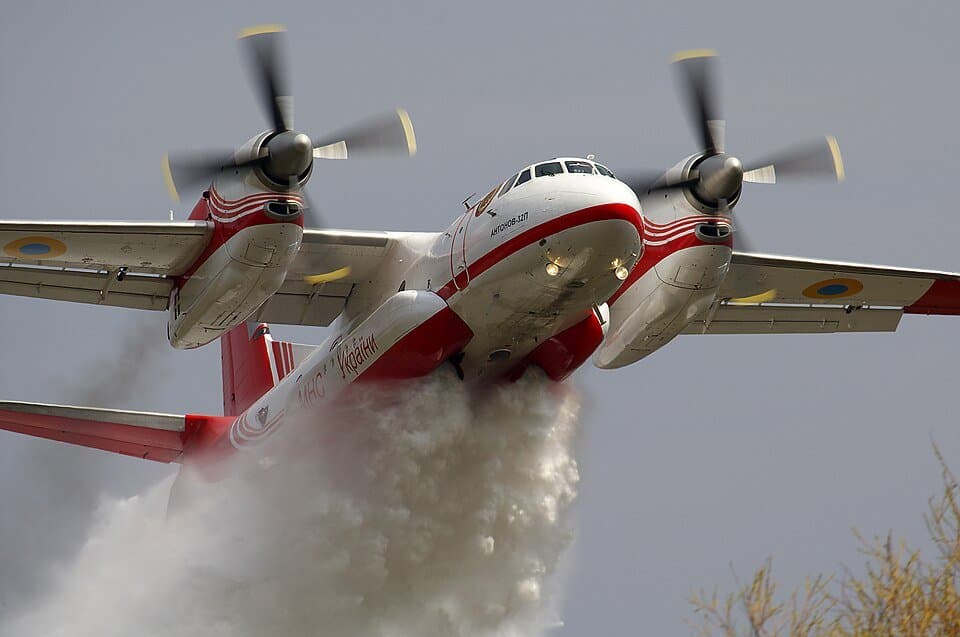


Credit
Oleg Belyakov · CC BY-SA 3.0 · Resized · CC BY-SA 3.0 · Source ↗ · Modified


Preparing your view.

At a glance
True scale
Side by side. From every angle. A human reference for perspective.
3.44 MB · Loads when you open it| Model | Length | Width / span | Height |
|---|---|---|---|
| Antonov An-32 | ≈ 23.78 m | ≈ 29.2 m (Width) | ≈ 8.75 m |
| Curtiss C-46 Commando | ≈ 23.27 m | ≈ 32.92 m (Width) | ≈ 6.63 m |
Scaled uniformly to the sourced length of 23.78 m. The shape was turned square to the axes; the height was fitted to the sourced 8.75 m; the width was fitted to the sourced 29.2 m. Not an official model or a measured survey.
ForceTally · All rights reserved
Scaled uniformly to the sourced length of 23.27 m. The shape was turned square to the axes; the height was fitted to the sourced 6.63 m; the width was fitted to the sourced 32.92 m. Not an official model or a measured survey.
ForceTally · All rights reserved
The human reference is a generic 1.75 m figure. Models describe external size, not combat performance.
Measured figures
An-32 · Length
Single source23.78 m (78 ft 0 in)[source]
Configuration
| Specification | Antonov An-32 | Curtiss C-46 Commando |
|---|---|---|
| Type | Military transport aircraft[source] | Military transport aircraft[source] |
| National origin | Soviet Union / Russia / Ukraine[source] | United States[source] |
| Manufacturer | Antonov Serial Production Plant[source] | Curtiss-Wright Higgins Aircraft[source] |
| Designer | Antonov[source] | — |
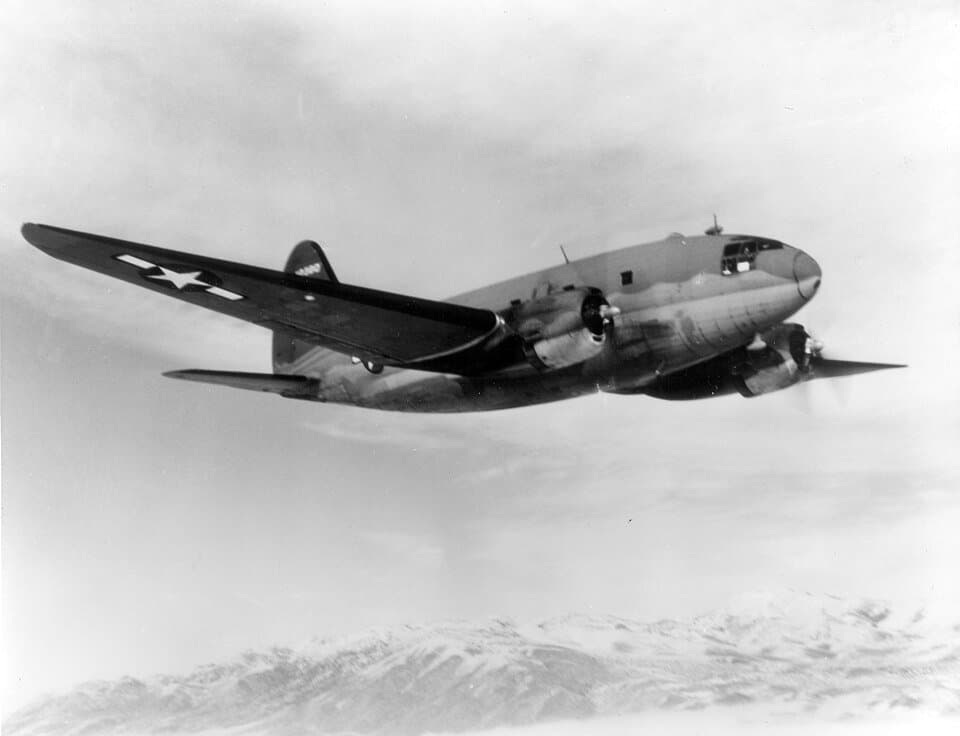
C-46A · Length
76 ft 4 in (23.27 m)[source]
An-32 · with 3,700 kg (8,160 lb) payload, no reserves
Single source2,500 km (1,600 mi, 1,300 nmi) with 3,700 kg (8,160 lb) payload, no reserves[source]
C-46A · at 173 mph (150 kn; 278 km/h)
Single sourceC-46A · at 237 mph (206 kn; 381 km/h)
Single source3,150 mi (5,070 km, 2,740 nmi) at 173 mph (150 kn; 278 km/h); 1,000 mi (870 nmi; 1,600 km) at 237 mph (206 kn; 381 km/h)[source]
An-32 · 2 × ZMKB Progress AI-20DM turboprop engines each
Single source2 × ZMKB Progress AI-20DM turboprop engines, 3,812 kW (5,112 hp) each[source]
C-46A · 2 × Pratt & Whitney R-2800-51 Double Wasp 18-cylinder air-cooled radial piston engines each
Single source2 × Pratt & Whitney R-2800-51 Double Wasp 18-cylinder air-cooled radial piston engines, 2,000 hp (1,500 kW) each[source]
Bars compare reported quantities only. A larger figure does not make a system better; configurations and test conditions differ.
| Status | In service[source] | Active in limited civilian use[source] |
|---|
| Primary users | Indian Air Force National Air Force of Angola Sri Lanka Air Force Ukrainian Air Force[source] | Buffalo Airways United States Air Force United States Marine Corps United States Navy[source] |
|---|
| Number built | 373[source] | 3,181[source] |
|---|
| Manufactured | 1982–2012[source] | 1940–1945[source] |
|---|
| First flight | 9 July 1976[source] | 26 March 1940[source] |
|---|
| Developed from | Antonov An-26[source] | — |
|---|
| Developed into | Antonov/Taqnia An-132[source] | — |
|---|
| Capacity | 42 paratroopers/50 passengers/24 Casualties on stretcher with three medical personnel / 6,700 kg (14,771 lb) max payload[source] | 40 troops or 30 stretcher patients or 15,000 lb (6,800 kg) cargo[source] |
|---|
| Propellers | 4-bladed constant speed propellers[source] | 4-bladed Curtiss Electric constant-speed propellers[source] |
|---|
| Introduction date | — | 1941[source] |
|---|
| Airfoil | — | root: NACA 23017 ; tip: NACA 4410.5[source] |
|---|
| Time to altitude | — | 10,000 ft (3,000 m) in 17 minutes 24 seconds[source] |
|---|
| Source measurement | — | The Curtiss C-46 Commando is a low-wing , twin-engine aircraft derived from the Curtiss CW-20 pressurized high-altitude airliner design. Early press reports used the name "Condor III" but the Commando name was in use by early 1942 in company publicity. It was used primarily as a cargo aircraft during World War II , with fold-down seating for military transport and some use in delivering paratroops. Mainly deployed by the United States Army Air Forces , it also served the U.S. Navy / Marine Corps , which called it R5C . The C-46 filled similar roles as its Douglas-built counterpart, the C-47 Skytrain , with some 3,200 C-46s produced to approximately 10,200 C-47s.[source]Curtiss C-46 Commando · Lead; only the objects and conditions stated in this passage The company approached many airlines to obtain their requirements for an advanced airliner. No firm orders resulted, although 25 letters of intent were received, sufficient to begin production. The design of a 24–34 passenger airliner proceeded to the prototype stage as the CW-20 at the St. Louis, Missouri facility with the initial configuration featuring twin vertical tail surfaces. Powered by two 1,700 hp (1,300 kW ) R-2600-C14-BA2 Wright Twin Cyclones , the prototype, registered NX-19436 flew for the first time on 26 March 1940 with test pilot Edmund T. "Eddie" Allen at the controls. After testing, modifications, including the fitting of a large single tail to improve stability at low speeds were made.[source]Curtiss C-46 Commando · Design and development; only the objects and conditions stated in this passage A total of 200 C-46As in two batches were ordered in 1940, although only two were actually delivered by 7 December 1941. An important change was made: more powerful 2,000 hp (1,500 kW)c Pratt & Whitney R-2800 Double Wasp engines replaced the Twin Cyclones. By November 1943, 721 modifications had been made to production models, although many were minor, such as fuel system changes and a reduction in cabin windows. Subsequent military contracts for the C-46A extended the production run to 1,454 examples, 40 of which were destined for the U.S. Marine Corps, to be called R5C-1 . The military model was fitted with double cargo doors, a strengthened floor and a hydraulically operated cargo handling winch; 40 folding seats were the sole passenger accommodation for what was essentially a cargo hauler. Two C-46 were delivered from Higgins Industries Michoud Factory Field in 1942.[source]Curtiss C-46 Commando · Design and development; only the objects and conditions stated in this passage The final large production-run C-46D arrived in 1944–45 and featured single doors to facilitate paratroop drops. Production totaled 1,430 aircraft. Although a one-off XC-46B experimented with a stepped windscreen and more powerful engines, a small run of 17 C-46E s had many of the same features as the XC-46B, along with three-bladed Hamilton-Standard propellers replacing the standard Curtiss-Electric four-bladed units. A last contract for 234 C-46F s reverted to the earlier cockpit shape but introduced square wing tips. A sole C-46G had the stepped windscreen and square wing tips but the end of the war resulted in the cancellation of any additional orders for the type.[source]Curtiss C-46 Commando · Design and development; only the objects and conditions stated in this passage Its powerful engines enabled it to climb satisfactorily with heavy loads, staying aloft on one engine if not overloaded, though "war emergency" load limits of up to 40,000 lb (18,000 kg) often erased any safety margins.[source]Curtiss C-46 Commando · Operational history / Pacific Theater; only the objects and conditions stated in this passage The operation's paratroop drop phase was flown in daylight at low speeds at very low altitudes by an unarmed cargo aircraft without self-sealing fuel tanks , over heavy concentrations of German 20 mm, 37 mm and larger caliber anti-aircraft (AA) cannon firing explosive, incendiary and armor-piercing incendiary ammunition.[source]Curtiss C-46 Commando · Operational history / Europe; only the objects and conditions stated in this passage Indeed, Eastern Air Lines lost only one C-46 in more than two years of operation.[source]Curtiss C-46 Commando · Operational history / Design shortcomings; only the objects and conditions stated in this passage The type served in the Central Intelligence Agency (CIA). The C-46 played a supporting role in many clandestine operations during the late 1940s and early 1950s, including supply efforts to Chiang Kai-Shek 's troops battling Mao 's Communists in China as well as flying cargoes of military and medical supplies to French forces via Gialam Airfield in Hanoi and other bases in French Indochina. The CIA operated its own "airline" for these operations, Civil Air Transport, which was eventually renamed Air America in 1959. An Air America C-46 was the last fixed-wing aircraft flown out of Vietnam [Saigon] at the close of hostilities there. On 29 April 1975, Capt. E. G. Adams flew a 52-seat version, with 152 people on board, to Bangkok, Thailand .[source]Curtiss C-46 Commando · Operational history / Postwar / Operators; only the objects and conditions stated in this passage Prices for a used C-46 in 1960 ranged from £20,000 for a C-46F conversion, to £60,000 for a C-46R.[source]Curtiss C-46 Commando · Operational history / Postwar / Operators; only the objects and conditions stated in this passage Company designation for the C-46G .[source]Curtiss C-46 Commando · Variants; only the objects and conditions stated in this passage CW-20G[source]Curtiss C-46 Commando · Variants; only the objects and conditions stated in this passage CW-20H[source]Curtiss C-46 Commando · Variants; only the objects and conditions stated in this passage 1. The original passenger airliner prototype, fitted with a dihedralled tailplane and endplate fins, powered by two 1,700 hp (1,300 kW) Wright R-2600 Twin Cyclone radial piston engines .[source]Curtiss C-46 Commando · Variants; only the objects and conditions stated in this passage Twin-engined military transport aircraft, powered by two 2,000 hp (1,500 kW) Pratt & Whitney R-2800-43 radial piston engines.[source]Curtiss C-46 Commando · Variants; only the objects and conditions stated in this passage Twin-engined military transport aircraft, powered by two 2,000 hp Pratt & Whitney R-2800-51 radial piston engines, fitted with a large cargo door on the port side of the fuselage, equipped with strengthened cargo floor, a hydraulic winch and folding seats for up to 40 troops.[source]Curtiss C-46 Commando · Variants; only the objects and conditions stated in this passage One C-46A was converted into a test aircraft to evaluate a stepped windscreen design, it was powered by two 2,100 hp (1,600 kW) R-2800-34W radial piston engines with water injection.[source]Curtiss C-46 Commando · Variants; only the objects and conditions stated in this passage Redesignated from C-46G, later redesignated XC-113.[source]Curtiss C-46 Commando · Variants; only the objects and conditions stated in this passage 17 C-46Ds modified with a large single cargo door on the port side of the fuselage, fitted with a stepped windscreen and 2,000 hp R-2800-75 engines with 3-bladed Hamilton Standard propellers.[source]Curtiss C-46 Commando · Variants; only the objects and conditions stated in this passage C-46G Commando[source]Curtiss C-46 Commando · Variants; only the objects and conditions stated in this passage C-46H[source]Curtiss C-46 Commando · Variants; only the objects and conditions stated in this passage More powerful version of C-46F, equipped with twin tail wheels, 300 ordered but later cancelled. One C-46A was modified to C-46H standard after WWII.[source]Curtiss C-46 Commando · Variants; only the objects and conditions stated in this passage Unbuilt version, intended to be powered by two 2,500 hp (1,900 kW) Wright R-3350-BD radial piston engines.[source]Curtiss C-46 Commando · Variants; only the objects and conditions stated in this passage Conversion project for C-46F with two 2,500 hp Wright R-3350-BD engines.[source]Curtiss C-46 Commando · Variants; only the objects and conditions stated in this passage Mid 1950s modification in response to CAB certification mandate (see text) offered by Riddle Airlines , which added 40 mph (64 km/h) to cruising speed and 2,200 lb (1,000 kg) to the payload.[source]Curtiss C-46 Commando · Variants; only the objects and conditions stated in this passage Engine change: One C-46G, s/n 44-78945, was converted into an engine testbed, the aircraft was fitted with a General Electric T31 turboprop in place of right-hand side R-2800. The aircraft handled so poorly on the ground that it was never flown.[source]Curtiss C-46 Commando · Variants; only the objects and conditions stated in this passage Capacity: 40 troops or 30 stretcher patients or 15,000 lb (6,800 kg) cargo[source]Curtiss C-46 Commando · Specifications (C-46A); only the objects and conditions stated in this passage Length: 76 ft 4 in (23.27 m)[source]Curtiss C-46 Commando · Specifications (C-46A); only the objects and conditions stated in this passage Wingspan: 108 ft 0 in (32.92 m)[source]Curtiss C-46 Commando · Specifications (C-46A); only the objects and conditions stated in this passage Height: 21 ft 9 in (6.63 m)[source]Curtiss C-46 Commando · Specifications (C-46A); only the objects and conditions stated in this passage Wing area: 1,360 sq ft (126 m 2 )[source]Curtiss C-46 Commando · Specifications (C-46A); only the objects and conditions stated in this passage Empty weight: 30,669 lb (13,911 kg)[source]Curtiss C-46 Commando · Specifications (C-46A); only the objects and conditions stated in this passage Gross weight: 45,000 lb (20,412 kg)[source]Curtiss C-46 Commando · Specifications (C-46A); only the objects and conditions stated in this passage Powerplant: 2 × Pratt & Whitney R-2800-51 Double Wasp 18-cylinder air-cooled radial piston engines, 2,000 hp (1,500 kW) each[source]Curtiss C-46 Commando · Specifications (C-46A); only the objects and conditions stated in this passage Maximum speed: 270 mph (430 km/h, 230 kn) at 15,000 ft (4,600 m)[source]Curtiss C-46 Commando · Specifications (C-46A); only the objects and conditions stated in this passage Cruise speed: 173 mph (278 km/h, 150 kn)[source]Curtiss C-46 Commando · Specifications (C-46A); only the objects and conditions stated in this passage Range: 3,150 mi (5,070 km, 2,740 nmi) at 173 mph (150 kn; 278 km/h); 1,000 mi (870 nmi; 1,600 km) at 237 mph (206 kn; 381 km/h)[source]Curtiss C-46 Commando · Specifications (C-46A); only the objects and conditions stated in this passage Service ceiling: 24,500 ft (7,500 m)[source]Curtiss C-46 Commando · Specifications (C-46A); only the objects and conditions stated in this passage Time to altitude: 10,000 ft (3,000 m) in 17 minutes 24 seconds[source]Curtiss C-46 Commando · Specifications (C-46A); only the objects and conditions stated in this passage |
|---|
Maximum take-off; C-46A Commando · maximum takeoff weight · C-46A Commando · maximum takeoff weight
Single source