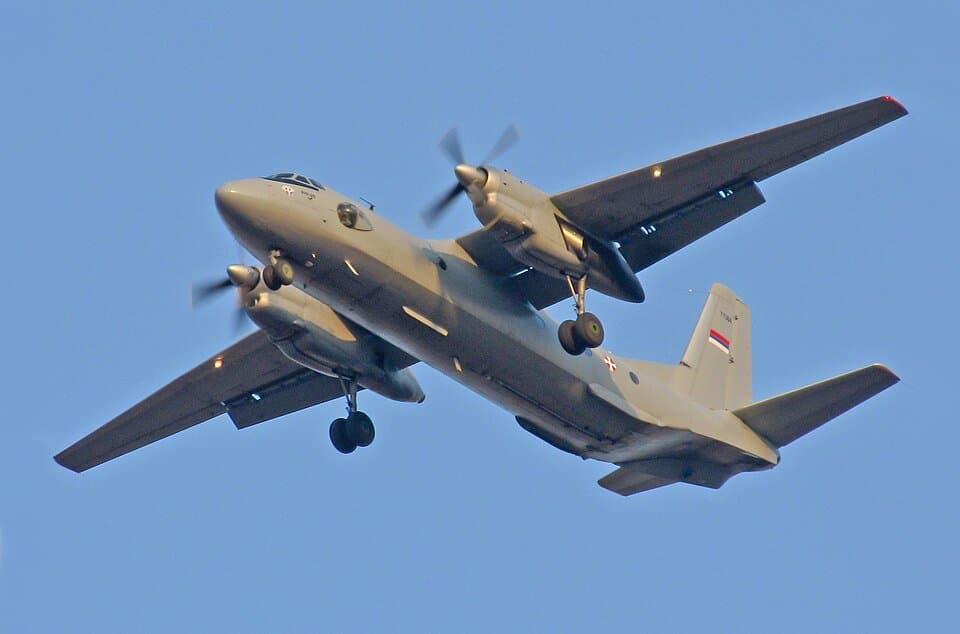
Credit
Marko Stojkovic · CC BY-SA 3.0 · Resized · CC BY-SA 3.0 · Source ↗ · Modified


Preparing your view.

At a glance
True scale
Side by side. From every angle. A human reference for perspective.
3.21 MB · Loads when you open it| Model | Length | Width / span | Height |
|---|---|---|---|
| Antonov An-26 | ≈ 23.8 m | ≈ 29.3 m (Width) | ≈ 8.58 m |
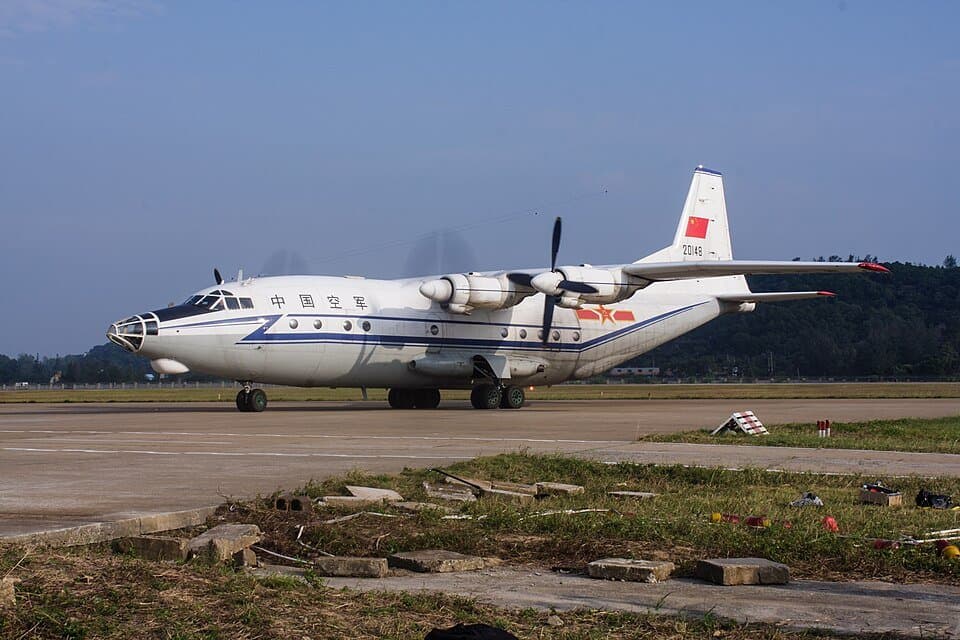
| Shaanxi Y-8 | ≈ 34.02 m | ≈ 38 m (Width) | ≈ 11.16 m |
Scaled uniformly to the sourced length of 23.8 m. The height was fitted to the sourced 8.58 m; the width was fitted to the sourced 29.3 m. Not an official model or a measured survey.
ForceTally · All rights reserved
Scaled uniformly to the sourced length of 34.02 m. The shape was turned square to the axes; the height was fitted to the sourced 11.16 m; the width was fitted to the sourced 38 m. Not an official model or a measured survey.
ForceTally · All rights reserved
The human reference is a generic 1.75 m figure. Models describe external size, not combat performance.
Measured figures
Length
Single source23.8 m (78 ft 1 in)[source]
Y-8 · Length
Single sourceConfiguration
| Specification | Antonov An-26 | Shaanxi Y-8 |
|---|---|---|
| Crew | five (two pilots, one radio operator, one flight engineer, one navigator)[source] | 5, 3, or 2 ( Y-8F600 )[source] |
| Type | Transport aircraft / regional airliner[source] | Military transport aircraft / Maritime patrol aircraft[source] |
| National origin | Soviet Union[source] | China[source] |
| Manufacturer | Antonov Serial Production Plant[source] | Shaanxi Aircraft Corporation |
34.02 m (111 ft 7 in)[source]
Bars compare reported quantities only. A larger figure does not make a system better; configurations and test conditions differ.
| Designer | Antonov[source] | — |
|---|
| Status | In service[source] | In service, in production[source] |
|---|
| Primary users | Soviet Air Forces (former) Russian Aerospace Forces Ukrainian Air Force People's Liberation Army Air Force[source] | People's Liberation Army Air Force People's Liberation Army Navy Air Force Myanmar Air Force Pakistan Air Force[source] |
|---|
| Number built | 1,403[source] | 169 (2010)[source] |
|---|
| Manufactured | 1969–present (in China as Y-7)[source] | 1981–present[source] |
|---|
| Introduction date | 1972[source] | — |
|---|
| First flight | 21 May 1969[source] | 25 December 1974[source] |
|---|
| Developed from | Antonov An-24[source] | Antonov An-12[source] |
|---|
| Developed into | Xi'an Y-7 Antonov An-32[source] | Shaanxi Y-9[source] |
|---|
| Capacity | 40 passengers / 5,500 kg (12,100 lb)[source] | ≈90 equipped troops / 20,000 kg (44,092 lb) payload[source] |
|---|
| Aspect ratio | 11.7:1[source] | — |
|---|
| Propellers | 4-bladed Constant speed metal bladed propellers, 3.90 m (12 ft 10 in) diameter[source] | 4-bladed constant-speed propellers[source] |
|---|
| Range with max payload | 1,100 km (680 mi)[source] | — |
|---|
| Role | military transport aircraft[source] | medium-size, four-engine turboprop military transport aircraft[source] |
|---|
| Source design development | While the An-24T tactical transport had proved successful in supporting Soviet troops in austere locations, its ventral loading hatch restricted the handling of cargo, and in particular vehicles, and made it less effective than hoped in parachuting men and supplies. As a result, interest in a version with a retractable cargo ramp increased, and the Antonov design bureau decided in 1966 to begin development on the new An-26 derivative, in advance of an official order. The cargo ramp was based on that design and allowed the cargo deck to be sealed and pressurised in flight. When loading cargo, it could either be lowered to allow vehicles to be driven in, or slid beneath the aircraft's fuselage, so that cargo could be loaded straight in off a truck bed. In March 1968, the OKB received official permission to begin development. Particular attention was given to the military mission, and the majority of early An-26 production was delivered to the VTA (voyenno-transportnaya aviatsiya) .[source] | — |
|---|
| Variant | — | Shaanxi KJ-200[source] |
|---|
| Airfoil | — | root: C-5-18; tip: C-3-14[source] |
|---|
| Guns | — | 2× 23 mm (0.906 in) cannon in tail turret (early models only)[source] |
|---|
| Source measurement | — | The Shaanxi Y-8 or Yunshuji Y-8 ( Chinese : 运-8 ; pinyin : Yùn Bā ) aircraft is a medium-size, four-engine turboprop military transport aircraft produced by Shaanxi Aircraft Corporation in China , based on the Soviet Antonov An-12 . It has become one of China's most popular military and civilian transport/cargo aircraft, with many variants produced and exported. Although the Soviet Union ended production of the An-12 in 1973, the Chinese Y-8 continues to be upgraded and produced. An estimated 169 Y-8 aircraft had been built by 2010.[source]Shaanxi Y-8 · Lead; only the objects and conditions stated in this passage Design of the aircraft was completed by February 1972. Major features of the Y-8 included a glazed nose and tail turret derived from that of the H-6 bomber, a roller-type palletized-cargo-handling device instead of the overhead conveyor, and a gaseous oxygen system as opposed to a liquid oxygen system. The original Y-8 inherited the An-12's twin 23 mm cannon tail turret, but this was removed on subsequent variants.[source]Shaanxi Y-8 · Design and development / Domestic; only the objects and conditions stated in this passage The Y-8 is capable of carrying troops, dropping supplies, parachute drops, and functioning as an air ambulance. It also can be used for commercial purposes as a freighter. It is capable of hauling 20 tons of cargo, approximately 96 soldiers, or about 82 paratroopers in the cargo compartment which is 13.5 metres long, 3 metres wide and 2.4 metres high. It can also carry 60 severely wounded soldiers with their stretchers, 20 slightly injured soldiers and 3 medical attendants. Many variants for specialized roles have been built, but information on them can be vague or difficult to obtain due to the secretive nature of the Chinese military.[source]Shaanxi Y-8 · Design and development / Domestic; only the objects and conditions stated in this passage In 1986, two engineers from Beijing's Ministry of Aviation visited Lockheed. They could not speak very much English, and the Lockheed-Georgia sales person who met them could not speak Chinese. So for half a day, they did a point-and-grunt tour until they found a Lockheed employee who could speak Chinese. The Chinese wanted to purchase Lockheed wind tunnel testing on the Y-8 in order to address the stall problem.[source]Shaanxi Y-8 · Design and development / Modification; only the objects and conditions stated in this passage As a result of these wind tunnel tests, conducted in 1986, Lockheed was given a contract to do a flight test series on the Y-8. Lockheed was told that flight test data was not provided by the Soviets when they helped China build the Y-8 factory. The flight test series was flown by Lockheed test pilot Hank Dees. Hank had flown the test flight series for the Lockheed L-1011 and later for China's Y-12 in Harbin.[source]Shaanxi Y-8 · Design and development / Modification; only the objects and conditions stated in this passage Y-8F-200 : This model has a 2.2m (7 ft 10in) stretched fuselage. Capacity: 23 tons.[source]Shaanxi Y-8 · Variants; only the objects and conditions stated in this passage Y-8F-300 : Civil transport with western avionics. Capacity: 23 tons.[source]Shaanxi Y-8 · Variants; only the objects and conditions stated in this passage Y-8F-400 : As for Y-8F-300 but with pressurised cargo hold. Capacity: 23 tons.[source]Shaanxi Y-8 · Variants; only the objects and conditions stated in this passage Y-8F-600 : Newest civilian transport variant with a redesigned fuselage, Pratt and Whitney turboprop engines, an Electronic Flight Instrument System "glass cockpit", and a two-person crew. Capacity: 25 tons. Cancelled in 2008 and developed into the Y-9 .[source]Shaanxi Y-8 · Variants; only the objects and conditions stated in this passage Y-8G : IFR tanker. (project). Also identified as the Y-8GX3.[source]Shaanxi Y-8 · Variants; only the objects and conditions stated in this passage Y-8H : Aerial survey aircraft.[source]Shaanxi Y-8 · Variants; only the objects and conditions stated in this passage Capacity: ≈90 equipped troops / 20,000 kg (44,092 lb) payload[source]Shaanxi Y-8 · Specifications (Y-8); only the objects and conditions stated in this passage Length: 34.02 m (111 ft 7 in)[source]Shaanxi Y-8 · Specifications (Y-8); only the objects and conditions stated in this passage Wingspan: 38 m (124 ft 8 in)[source]Shaanxi Y-8 · Specifications (Y-8); only the objects and conditions stated in this passage Height: 11.16 m (36 ft 7 in)[source]Shaanxi Y-8 · Specifications (Y-8); only the objects and conditions stated in this passage Wing area: 121.9 m 2 (1,312 sq ft)[source]Shaanxi Y-8 · Specifications (Y-8); only the objects and conditions stated in this passage Empty weight: 35,490 kg (78,242 lb)[source]Shaanxi Y-8 · Specifications (Y-8); only the objects and conditions stated in this passage Max takeoff weight: 61,000 kg (134,482 lb)[source]Shaanxi Y-8 · Specifications (Y-8); only the objects and conditions stated in this passage Powerplant: 4 × Zhuzhou WoJiang-6 (WJ-6) turboprop engines, 3,170 kW (4,250 hp) each[source]Shaanxi Y-8 · Specifications (Y-8); only the objects and conditions stated in this passage Maximum speed: 660 km/h (410 mph, 360 kn)[source]Shaanxi Y-8 · Specifications (Y-8); only the objects and conditions stated in this passage Cruise speed: 550 km/h (340 mph, 300 kn)[source]Shaanxi Y-8 · Specifications (Y-8); only the objects and conditions stated in this passage Range: 5,615 km (3,489 mi, 3,032 nmi)[source]Shaanxi Y-8 · Specifications (Y-8); only the objects and conditions stated in this passage Service ceiling: 10,400 m (34,100 ft)[source]Shaanxi Y-8 · Specifications (Y-8); only the objects and conditions stated in this passage Rate of climb: 10 m/s (2,000 ft/min)[source]Shaanxi Y-8 · Specifications (Y-8); only the objects and conditions stated in this passage Guns: 2× 23 mm (0.906 in) cannon in tail turret (early models only)[source]Shaanxi Y-8 · Specifications (Y-8); only the objects and conditions stated in this passage |
|---|
| Origin reported by inventory | — | China / Pakistan[source]Inventory Origin column; table 1, row 52, cell 4; revision 1377423821; retrieved 2026-10-02 |
|---|