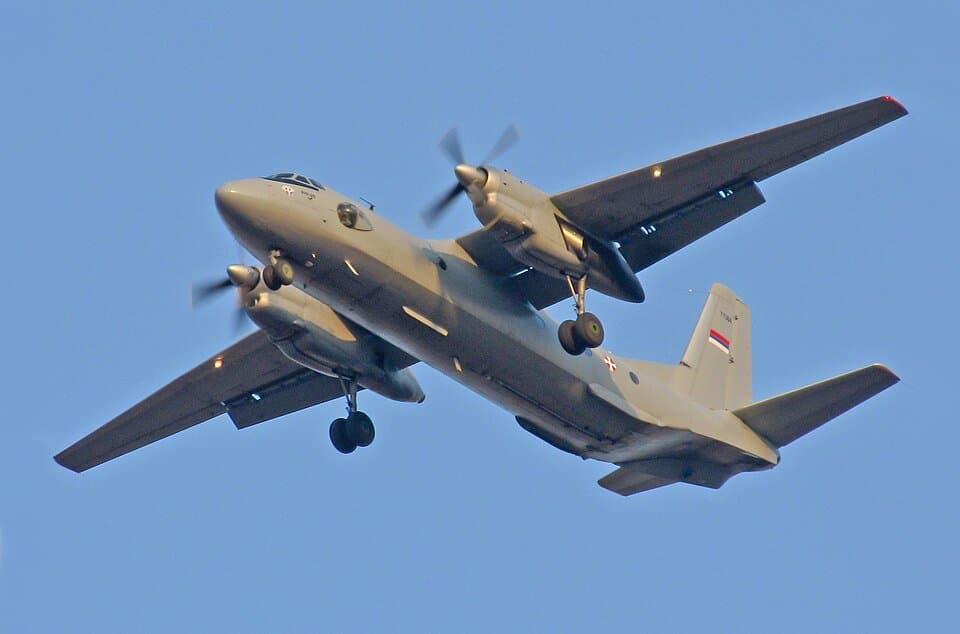
Credit
Marko Stojkovic · CC BY-SA 3.0 · Resized · CC BY-SA 3.0 · Source ↗ · Modified


Preparing your view.


BSupport aircraft
Military transport , aerial refuelling aircraft
At a glance
Measured figures
Length
Single source23.8 m (78 ft 1 in)[source]
C-130J · Length
Single sourceConfiguration
| Specification | Antonov An-26 | Lockheed Martin C-130J Super Hercules |
|---|---|---|
| Type | Transport aircraft / regional airliner[source] | Military transport , aerial refuelling aircraft[source] |
| National origin | Soviet Union[source] | United States[source] |
| Manufacturer | Antonov Serial Production Plant[source] | Lockheed Martin[source] |
| Designer | Antonov[source] |
97 ft 9 in (29.79 m)[source]
Cruise; Cruise speed
Single source440 km/h (270 mph, 240 kn)[source]
2 × Progress AI-24VT Turboprop engines each
Single source2 × Progress AI-24VT Turboprop engines, 2,103 kW (2,820 hp) each[source]
C-130J · 4 × Rolls-Royce AE 2100D3 turboprop engines, 4,637 shp ( ) each
Single source4 × Rolls-Royce AE 2100D3 turboprop engines, 4,637 shp (3,458 kW) each[source]
1,600 ft/min
Single source8 m/s (1,600 ft/min)[source]
Bars compare reported quantities only. A larger figure does not make a system better; configurations and test conditions differ.
| — |
| Status | In service[source] | In service[source] |
|---|
| Primary users | Soviet Air Forces (former) Russian Aerospace Forces Ukrainian Air Force People's Liberation Army Air Force[source] | United States Air Force United States Marine Corps See Operators section for others[source] |
|---|
| Number built | 1,403[source] | 500 as of March 2022[source] |
|---|
| Manufactured | 1969–present (in China as Y-7)[source] | 1996–present[source] |
|---|
| Introduction date | 1972[source] | 1999[source] |
|---|
| First flight | 21 May 1969[source] | 5 April 1996[source] |
|---|
| Developed from | Antonov An-24[source] | Lockheed C-130 Hercules[source] |
|---|
| Developed into | Xi'an Y-7 Antonov An-32[source] | — |
|---|
| Capacity | 40 passengers / 5,500 kg (12,100 lb)[source] | — |
|---|
| Aspect ratio | 11.7:1[source] | — |
|---|
| Propellers | 4-bladed Constant speed metal bladed propellers, 3.90 m (12 ft 10 in) diameter[source] | 6-bladed Dowty R391 composite constant-speed fully-feathering reversible-pitch propellers[source] |
|---|
| Range with max payload | 1,100 km (680 mi)[source] | — |
|---|
| Role | military transport aircraft[source] | — |
|---|
| Source design development | While the An-24T tactical transport had proved successful in supporting Soviet troops in austere locations, its ventral loading hatch restricted the handling of cargo, and in particular vehicles, and made it less effective than hoped in parachuting men and supplies. As a result, interest in a version with a retractable cargo ramp increased, and the Antonov design bureau decided in 1966 to begin development on the new An-26 derivative, in advance of an official order. The cargo ramp was based on that design and allowed the cargo deck to be sealed and pressurised in flight. When loading cargo, it could either be lowered to allow vehicles to be driven in, or slid beneath the aircraft's fuselage, so that cargo could be loaded straight in off a truck bed. In March 1968, the OKB received official permission to begin development. Particular attention was given to the military mission, and the majority of early An-26 production was delivered to the VTA (voyenno-transportnaya aviatsiya) .[source] | — |
|---|
| Variant | — | Lockheed Martin E-130J[source] |
|---|
| Cargo bay length | — | 41 ft (12.50 m)[source] |
|---|
| Cargo bay width | — | 10 ft (3.05 m)[source] |
|---|
| Cargo bay height | — | 9 ft (2.74 m)[source] |
|---|
| Payload main | — | 42,000 lb (19,051 kg)[source] |
|---|
| Airfoil | — | root : NACA 64A318 ; tip : NACA 64A412[source] |
|---|
| Absolute ceiling | — | 40,386 ft (12,310 m)[source] |
|---|
| Normal takeoff distance over 50 ft barrier | — | 5,850 feet (1,780 m)[source] |
|---|
| Maximum effort takeoff roll | — | 3,100 feet (940 m)[source] |
|---|
| Normal landing distance over 50 ft barrier | — | 3,000 feet (910 m)[source] |
|---|
| Maximum effort landing roll | — | 1,630 ft (500 m)[source] |
|---|
| Wingtip turning radius (ground) | — | 89 feet 8 inches (27.33 m)[source] |
|---|
Maximum take-off; C-130J · Max takeoff weight
Single source