Credit
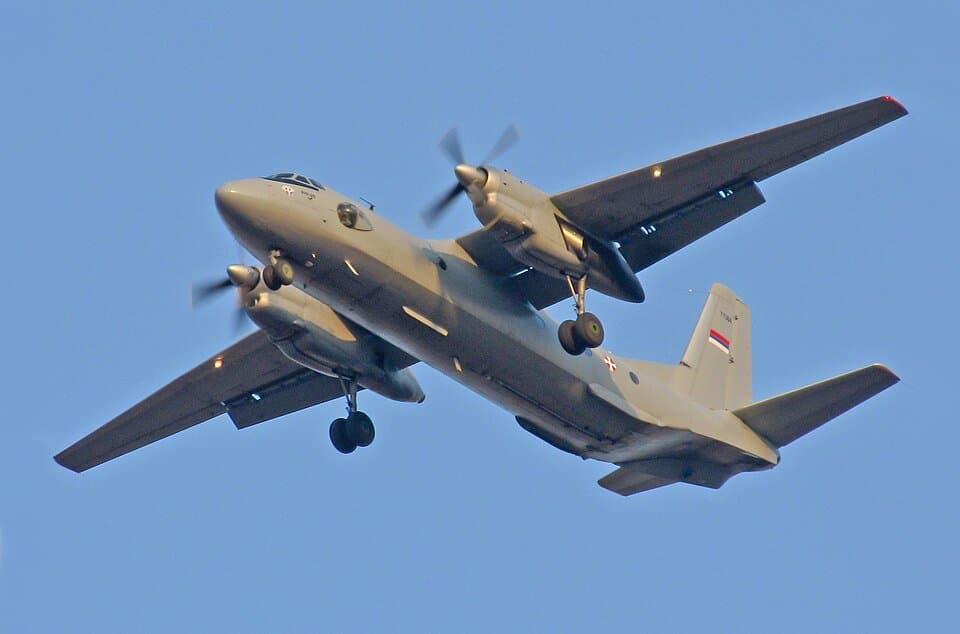
Marko Stojkovic · CC BY-SA 3.0 · Resized · CC BY-SA 3.0 · Source ↗ · Modified


Preparing your view.
At a glance
True scale
Side by side. From every angle. A human reference for perspective.
3.18 MB · Loads when you open it| Model | Length | Width / span | Height |
|---|---|---|---|
| Antonov An-26 | ≈ 23.8 m | ≈ 29.3 m (Width) | ≈ 8.58 m |
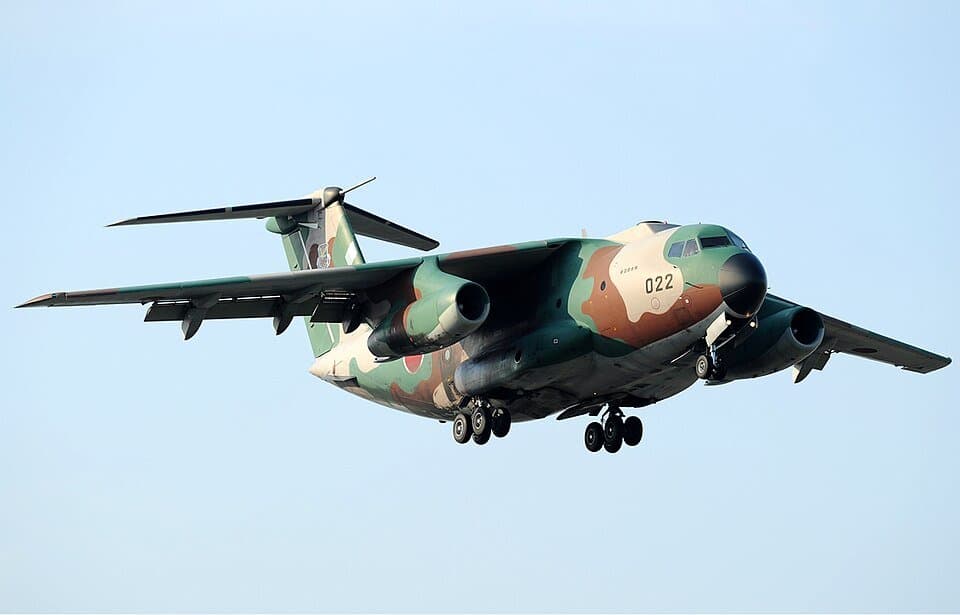
| Kawasaki C-1 | ≈ 29 m | ≈ 30.6 m (Width) | ≈ 9.99 m |
Scaled uniformly to the sourced length of 23.8 m. The height was fitted to the sourced 8.58 m; the width was fitted to the sourced 29.3 m. Not an official model or a measured survey.
ForceTally · All rights reserved
Scaled uniformly to the sourced length of 29 m. The shape was turned square to the axes; the height was fitted to the sourced 9.99 m; the width was fitted to the sourced 30.6 m. Not an official model or a measured survey.
ForceTally · All rights reserved
The human reference is a generic 1.75 m figure. Models describe external size, not combat performance.
Measured figures
Length
Single source23.8 m (78 ft 1 in)[source]
Kawasaki C-1 · Length
Single sourceConfiguration
| Specification | Antonov An-26 | Kawasaki C-1 |
|---|---|---|
| Crew | five (two pilots, one radio operator, one flight engineer, one navigator)[source] | 2 flight crew and 3 mission crew[source] |
| Type | Transport aircraft / regional airliner[source] | Military transport aircraft[source] |
| National origin | Soviet Union[source] | Japan[source] |
| Manufacturer | Antonov Serial Production Plant[source] | Kawasaki Heavy Industries |
29 m (95 ft 2 in)[source]
Cruise; Cruise speed
Single source440 km/h (270 mph, 240 kn)[source]
Cruise; Kawasaki C-1 · at 10,670 m (35,010 ft) at 35,450 kg (78,150 lb)
Single sourceMaximum; Kawasaki C-1 · at 7,620 m (25,000 ft) at 35,450 kg (78,150 lb)
Single source806 km/h (501 mph, 435 kn) at 7,620 m (25,000 ft) at 35,450 kg (78,150 lb)[source]
657 km/h (408 mph, 355 kn) at 10,670 m (35,010 ft) at 35,450 kg (78,150 lb)[source]
2 × Progress AI-24VT Turboprop engines each
Single source2 × Progress AI-24VT Turboprop engines, 2,103 kW (2,820 hp) each[source]
Kawasaki C-1 · 2 × Pratt & Whitney JT8D -M-9 ( Mitsubishi -built) low-bypass turbofans thrust each
Single source2 × Pratt & Whitney JT8D -M-9 ( Mitsubishi -built) low-bypass turbofans , 64 kN (14,500 lbf) thrust each[source]
Bars compare reported quantities only. A larger figure does not make a system better; configurations and test conditions differ.
| Designer | Antonov[source] | — |
|---|
| Status | In service[source] | Retired[source] |
|---|
| Primary users | Soviet Air Forces (former) Russian Aerospace Forces Ukrainian Air Force People's Liberation Army Air Force[source] | — |
|---|
| Number built | 1,403[source] | 31[source] |
|---|
| Manufactured | 1969–present (in China as Y-7)[source] | — |
|---|
| Introduction date | 1972[source] | December 1974[source] |
|---|
| First flight | 21 May 1969[source] | 12 November 1970[source] |
|---|
| Developed from | Antonov An-24[source] | — |
|---|
| Developed into | Xi'an Y-7 Antonov An-32[source] | — |
|---|
| Capacity | 40 passengers / 5,500 kg (12,100 lb)[source] | 8,000 kg (18,000 lb) normal payload[source] |
|---|
| Aspect ratio | 11.7:1[source] | 7.8[source] |
|---|
| Propellers | 4-bladed Constant speed metal bladed propellers, 3.90 m (12 ft 10 in) diameter[source] | — |
|---|
| Range with max payload | 1,100 km (680 mi)[source] | — |
|---|
| Role | military transport aircraft[source] | twin-engined short-range military transport aircraft[source] |
|---|
| Source design development | While the An-24T tactical transport had proved successful in supporting Soviet troops in austere locations, its ventral loading hatch restricted the handling of cargo, and in particular vehicles, and made it less effective than hoped in parachuting men and supplies. As a result, interest in a version with a retractable cargo ramp increased, and the Antonov design bureau decided in 1966 to begin development on the new An-26 derivative, in advance of an official order. The cargo ramp was based on that design and allowed the cargo deck to be sealed and pressurised in flight. When loading cargo, it could either be lowered to allow vehicles to be driven in, or slid beneath the aircraft's fuselage, so that cargo could be loaded straight in off a truck bed. In March 1968, the OKB received official permission to begin development. Particular attention was given to the military mission, and the majority of early An-26 production was delivered to the VTA (voyenno-transportnaya aviatsiya) .[source] | — |
|---|
| Primary user | — | Japan Air Self-Defense Force[source] |
|---|
| Retired | — | 15 March 2025[source] |
|---|
| Fuel capacity | — | 15,200 L (4,000 US gal; 3,300 imp gal) in 4 integral tanks in the wings[source] |
|---|
| Wing loading | — | 321.2 kg/m 2 (65.8 lb/sq ft)[source] |
|---|
| Thrust/weight | — | 0.003 kN/kg (0.34 lbf/lb)[source] |
|---|
| Source measurement | — | Development of the C-1 commenced in 1966 in response to a requirement from the JASDF, which sought an indigenous jet-powered replacement for its aging Second World War –era Curtiss C-46 Commando transport fleet. First flown on 12 November 1970, quantity production of the type commenced during the following year. The C-1 has formed the backbone of the JASDF's transport capability throughout the latter half of the twentieth century and the initial years of the twenty-first century as well. During the 2010s, Kawasaki developed a newer, larger, and longer-range airlifter, the Kawasaki C-2 , which will eventually replace the JASDF's C-1 fleet entirely.[source]Kawasaki C-1 · Lead; only the objects and conditions stated in this passage In terms of its basic configuration, the C-1 is a twin-engine medium-range airlifter, somewhat resembling the larger Lockheed C-141 Starlifter . It is powered by a pair of Pratt & Whitney JT8D -M-9 low-bypass turbofan engines, which were locally manufactured under license by Mitsubishi, each capable of generating up to 64 kN (14,500 lbf) of thrust. In terms of payload capacity, a single C-1 could carry up to 80 fully-equipped troops, 45 paratroopers , or 36 stretcher-bound personnel, in addition to bulky cargo, including a whole truck or a pair of jeeps , which would be loaded via a ramp deployed at the airlifter's rear. It was designed to be typically operated by a crew of five, comprising two pilots, a flight engineer , a navigator , and a loadmaster. The C-1 incorporates a high-lift system, which includes aerodynamic features such as a leading edge slat and a four-stage Fowler flap , facilitates a high level of short takeoff and landing (STOL) performance, while day-and-night all-weather operations are achieved via the application of numerous electronic navigation systems.[source]Kawasaki C-1 · Design and development; only the objects and conditions stated in this passage The maximum range of C-1 caused a problem after the island of Okinawa was returned to Japan from the United States; the airlifter was unable to fly directly to Okinawa from most parts of the Japanese home islands. This may have been a factor in the decision to reduce the planned procurement of the C-1 in favour of the American-built C-130H Hercules utility transport aircraft instead, which entered service with the JASDF's 401st Tactical Airlift Squadron in 1989. Another reason for the curtailment was the enactment of general cutbacks upon various military programmes and procurement initiatives during the 1970s.[source]Kawasaki C-1 · Design and development; only the objects and conditions stated in this passage The last five C-1s ordered were fitted with an additional 4,730-litre fuel tank.[source]Kawasaki C-1 · Variants; only the objects and conditions stated in this passage Two C-1s of the 401st Tactical Airlift Squadron crashed near Toba, Mie when the lead two airplanes of a formation of 5 en route from Komaki Air Base to Iruma Air Base flew into a hill while flying in low visibility at low altitude. A third airplane narrowly avoided also crashing and struck trees, but was able to return to Komaki Air Base. Fourteen personnel were killed in these two aircraft, six personnel in airplane 68-1015 and eight in aircraft 58–1009.[source]Kawasaki C-1 · Accidents; only the objects and conditions stated in this passage A C-1 crashed into the sea of Japan's west coast during a test flight with five personnel on board. There were no survivors.[source]Kawasaki C-1 · Accidents; only the objects and conditions stated in this passage Capacity: 8,000 kg (18,000 lb) normal payload[source]Kawasaki C-1 · Specifications (Kawasaki C-1); only the objects and conditions stated in this passage Length: 29 m (95 ft 2 in)[source]Kawasaki C-1 · Specifications (Kawasaki C-1); only the objects and conditions stated in this passage Wingspan: 30.6 m (100 ft 5 in)[source]Kawasaki C-1 · Specifications (Kawasaki C-1); only the objects and conditions stated in this passage Height: 9.99 m (32 ft 9 in)[source]Kawasaki C-1 · Specifications (Kawasaki C-1); only the objects and conditions stated in this passage Wing area: 120.5 m 2 (1,297 sq ft)[source]Kawasaki C-1 · Specifications (Kawasaki C-1); only the objects and conditions stated in this passage Empty weight: 23,220 kg (51,191 lb)[source]Kawasaki C-1 · Specifications (Kawasaki C-1); only the objects and conditions stated in this passage Max takeoff weight: 38,700 kg (85,319 lb)[source]Kawasaki C-1 · Specifications (Kawasaki C-1); only the objects and conditions stated in this passage Powerplant: 2 × Pratt & Whitney JT8D -M-9 ( Mitsubishi -built) low-bypass turbofans , 64 kN (14,500 lbf) thrust each[source]Kawasaki C-1 · Specifications (Kawasaki C-1); only the objects and conditions stated in this passage Maximum speed: 806 km/h (501 mph, 435 kn) at 7,620 m (25,000 ft) at 35,450 kg (78,150 lb)[source]Kawasaki C-1 · Specifications (Kawasaki C-1); only the objects and conditions stated in this passage Cruise speed: 657 km/h (408 mph, 355 kn) at 10,670 m (35,010 ft) at 35,450 kg (78,150 lb)[source]Kawasaki C-1 · Specifications (Kawasaki C-1); only the objects and conditions stated in this passage Range: 3,353 km (2,083 mi, 1,810 nmi) with max fuel & 2,300 kg (5,100 lb) payload[source]Kawasaki C-1 · Specifications (Kawasaki C-1); only the objects and conditions stated in this passage Service ceiling: 11,580 m (37,990 ft)[source]Kawasaki C-1 · Specifications (Kawasaki C-1); only the objects and conditions stated in this passage Rate of climb: 17.75 m/s (3,494 ft/min) at sea level[source]Kawasaki C-1 · Specifications (Kawasaki C-1); only the objects and conditions stated in this passage |
|---|
| Country of origin | — | Japan[source]Inventory Origin column; table 2, row 41, cell 2; revision 1359403478 |
|---|