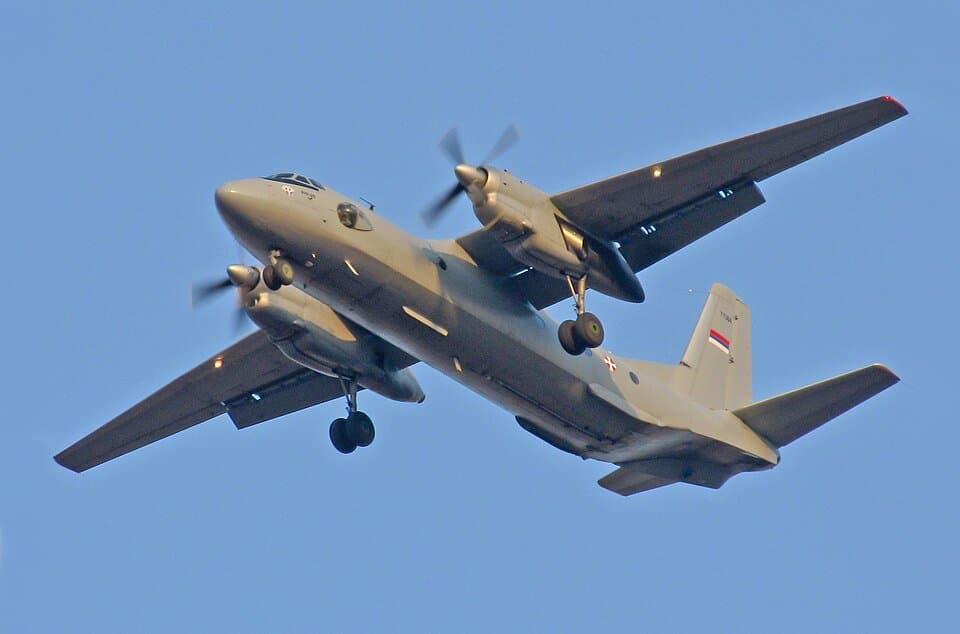
Credit
Marko Stojkovic · CC BY-SA 3.0 · Resized · CC BY-SA 3.0 · Source ↗ · Modified


Preparing your view.


At a glance
Antonov An-26larger figure on 0 of 7
Ilyushin Il-276larger figure on 7 of 7
Measured figures
Length
Single source23.8 m (78 ft 1 in)[source]
Length
Single sourceConfiguration
| Specification | Antonov An-26 | Ilyushin Il-276 |
|---|---|---|
| Type | Transport aircraft / regional airliner[source] | Military transport aircraft[source] |
| National origin | Soviet Union[source] | — |
| Manufacturer | Antonov Serial Production Plant[source] | United Aircraft Corporation[source] |
| Designer | Antonov[source] | — |
| Status | In service[source] |
Counts only measures both sources give with the same scope. A larger figure is not a better system.
37.7 m (123 ft 8 in)[source]
with maximum fuel
Single source2,500 km (1,600 mi, 1,300 nmi) with maximum fuel[source]
2 × Progress AI-24VT Turboprop engines each
Single source2 × Progress AI-24VT Turboprop engines, 2,103 kW (2,820 hp) each[source]
2 × Aviadvigatel PD-14M turbofan engines thrust each
Single source2 × Aviadvigatel PD-14M turbofan engines, 152.98 kN (34,392 lbf) thrust each[source]
1,600 ft/min
Single source8 m/s (1,600 ft/min)[source]
Payload
Single source20,000 kilograms (44,000 lb)[source]
Bars compare reported quantities only. A larger figure does not make a system better; configurations and test conditions differ.
Under development[source] |
| Primary users | Soviet Air Forces (former) Russian Aerospace Forces Ukrainian Air Force People's Liberation Army Air Force[source] | — |
|---|
| Number built | 1,403[source] | — |
|---|
| Manufactured | 1969–present (in China as Y-7)[source] | — |
|---|
| Introduction date | 1972[source] | Under development[source] |
|---|
| First flight | 21 May 1969[source] | Sometime in 2026[source] |
|---|
| Developed from | Antonov An-24[source] | — |
|---|
| Developed into | Xi'an Y-7 Antonov An-32[source] | — |
|---|
| Capacity | 40 passengers / 5,500 kg (12,100 lb)[source] | 70 to 150 passengers[source] |
|---|
| Aspect ratio | 11.7:1[source] | — |
|---|
| Propellers | 4-bladed Constant speed metal bladed propellers, 3.90 m (12 ft 10 in) diameter[source] | — |
|---|
| Range with max payload | 1,100 km (680 mi)[source] | — |
|---|
| Role | military transport aircraft[source] | — |
|---|
| Source design development | While the An-24T tactical transport had proved successful in supporting Soviet troops in austere locations, its ventral loading hatch restricted the handling of cargo, and in particular vehicles, and made it less effective than hoped in parachuting men and supplies. As a result, interest in a version with a retractable cargo ramp increased, and the Antonov design bureau decided in 1966 to begin development on the new An-26 derivative, in advance of an official order. The cargo ramp was based on that design and allowed the cargo deck to be sealed and pressurised in flight. When loading cargo, it could either be lowered to allow vehicles to be driven in, or slid beneath the aircraft's fuselage, so that cargo could be loaded straight in off a truck bed. In March 1968, the OKB received official permission to begin development. Particular attention was given to the military mission, and the majority of early An-26 production was delivered to the VTA (voyenno-transportnaya aviatsiya) .[source] | — |
|---|
| Primary user | — | Russian Aerospace Forces[source] |
|---|
| Fuel capacity | — | 30,700 kilograms (67,700 lb)[source] |
|---|
| Takeoff run | — | 1,050 metres (3,440 ft)[source] |
|---|
| Landing run | — | 1,050 metres (3,440 ft)[source] |
|---|
| Country of origin | — | Russia, India[source] |
|---|