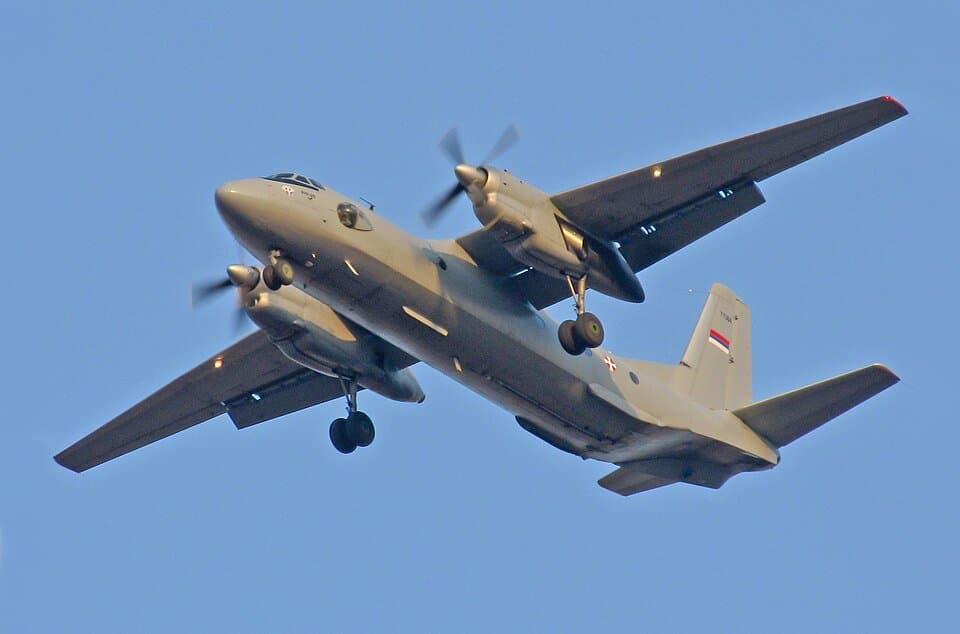
Credit
Marko Stojkovic · CC BY-SA 3.0 · Resized · CC BY-SA 3.0 · Source ↗ · Modified


Preparing your view.
At a glance
Antonov An-26larger figure on 0 of 7
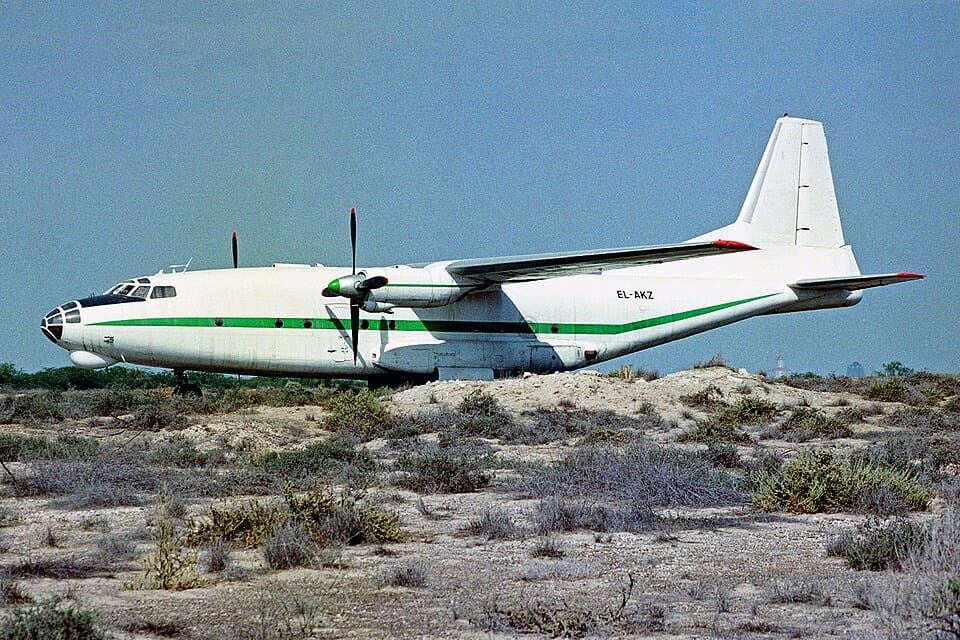
Antonov An-8larger figure on 7 of 7
True scale
Side by side. From every angle. A human reference for perspective.
3.30 MB · Loads when you open it| Model | Length | Width / span | Height |
|---|---|---|---|
| Antonov An-26 | ≈ 23.8 m | ≈ 29.3 m (Width) | ≈ 8.58 m |
| Antonov An-8 | ≈ 26 m | ≈ 30 m (Width) | ≈ 9.7 m |
Scaled uniformly to the sourced length of 23.8 m. The height was fitted to the sourced 8.58 m; the width was fitted to the sourced 29.3 m. Not an official model or a measured survey.
ForceTally · All rights reserved
Scaled uniformly to the sourced length of 26 m. The shape was turned square to the axes; the height was fitted to the sourced 9.7 m; the width was fitted to the sourced 30 m. Not an official model or a measured survey.
ForceTally · All rights reserved
The human reference is a generic 1.75 m figure. Models describe external size, not combat performance.
Measured figures
Length
Single source23.8 m (78 ft 1 in)[source]
Length
Single sourceConfiguration
| Specification | Antonov An-26 | Antonov An-8 |
|---|---|---|
| Type | Transport aircraft / regional airliner[source] | Military transport aircraft[source] |
| National origin | Soviet Union[source] | Soviet Union[source] |
| Manufacturer | Antonov Serial Production Plant[source] | Antonov[source] |
| Designer | Antonov[source] | — |
| Status |
Counts only measures both sources give with the same scope. A larger figure is not a better system.
26 m (85 ft 4 in)[source]
Bars compare reported quantities only. A larger figure does not make a system better; configurations and test conditions differ.
In service[source] |
One in service with Uhuru Airlines[source] |
| Primary users | Soviet Air Forces (former) Russian Aerospace Forces Ukrainian Air Force People's Liberation Army Air Force[source] | Soviet Air Force Aeroflot[source] |
|---|
| Number built | 1,403[source] | ~151[source] |
|---|
| Manufactured | 1969–present (in China as Y-7)[source] | 1956-1961[source] |
|---|
| Introduction date | 1972[source] | 1958[source] |
|---|
| First flight | 21 May 1969[source] | 11 February 1956[source] |
|---|
| Developed from | Antonov An-24[source] | — |
|---|
| Developed into | Xi'an Y-7 Antonov An-32[source] | Antonov An-10[source] |
|---|
| Capacity | 40 passengers / 5,500 kg (12,100 lb)[source] | 48 persons / 11,000 kg (24,000 lb) max payload[source] |
|---|
| Aspect ratio | 11.7:1[source] | 11.7[source] |
|---|
| Propellers | 4-bladed Constant speed metal bladed propellers, 3.90 m (12 ft 10 in) diameter[source] | 4-bladed constant-speed propellers[source] |
|---|
| Range with max payload | 1,100 km (680 mi)[source] | — |
|---|
| Role | military transport aircraft[source] | — |
|---|
| Source design development | While the An-24T tactical transport had proved successful in supporting Soviet troops in austere locations, its ventral loading hatch restricted the handling of cargo, and in particular vehicles, and made it less effective than hoped in parachuting men and supplies. As a result, interest in a version with a retractable cargo ramp increased, and the Antonov design bureau decided in 1966 to begin development on the new An-26 derivative, in advance of an official order. The cargo ramp was based on that design and allowed the cargo deck to be sealed and pressurised in flight. When loading cargo, it could either be lowered to allow vehicles to be driven in, or slid beneath the aircraft's fuselage, so that cargo could be loaded straight in off a truck bed. In March 1968, the OKB received official permission to begin development. Particular attention was given to the military mission, and the majority of early An-26 production was delivered to the VTA (voyenno-transportnaya aviatsiya) .[source] | — |
|---|
| Guns | — | One 23 mm cannon in the tail turret.[source] |
|---|
| Country of origin | — | Soviet Union[source] Soviet Union[source] |
|---|