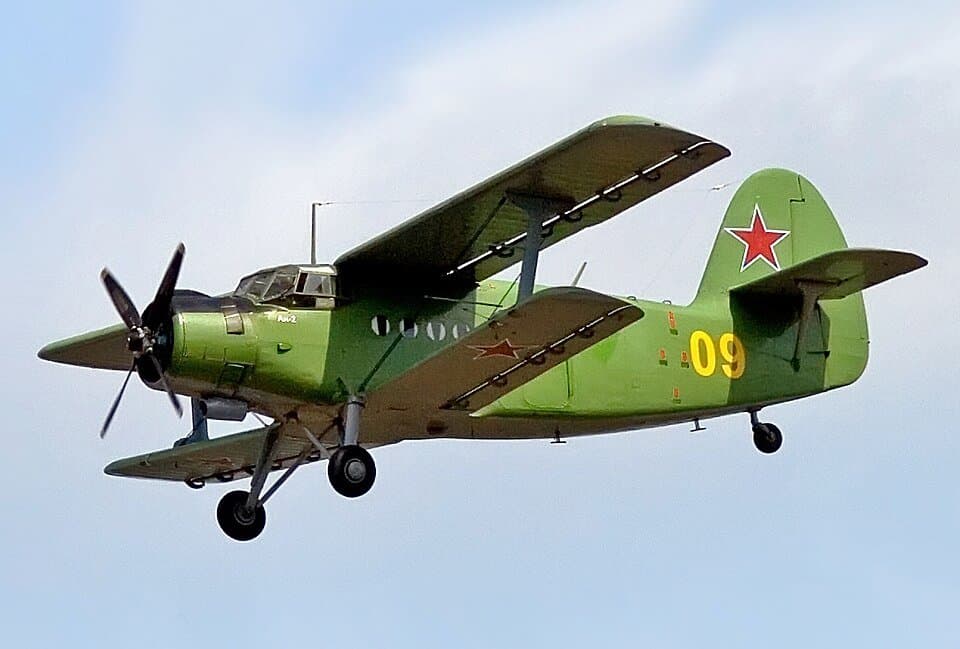
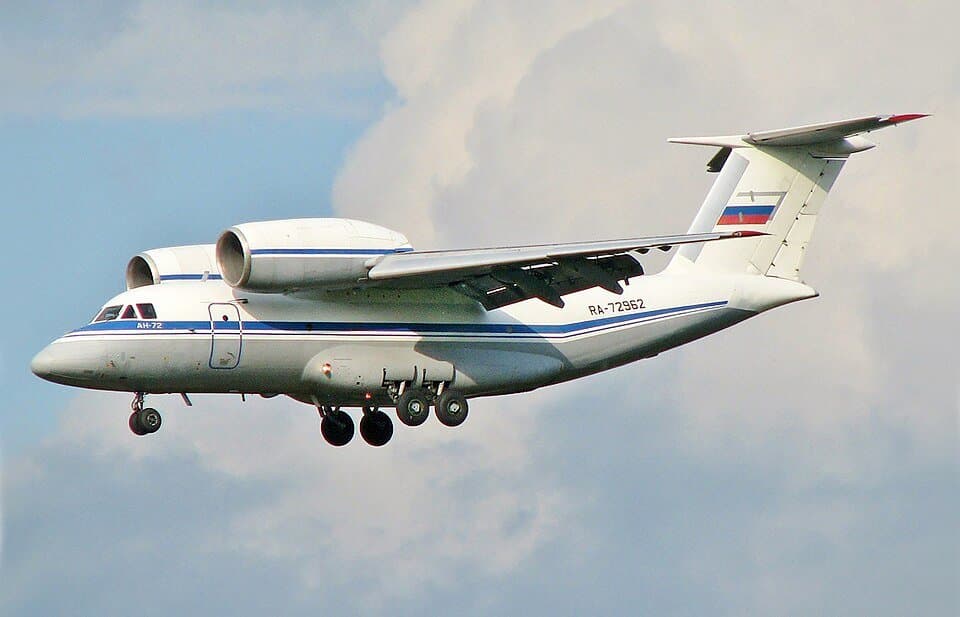
Credit
Artem Katranzhi · CC BY-SA 2.0 · Resized · CC BY-SA 2.0 · Source ↗ · Modified


Preparing your view.
At a glance
Measured figures
An-2 · Length
Single source12.4 m (40 ft 8 in)[source]
An-72 · Length
Single sourceConfiguration
| Specification | Antonov An-2 | Antonov An-72 |
|---|---|---|
| Type | Agricultural , utility aircraft and military transport aircraft[source] | Transport aircraft[source] |
| Manufacturer | Antonov[source] | Antonov[source] |
| Designer | Oleg Antonov[source] | — |
| Status | In service[source] | In service[source] |
| Primary users |
28.07 m (92 ft 1 in)[source]
An-72 · Wingspan
Single source31.89 m (104 ft 7.5 in)[source]
An-2 · 1 × Shvetsov ASh-62IR 9-cylinder air-cooled supercharged radial piston engine
Single source1 × Shvetsov ASh-62IR 9-cylinder air-cooled supercharged radial piston engine, 750 kW (1,010 hp)[source]
An-72 · 2 × Lotarev D-36 series 1A Turbofan thrust each
Single source2 × Lotarev D-36 series 1A Turbofan, 63.9 kN (14,330 lbf) thrust each[source]
An-2 · 690 ft/min
Single source3.5 m/s (690 ft/min)[source]
Bars compare reported quantities only. A larger figure does not make a system better; configurations and test conditions differ.
Soviet Air Forces (historical) Russian Aerospace Forces Korean People's Army Air Force Ukrainian Air Force[source] |
Russian Aerospace Forces Russian Navy Angolan Air Force Soviet Air Force (historical)[source] |
| Number built | 18,000+[source] | 133[source] |
|---|
| Manufactured | 1947–2001[source] | 1977–2002[source] |
|---|
| First flight | 31 August 1947[source] | 31 August 1977 ( 1977-08-31 )[source] |
|---|
| Developed into | Antonov An-3 SibNIA TVS-2DTS[source] | Antonov An-71 Antonov An-74[source] |
|---|
| Capacity | 12 passengers / 2,140 kg (4,718 lb)[source] | up to 52 passengers or 10 tonnes of cargo[source] |
|---|
| Upper wingspan | 18.2 m (59 ft 9 in)[source] | — |
|---|
| Lower wingspan | 14.2 m (46 ft 7 in)[source] | — |
|---|
| Airfoil | TsAGI R-11 (14%)[source] | — |
|---|
| Fuel capacity | 1,200 L (320 US gal; 260 imp gal)[source] | — |
|---|
| Propellers | 4-bladed constant-speed propeller[source] | — |
|---|
| Stall speed | 50 km/h (31 mph, 27 kn) circa[source] | — |
|---|
| Power/mass | 0.136 kW/kg (0.083 hp/lb)[source] | — |
|---|
| Fuel consumption | 185–200 L/h (49–53 gal/h; 41–44 imp gal/h)[source] | — |
|---|
| Role | Soviet mass-produced single-engine biplane utility/agricultural aircraft[source] | — |
|---|
| National origin | Soviet Union[source] | Soviet Union[source] |
|---|
| Source measurement | The most common version is the An-2T 12-seater passenger aircraft. All versions (other than the An-3 and the An-2-100) are powered by a 750 kW (1,010 hp) nine-cylinder Shvetsov ASh-62 radial engine .[source]Antonov An-2 · Lead; only the objects and conditions stated in this passage The Antonov An-2 was designed to meet a 1940s Soviet Ministry of Forestry requirement to replace the smaller Polikarpov Po-2 , which was used in large numbers in both agricultural and utility roles. Antonov designed a large single bay biplane of all-metal construction, with an enclosed cockpit and a cabin with seats for twelve passengers. The first prototype, designated SKh-1 , powered by a Shvetsov ASh-21 radial engine, flew on 31 August 1947 from Yeltsovka Airport in Novosibirsk Oblast , Russia. The second prototype was fitted with a more powerful Shvetsov ASh-62 engine, which allowed the aircraft's payload to be increased from 1,300 to 2,140 kg (2,870 to 4,720 lb), and in this form saw production.[source]Antonov An-2 · Design and development / Origins; only the objects and conditions stated in this passage Initial production was at State Factory 473 in Kyiv , Ukrainian SSR , where the majority of up to 5,000 units had been produced by 1960. Later Soviet production (after 1965, of model An-2M especially) was at State Factory 464 at Dolgoprudniy, Russian SFSR . After 1960, most An-2s were constructed at Poland's WSK factory in Mielec . It is believed that over 13,000 were built in Poland before manufacturing ended in 1991.[source]Antonov An-2 · Design and development / Origins; only the objects and conditions stated in this passage During the early 1980s, Antonov experimented with an An-2 powered by a 1,080 kW (1,450 hp) Glushenkov turboprop engine. Aircraft with this engine had a longer, streamlined nose. It received the designation An-3 .[source]Antonov An-2 · Design and development / Further development; only the objects and conditions stated in this passage During 2013, Antonov announced that it had flown a new An-2 version, the An-2-100 , with a three-blade reversible propeller and a 1,100 kW (1,500 shp) Motor Sich MS-14 turboprop running on kerosene rather than Avgas, which is no longer produced in CIS countries. That same year, the company stated that it had received orders for upgrading hundreds in Azerbaijan , Cuba and Russia to the An-2-100 version.[source]Antonov An-2 · Design and development / Further development; only the objects and conditions stated in this passage The An-2 is a mass-produced single-engine biplane that was deliberately furnished with a minimum of complex systems. The wing leading edge slats that give the aircraft its slow flight ability are fully automatic, being held shut by the airflow over the wings. When airspeed drops below 64 km/h (40 mph), elastic rubber springs extend the slats. Under typical conditions, take-off can be made within 170 m (560 ft) while the landing run requires 215 m (705 ft). These figures vary dependent on weight, air temperature, runway surface, and wind direction.[source]Antonov An-2 · Design; only the objects and conditions stated in this passage The operating handbook does not explicitly specify a stall speed, stating instead: "If the engine quits in instrument conditions or at night, the pilot should pull the control column full aft and keep the wings level. The leading-edge slats will snap out at about 64 km/h (40 mph) and when the airplane slows to a forward speed of about 40 km/h (25 mph), the airplane will sink at about a parachute descent rate until the aircraft hits the ground."[source]Antonov An-2 · Design; only the objects and conditions stated in this passage Over the years, dozens of nations and companies have employed the An-2 in civil roles. The type was heavily used throughout the Soviet Union and the Eastern Bloc nations. In particular, the Russian airline Aeroflot operated a large number of them. The An-2 was used as a short-range airliner, and in Estonia , made regular flights between the towns of Kuressaare and Kärdla , which are on separate islands, Saaremaa and Hiiumaa .[source]Antonov An-2 · Operational history / Civil aviation; only the objects and conditions stated in this passage As of 2015, there were thousands of An-2s in operation around the world, including over 1,500 in Russia, 294 in Kazakhstan and 54 in Ukraine .[source]Antonov An-2 · Operational history / Civil aviation; only the objects and conditions stated in this passage Izdeliye T – The original design concept originated at OKB-153 in Novosibirsk.[source]Antonov An-2 · Variants / Soviet / Polish production / Prototype; only the objects and conditions stated in this passage An-2A – Developed from the An-2T for use as a Balloon interceptor to intercept reconnaissance balloons from, US intelligence assets, over-flying the USSR. The prototype was converted from a Kyiv built An-2 (c/n 110347315) using the Turbo-charged Ash-62IR/TK of the 'An-6 Meteo' and a combined searchlight/gun turret mounted on top of the rear fuselage, which mounted either a single Gryazev-Shipunov GSh-23 23 mm calibre twin-barrelled cannon or a single Afanas'yev A-12.7 12.7 mm calibre heavy machine-gun.[source]Antonov An-2 · Variants / Soviet / Polish production / Prototype; only the objects and conditions stated in this passage An-2E (second use of the designation) – An Ekranoplan conversion ( Russian : Ан-2Э ) of an An-2P (RA-84692). The fuselage was retained and a large trapezoidal monoplane wing having extended wingtips with approx 45° dihedral, attached to the lower wing attachment points. The prototype conversion was intended to be a floatplane; however, its first public appearance was as a landplane with the standard An-2 undercarriage. Jointly developed by the Moscow Aviation Institute, MARZ ( Moskovskiy Aviaremontnyy Zavod – Moscow Aircraft Overhaul Plant) and The TSZP-Saturn research institute the An-2E was also known as EA-00078. Power was supplied by the standard ASh-62IR radial engine with AV-2 propeller, but production versions were intended to be powered by automotive diesel engines of around 430 kW (580 hp).[source]Antonov An-2 · Variants / Soviet / Polish production / Prototype; only the objects and conditions stated in this passage An-2G (a.k.a. An-2Geo ) – During 1974 WSK-Mielec developed a geo-physical survey aircraft for the Polish State Geophysical Survey Agency ( Państwowe Przedsiębiorstwo Poszukiwań Geofizycznych ), with equipment for measuring magnetic fields, radiation and other instruments for prospecting. Adapted to fly in tropical latitudes at low altitude the 'An-2G' could fly for six hours and two were used for survey work in Nigeria in 1974.[source]Antonov An-2 · Variants / Soviet / Polish production / Prototype; only the objects and conditions stated in this passage An-2LP ( Lesopozharnyy – forest firefighter) – A single prototype converted from an An-2V floatplane, with 630 litre(139 Imp.Gal.) water tanks in each float for dropping on fires. The water tanks could be re-filled in flight, as the aircraft skimmed the surface of suitable bodies of water. Prior to dropping an alkaline wetting agent (NP-1 Sulphanol) was added to the water which was released through the scoops which also picked up the water to refill the tanks. Ten production aircraft were built seeing service in the Siberian and Far East regions of the USSR.[source]Antonov An-2 · Variants / Soviet / Polish production / Prototype; only the objects and conditions stated in this passage An-2L ( Lesozashchita – forestry protection) – A fire bomber variant with three cassettes each holding 120 ampoules, containing 1litre (34 fl.oz.) of fire-retardant which were dropped as required. Trials revealed that this system was inefficient and further work was abandoned.[source]Antonov An-2 · Variants / Soviet / Polish production / An-2; only the objects and conditions stated in this passage An-2M (Polish: [samolot] Morski – seaplane) – Polish production of the An-2V floatplane, designated An-2M, (not to be confused with the Soviet designation An-2M). Also known as the An-2W.[source]Antonov An-2 · Variants / Soviet / Polish production / An-2; only the objects and conditions stated in this passage An-2M ( Modifitsirovannyy – modified) – The designation An-2M was also used in the USSR for a much improved agricultural crop-sprayer/duster. The An-2M featured an all-duralumin welded and bonded fuselage, lockable tailwheel, enlarged fibre-glass hopper, Shvetsov ASh-62 radial engine with power take off to an auxiliary gearbox to drive the dusting/spraying equipment, an angular fin of increased area and a hermetically sealed cockpit with no access to the cabin/hopper area. The hopper capacity was increased 42% to 2,000 litres (440 Imp.gal.) delivering product through an outlet enlarged to 400 mm ( 15 + 1 ⁄ 2 in) with dry product being fed to two dusting outlets at the tips of the lower wings. Due to lack of capacity at the Kyiv factory and WSK-Mielec the An-2M was manufactured at DMZ N0.464 ( Dolgoproodnyy Machinery Factory No.464 ) to the north of Moscow.[source]Antonov An-2 · Variants / Soviet / Polish production / An-2; only the objects and conditions stated in this passage An-2R (Polish: Rolniczy – agricultural) – WSK-Mielec manufactured agricultural variant with tank for 1,300 kg (2,900 lb) of liquid or powdered chemicals.[source]Antonov An-2 · Variants / Soviet / Polish production / An-2; only the objects and conditions stated in this passage A metal construction chemical hopper was installed in the cabin near the centre of gravity, feeding a spreader through a 300mm orifice.[source]Antonov An-2 · Variants / Soviet / Polish production / An-2; only the objects and conditions stated in this passage The original spreader was replaced in 1975 by a standardised RTSh-1 three channel spreader which increased distribution width from 18–22 m (59–72 ft) to 34–36 m (112–118 ft).[source]Antonov An-2 · Variants / Soviet / Polish production / An-2; only the objects and conditions stated in this passage Liquid chemicals could be sprayed using an interchangeable system which delivered chemical to spraybars via a ram air turbine driven regulator pump to give coverage 30 m (98 ft) wide.[source]Antonov An-2 · Variants / Soviet / Polish production / An-2; only the objects and conditions stated in this passage Early An-2SKh's were typically limited to a 6,000-hour life, as opposed to a normal life of 12,000 hours, due to the corrosive effects of the chemicals.[source]Antonov An-2 · Variants / Soviet / Polish production / An-2; only the objects and conditions stated in this passage An-2W ( Wodnosamolot – seaplane) – Polish production of the An-2V, also sometimes designated An-2M (not to be confused with the improved variant).[source]Antonov An-2 · Variants / Soviet / Polish production / An-2; only the objects and conditions stated in this passage An-3 (second use of designation) – In an effort to replace the An-2SKh, after the poor performance of the abortive WSK-Mielec M-15 Belphegor , it was proposed to fit a turboprop engine on an all new fuselage featuring a hunchback for the cockpit and An-2M tail surfaces. This design was not carried through and a less ambitious re-design resulted in the third and final use of the An-3 designation.[source]Antonov An-2 · Variants / Soviet / Polish production / An-3; only the objects and conditions stated in this passage An-3 (third use of designation) – The prototype An-3 with a 1,054 kW (1,413 shp) Glushenkov TVD-20 turboprop engine, sealed cockpit with separate entrance door above lower wing leading edge and air conditioning to improve the cockpit environment.[source]Antonov An-2 · Variants / Soviet / Polish production / An-3; only the objects and conditions stated in this passage An-6 Meteo – After the failure of 'Izdeliye K', the Antonov bureau was tasked with developing the 'An-2ZA' high-altitude weather reconnaissance aircraft based on the An-2. Featuring the same observers cockpit, forward of the vertical stabiliser above the rear fuselage, used on 'Izdeliye K', power was supplied by a turbo-charged Shvetsov Ash-62IR/TK which enabled the 'An-2ZA' to carry out its intended high-altitude research role. On 9 June 1954 OKB-153 test pilot V.A. Kalinin and Flight Engineer V.I. Baklaykin set a World altitude record for Class C-1e-1 (3,000–6,000 kg (6,600–13,200 lb)) at 11,248 m (36,903 ft) which had not been broken by 2004. The 'An-2ZA' was re-designated 'An-6 Meteo' early in its career and continued to fly until a take-off accident in September 1958 caused extensive damage.[source]Antonov An-2 · Variants / Soviet / Polish production / An-6; only the objects and conditions stated in this passage SibNIA TVS-2MS – Turboprop conversion of An-2 by Siberian Aeronautical Research Institute (SibNIA) using 820 kW (1,100 shp) Honeywell TPE331-12UHR engine. First flown 5 September 2011. Deliveries to the Aerial Forest Protection Service began in 2014, with six flying by August 2014 and 16 in service by early 2017.[source]Antonov An-2 · Variants / Soviet / Polish production / others; only the objects and conditions stated in this passage Feihong-98 (FH-98) – Unmanned transport aircraft with a payload of 1.5 tonnes.[source]Antonov An-2 · Variants / Chinese variants; only the objects and conditions stated in this passage Shijiazhuang Y-5B (turboprop) – A projected turboprop upgrade conversion programme replacing the 1,000 hp Huosai-5 radial engine with a more powerful turboprop.[source]Antonov An-2 · Variants / Chinese variants; only the objects and conditions stated in this passage HY100 Large UAV - An unmanned aerial vehicle based on either the Shijiazhuang or Nanchang models. According to the manufacturer, the HY100 "is the first and only "large-scale" UAV approved by the Civil Aviation Administration of China ," has a listed payload of 1900 kilograms, and can be equipped for roles including crop spraying, forestry monitoring, and aerial firefighting.[source]Antonov An-2 · Variants / Chinese variants; only the objects and conditions stated in this passage AN-2-100 An-2-100 – Modification of the design first flown in 2013 with a modern 3-bladed reversible propeller and a 1500shp Motor Sich Sich MS-14 turboprop engine running on kerosene rather than Avgas. First flew on 10 July 2013 in Kyiv[source]Antonov An-2 · Variants / Ukrainian variants; only the objects and conditions stated in this passage On 26 September 1976, Russian national Vladimir Serkov made an unauthorized takeoff with an An-2 (Reg # USSR-79868) from Novosibirsk-Severny Airport . He crashed it into the stairwell of an apartment complex at Stepnaya st., house 43 / 1, where his ex-wife's parents lived, in an attempt to kill his ex-wife. After completing two laps around the scene, Serkov attempted to pilot the plane to the parents' apartment where his wife and two-year-old son were visiting. The aircraft pierced the stairwell between the 3rd and 4th floors, and being fueled with 800 liters of gasoline, ignited a large fire inside the stairwell that ultimately spread to damage 30 total apartments. Firefighters were on scene in five minutes, taking 57 minutes to extinguish the blaze. A four-year-old and two six-year-old children were killed at the scene from burns. Another four-year-old child died eight days later as a result of burns. In total, 11 residents were injured as a result of fire burns. Serkov's ex-wife (and her parents) and his toddler son were not injured in the incident.[source]Antonov An-2 · Accidents and incidents; only the objects and conditions stated in this passage On 11 February 2009, an Antonov An-2 aircraft suffered a loss in engine power while climbing through an altitude of about 50–70 metres. The pilot had to carry out a forced landing in a wooded area because he could not reach the airport at Pskov . All three crew members and ten paratroopers on board survived.[source]Antonov An-2 · Accidents and incidents; only the objects and conditions stated in this passage On October 25, 2024, an An-2 was landing at a local airstrip after an agricultural spraying flight when the plane hit a tuk tuk with 15 people on board. Of the occupants of the tuk tuk 4 died and 8 other were injured. The 3 crew members, composed of Ukrainian and Sudanese nationals, were uninjured. The aircraft sustained substantial damage to its right wing and propeller.[source]Antonov An-2 · Accidents and incidents; only the objects and conditions stated in this passage Capacity: 12 passengers / 2,140 kg (4,718 lb)[source]Antonov An-2 · Specifications (An-2); only the objects and conditions stated in this passage Length: 12.4 m (40 ft 8 in)[source]Antonov An-2 · Specifications (An-2); only the objects and conditions stated in this passage Upper wingspan: 18.2 m (59 ft 9 in)[source]Antonov An-2 · Specifications (An-2); only the objects and conditions stated in this passage Lower wingspan: 14.2 m (46 ft 7 in)[source]Antonov An-2 · Specifications (An-2); only the objects and conditions stated in this passage Height: 4.1 m (13 ft 5 in)[source]Antonov An-2 · Specifications (An-2); only the objects and conditions stated in this passage Wing area: 71.52 m 2 (769.8 sq ft)[source]Antonov An-2 · Specifications (An-2); only the objects and conditions stated in this passage Empty weight: 3,300 kg (7,275 lb)[source]Antonov An-2 · Specifications (An-2); only the objects and conditions stated in this passage Gross weight: 5,440 kg (11,993 lb)[source]Antonov An-2 · Specifications (An-2); only the objects and conditions stated in this passage Powerplant: 1 × Shvetsov ASh-62IR 9-cylinder air-cooled supercharged radial piston engine, 750 kW (1,010 hp)[source]Antonov An-2 · Specifications (An-2); only the objects and conditions stated in this passage Maximum speed: 258 km/h (160 mph, 139 kn)[source]Antonov An-2 · Specifications (An-2); only the objects and conditions stated in this passage Cruise speed: 190 km/h (120 mph, 100 kn)[source]Antonov An-2 · Specifications (An-2); only the objects and conditions stated in this passage Stall speed: 50 km/h (31 mph, 27 kn) circa[source]Antonov An-2 · Specifications (An-2); only the objects and conditions stated in this passage Range: 845 km (525 mi, 456 nmi)[source]Antonov An-2 · Specifications (An-2); only the objects and conditions stated in this passage Service ceiling: 4,500 m (14,800 ft)[source]Antonov An-2 · Specifications (An-2); only the objects and conditions stated in this passage Rate of climb: 3.5 m/s (690 ft/min)[source]Antonov An-2 · Specifications (An-2); only the objects and conditions stated in this passage | — |
|---|
| Reported operators | — |
|
|---|