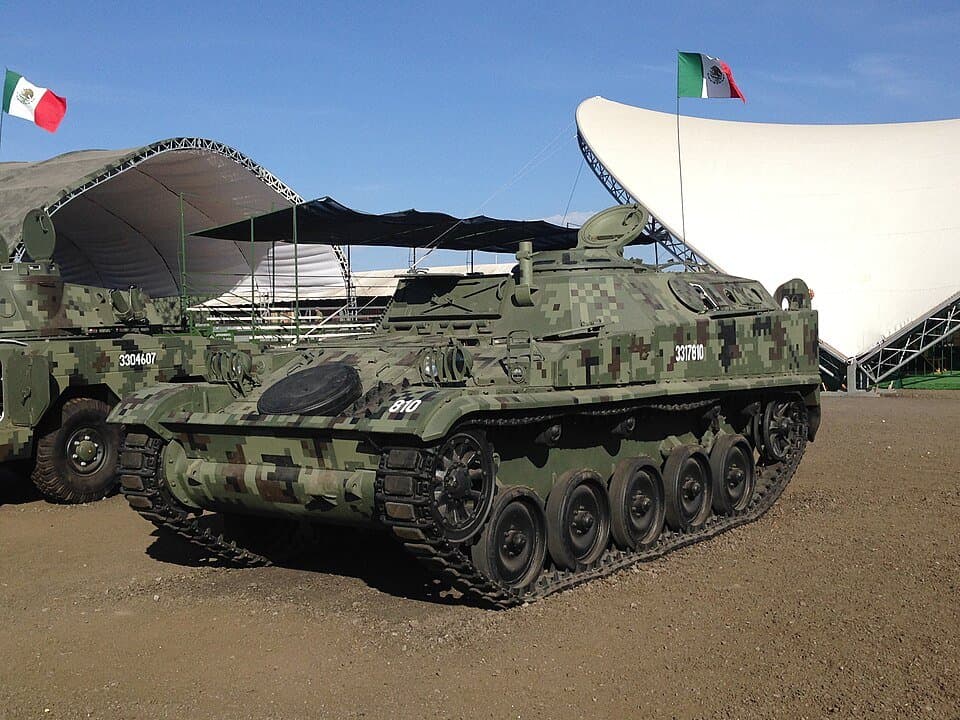

Credit
Mizael Contreras · CC BY-SA 4.0 · Resized · CC BY-SA 4.0 · Source ↗ · Modified


Preparing your view.

At a glance
AMX-VCIlarger figure on 0 of 4
SPG Kalinalarger figure on 4 of 4
True scale
Side by side. From every angle. A human reference for perspective.
3.45 MB · Loads when you open it| Model | Length | Width / span | Height |
|---|---|---|---|
| AMX-VCI | ≈ 5.7 m | ≈ 2.67 m (Width) | ≈ 2.32 m |
| SPG Kalina | ≈ 10.41 m | ≈ 2.87 m (Width) | ≈ 3.08 m |
Scaled uniformly to the sourced length of 5.7 m. The width was fitted to the sourced 2.67 m. Not an official model or a measured survey.
ForceTally · All rights reserved
Scaled uniformly to the sourced length of 10.41 m. Thin antennas or poles standing above the body were pressed down to it, so they do not set the height; the width was fitted to the sourced 2.87 m. Not an official model or a measured survey.
ForceTally · All rights reserved
The human reference is a generic 1.75 m figure. Models describe external size, not combat performance.
Measured figures
Length
Single source5.7 m[source]
Length
Single sourceConfiguration
| Specification | AMX-VCI | SPG Kalina |
|---|---|---|
| Type | Armored personnel carrier[source] | Armored personnel carrier[source] |
| Place of origin | France[source] | Poland[source] |
| Wars | Turkish invasion of Cyprus Indonesian invasion of East Timor Lebanese Civil War South Lebanon conflict (1985–2000) Cenepa War Mexican drug war South Sudanese Civil War[source] | — |
| Armor | 10-40mm[source] | — |
| Main armament | turret mounted 20mm F2/M693 autocannon |
Counts only measures both sources give with the same scope. A larger figure is not a better system.
10.41 m[source]
Bars compare reported quantities only. A larger figure does not make a system better; configurations and test conditions differ.
12.7mm NSVT machine-gun[source] |
| Secondary armament | 12.7 mm M2 Browning machine gun or 7.62 mm MAS[source] | — |
|---|
| Power/weight | 16.7/tonne[source] | — |
|---|
| Suspension | Torsion-bar[source] | Torsion bar[source] |
|---|
| Former operator · Belgium | Belgium[source] | — |
|---|
| Former operator · France | France[source] | — |
|---|
| Former operator · Italy | Italy[source] | — |
|---|
| Former operator · Lebanon | Lebanon[source] | — |
|---|
| Former operator · Netherlands | Netherlands[source] | — |
|---|
| Former operator · Lebanese Forces | Lebanese Forces[source] | — |
|---|
| Source measurement | The AMX-VCI ( French : Véhicule de Combat d'Infanterie ) is one of the many variants of the French AMX-13 light tank. It was the front line APC of the French Army until replaced by the AMX-10P . It is still used by some countries, for example Mexico, where it goes under the name of DNC-1 and is armed with a 20mm cannon.[source]AMX-VCI · Lead; only the objects and conditions stated in this passage Beginning in 1957, some 3,000 vehicles were produced. It was initially produced as the AMX-13 VTT ( véhicule de transport de troupe ), which carried ten infantrymen and was armed with either an AA-52 7.62 mm machine gun or a 12.7 mm M2 Browning machine gun in an open mounting. The final versions had a turret equipped with a 20mm light autocannon , producing a vehicle that can be seen as an early example of the infantry fighting vehicle .[source]AMX-VCI · History; only the objects and conditions stated in this passage AMX-VCA: VTT based 155 mm Support Vehicle designed to accompany the Mk F3 SPH[source]AMX-VCI · Variants; only the objects and conditions stated in this passage AMX-VCI 12.7: Version with a 50 calibre (12.7 mm) HMG used by France and the Netherlands[source]AMX-VCI · Variants; only the objects and conditions stated in this passage AMX-VCI M-56: Fitted with a 20mm cannon[source]AMX-VCI · Variants; only the objects and conditions stated in this passage AMX-VCPM de 81: VTT-based 81 mm Mortar Carrier[source]AMX-VCI · Variants; only the objects and conditions stated in this passage AMX-VCPM de 120: VTT-based 120 mm Mortar Carrier[source]AMX-VCI · Variants; only the objects and conditions stated in this passage AMX-13 mod.56 [81 mm mortar carrier]: Belgian Army version[source]AMX-VCI · Variants; only the objects and conditions stated in this passage AMX-VCI Retrofit: Indonesian Army modernization with the hull lengthened 20 cm to accommodate Navistar 400hp engine, redesigned engine deck, frontal armor, and exhaust, also modification to transmission and suspension.[source]AMX-VCI · Variants; only the objects and conditions stated in this passage DNC-1: Mexican Army local designation, slightly modernized version with a diesel engine and a 20 mm. cannon, upgraded by SEDENA[source]AMX-VCI · Variants; only the objects and conditions stated in this passage A total of 60 AMX-VCIs were delivered to the Lebanese Army in 1971-72, with additional 30 vehicles being reportedly delivered in May 1983. A number of VCIs were seized by the Amal Movement militia and the pro-Israeli South Lebanon Army (SLA) militia in February 1984 after the defeat of the Lebanese government forces by Shia Muslim and Druze militias during the Mountain War . The captured vehicles were quickly pressed into service by the SLA, who used them during the South Lebanon conflict (1985–2000) until the collapse of the militia in the wake of the Israeli withdrawal of April 2000; those used by Amal were returned to the Lebanese Army earlier in October 1990. VCIs up-armed with US M40 106mm recoilless rifles were also employed by Lebanese Army General Michel Aoun 's loyalist troops during the Elimination War waged against his Christian rivals of the Lebanese Forces (LF) militia at East Beirut in February 1990, who in turn also managed to capture some VCIs from Army barracks, which were returned in 1991-94.[source]AMX-VCI · Combat history / Lebanon; only the objects and conditions stated in this passage | N-21 radar is a three-dimensional radar used to detect targets at low altitudes (up to 5 km) at ranges up to 100 km. The radar was designed by Polish company Radwar . Radar is using SPG-1, non armored carrier vehicle.[source]SPG Kalina · Variants / N-21; only the objects and conditions stated in this passage Self propelled Minelayer ) is a tracked minelayer developed from SPG-1M specifically for the rapid laying of surface and buried anti-tank mines.[source]SPG Kalina · Variants / SUM Kalina; only the objects and conditions stated in this passage The minelaying system is carried at the rear of the vehicle with mines being automatically fed into the system from two magazines carried within the armoured superstructure; each magazine can hold up to 125 anti-tank mines of the TM-62M or TM-62M Wierzba type.[source]SPG Kalina · Variants / SUM Kalina; only the objects and conditions stated in this passage The mine magazines are replenished or replaced using a K10 crane mounted at the rear of the vehicle which has a lifting capacity of 2,800 kg.[source]SPG Kalina · Variants / SUM Kalina; only the objects and conditions stated in this passage When burying mines the vehicle can travel at a speed between 6 and 10 km/h.[source]SPG Kalina · Variants / SUM Kalina; only the objects and conditions stated in this passage When laying surface mines the speed range is from 6 to 20 km/h.[source] |
|---|
| Manufacturer | ateliers de construction de Roanne[source]AMX-VCI · explicitly named manufacturer in own article production history Creusot-Loire[source]AMX-VCI · explicitly named manufacturer in own article production history | Bumar Łabędy[source] |
|---|
| Used by | — | Poland[source] |
|---|
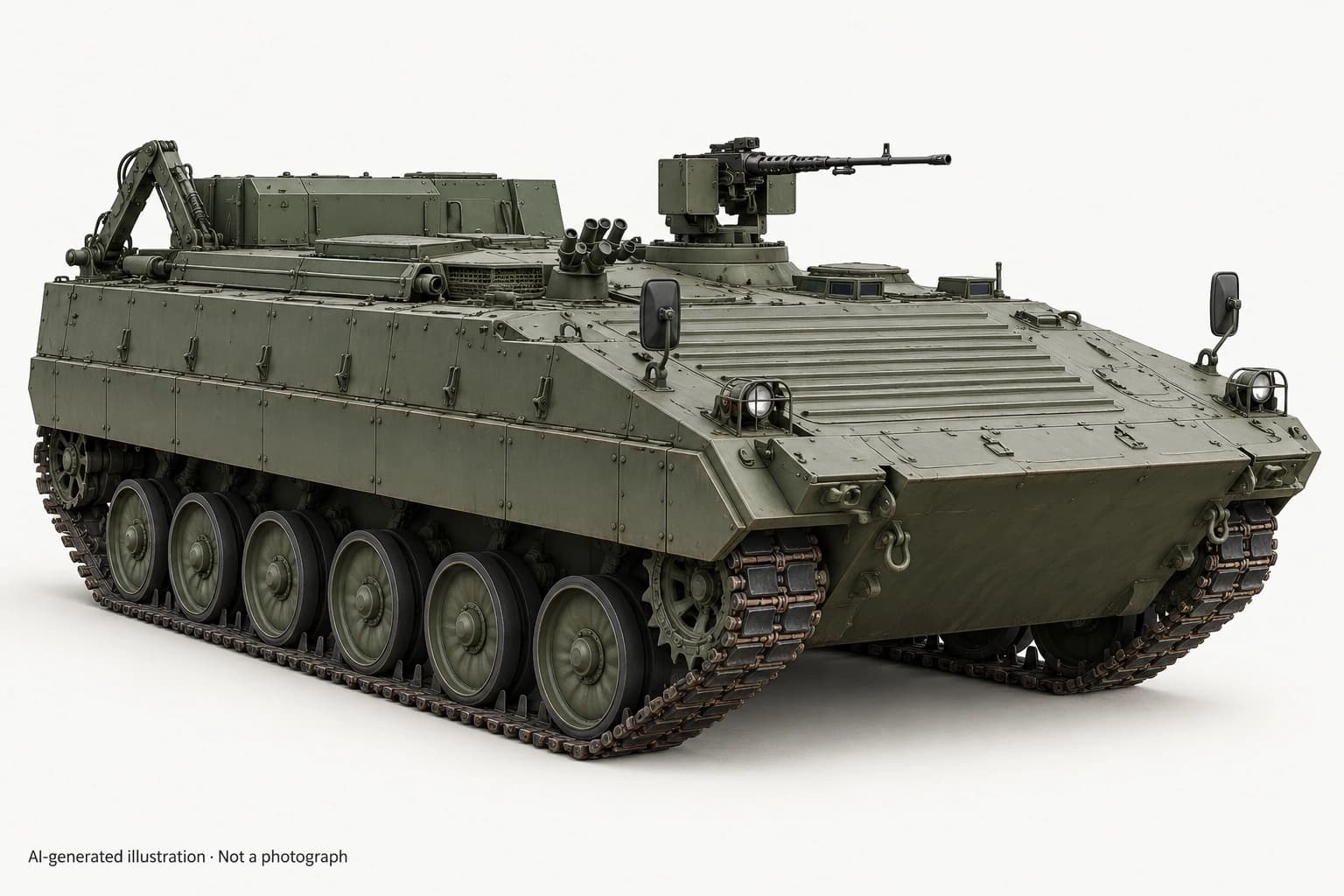
| Source manufacturer statement | — | Special-purpose Tracked Chassis ; Kalina is Polish for guelder rose ) is a heavy, multi-purpose armoured personnel carrier designed at the OBRUM ( OBRUM stands for Ośrodek Badawczo-Rozwojowy Urządzeń Mechanicznych – Polish for Research and Development Centre for Mechanical Appliances ) and is produced by the Bumar Łabędy company - part of Polish military consortium - Bumar Group.[source]Only the subject, component or variant named in this passage; unresolved names do not create a manufacturer identity |
|---|
| Reported operators | — |
|---|
It is possible to lay mines in water up to 900 mm deep at a speed of 6 km/h.The vehicle is armed with a 12.7 mm NSW machine gun; 902A smoke grenade launchers are also provided.[source]SPG Kalina · Variants / SUM Kalina; only the objects and conditions stated in this passage
Infantry fighting vehicle based on SPG-1M.[source]SPG Kalina · Variants / BWP-2000; only the objects and conditions stated in this passage
It protects the vehicle against APFSDS-T projectiles of up to 35 mm in calibre over the frontal arc.[source]SPG Kalina · Variants / BWP-2000; only the objects and conditions stated in this passage
The roof and sides protect it against 12.7 mm rounds fired from a range of 100 m.[source]SPG Kalina · Variants / BWP-2000; only the objects and conditions stated in this passage
The other parts of the armour protect it against 7.62 mm rounds from any distance and angle.[source]SPG Kalina · Variants / BWP-2000; only the objects and conditions stated in this passage
The turret is the Italian Oto Melara T60/70A which is normally armed with a stabilized 60 mm rifled autocannon, a 7.62 mm coaxial machine gun and 12.7 mm anti-aircraft heavy machine gun.[source]SPG Kalina · Variants / BWP-2000; only the objects and conditions stated in this passage
The 60 mm autocannon can be replaced by a variety of guns from 25 mm autocannons to 105 mm guns.[source]SPG Kalina · Variants / BWP-2000; only the objects and conditions stated in this passage
A 155mm howitzer on UPG chassis. UPG (UPG for Uniwersalne Podwozie Gąsiennicowe – lit. Universal Tracked Chassis) is a heavy APC that is using technologies from SPG Kalina and PT-91 Twardy .[source]SPG Kalina · Variants / Krab; only the objects and conditions stated in this passage