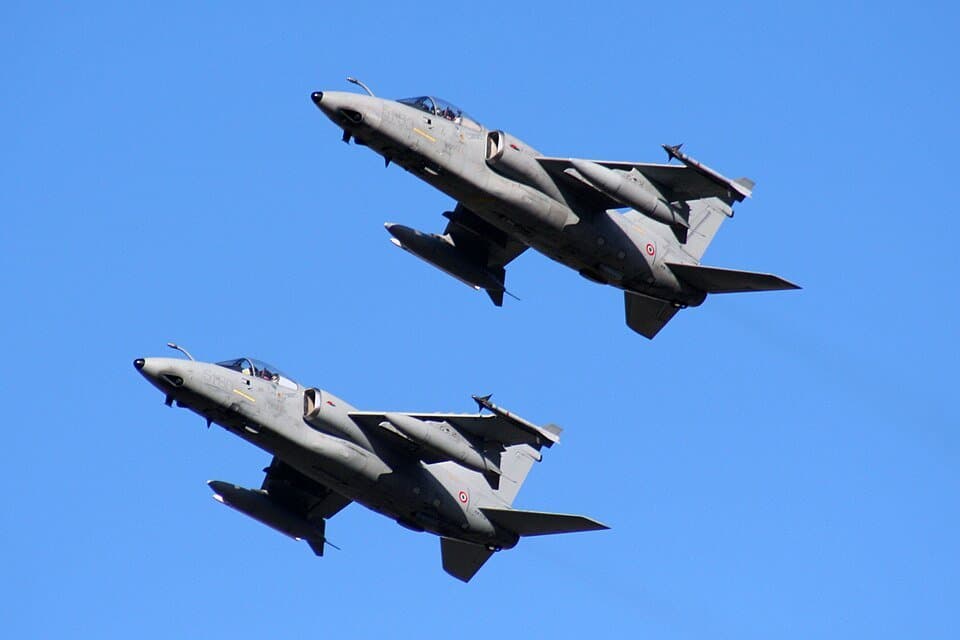


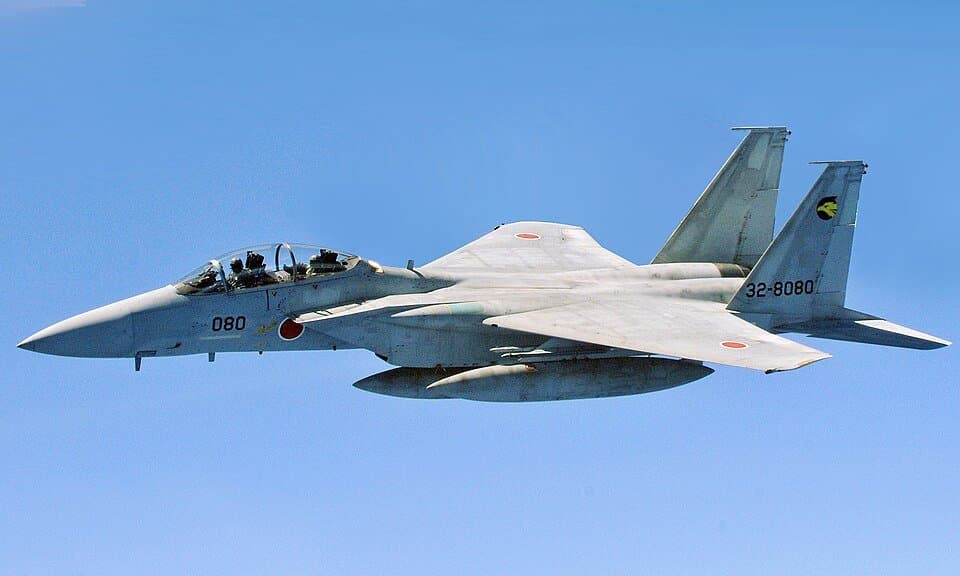
Credit
Carlos Menendez San Juan · CC BY-SA 2.0 · Resized · CC BY-SA 2.0 · Source ↗ · Modified


Preparing your view.


At a glance
Measured figures
AMX · Length
Single source13.23 m (43 ft 5 in)[source]
F-15J · Length
Single sourceConfiguration
| Specification | AMX International AMX | Mitsubishi F-15J |
|---|---|---|
| Type | Ground-attack aircraft[source] | Air superiority fighter[source] |
| National origin | Italy / Brazil[source] | Japan United States[source] |
| Manufacturer | AMX International[source] | Mitsubishi Heavy Industries McDonnell Douglas[source] |
| Status | Active service[source] | In service |
19.43 m (63 ft 9 in)[source]
Empty; AMX · Empty weight
Single sourceGross; AMX · Gross weight
Single sourceMaximum take-off; AMX · Max takeoff weight
Single source6,700 kg (14,771 lb)[source]
10,750 kg (23,700 lb)[source]
13,000 kg (28,660 lb)[source]
Empty; F-15J · Empty weight
Single sourceGross; F-15J · Gross weight
Single sourceFerry; AMX · Ferry range
Single source3,336 km (2,073 mi, 1,801 nmi)[source]
AMX · hi-lo-hi profile, with 900 kg (1,984 lb) of external stores
Single source889 km (552 mi, 480 nmi) hi-lo-hi profile, with 900 kg (1,984 lb) of external stores[source]
AMX · 1 × Rolls-Royce Spey 807 turbofan engine thrust
Single source1 × Rolls-Royce Spey 807 turbofan engine, 49.1 kN (11,000 lbf) thrust[source]
F-15J · 2 × Pratt & Whitney F100-220 (or −100)The engine is a Pratt & Whitney F100 built under licence by IHI Corporation . afterburning turbofan engine thrust each dry
Single sourceF-15J · with afterburner
Single source2 × Pratt & Whitney F100-220 (or −100)The engine is a Pratt & Whitney F100 built under licence by IHI Corporation . afterburning turbofan engine, 77.62 kN (17,450 lbf) thrust each dry, 111.2 kN (25,000 lbf) with afterburner[source]
AMX · Endurance
Single source4 hours, 15 minutes[source]
Bars compare reported quantities only. A larger figure does not make a system better; configurations and test conditions differ.
| Primary users | Italian Air Force (historical) Brazilian Air Force[source] | — |
|---|
| Number built | 230[source] | 213[source] |
|---|
| Manufactured | 1986–1999[source] | — |
|---|
| Introduction date | 1989[source] | 7 December 1981[source] |
|---|
| First flight | 15 May 1984[source] | 4 June 1980[source] |
|---|
| Retired | 2024 (Italy)[source] | — |
|---|
| Fuel capacity | 3,555 L (939 US gal; 782 imp gal) / 2,700 kg (5,952 lb) internal[source] | 6,100 kg (13,448 lb) internal[source] |
|---|
| Wing loading | 512 kg/m 2 (105 lb/sq ft)[source] | 358 kg/m 2 (73 lb/sq ft)[source] |
|---|
| Thrust/weight | 0.47[source] | 1.12[source] |
|---|
| Rockets | rocket pods[source] | — |
|---|
| Missiles | 2× AIM-9 Sidewinders or MAA-1 Piranha or A-Darter , carried on wingtip rails[source] | Air-to-air missiles Mitsubishi AAM-3 Mitsubishi AAM-4 Mitsubishi AAM-5 AIM-9 Sidewinder AIM-7 Sparrow Air-to-ground missiles AGM-158 JASSM Bombs Mk 82 General-Purpose Bomb CBU-87 Cluster bomb[source] |
|---|
| Bombs | 3,800 kg (8,378 lb) on 5 external hardpoints, including MAR-1 missiles, general-purpose and laser-guided bombs[source] | — |
|---|
| Guns | 1× 20 mm (0.787 in) M61A1 Vulcan 6-barreled Gatling cannon (Italian aircraft) 2× 30 mm (1.181 in) Bernardini Mk-164 cannon (Brazilian aircraft)[source] | 1× 20 mm M61 Vulcan 940 shells.[source] |
|---|
| Hardpoints | Bombs: 3,800 kg (8,378 lb) on 5 external hardpoints, including MAR-1 missiles, general-purpose and laser-guided bombs[source] | 10 , with provisions to carry combinations of: Missiles: Air-to-air missiles Mitsubishi AAM-3 Mitsubishi AAM-4 Mitsubishi AAM-5 AIM-9 Sidewinder AIM-7 Sparrow Air-to-ground missiles AGM-158 JASSM Bombs Mk 82 General-Purpose Bomb CBU-87 Cluster bomb[source] |
|---|
| Primary user | — | Japan Air Self-Defense Force[source] |
|---|
| Developed from | — | McDonnell Douglas F-15 Eagle[source] |
|---|
| Airfoil | — | root: NACA 64A006.6 ; tip: NACA 64A203[source] |
|---|
Maximum take-off; F-15J · Max takeoff weight
Single source