


Preparing your view.
At a glance
AMX-10Plarger figure on 0 of 3
BMP-3larger figure on 3 of 3
Counts only measures both sources give with the same scope. A larger figure is not a better system.
True scale
Side by side. From every angle. A human reference for perspective.
3.47 MB · Loads when you open it| Model | Length | Width / span | Height |
|---|---|---|---|
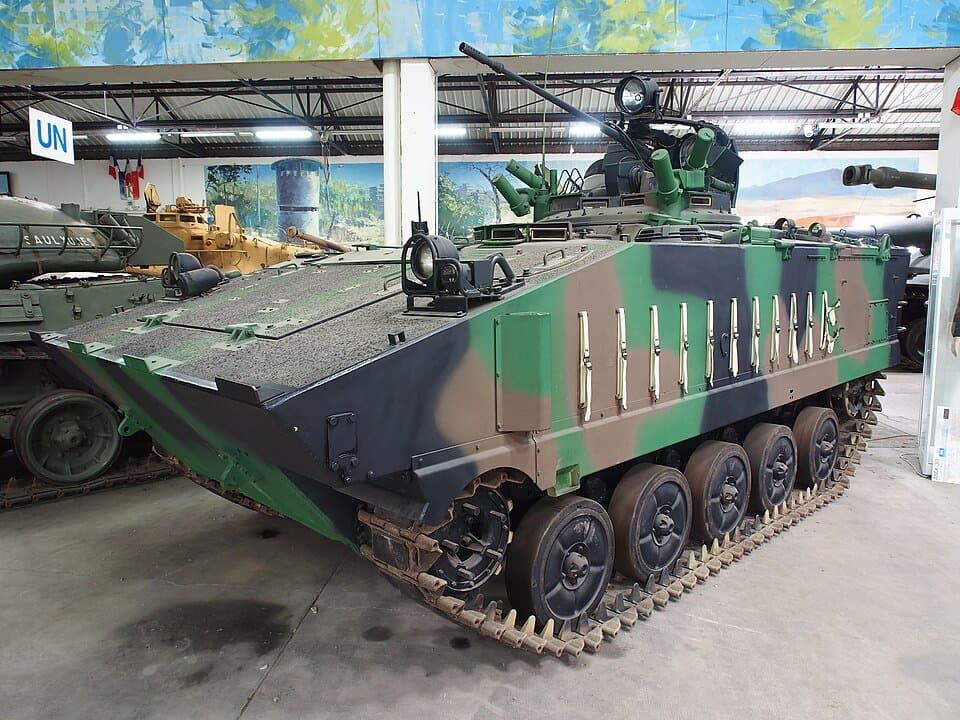
| AMX-10P | ≈ 5.78 m | ≈ 2.78 m (Width) | ≈ 2.99 m |
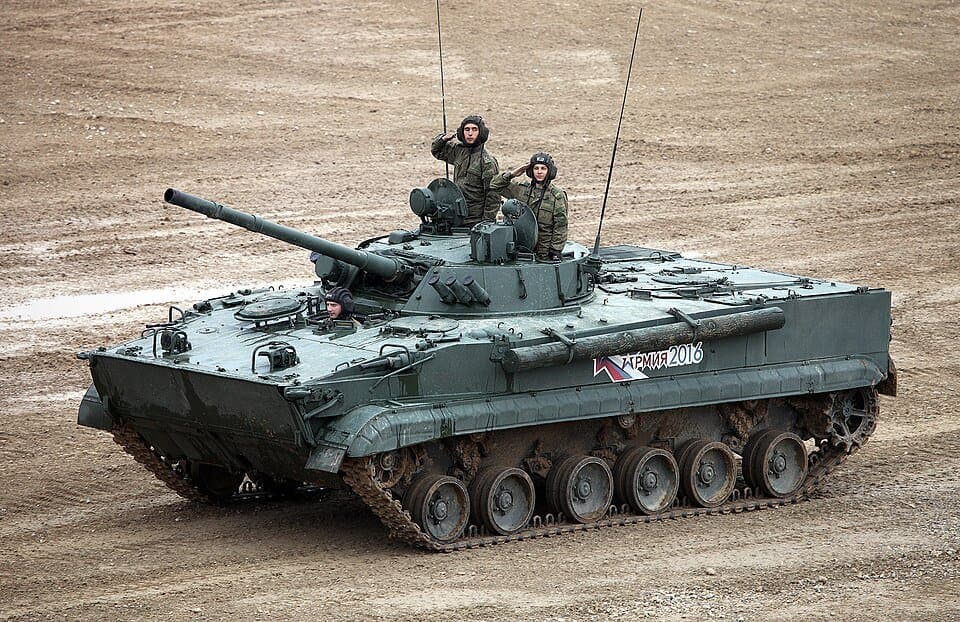
| BMP-3 | ≈ 7.14 m | ≈ 3.2 m (Width) | ≈ 2.97 m |
Scaled uniformly to the sourced length of 5.778 m. The width was fitted to the sourced 2.78 m. Not an official model or a measured survey.
ForceTally · All rights reserved
Scaled uniformly to the sourced length of 7.14 m. The width was fitted to the sourced 3.2 m. Not an official model or a measured survey.
ForceTally · All rights reserved
The human reference is a generic 1.75 m figure. Models describe external size, not combat performance.
Measured figures
Length
Single source5.778 m (18 ft 11.5 in)[source]
Length
Single sourceConfiguration
| Specification | AMX-10P | BMP-3 |
|---|---|---|
| Type | Infantry fighting vehicle[source] | Infantry fighting vehicle[source] |
| Place of origin | France[source] | Soviet Union Russia[source] |
| Used by | See Operators[source] | See Operators[source] |
| Wars | Iran–Iraq War Gulf War Bosnian War War in Iraq (2013–2017)[source] | First Chechen War Second Chechen War Yemeni Civil War (2014–present) Saudi Arabian-led intervention in Yemen Second Nagorno-Karabakh War Russo-Ukrainian War Russo-Ukrainian war (2022–present) |
7.14 m (23 ft 5 in)[source]
Operational; Operational range
Single source600 km (370 mi)[source]
Bars compare reported quantities only. A larger figure does not make a system better; configurations and test conditions differ.
| Designed | 1968[source] | 1975–1987[source] |
|---|
| Manufacturer | GIAT Industries[source] | Kurganmashzavod[source] |
|---|
| Produced | 1973–1994[source] | — |
|---|
| No. built | 1,750[source] | 2,000+[source] |
|---|
| Variants | See Variants[source] | — |
|---|
| Main armament | 20 mm F2/M693 autocannon (800 rounds)[source] | 2K23/Bakhcha-U/Berezhok turret with 100 mm 2A70 cannon 30 mm 2A72 autocannon AGS-30 grenade launcher and Kornet-EM (Berezhok turret only) AU-220M Baikal remote weapon station turret with 57 mm BM-57 autocannon[source] |
|---|
| Secondary armament | 7.62 mm MAS coaxial machine gun (2,000 rounds)[source] | 3 × 7.62 mm PKT machine guns[source] |
|---|
| Power/weight | 14.9 kW/t (20.0 hp/t)[source] | 27 hp/tonne[source] |
|---|
| Ground clearance | 0.45m[source] | — |
|---|
| Fuel capacity | 528 litres[source] | — |
|---|
| Former operator · Bosnia-Herzegovina | Bosnia-Herzegovina[source] | — |
|---|
| Former operator · France | France[source] | — |
|---|
| Former operator · Greece | Greece[source] | — |
|---|
| Former operator · Iraq | Iraq[source] | — |
|---|
| Former operator · UAE | UAE[source] | — |
|---|
| Role | French amphibious infantry fighting vehicle[source] | Soviet and Russian infantry fighting vehicle , successor to the BMP-1 and BMP-2[source] |
|---|
| Source measurement | The AMX-10P was also successfully exported, and continues to serve with several nations' militaries. It was selected by a number of Arab armies and has been operated by Iraq , Qatar , Saudi Arabia , and the United Arab Emirates . Special marine variants were developed for Singapore and Indonesia , including the AMX-10 PAC 90 fire support version with a 90 mm gun.[source]AMX-10P · Lead; only the objects and conditions stated in this passage The AMX-10P is fully amphibious, being propelled through water at speeds of up to 7 km/h by twin waterjets. It is fitted as standard with a trim vane and bilge pumps to assist with the flotation process. The AMX-10P shares a number of common transmission and chassis components with its wheeled counterpart, the AMX-10 RC .[source]AMX-10P · Lead; only the objects and conditions stated in this passage The AMX-10P was developed by the Atelier de Construction d'Issy-les-Moulineaux (AMX) in response to a French army requirement for a new tracked armoured fighting vehicle to supplement or replace the ageing AMX-VCI . The first prototypes were completed around 1968. They were showcased to potential domestic and international customers at Satory in 1969. Production did not commence until the French Army placed its first order in late 1972. The first AMX-10Ps were delivered in mid to late 1973 to the 7th Mechanised Brigade stationed at Reims .[source]AMX-10P · Development history; only the objects and conditions stated in this passage French Army AMX-10Ps were fitted with a 20 mm autocannon in a Toucan II two-man turret with seating for a gunner and commander. Other one-man turrets could be fitted, as well as an observation cupola for training vehicles. Export variants of the AMX-10P abounded, including models equipped with battlefield surveillance radars, the ATILA artillery fire control system, a bank of HOT anti-tank missiles, 60 mm or 81 mm gun-mortars, and a large 90 mm gun.[source]AMX-10P · Development history; only the objects and conditions stated in this passage Greece was the first foreign power to purchase the AMX-10P. Between 1974 and 1977 the Hellenic Army ordered over 100 vehicles in three separate variants. Qatar ordered 30 AMX-10Ps in 1975, while Iraq, Saudi Arabia and Indonesia accounted for large export orders during the early 1980s. GIAT Industries accepted a final order from Singapore for AMX-10P PAC-90s in 1994, following which the production lines were closed. At this point 1,750 AMX-10Ps had been manufactured.[source]AMX-10P · Development history; only the objects and conditions stated in this passage 108 AMX-10Ps underwent extensive overhauls to improve their armour and mobility between 2006 and 2008, including new gearboxes and suspension systems. By 2015, however, the AMX-10P had been entirely withdrawn from French service, being replaced by the VBCI .[source]AMX-10P · Development history; only the objects and conditions stated in this passage Standard AMX-10P turrets are equipped with a GIAT M693 automatic cannon firing two different types of both high explosive ammunition and armour-piercing ammunition. More than one ammunition type may be loaded at once and fired alternatively. The high explosive rounds have a muzzle velocity of 1,050 m/s. The latest armour-piercing round has a muzzle velocity of 1,300 m/s and is capable of penetrating 20 mm of rolled homogeneous armour at an incidence of 60°. The autocannon has a cyclic rate of fire of 740 rounds per minute, with the gunner being able to switch between semiautomatic, limited burst, or fully automatic fire as necessary.[source]AMX-10P · Description; only the objects and conditions stated in this passage AMX-10Ps have a very distinctive, pointed hull and a sloping glacis plate, with the driver's position plainly visible to the left. The hull roof is horizontal as well as sloped slightly inwards, accommodating a turret ring near the centre of the chassis. Both hull sides are vertical and lack firing ports. There is a circular exhaust outlet on the right side of the hull above the second and third road wheels.[source]AMX-10P · Description / External; only the objects and conditions stated in this passage AMX-10P : Standard production model. Armed with a two-man Toucan II turret and a M963 F2 20 mm autocannon.[source]AMX-10P · Variants; only the objects and conditions stated in this passage AMX-10P 25 : AMX-10P with a one-man Dragar turret and a M811 25 mm autocannon. This was trialled by the French Army but not adopted into service. It was later adopted by the Singapore Armed Forces .[source]AMX-10P · Variants; only the objects and conditions stated in this passage AMX-10P Marine : AMX-10P with improved amphibious capabilities and a modified propulsion system that allowed for top speeds of up to 10 km/h in water. This variant was developed for the Indonesian Marine Corps .[source]AMX-10P · Variants; only the objects and conditions stated in this passage AMX-10SAO : AMX-10P modified as a mobile forward artillery observation post. It possessed a long-range laser rangefinder in its turret, as well as a 7.62mm machine gun.[source]AMX-10P · Variants; only the objects and conditions stated in this passage AMX-10TM : AMX-10P modified as an artillery tractor , with a new one-man turret and its rear ramp removed. It towed a F1 120 mm mortar and carried 60 mortar projectiles.[source]AMX-10P · Variants; only the objects and conditions stated in this passage AMX-10P TMC-81 : AMX-10P with an 81 mm breech loading, Hotchkiss-Brandt CL-81 gun-mortar. Similar in concept to the earlier CM60A1 , the CL-81 fired both high explosive and armour-piercing shells.[source]AMX-10P · Variants; only the objects and conditions stated in this passage AMX-10P PAC-90 : AMX-10P with the complete turret and 90 mm main gun assembly of the Panhard ERC-90 Sagaie armoured car. It carried 30 90 mm shells and 2,000 rounds of 7.62mm machine gun ammunition. This variant was marketed primarily to Indonesia and Singapore.[source]AMX-10P · Variants; only the objects and conditions stated in this passage AMX-10M : Modified AMX-10M to fitted the 142mm ACRA Launcher with 20mm secondary gun.[source]AMX-10P · Variants; only the objects and conditions stated in this passage The production version of the AMX 10P is present in the game War Thunder as an SPAA . The modified AMX 10P with the 142mm ACRA Launcher, the AMX 10M, is also present in the game War Thunder as a Tank Destroyer .[source]AMX-10P · In the popular culture; only the objects and conditions stated in this passage | The design of the BMP-3 ( Obyekt 688M) can be traced back to the Obyekt 685 light tank prototype with an 2A48-1 100 mm gun from 1975. The prototype did not enter series production, but the chassis, with a new engine, was used for the next-generation infantry combat vehicle Obyekt 688 from A. Blagonravov's design bureau. The Ob. 688's original weapon configuration consisting of an externally mounted Shipunov 2A42 30 mm autocannon , a 7.62 mm PKT machine gun and twin 9M113 Konkurs ATGM launcher was rejected; instead, the new 2K23 armament system was selected. The resulting BMP-3 was developed in the early 1980s and entered service with the Soviet Army officially in 1987. It was shown for the first time in public during the 1990 Victory Day parade and was given the NATO code IFV M1990/1 .[source]BMP-3 · Production history; only the objects and conditions stated in this passage The BMP-3 is one of the most heavily armed infantry combat vehicles in service. The original version has a turret fitted with a low-velocity 2A70 100 mm rifled gun which can fire conventional shells or 9M117 Bastion Anti Tank Guided Missiles (AT-10 Stabber). It carries 40 100 mm rounds and 8 ATGMs. A 2A72 30 mm dual feed autocannon with 500 (300 HEI and 200 AP-T ) rounds and a rate of fire of 350 to 400 rounds per minute and a 7.62 mm PKT machine gun with 2,000 rounds are mounted coaxially in the turret. The main gun elevates from −5° to +60°. There are also two 7.62 mm PKT bow machine guns, again with 2,000 rounds each. The BMP-3 is capable of engaging targets out to 5,000–6,000 metres with its ATGM weapon system 9K116-3 "Basnya". With conventional ammunition, such as the HE-Frag shell 3OF32, the 2A70 gun has a range of 4,000 metres.[source]BMP-3 · Design / Weaponry and optics; only the objects and conditions stated in this passage Standard equipment includes five firing ports with associated vision blocks, an R-173 transceiver, an R-173P receiver, a GO-27 radiation and chemical agent detector, an FVU filtration system, an automatic fire extinguisher and six 902V "Tucha-2" 81 mm smoke grenade launchers.[source]BMP-3 · Design / Weaponry and optics; only the objects and conditions stated in this passage |
|---|
| Country of origin | France[source]Inventory Origin column; table 5, row 5, cell 3; revision 1376380667; retrieved 2026-10-01 | — |
|---|
| In service | — | 1987–present[source] |
|---|
| Armor | — | Aluminium alloy (ABT-102) and steel armour (BT-70Sh) Hull Front: 22 mm steel, 60 mm aluminium Hull Sides/Rear: 43 mm aluminium Hull Roof: 15 mm aluminium Hull Floor: 10 mm aluminium Turret Front: 16 mm steel, 70 mm space, 50 mm aluminium Turret Roof: 18 mm aluminium Turret Sides/Rear: 43 mm aluminium[source] |
|---|
| Suspension | — | torsion bar[source] |
|---|
| Reported operators |
|---|
BMP-3M is equipped with Bakhcha-U turret, which has similar weapons to the original BMP-3 turret but with a new dual-channel FLIR gunner's sight, commander's panoramic thermal imaging device, vertical-storage conveyor, new autoloader, and a new sighting system. It also has a stronger armor on the turret, and two-axis stabilisation.[source]BMP-3 · Design / Weaponry and optics; only the objects and conditions stated in this passage
In August 2017, a BMP-3M was presented with a new ATGM remote weapon station fitted on the standard turret carrying two 9M120 Ataka (AT-9 Spiral-2) missiles.[source]BMP-3 · Design / Weaponry and optics; only the objects and conditions stated in this passage
In June 2018, the Russian Defense Ministry announced that BMP-3s would be fitted with the AU-220M combat module equipped with a 57 mm cannon. The module can carry 80 rounds and fire 80 rounds per minute including air burst, high-explosive, fragmentation, armor-piercing and guided munitions with a maximum range of 14.5 km (9.0 mi), and can even punch through the side armor of main battle tanks .[source]BMP-3 · Design / Weaponry and optics; only the objects and conditions stated in this passage
Early models were powered by a 450 hp engine UTD-29, but most BMP-3s are now equipped with the 500 hp UTD-29M version. The engine was developed at the Transmash Diesel Engine Plant in Barnaul. The BMP-3 has a range of 600 km, an altitude of operation of up to 3,000 m and it is transportable by train, truck, sea, and air. The BMP-3 engine is a diesel four-stroke, liquid-cooled design. The transmission is a four-speed hydromechanical power unit, with power takeoff to its water jets. The suspension is independent, with a torsion bar and six hydraulic shock absorbers. Steering is by gear differential with hydrostatic drive. The track adjusting mechanism is remotely controlled from the driver's station, with tension force indication. The water-jet propulsion unit is single-stage, axial, auger-type .[source]BMP-3 · Design / Mobility; only the objects and conditions stated in this passage
The hull and turret are made of a high-strength aluminum alloy, with the front of the hull being provided with an extra steel plate welded over it plus spaced armor from the trim vane. The turret is also provided with a thick steel spaced armour shield over its frontal arc. Over the frontal arc, the vehicle is protected against 30 mm gun rounds at a range of 200 m. In addition to "hard" protection, the BMP-3's self-sealing fuel tank is located in front of the driver, directly behind the front armour plating. It is specially constructed to act as armour, effective against shaped charge warheads as well as any autocannon shells that managed to go through the front armour.[source]BMP-3 · Design / Countermeasures; only the objects and conditions stated in this passage
The BMP-3 can create a smoke screen by injecting fuel into the exhaust manifolds. A chemical agent detector, an FVU filtration system, an automatic fire extinguisher and six 902V "Tucha-2" 81 mm smoke grenade launchers are standard.[source]BMP-3 · Design / Countermeasures; only the objects and conditions stated in this passage
The standard weight of the vehicle is 18.7 tonnes. If additional armour overlay (metal sheet of armour and Kaktus ERA) is installed, the weight will reach to 22.2 tonnes. The body is covered from the sides and the top. In such kit, it is protected against 12.7 mm machine gun rounds in the range of 100–200 m. Rostec reported in September 2023 that the production of additional protection kits for the BMP-3 increased 30 times in comparison with 2022.[source]BMP-3 · Design / Countermeasures; only the objects and conditions stated in this passage
BMP-3M – KBP and Kurganmashzavod have upgraded the vehicle with a new engine and turret with a new ATGM system 9K116-3 Basnya. The upgraded vehicle is called the BMP-3M and the new Bakhcha-U turret includes a new automatic fire control system with ballistic computer, new Sodema gunner's sight with laser rangefinder and an ATGM guidance channel, thermal imager, TKN-AI commander's vision device with laser illuminator and new ammunition loading system for ATGM. The BMP-3M is also able to fire various ammunition types, including new 100 mm laser-guided projectiles, new 100 mm HE-FRAG (high explosive fragmentation) rounds and new 30 mm APDS (armour piercing discarding sabot) rounds. Its additional auxiliary armour shields are effective against 12.7 mm armour-piercing rounds from a range of 50 m. Since November 2022 all upgraded vehicles have Kaktus ERA. The new uprated engine is the UTD-32, which is rated at 660 hp. There are actually several different M models, some fitted with additional armour, "Arena-E" or " Shtora -1" active protection systems , air conditioner etc.[source]BMP-3 · Variants / Russia; only the objects and conditions stated in this passage
BMP-3M Ataka – BMP-3M version with a two men turret armed with the 30 mm 2A72 autocannon, and the 9M120-1 Ataka ATGM.[source]BMP-3 · Variants / Russia; only the objects and conditions stated in this passage
BMP-3F – Armed with the standard 2K23 turret. Specially designed for operations at sea, with improved seaworthiness and buoyancy, capability to move afloat at sea state 3 and fire with the required accuracy at sea state 2. Compared to the basic model, the vehicle design features changes increasing flotation and vehicle stability: the self-entrenching equipment is omitted, a lightweight anti-surge vane and an air intake tube are introduced; the BMP-3F turret is also protected by anti-surge vanes. Water jet propellers develop a speed of 10 km/h when afloat. The BMP-3F design allows the vehicle to come ashore under rough sea conditions and to tow the same-type vehicle. A new main sight, the SOZH, which has an integrated laser rangefinder and an ATGM guidance channel, is installed. This version can endure continuous amphibious operation for seven hours with the running engine.[source]BMP-3 · Variants / Russia; only the objects and conditions stated in this passage
BT-3F – Amphibious version based on BMP-3F with the original turret replaced by a smaller remote weapon station with either 7.62, 12.7 or 14.5 mm machine gun. It can accommodate a crew commander, driver, gunner, and 14 troops, and can use optional ERA armor.[source]BMP-3 · Variants / Russia; only the objects and conditions stated in this passage
BRM-3K "Rys" (Ob.501) ( boyevaya razvedivatel'naya mashina ) – Surveillance and reconnaissance variant with 1PN71 thermal sight (3.7x/11x, 3 km range), 1PN61 active-pulse night vision device ( 3 km range), 1RL-133-1 ("TALL MIKE") I-band surveillance radar (3 km man, 12 km vehicle), 1V520 computer and a TNA-4-6 navigation system. The armament consists of the stabilized 30 mm autocannon 2A72 (600 rounds) and a coaxial 7.62 mm machine gun (2,000 rounds) or AU-220M Baikal remote weapon station with 57 mm BM-57 autocannon and 7.62 mm PKMT machine gun. Combat weight: 19 t, crew: 6. In 1993, Russia started quantity production of BRM-3K vehicles.[source]BMP-3 · Variants / Russia; only the objects and conditions stated in this passage
BMP-3 Dragoon – New IFV version with an unmanned turret which can be armed with a variety of combat modules, including standard BMP-3's Bakhcha-U turret with a 2A70 100 mm cannon, a 2A72 30 mm autocannon and a PKTM 7.62 mm machine gun, the AU-220M Baikal remote weapon station module with a 57 mm BM-57 gun and a module with a 125 mm 2A82-1M tank gun, the new 816 hp turbocharged UTD-32T engine and powerplant moved to the front, and a hydraulic ramp fitted to the rear. It is reported that its trials were finished in October 2017.[source]BMP-3 · Variants / Russia; only the objects and conditions stated in this passage
BREM-L "Beglianka" (Ob.691) ( bronirovannaya remontno-evakuatsionnaya mashina ) – Armoured recovery vehicle with five-tonne crane and 20/40 tonne capacity winch.[source]BMP-3 · Variants / Russia; only the objects and conditions stated in this passage
NBC protection is provided for the crew (gunner and driver) of each 9P157-2 in addition to full armor protection equivalent to the standard BMP-3 chassis and entrenching equipment.[source]BMP-3 · Variants / Russia; only the objects and conditions stated in this passage
The 9M123 missile itself is supersonic, flying at an average speed of 400 m/s (Mach 1.2) and a range of between 400 and 6,000 meters.[source]BMP-3 · Variants / Russia; only the objects and conditions stated in this passage
2S18 "Pat-S" (Ob.697) – Self-propelled version of the 152 mm howitzer 2A61 "Pat-B". This was only a prototype, further development led to the 2S31 Vena .[source]BMP-3 · Variants / Russia; only the objects and conditions stated in this passage
2S31 Vena – Self-propelled mortar carrier equipped with a 120 mm mortar based on BMP-3 chassis. It entered production in 1996 and service in 2010.[source]BMP-3 · Variants / Russia; only the objects and conditions stated in this passage
2S38 ZAK-57 Derivatsiya-PVO – Self-propelled air defense vehicle based on BMP-3 chassis fitted with a 57 mm autocannon and passive reconnaissance and target tracking equipment. It is designed to shoot down unmanned aerial vehicles (UAVs), cruise missiles , air-to-surface missiles, aircraft, helicopters, and MLRS rockets. 2S38 is equipped with a TV/thermal-imaging system with automatic target lock-on and tracking capabilities, a laser rangefinder and a laser guidance system. The optical and electronic target acquisition system can spot an aircraft at 6.4 km (4.0 mi) and using sectoral observation can detect aircraft over 12 km (7.5 mi) out. The cannon is fast enough to destroy targets traveling 500 m/s (1,100 mph; 1,800 km/h; Mach 1.5). Laser-guided , air burst and specialized anti-drone munitions for ZAK-57 are in development. Its guided projectiles have four wings folded in the casing and controlled by the actuator in the projectile's nose section, using the energy of the airflow to steer themselves to the target. Completed development in 2023.[source]BMP-3 · Variants / Russia; only the objects and conditions stated in this passage
UDAR UGV – Unmanned ground vehicle based on the tracked chassis of the BMP-3 with the center hull raised to fit the DUBM-30 Epoch armed with 2A42 autocannon, 7.62 mm PKMT machine gun, and Kornet-M ATGM.[source]BMP-3 · Variants / Russia; only the objects and conditions stated in this passage
Vikhr UGV – Unmanned ground vehicle based on BMD-3 equipped with a smaller turret armed with 2A72 autocannon, 7.62 mm PKMT coaxial machine gun and six anti-tank guided missiles 9M133M Kornet-M , three on each side of the turret. It can carry separate aerial and ground drones .[source]BMP-3 · Variants / Russia; only the objects and conditions stated in this passage
Prokhod-1 – Unmanned mine-clearing vehicle based on the BMP-3 chassis. It is equipped with the anti-mine TMT-C trawl, and a remote weapon station turret with a 12.7 mm machine gun.[source]BMP-3 · Variants / Russia; only the objects and conditions stated in this passage
BMP B-19 – BMP-3 hull with the turret replaced with the Epoch Remote Control Turret armed with one 57 mm cannon, four Kornet-EM anti-tank missiles and a Bulat guided missile system.[source]BMP-3 · Variants / Russia; only the objects and conditions stated in this passage