


Preparing your view.


At a glance
AMX-10Plarger figure on 2 of 4
True scale
Side by side. From every angle. A human reference for perspective.
3.44 MB · Loads when you open it| Model | Length | Width / span | Height |
|---|---|---|---|
| AMX-10P | ≈ 5.78 m | ≈ 2.78 m (Width) | ≈ 2.99 m |
| Bionix (family of armoured fighting vehicles) | ≈ 5.9 m | ≈ 2.7 m (Width) | ≈ 2.91 m |
Scaled uniformly to the sourced length of 5.778 m. The width was fitted to the sourced 2.78 m. Not an official model or a measured survey.
ForceTally · All rights reserved
Scaled uniformly to the sourced length of 5.9 m. Thin antennas or poles standing above the body were pressed down to it, so they do not set the height; the width was fitted to the sourced 2.7 m. Not an official model or a measured survey.
ForceTally · All rights reserved
The human reference is a generic 1.75 m figure. Models describe external size, not combat performance.
Measured figures
Length
Single source5.778 m (18 ft 11.5 in)[source]
Length
Single sourceConfiguration
| Specification | AMX-10P | Bionix (family of armoured fighting vehicles) |
|---|---|---|
| Type | Infantry fighting vehicle[source] | Infantry fighting vehicle[source] |
| Place of origin | France[source] | Singapore[source] |
| Used by | See Operators[source] | Singapore Army[source] |
| Wars | Iran–Iraq War Gulf War Bosnian War War in Iraq (2013–2017)[source] |
Bionix (family of armoured fighting vehicles)larger figure on 2 of 4
Counts only measures both sources give with the same scope. A larger figure is not a better system.
5.9 metres (19 ft 4 in)[source]
(commander, gunner, driver) + 8 passengers
Single source3 (commander, gunner, driver) + 8 passengers[source]
(Commander, Gunner, Driver) plus 7 combat troops (2 men turret version) 9 combat troops (40/50 version)
Single source3 (Commander, Gunner, Driver) plus 7 combat troops (2 men turret version) 9 combat troops (40/50 version)[source]
Hispano-Suiza Model 115-2 eight-cylinder liquid-cooled diesel at 3,000 rpm
Single sourceHispano-Suiza Model 115-2 eight-cylinder liquid-cooled diesel 205 kW (275 hp) at 3,000 rpm[source]
Detroit Diesel 6V 92TA
Single sourcewith Turbo-charge
Single sourceDetroit Diesel 6V 92TA 475 horsepower (354 kW) 550 hp (410 kW) with Turbo-charge[source]
Bars compare reported quantities only. A larger figure does not make a system better; configurations and test conditions differ.
| — |
| Designed | 1968[source] | 1988[source] |
|---|
| Manufacturer | GIAT Industries[source] | Singapore Technologies Automotive (formerly) ST Kinetics (formerly) ST Engineering[source] |
|---|
| Produced | 1973–1994[source] | 1996 – present[source] |
|---|
| No. built | 1,750[source] | 800[source] |
|---|
| Variants | See Variants[source] | See variants[source] |
|---|
| Main armament | 20 mm F2/M693 autocannon (800 rounds)[source] | Bionix 25: M242 Bushmaster 25 mm Cannon Bionix II: Mk44 Bushmaster II 30 mm Cannon[source] |
|---|
| Secondary armament | 7.62 mm MAS coaxial machine gun (2,000 rounds)[source] | 7.62×51mm NATO Commander's MG 7.62×51mm NATO Coaxial MG 7.62×51mm NATO Trooper Compartment Side Mounted GMPG[source] |
|---|
| Power/weight | 14.9 kW/t (20.0 hp/t)[source] | 20 hp/tonne[source] |
|---|
| Ground clearance | 0.45m[source] | — |
|---|
| Fuel capacity | 528 litres[source] | — |
|---|
| Former operator · Bosnia-Herzegovina | Bosnia-Herzegovina[source] | — |
|---|
| Former operator · France | France[source] | — |
|---|
| Former operator · Greece | Greece[source] | — |
|---|
| Former operator · Iraq | Iraq[source] | — |
|---|
| Former operator · UAE | UAE[source] | — |
|---|
| Role | French amphibious infantry fighting vehicle[source] | — |
|---|
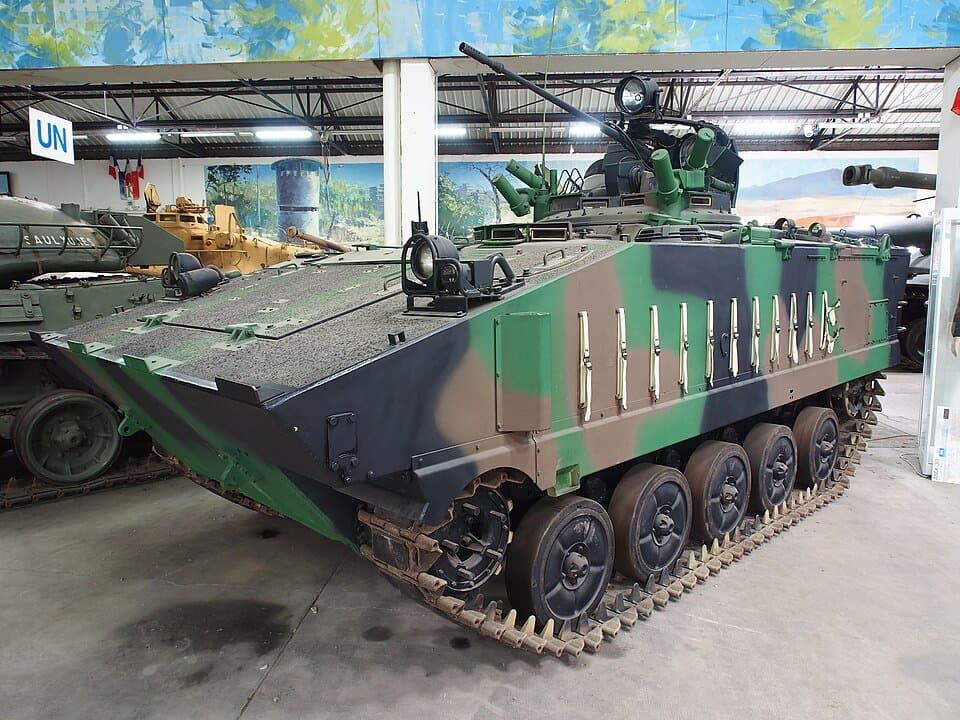
| Source measurement | The AMX-10P was also successfully exported, and continues to serve with several nations' militaries. It was selected by a number of Arab armies and has been operated by Iraq , Qatar , Saudi Arabia , and the United Arab Emirates . Special marine variants were developed for Singapore and Indonesia , including the AMX-10 PAC 90 fire support version with a 90 mm gun.[source]AMX-10P · Lead; only the objects and conditions stated in this passage The AMX-10P is fully amphibious, being propelled through water at speeds of up to 7 km/h by twin waterjets. It is fitted as standard with a trim vane and bilge pumps to assist with the flotation process. The AMX-10P shares a number of common transmission and chassis components with its wheeled counterpart, the AMX-10 RC .[source]AMX-10P · Lead; only the objects and conditions stated in this passage The AMX-10P was developed by the Atelier de Construction d'Issy-les-Moulineaux (AMX) in response to a French army requirement for a new tracked armoured fighting vehicle to supplement or replace the ageing AMX-VCI . The first prototypes were completed around 1968. They were showcased to potential domestic and international customers at Satory in 1969. Production did not commence until the French Army placed its first order in late 1972. The first AMX-10Ps were delivered in mid to late 1973 to the 7th Mechanised Brigade stationed at Reims .[source]AMX-10P · Development history; only the objects and conditions stated in this passage French Army AMX-10Ps were fitted with a 20 mm autocannon in a Toucan II two-man turret with seating for a gunner and commander. Other one-man turrets could be fitted, as well as an observation cupola for training vehicles. Export variants of the AMX-10P abounded, including models equipped with battlefield surveillance radars, the ATILA artillery fire control system, a bank of HOT anti-tank missiles, 60 mm or 81 mm gun-mortars, and a large 90 mm gun.[source]AMX-10P · Development history; only the objects and conditions stated in this passage Greece was the first foreign power to purchase the AMX-10P. Between 1974 and 1977 the Hellenic Army ordered over 100 vehicles in three separate variants. Qatar ordered 30 AMX-10Ps in 1975, while Iraq, Saudi Arabia and Indonesia accounted for large export orders during the early 1980s. GIAT Industries accepted a final order from Singapore for AMX-10P PAC-90s in 1994, following which the production lines were closed. At this point 1,750 AMX-10Ps had been manufactured.[source]AMX-10P · Development history; only the objects and conditions stated in this passage 108 AMX-10Ps underwent extensive overhauls to improve their armour and mobility between 2006 and 2008, including new gearboxes and suspension systems. By 2015, however, the AMX-10P had been entirely withdrawn from French service, being replaced by the VBCI .[source]AMX-10P · Development history; only the objects and conditions stated in this passage Standard AMX-10P turrets are equipped with a GIAT M693 automatic cannon firing two different types of both high explosive ammunition and armour-piercing ammunition. More than one ammunition type may be loaded at once and fired alternatively. The high explosive rounds have a muzzle velocity of 1,050 m/s. The latest armour-piercing round has a muzzle velocity of 1,300 m/s and is capable of penetrating 20 mm of rolled homogeneous armour at an incidence of 60°. The autocannon has a cyclic rate of fire of 740 rounds per minute, with the gunner being able to switch between semiautomatic, limited burst, or fully automatic fire as necessary.[source]AMX-10P · Description; only the objects and conditions stated in this passage AMX-10Ps have a very distinctive, pointed hull and a sloping glacis plate, with the driver's position plainly visible to the left. The hull roof is horizontal as well as sloped slightly inwards, accommodating a turret ring near the centre of the chassis. Both hull sides are vertical and lack firing ports. There is a circular exhaust outlet on the right side of the hull above the second and third road wheels.[source]AMX-10P · Description / External; only the objects and conditions stated in this passage AMX-10P : Standard production model. Armed with a two-man Toucan II turret and a M963 F2 20 mm autocannon.[source]AMX-10P · Variants; only the objects and conditions stated in this passage AMX-10P 25 : AMX-10P with a one-man Dragar turret and a M811 25 mm autocannon. This was trialled by the French Army but not adopted into service. It was later adopted by the Singapore Armed Forces .[source]AMX-10P · Variants; only the objects and conditions stated in this passage AMX-10P Marine : AMX-10P with improved amphibious capabilities and a modified propulsion system that allowed for top speeds of up to 10 km/h in water. This variant was developed for the Indonesian Marine Corps .[source]AMX-10P · Variants; only the objects and conditions stated in this passage AMX-10SAO : AMX-10P modified as a mobile forward artillery observation post. It possessed a long-range laser rangefinder in its turret, as well as a 7.62mm machine gun.[source]AMX-10P · Variants; only the objects and conditions stated in this passage AMX-10TM : AMX-10P modified as an artillery tractor , with a new one-man turret and its rear ramp removed. It towed a F1 120 mm mortar and carried 60 mortar projectiles.[source]AMX-10P · Variants; only the objects and conditions stated in this passage AMX-10P TMC-81 : AMX-10P with an 81 mm breech loading, Hotchkiss-Brandt CL-81 gun-mortar. Similar in concept to the earlier CM60A1 , the CL-81 fired both high explosive and armour-piercing shells.[source]AMX-10P · Variants; only the objects and conditions stated in this passage AMX-10P PAC-90 : AMX-10P with the complete turret and 90 mm main gun assembly of the Panhard ERC-90 Sagaie armoured car. It carried 30 90 mm shells and 2,000 rounds of 7.62mm machine gun ammunition. This variant was marketed primarily to Indonesia and Singapore.[source]AMX-10P · Variants; only the objects and conditions stated in this passage AMX-10M : Modified AMX-10M to fitted the 142mm ACRA Launcher with 20mm secondary gun.[source]AMX-10P · Variants; only the objects and conditions stated in this passage The production version of the AMX 10P is present in the game War Thunder as an SPAA . The modified AMX 10P with the 142mm ACRA Launcher, the AMX 10M, is also present in the game War Thunder as a Tank Destroyer .[source]AMX-10P · In the popular culture; only the objects and conditions stated in this passage | The Bionix ( BX ) is a family of tracked Singaporean armoured fighting vehicles jointly developed by the former Defence Material Organisation of the Ministry of Defence of Singapore (now Defence Science and Technology Agency (DSTA) ), and the former Singapore Technologies Automotive (STA) (now ST Engineering ). Intended to augment the Singapore Army's aging M113 armoured personnel carriers , it is the first indigenous armoured vehicle to be developed in Southeast Asia. The Bionix has been operational with the Singapore Armed Forces (SAF) since 1999 in a wide variety of adaptations including the Bionix II, Bionix 25 and Bionix 40/50 variants.[source]Bionix (family of armoured fighting vehicles) · Lead; only the objects and conditions stated in this passage The Bionix is a compact design produced to meet the conditions of Pacific rim countries where small size is a great asset when it comes to travelling among rubber plantations and over roads and bridges not designed for heavy vehicles. The power provided by the 475 hp (354 kW) Detroit Diesel engine to drive its 23 tonnes, ensures the Bionix is able to overcome the most difficult terrain. Future upgrades in power ratings can be developed according to needs.[source]Bionix (family of armoured fighting vehicles) · Description; only the objects and conditions stated in this passage The integrated power pack is mounted to the right of the vehicle and can be removed from the Bionix as a complete unit in under 15 minutes. The engine is coupled to the L-3 Combat Propulsion Systems HMPT-500EC fully hydro mechanical transmission, with the final drives being provided by David Brown Defence Systems . The engine compartment is also fitted with an automatic fire detection and dry-powder fire suppression system with a supplementary manual back up.[source]Bionix (family of armoured fighting vehicles) · Description; only the objects and conditions stated in this passage In the turret, the gunner's station is on the right and the commander's station is on the left, each with a single hatch cover. The turret traverses through 360°. Traverse and weapon elevation is by all-electric digital control. Both the gunner and commander have a turret stop button and are able to lay and fire the weapons. The gunner has the turret control box mounted to the right of his position and both turret-crew members have an adjustable seat. The communications equipment is installed in the turret bustle. |
|---|
| Country of origin | France[source]Inventory Origin column; table 5, row 5, cell 3; revision 1376380667; retrieved 2026-10-01 | — |
|---|
| In service | — | 1997 – present[source] |
|---|
| Designer | — | Defence Material Organisation of the Ministry of Defence (Singapore) Singapore Technologies Automotive[source] |
|---|
| Armor | — | MEXAS-M[source] |
|---|
| Suspension | — | Hydropneumatic suspension[source] |
|---|
| Reported operators | — |
|---|
The gunner has a twin-control handles and a day/thermal sight, with a magnification of x8 and two fields of view (high and low), with stadias for the 25mm cannon and 7.62mm coaxial machine gun. The commander has an optical relay from the gunner's sight and a single control handle. The vehicle commander has a further five day periscopes to give observation to the turret front, left side and rear; the gunner has three periscopes (1 x M17 and 2 x L794D) to give observation to the right and rear.[source]Bionix (family of armoured fighting vehicles) · Description; only the objects and conditions stated in this passage
Interim Armored Vehicle - The variant was designed as an entry for the US Army's requirements for its Interim Brigade Combat Team (IBCT) concept in 2000. The original turret was replaced with a US-designed and built Recon/Optical stabilised remote weapon station armed with either a 12.7 mm M2 Browning machine gun , a 7.62mm machine gun or a 40mm automatic grenade launcher. The replacement of the original turret decreased the overall weight to 17 tonnes, light enough to be air-lifted by a C-130 Hercules plane. It eventually lost the competition to the LAV III Stryker proposed by General Dynamics Land Systems (GDLS) and GM Defense .[source]Bionix (family of armoured fighting vehicles) · Variants / Prototypes; only the objects and conditions stated in this passage
Bionix Light Tank - Stemming from a need to replace/augment the current fleet of AMX-13 SM1 light tanks, MINDEF and United Defense conducted a series of studies to mount the Thunderbolt Armoured Gun System's 120 mm cannon turret (and alternatively, 105mm) on a variety of chassis, namely an extended Bionix chassis, the Universal Combat Vehicle Platform (which the SSPH Primus was based on) and a variant of the Thunderbolt's chassis. Early extensive attempts to mount an Oto Melara 120 mm turret on the Bionix have been unsuccessful. Singapore has since procured refurbished Leopard 2A4 MBTs.[source]Bionix (family of armoured fighting vehicles) · Variants / Prototypes; only the objects and conditions stated in this passage
Bionix 25 - First production model. Armed with 25mm Bushmaster cannon turret and 2 x 7.62mm GPMG. The first Bionix 25 production vehicles were completed in September 1997 and, under the Phase I production contract awarded to Singapore Technologies Automotive. Production continued until 2001. A total of 300 were built for the SAF.[source]Bionix (family of armoured fighting vehicles) · Variants / Production models; only the objects and conditions stated in this passage
Bionix 40/50 - Variant with Cupola mounted 40mm AGL / 0.5-inch HMG twin weapon station and 7.62mm GPMG. Can accommodate up to 11 troops. Approx. 300 were built.[source]Bionix (family of armoured fighting vehicles) · Variants / Production models; only the objects and conditions stated in this passage
The main turret was upgraded to the 30 mm Bushmaster II cannon and armour was improved.[source]Bionix (family of armoured fighting vehicles) · Variants / Production models; only the objects and conditions stated in this passage
The Bionix II has an improved day / night thermal sighting system (DNTSS) with a dual-axis stabilisation system for enhanced target tracking, and an integrated eye-safe laser rangefinder has a range of up to 3 km.[source]Bionix (family of armoured fighting vehicles) · Variants / Production models; only the objects and conditions stated in this passage
Upgrades also include minefield protection and enhancements to the 30mm cannon.[source]Bionix (family of armoured fighting vehicles) · Variants / Production models; only the objects and conditions stated in this passage
About 200 were built for the SAF, mostly were upgraded from existing 25mm variants.[source]Bionix (family of armoured fighting vehicles) · Variants / Production models; only the objects and conditions stated in this passage
Bionix ARV - Armoured Recovery Vehicle variant equipped with a 25 tonne winch and a 30 tonne crane.[source]Bionix (family of armoured fighting vehicles) · Variants / Production models; only the objects and conditions stated in this passage
Bionix AVLB - Armoured Vehicle Launched Bridge variant fitted with an MLC30 bridge that can be launched within 7 minutes by a crew of two (commander and driver) from the internal armoured compartment or via remote control panel. When extended the bridge can be used to span a gap of up to 22 metres.[source]Bionix (family of armoured fighting vehicles) · Variants / Production models; only the objects and conditions stated in this passage
Bionix Counter-Mine Vehicle (Trailblazer) - The SAF has inducted a 30-ton class Counter-Mine Vehicle (CMV) built on the Bionix chassis called the Trailblazer, which uses a mine flail system. In addition to mine-clearing, the Trailblazer is able to mark its trails using a lane marking system with pneumatically fired rods, enabling vehicles to quickly travel behind the Trailblazer safely without losing momentum.[source]Bionix (family of armoured fighting vehicles) · Variants / Production models; only the objects and conditions stated in this passage