



Preparing your view.

At a glance
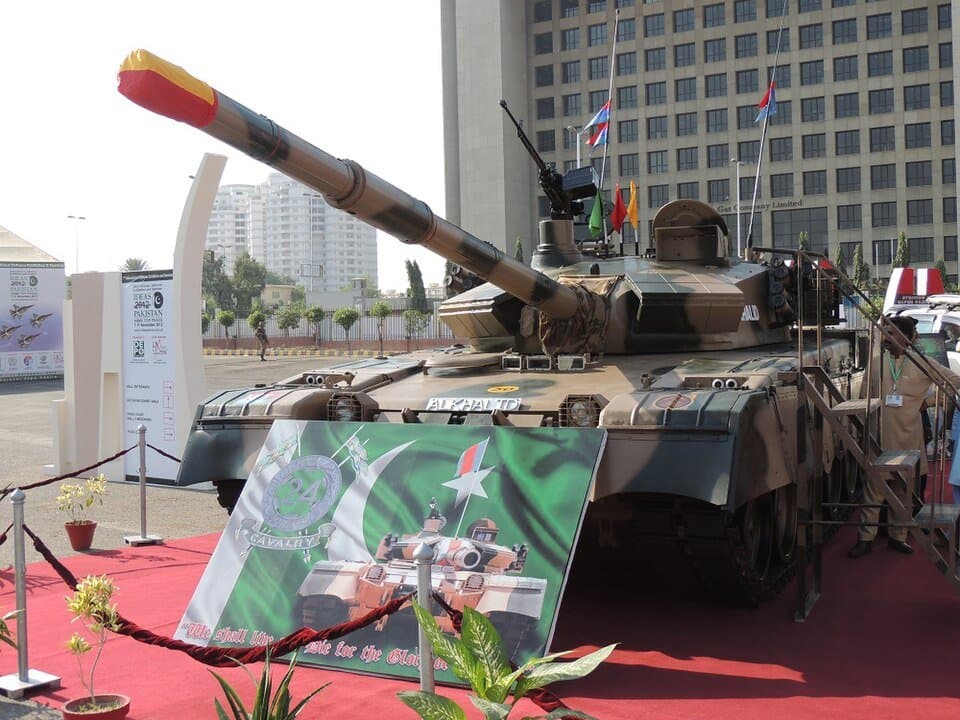
Al-Khalid tanklarger figure on 2 of 6
True scale
Side by side. From every angle. A human reference for perspective.
3.27 MB · Loads when you open it| Model | Length | Width / span | Height |
|---|---|---|---|
| Al-Khalid tank | ≈ 10.07 m | ≈ 3.5 m (Width) | ≈ 2.4 m |
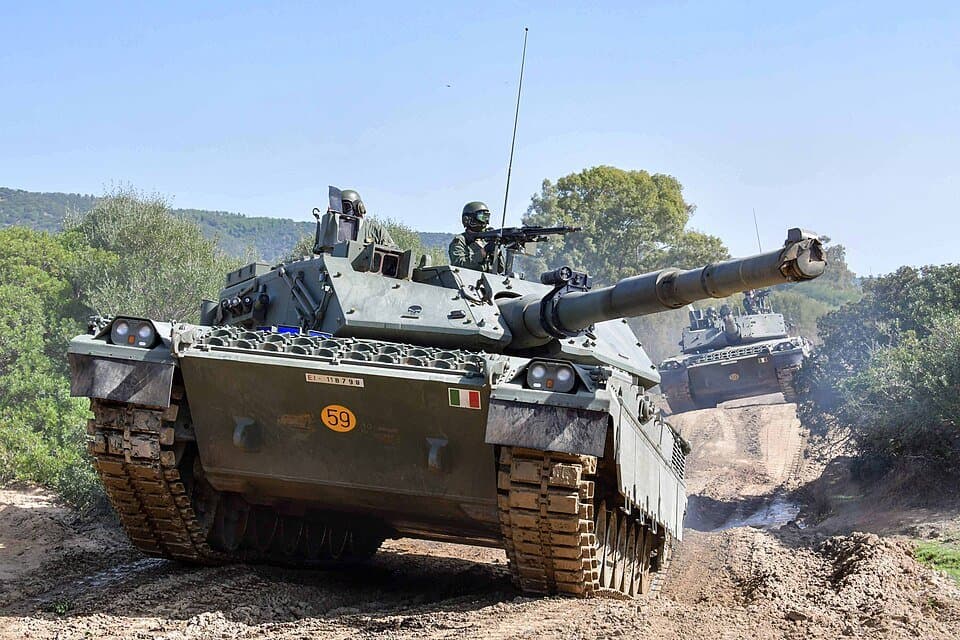
| Ariete | ≈ 9.52 m | ≈ 3.61 m (Width) | ≈ 2.45 m |
Scaled uniformly to the sourced length of 10.07 m. Thin antennas or poles standing above the body were pressed down to it, so they do not set the height; the height was fitted to the sourced 2.4 m; the width was fitted to the sourced 3.5 m. Not an official model or a measured survey.
ForceTally · All rights reserved
Scaled uniformly to the sourced length of 9.52 m. Thin antennas or poles standing above the body were pressed down to it, so they do not set the height; the height was fitted to the sourced 2.45 m; the width was fitted to the sourced 3.61 m. Not an official model or a measured survey.
ForceTally · All rights reserved
The human reference is a generic 1.75 m figure. Models describe external size, not combat performance.
Measured figures
Length
Single source10.07 m (33 ft 0 in)[source]
Length
Single sourceConfiguration
| Specification | Al-Khalid tank | Ariete |
|---|---|---|
| Type | Main battle tank[source] | Main battle tank[source] |
| Place of origin | Pakistan / China[source] | Italy[source] |
| In service | 2001 – present[source] | 1995–present[source] |
| Used by | Operators[source] | — |
| Designer | Norinco |
Counts only measures both sources give with the same scope. A larger figure is not a better system.
9.52 m (31.2 ft)[source]
Bars compare reported quantities only. A larger figure does not make a system better; configurations and test conditions differ.
| — |
| Designed | 1993–1999[source] | — |
|---|
| Manufacturer | Norinco (VT-1A/MBT-2000, Type 96-IIM) Heavy Industries Taxila (Al Khalid, Al Khalid-1)[source] | Consorzio Iveco Oto Melara (CIO), a consortium formed by Iveco and OTO Melara[source] |
|---|
| Unit cost | US$4.7 million – US$5.8 million in 2011[source] | — |
|---|
| Produced | 2001 – 2014 (Al-Khalid) 2020 – present (Al-Khalid-1)[source] | 1995–2002[source] |
|---|
| Variants | Pakistani: Al-Khalid Al-Khalid I Chinese: Type 90-IIM / MBT-2000 VT-1A[source] | — |
|---|
| Armour | Composite armour , RHA , ERA[source] | — |
|---|
| Main armament | Al-Khalid: 125 mm smoothbore gun, 39 rounds Al-Khalid I: 125 mm smoothbore gun, 49 rounds[source] | 120 mm OTO Breda L/44 smoothbore gun 42 rounds (15 ready-rounds in the turret basket with additional 27 rounds in the hull rack)[source] |
|---|
| Secondary armament | Al-Khalid: 7.62 mm coaxial machine gun , 3000 rds 12.7 mm external AA machine gun, 500 rds Al-Khalid I: 7.62 mm coaxial machine gun , 7,100 rds 12.7 mm external AA machine gun, 1,500 rds[source] | 7.62 mm MG 42/59 coaxial machine-gun, 7.62 mm MG 42/59 AA machine-gun 2,500 rounds[source] |
|---|
| Power/weight | 26 hp/ton[source] | 17.5 kW/t (23.5 hp/t)[source] |
|---|
| Transmission | 7 forward and 4 reverse gears, Semi-automatic[source] | ZF Friedrichshafen LSG 3000 (4 gears forward, 2 backwards)[source] |
|---|
| Suspension | Torsion bar with hydraulic dampers[source] | torsion bar[source] |
|---|
| No. built | — | 200[source] |
|---|
| Armor | — | steel and composite[source] |
|---|
| Ground clearance | — | 0.44 m (1.4 ft)[source] |
|---|
| Role | — | 3rd generation main battle tank of the Italian Army ,[source] |
|---|
| Source measurement | — | The C1 Ariete (English: battering ram , ram ) is a 3rd generation main battle tank of the Italian Army , developed by Consorzio Iveco Oto Melara (CIO), a consortium formed by Iveco and OTO Melara . The chassis and engine were produced by Iveco, while the turret and fire-control system were supplied by OTO Melara. The vehicle carries the latest optical and digital-imaging and fire-control systems, enabling it to fight day and night and to fire on the move. Six prototypes were developed by 1988, which were subject to intensive testing. The following year the vehicles travelled a combined 16,000 km. Deliveries were first planned for 1993, and took place in 1994 due to delays. The final tank was delivered seven years later, in August 2002.[source]Ariete · Lead; only the objects and conditions stated in this passage The Ariete's main armament is 120 mm smoothbore gun, designed by OTO Breda , similar to the Rheinmetall L/44 . The gun fires most NATO-standard rounds of the same calibre. It carries 42 rounds; 15 ready rounds are stored vertically on the left side of the main gun breech. The other 27 rounds are stowed in a hull rack to the left of the driver's station. The gun barrel has a thermal insulating sleeve and a fume extractor ; it is fully stabilized in both azimuth and elevation by an electro-hydraulic drive system.[source]Ariete · Design / Armament; only the objects and conditions stated in this passage Secondary armament consists of a 7.62 mm MG 42/59 coaxial machine gun operated by the tank gunner or commander and an additional 7.62 mm MG 42/59 configured as an anti-aircraft weapon operated by the main-gun loader from his hatch.[source]Ariete · Design / Armament; only the objects and conditions stated in this passage This computer is also a component of the tank's navigation system and allows for the exchange of tactical information between vehicles in a network. The Ariete has a "hunter-killer" capability in which the commander spots and designates targets for the gunner in a 360° field of vision around the vehicle without changing his position or having to open the turret hatch for visual identification of targets. The commander's sight also has a vertical traverse from –10° to +60° from the horizontal, which allows the tank to engage low-flying airborne threats—primarily helicopters. During night fighting, the commander and gunner both share the thermal sight which is able to resolve a 2.3×x2.3 m target from a distance of 1,500 m.[source]Ariete · Design / Fire control and target acquisition; only the objects and conditions stated in this passage The Ariete features two side-mounted, electronically fired GALIX 80mm grenade launchers. Each launcher consists of four 80 mm barrels which can be intermixed with either smoke or chaff grenades. The smoke grenades are capable of shrouding the tank from visual or thermal detection, while the chaff grenades disperse the tank's radar cross section . The tank is fully NBC protected .[source]Ariete · Design / Crew and tank protection; only the objects and conditions stated in this passage The Ariete is powered by a 25.8-litre Fiat-Iveco MTCA turbo-diesel V12 rated at 937 kW (1,257 hp) at 2,300 rpm, with a maximum torque of 4,615 N⋅m (3,404 lbf⋅ft) at 1,600 rpm driving through a ZF LSG3000 automatic transmission , with four forward gears and two reverse, allowing for a top cruising speed of 65 km/h and a 0–32 km/h acceleration in 6 seconds. The computer-controlled transmission allows it to climb grades rated up to 60%, and can ford waterways of up to 1.25 m on-the-fly. The entire engine and transmission assembly can be replaced in under 1 hour.[source]Ariete · Design / Powerplant and drivetrain; only the objects and conditions stated in this passage During the first years of adoption, the Ariete MBT showed some deficiencies regarding the powerplant. While the original V12 1,250 hp FIAT-Iveco MTCA (Modular Turbo-Charged Aftercooler) was a coupling of two of the V6 engines used by several Italian Army vehicles such as the B1 Centauro tank destroyer and the Dardo IFV , it produced less power than the most advanced contemporary western designs. The Ariete's engine had to run at a high RPM to perform well, thus reducing the operating time between failures.[source]Ariete · History / Further development; only the objects and conditions stated in this passage Moreover, to retain a good power-to-weight ratio , the total weight of the tank had to be kept below 60 tonnes. The relatively light weight of the Ariete helped lower consumption and facilitated the transport and mobility of the MBT (especially over bridges). This was obtained partially at the expense of the thickness of the armour that, only partially compensated by the good ballistic shape of the vehicle, raised some doubt about its ability to survive in the harshest environments.[source]Ariete · History / Further development; only the objects and conditions stated in this passage As an improvement, Iveco developed a new version of the MTCA engine. The stroke was lengthened, increasing displacement to 30 litres, with a new common rail direct fuel injection system along a new double turbocharger, increasing power output to 1,200 kW (1,600 hp) at 1,800 rpm (with an electronically reduced torque of 5,500 N·m, maintained from 1,100 to 1,800 rpm to reduce damage to the transmission) and further reducing fuel consumption. The new engine had to be adopted during the first general revision of the existing vehicles, but seems to have been blocked by technical and financial problems. As for the armour, Oto Melara developed two different sets (with different thickness levels, depending upon mission nature) of adjunctive armour, shown for the first time at Eurosatory 2002.[source]Ariete · History / Further development; only the objects and conditions stated in this passage Mobility: New engine: 30.1-litre Iveco Vector 12 with a power of 1,500 hp (1,100 kW) and a torque of 5,800 N⋅m (4,300 ft⋅lb) This engine shares parts with the Iveco Vector 8V engine of the Centauro 2 , which will improve the logistics of the Italian Army. Transmission LSG-3000 updated to take the added power Widened tracks for higher mobility[source]Ariete · History / Ariete C2; only the objects and conditions stated in this passage CIO-Oto Melara planned to offer the opening of a production line in Brazil at its Sete Lagoas plant, where the LMV is already produced and the Centauro 2 will be produced for the Brazilian Army. However, the Army Strategic Program Armored Forces , which would provide 65 MBTs for the Brazilian Army, limits contenders to a maximum weight of 50 tonnes, which rules out the Ariete unless changes were made to Brazilian technical requirements.[source]Ariete · Export / Brazil; only the objects and conditions stated in this passage |
|---|
| Reported operators | — |
|---|