


Preparing your view.

At a glance
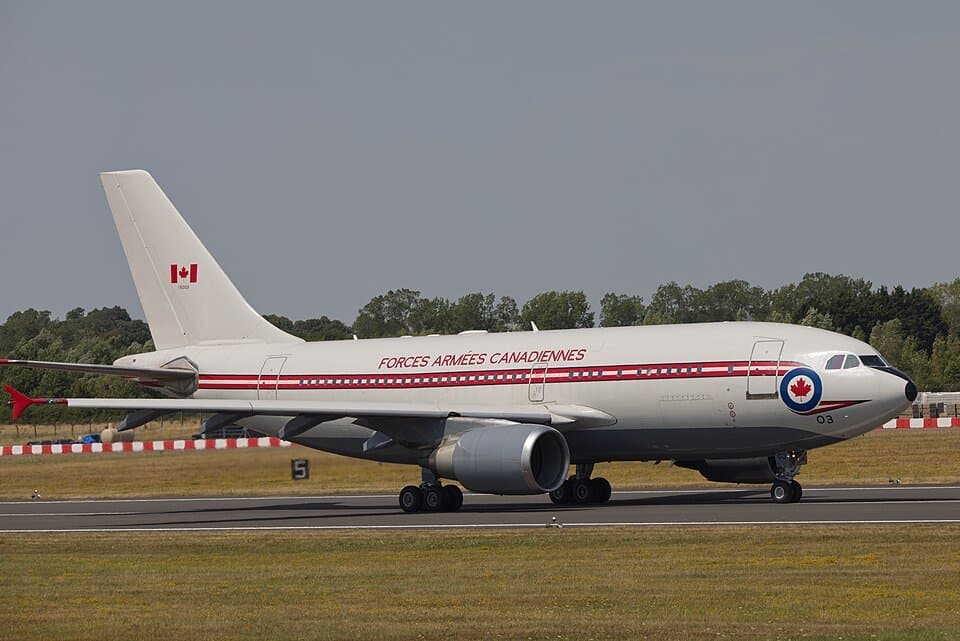
Airbus CC-150 Polarislarger figure on 1 of 5
Measured figures
Length
Single sourceCC-150 Polaris · Length
Single sourceConfiguration
| Specification | Airbus CC-150 Polaris | Boeing KC-46 Pegasus |
|---|---|---|
| Type | Strategic transport/VIP transport/tanker[source] | Tanker / transport[source] |
| Manufacturer | Airbus[source] | Boeing Defense, Space & Security[source] |
| Status | Active service (Being Retired)[source] | In service[source] |
| Primary users | Canadian Forces Royal Canadian Air Force[source] | U.S. Air Force (USAF) Japan Air Self-Defense Force Israeli Air Force |
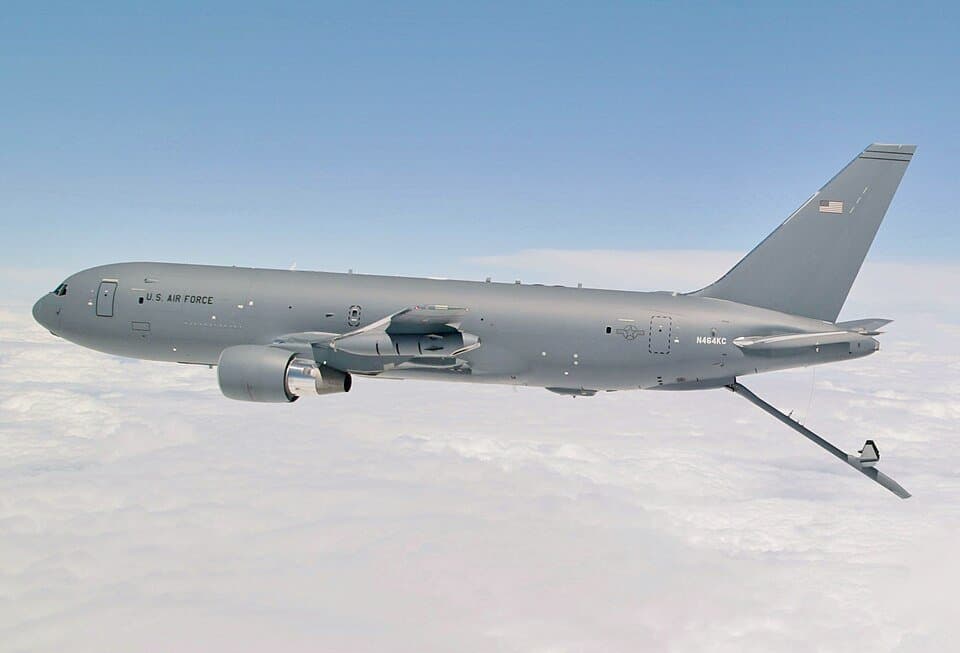
Boeing KC-46 Pegasuslarger figure on 4 of 5
Counts only measures both sources give with the same scope. A larger figure is not a better system.
46.66 m (153 ft 1 in)[source]
46.66 m[source]CC-150 Polaris
46.66 m[source]CC-150 Polaris
46.66 m[source]CC-150 Polaris
Empty; Empty weight
Single sourceMaximum take-off; Max takeoff weight
Single sourceGross; CC-150 Polaris · Gross weight · Maximum gross weight
Single sourceGross; Gross weight
Single source80,000 kg (176,370 lb)[source]
157,000 kg (346,126 lb)[source]
157000 кг[source]
157,000 kg[source]CC-150 Polaris · Maximum gross weight
157,000 kg[source]CC-150 Polaris · Maximum gross weight
157,000 kg[source]CC-150 Polaris · Maximum gross weight
Empty; Empty weight
Single sourceMaximum take-off; Max takeoff weight
Single sourceflight crew
Single source2 (flight crew)[source]
(2 pilots, 1 boom operator ) basic crew; 15 permanent seats for additional crew members, including aeromedical evacuation crew members
Single source3 (2 pilots, 1 boom operator ) basic crew; 15 permanent seats for additional crew members, including aeromedical evacuation crew members[source]
CC-150 Polaris · Range
Single sourceRange
Single source9,600 km (6,000 mi, 5,200 nmi)[source]
9,600 km[source]CC-150 Polaris
9,600 km[source]CC-150 Polaris
9,600 km[source]CC-150 Polaris
global with in flight refueling
Single source7,350 mi (11,830 km, 6,385 nmi) – global with in flight refueling[source]
2 × General Electric CF6-80C2A2 high bypass turbofan engines thrust each
Single source2 × General Electric CF6-80C2A2 high bypass turbofan engines, 220 kN (50,000 lbf) thrust each[source]
2 × Pratt & Whitney PW4062 turbofan thrust each
Single source2 × Pratt & Whitney PW4062 turbofan , 62,000 lbf (280 kN) thrust each[source]
Bars compare reported quantities only. A larger figure does not make a system better; configurations and test conditions differ.
| Number built | 5 (all converted from Airbus A310-300)[source] | 113 as of Aug 2026[source] |
|---|
| Introduction date | 1992[source] | 2019[source] |
|---|
| Retired | 2023 (CC150T 15003), 2025 (CC150 15001)[source] | — |
|---|
| Developed from | Airbus A310 MRTT[source] | Boeing KC-767[source] |
|---|
| Successors | Airbus CC-330 Husky[source] | — |
|---|
| Capacity | 194 passengers (up to) or 33,000 kg (73,000 lb) payload[source] | 65,000 lb (29,500 kg) payload, configurable as: seating for up to 54 passengers (up to 114 in contingencies), up to 18 463L pallets , or up to 58 patients (24 litters, 34 ambulatory)[source] |
|---|
| Source measurement | In 2008, two of the five CC-150s were converted to air-to-air refuelling tankers with a new military mission avionics package for the CF-18 fleet as part of the Multi Role Tanker Transport (MRTT) program. The Polaris tankers are capable of ferrying a flight of four CF-18 Hornets non-stop across the Atlantic Ocean, off-loading 80,000 pounds of fuel to the receiving aircraft over a 2,500 nautical mile (4,630 km) leg. The MRTT program was initiated because of a German Air Force requirement and provided a cost-effective solution for the Canadian Forces. The converted aircraft have been designated CC-150T . The tankers have hose-drogue pods under the wings.[source]Airbus CC-150 Polaris · Design and development / Tanker conversion; only the objects and conditions stated in this passage The RCAF uses converted C-130s , RCAF designation CC-130H(T), for tactical air-to-air refuelling but is limited when deploying CF-18s overseas, as they are better served by a strategic air-to-air refuelling platform. As a result of the CC-150's MRTT conversion, Canada regained its strategic air-to-air refuelling capability, lost when the final tanker-configured CC-137s were retired in 1997 (13703 & 13704 were modified with Beech refuelling kits in mid-1972 in support of the CF-5 tactical fighter).[source]Airbus CC-150 Polaris · Design and development / Tanker conversion; only the objects and conditions stated in this passage The five CC-150s are operated by 437 Transport Squadron at CFB Trenton , Ontario . They served in United Nations, Red Cross and NATO initiatives, including operations in Afghanistan.[source]Airbus CC-150 Polaris · Operational history; only the objects and conditions stated in this passage In 2011, two CC-150T air-to-air refuelling tankers were deployed to support Canadian CF-18 fighter jets enforcing the no-fly zone over Libya under Operation Mobile and Operation Unified Protector .[source]Airbus CC-150 Polaris · Operational history; only the objects and conditions stated in this passage The call sign of the VIP-configured CC-150 is known officially as CAN Force One. The decision to outfit one of the five CC-150s as a VIP transport intended for use by the Prime Minister of Canada , made while Brian Mulroney held office, was politically controversial. The $56 million in upgrades ($3 million of that went towards a private compartment with a dining room, entertainment area, fold-out beds and a shower) were criticized as a needless extravagance during a time of government budgetary challenges by then- Leader of the Opposition Jean Chrétien , who labelled the aircraft a "flying Taj Mahal ". Chrétien became Prime Minister soon thereafter and tried and failed to sell the aircraft; he refused to use the CC-150 during his ensuing 11 years in office. The interior was downgraded to a smaller, less lavish VIP cabin and the aircraft offered limited communications capability.[source]Airbus CC-150 Polaris · Operational history / Use as VIP transport; only the objects and conditions stated in this passage In recent years, various mechanical problems have occurred. In October 2016, a flap issue forced the aircraft to return to Ottawa 30 minutes after takeoff while Trudeau was en route to Belgium to sign the Canada Europe free trade deal. In March 2018, Prime Minister Trudeau's trip to India was delayed because of a mechanical issue during a refuelling stop in Rome.[source]Airbus CC-150 Polaris · Operational history / Use as VIP transport; only the objects and conditions stated in this passage In 2021 the Government of Canada began an effort to replace all five CC-150 Polaris aircraft. The Polaris are over 30 years old with lifespan set to end in 2027. The replacement tender is expected to cost US$5 billion. Early bid candidates included the Airbus A330 MRTT and the Boeing KC-46 , but the latter has since been dropped. On 14 July 2022, Canada announced that it has finalized a contract to acquire two A330-200 aircraft as the first two aircraft for the RCAF that will provide a strategic transport and air-to-air refuelling role—currently fulfilled by the fleet of five CC-150 Polaris aircraft—as part of the Strategic Tanker Transport Capability (STTC) project. The two A330 aircraft are former civilian airliners owned by International Airfinance Corporation . The new fleet will include four new and five used aircraft that are being outfitted to feature the same capabilities.[source]Airbus CC-150 Polaris · Operational history / Replacement; only the objects and conditions stated in this passage Royal Canadian Air Force (4) - 2 CC-150T and 2 CC-150 Polaris 437 Transport Squadron[source]Airbus CC-150 Polaris · Operators; only the objects and conditions stated in this passage Capacity: 194 passengers (up to) or 33,000 kg (73,000 lb) payload[source]Airbus CC-150 Polaris · Specifications; only the objects and conditions stated in this passage Length: 46.66 m (153 ft 1 in)[source]Airbus CC-150 Polaris · Specifications; only the objects and conditions stated in this passage Wingspan: 43.9 m (144 ft 0 in)[source]Airbus CC-150 Polaris · Specifications; only the objects and conditions stated in this passage Height: 15.8 m (51 ft 10 in)[source]Airbus CC-150 Polaris · Specifications; only the objects and conditions stated in this passage Empty weight: 80,000 kg (176,370 lb)[source]Airbus CC-150 Polaris · Specifications; only the objects and conditions stated in this passage Gross weight: 157,000 kg (346,126 lb)[source]Airbus CC-150 Polaris · Specifications; only the objects and conditions stated in this passage Powerplant: 2 × General Electric CF6-80C2A2 high bypass turbofan engines, 220 kN (50,000 lbf) thrust each[source]Airbus CC-150 Polaris · Specifications; only the objects and conditions stated in this passage Range: 9,600 km (6,000 mi, 5,200 nmi)[source]Airbus CC-150 Polaris · Specifications; only the objects and conditions stated in this passage Service ceiling: 12,500 m (41,000 ft)[source]Airbus CC-150 Polaris · Specifications; only the objects and conditions stated in this passage | The United States Air Force has taken delivery of 105 KC-46A aircraft and intends to procure 263 in total, a number which has grown with the cancellation of the KC-Y program and may grow further if the Next Generation Air-refueling System (NGAS) program does not develop as planned. Other nations which operate or have purchased the KC-46A include Japan and Israel.[source]Boeing KC-46 Pegasus · Lead; only the objects and conditions stated in this passage In September 2009, the USAF began a new round of bids with clearer criteria, including reducing the number of requirements from 800 to 373 in an attempt to simplify the process and allow more objective decision making. In March 2010, Boeing announced it would bid the KC-767 for the new KC-X round. EADS stated in April 2010 it would submit a bid without Northrop Grumman as a U.S. partner. Boeing submitted its KC-767 "NewGen Tanker" bid, based on the 767-200 with an improved version of the KC-10 's refueling boom , and cockpit displays from the 787, in July 2010. Boeing submitted a revised bid in February 2011.[source]Boeing KC-46 Pegasus · Development / USAF KC-X program; only the objects and conditions stated in this passage In December 2013, Boeing joined the wings and fuselage for the first 767-2C to be adapted into a KC-46A. The first of four 767-2C provision freighters were to complete assembly by the end of January 2014. Once assembled, it would go through ground vibration and instrumentation testing and have body fuel tanks added. The first test flight would occur during summer 2014 and include measuring its rate of climb and descent. The Engineering Manufacturing and Design (EMD) model was to be integrated with the needed systems and technologies to become a military-standard KC-46A by January 2015. Seven low-rate production KC-46s were to be delivered in 2015, 12 in 2016, and 15 delivered annually from 2017 to 2027. The last of four test aircraft began assembly in January 2014.[source]Boeing KC-46 Pegasus · Development / Selection and early development; only the objects and conditions stated in this passage The 767-2C's first flight took place on 28 December 2014. It flew from Paine Field and landed at Boeing Field . In March 2015, a refueling test with a C-17 transport was stopped because of a higher-than-expected boom axial load while delivering fuel. The problem was caused by the turbulent "bow wave effect" generated by two large aircraft flying in line. In January 2016, the KC-46 successfully refueled an F-16 for the first time during a five hour 36 minute sortie. Test refueling of several other military aircraft followed, including a C-17, F/A-18 , A-10 , and AV-8B . In February 2016, a KC-46 refueled an F/A-18, using its probe-and-drogue system for the first time. |
|---|
| Country of origin | France[source]Inventory Origin column; table 1, row 6, cell 3; revision 1374787326 | — |
|---|
| Origin reported by inventory | Multinational[source]Inventory Origin column; table 1, row 15, cell 2; revision 1376991819 | — |
|---|
| National origin | — | United States[source] |
|---|
| Manufactured | — | 2013–present[source] |
|---|
| First flight | — | 25 September 2015[source] |
|---|
| Fuel Capacity | — | 212,299 lb (96,297 kg) / 31,220 US gal (118,200 L; 26,000 imp gal)[source] |
|---|
| Maximum Fuel Available for Transfer | — | 207,672 lb (94,198 kg)[source] |
|---|
| Role | — | American military aerial refueling and strategic military transport aircraft[source] |
|---|
On 5 July 2016, USAF spokesman Daryl Mayer stated that, despite the testing delays, Milestone C approval was expected in the following month, and that Boeing would add a fifth EMD aircraft to accelerate testing. EMD-1 and EMD-3 primarily conducted flight tests towards FAA airworthiness certificates, while EMD-2 and EMD-4 focused on USAF aerial refueling and mission system testing. An F-16 was successfully refueled on 8 July, and a C-17 on 12 July 2016. Once the hardware fix was verified, a KC-46 with the updated boom underwent regression testing on the F-16, followed by refueling demonstrations with the C-17 and A-10 for the final test for Milestone C approval. On 15 July 2016, the KC-46 successfully refueled an A-10, offloading 1,500 pounds of fuel at 15,000 feet. At the time, more than 900 flight test hours have been completed by the five EMD aircraft. On 12 August 2016, the program received Milestone C approval, indicating production readiness. The issuing of contracts for two lots covering 19 aircraft was expected within 30 days.[source]Boeing KC-46 Pegasus · Development / Flight tests and delays; only the objects and conditions stated in this passage
Ongoing development efforts associated with the KC-46 aim to provide new capabilities and fix problems. In the FY27 budget request, the USAF proposed reallocating funds ($13M as requested) from the Next Generation air-refueling System (NGAS) to a new effort called the Advanced Tanker System (ATS). ATS will develop upgrades for connectivity, electronic warfare , and self-defense capabilities—many of the features associated with NGAS—for the existing tanker fleet. The USAF has clarified that they are not abandoning plans for the future NGAS.[source]Boeing KC-46 Pegasus · Development / Continuing development; only the objects and conditions stated in this passage
The aircraft is FAA-certified to transport up to 58 passengers in the rear fuselage using palletized seating similar to that of the C-17, along with a galley/lavatory pallet and passenger baggage loaded onto a cargo pallet.[source]Boeing KC-46 Pegasus · Design; only the objects and conditions stated in this passage
Boeing states that in contingency operations, the aircraft could accommodate up to 114 passengers.[source]Boeing KC-46 Pegasus · Design; only the objects and conditions stated in this passage
In an all-cargo configuration, the KC-46A can carry up to 65,000 pounds (29,000 kg) of cargo across 18 pallets.[source]Boeing KC-46 Pegasus · Design; only the objects and conditions stated in this passage
The KC-46A can carry 212,299 pounds (96,297 kg) of fuel, 10 percent more than the KC-135.[source]Boeing KC-46 Pegasus · Design; only the objects and conditions stated in this passage
In June 2024 the USAF completed a 45 hour non-stop flight around the globe as part of Project Magellan. The flight, which took off and landed at McConnell Air Force Base, was refueled several times while it refueled other operational aircraft at various places around the world.[source]Boeing KC-46 Pegasus · Operational history / United States; only the objects and conditions stated in this passage
The three tankers were to be fielded around 2020 at a cost of more than ¥20.8 billion, about US$173 million (~$206 million in 2024) per aircraft. An order for a third and fourth KC-46 was placed in October 2020. Japan ordered two additional KC-46s in December 2022, bringing Japan's order total to six. In February 2021, the JASDF conducted its first KC-46 flight. Training of Japanese KC-46 pilots began in June 2021 and Japan received its first KC-46 in November 2021.[source]Boeing KC-46 Pegasus · Operational history / Japan; only the objects and conditions stated in this passage
Capacity: 65,000 lb (29,500 kg) payload, configurable as: seating for up to 54 passengers (up to 114 in contingencies), up to 18 463L pallets , or up to 58 patients (24 litters, 34 ambulatory)[source]Boeing KC-46 Pegasus · Specifications; only the objects and conditions stated in this passage
Length: 165 ft 6 in (50.5 m)[source]Boeing KC-46 Pegasus · Specifications; only the objects and conditions stated in this passage
Wingspan: 157 ft 8 in (48.1 m)[source]Boeing KC-46 Pegasus · Specifications; only the objects and conditions stated in this passage
Height: 52 ft 1 in (15.9 m)[source]Boeing KC-46 Pegasus · Specifications; only the objects and conditions stated in this passage
Empty weight: 181,610 lb (82,377 kg)[source]Boeing KC-46 Pegasus · Specifications; only the objects and conditions stated in this passage
Max takeoff weight: 415,000 lb (188,240 kg)[source]Boeing KC-46 Pegasus · Specifications; only the objects and conditions stated in this passage
Fuel Capacity: 212,299 lb (96,297 kg) / 31,220 US gal (118,200 L; 26,000 imp gal)[source]Boeing KC-46 Pegasus · Specifications; only the objects and conditions stated in this passage
Maximum Fuel Available for Transfer: 207,672 lb (94,198 kg)[source]Boeing KC-46 Pegasus · Specifications; only the objects and conditions stated in this passage
Powerplant: 2 × Pratt & Whitney PW4062 turbofan , 62,000 lbf (280 kN) thrust each[source]Boeing KC-46 Pegasus · Specifications; only the objects and conditions stated in this passage
Maximum speed: 570 mph (914 km/h, 500 kn)[source]Boeing KC-46 Pegasus · Specifications; only the objects and conditions stated in this passage
Cruise speed: 530 mph (851 km/h, 460 kn)[source]Boeing KC-46 Pegasus · Specifications; only the objects and conditions stated in this passage
Range: 7,350 mi (11,830 km, 6,385 nmi) – global with in flight refueling[source]Boeing KC-46 Pegasus · Specifications; only the objects and conditions stated in this passage
Service ceiling: 40,100 ft (12,200 m)[source]Boeing KC-46 Pegasus · Specifications; only the objects and conditions stated in this passage