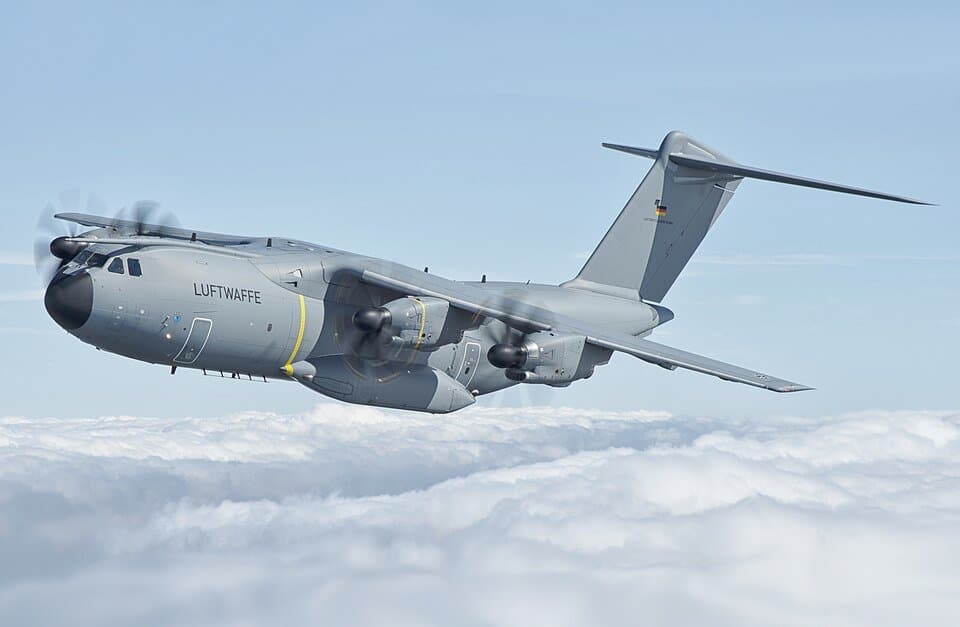



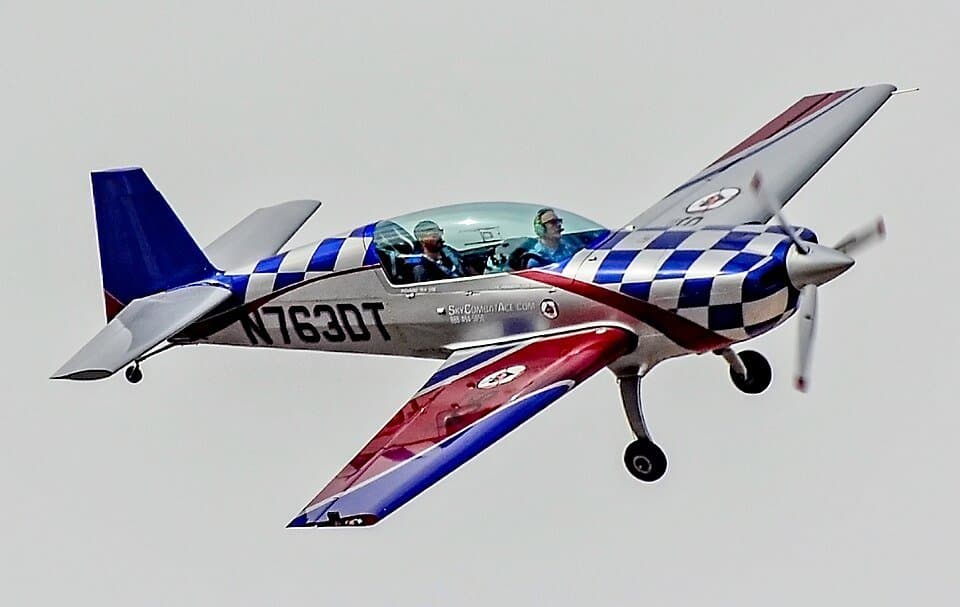
Credit
Peng Chen · CC BY-SA 4.0 · Resized · CC BY-SA 4.0 · Source ↗ · Modified


Preparing your view.
At a glance
Measured figures
Length
Single source45.1 m (148 ft 0 in)[source]
EA-330LT · Length
Single sourceConfiguration
| Specification | Airbus A400M Atlas | Extra EA-300 |
|---|---|---|
| Crew | 3 or 4 (2 pilots, 3rd optional, 1 loadmaster )[source] | 1 or 2[source] |
| Type | Strategic/tactical airlift / Aerial refueling[source] | Aerobatic monoplane[source] |
| Manufacturer | Airbus Defence and Space[source] | Extra Flugzeugbau[source] |
| Status | In service[source] | Active[source] |
7.01 m (23 ft 0 in)[source]
at max payload Range with 30-tonne payload
Single sourceFerry; Ferry range
Single sourceRange
Single sourceRange with 20-tonne payload
Single source3,300 km (2,100 mi, 1,800 nmi) at max payload Range with 30-tonne payload: 4,500 km (2,450 nmi) Range with 20-tonne payload: 6,400 km (3,450 nmi)[source]
8,700 km (5,400 mi, 4,700 nmi)[source]
Extra 300 · exact own native article technical table column 2; no range is stated for Extra 300/LC column4
Single sourceExtra 300L · exact own native article technical table column 3; no range is stated for Extra 300/LC column4
Single source4 × Europrop TP400-D6 turboprop each
Single source4 × Europrop TP400-D6 turboprop, 8,200 kW (11,000 hp) each[source]
EA-330LT · 1 × Lycoming AEIO-580 -B1A 6-cylinder air-cooled horizontally-opposed piston engine
Single source1 × Lycoming AEIO-580 -B1A 6-cylinder air-cooled horizontally-opposed piston engine, 235 kW (315 hp)[source]
Service ceiling
Single source12,200 m (40,000 ft)[source]
Bars compare reported quantities only. A larger figure does not make a system better; configurations and test conditions differ.
| Primary users | German Air Force French Air and Space Force Royal Air Force Spanish Air and Space Force See Operators below for others[source] | — |
|---|
| Number built | 130 as of 31 January 2025[source] | — |
|---|
| Manufactured | 2007–present[source] | 1988-present[source] |
|---|
| Introduction date | 2013[source] | — |
|---|
| First flight | 11 December 2009[source] | May 1988[source] |
|---|
| Capacity | 37,000 kg (81,600 lb) 116 fully equipped troops / paratroopers up to 66 stretchers accompanied by 25 medical personnel cargo compartment: width 4.00 m (13.12 ft) x height 3.85 m (12.6 ft) x length 17.71 m (58.1 ft) (without ramp 5.40 m (17.7 ft))[source] | — |
|---|
| Fuel capacity | 50,500 kg (111,300 lb) internal fuel[source] | 209 L / 55,2 gal (usable)[source] |
|---|
| Max landing weight | 123,000 kg (271,000 lb)[source] | — |
|---|
| Propellers | 8-bladed Ratier-Figeac variable pitch propellers with feathering and reversing capability , 5.3 m (17 ft 5 in) diameter[source] | 3-bladed Muehlbauer MTV 9-B-C/C198-25[source] |
|---|
| Initial cruise altitude | 9,000 m (29,000 ft) at MTOW[source] | — |
|---|
| Range with 30-tonne payload | 4,500 km (2,450 nmi)[source] | — |
|---|
| Range with 20-tonne payload | 6,400 km (3,450 nmi)[source] | — |
|---|
| Wing loading | 637 kg/m 2 (130.4 lb/sq ft)[source] | — |
|---|
| Tactical takeoff distance | 980 m (3,215 ft)[source] | — |
|---|
| Tactical landing distance | 770 m (2,530 ft)[source] | — |
|---|
| Turning radius (ground) | 28.6 m[source] | — |
|---|
| Country of origin | France, Germany, Spain[source] | — |
|---|
| National origin | — | Germany[source] |
|---|
| Designer | — | Walter Extra[source] |
|---|
| Airfoil | — | root: MA 15S; tip: MA 12S[source] |
|---|
| Stall speed | — | 110 km/h (69 mph, 60 kn) at 820 kg / 1,808 lbs[source] |
|---|
| Never exceed speed | — | 410 km/h (250 mph, 220 kn)[source] |
|---|
| g limits | — | +10/-10g at 820 kg / 1,808 lbs[source] |
|---|
| Source measurement | — | Design of the Extra 300 was based on the Extra 230 , an early 1980s monoplane having a wing made of wood . The Extra 300 has a welded steel tube fuselage covered in aluminium and fabric. The midset wing has a carbon fiber composite spar and carbon composite skins. A symmetrical airfoil , mounted with a zero angle of incidence , provides equal performance in both upright and inverted flight. The landing gear is fixed taildragger style with composite main legs and fiberglass wheel pants. The powerplant is a fuel-injected Lycoming AEIO-540 which produces 220 kW (300 hp).[source]Extra EA-300 · Design and development; only the objects and conditions stated in this passage The Extra 300 is stressed for ±10 G with one person on board and ±8 G with two. Some Extra 300s are registered in the experimental category under a Special Certificate of Airworthiness in the U.S., while others are type certified in the aerobatic category.[source]Extra EA-300 · Design and development; only the objects and conditions stated in this passage Regular inspections are mandated to ensure continued airworthiness. A 50-hour inspection typically includes checks on the elevator trim system, while a 1,000-hour inspection involves detailed evaluations of trim tab hinges and actuator levers for wear or damage.[source]Extra EA-300 · Maintenance and operating costs; only the objects and conditions stated in this passage The 300S is a single-seat version, with a wingspan reduced by 50 cm ( 19 + 1 ⁄ 2 in), and fitted with larger ailerons .[source]Extra EA-300 · Variants; only the objects and conditions stated in this passage The Extra 300L is a Lycoming AEIO-540-powered two-seat aircraft, with low-mounted wing and shorter fuselage. More of these two-seater variants have been produced than any other model. Its wing is mounted at the bottom of the fuselage, with its span reduced from 7.9 to 7.3 m (26 to 24 ft). Improved ailerons boost the 300L's roll rate to 400° per second. All 300Ls are fully certified under FAA and European Joint Aviation Authorities regulations.[source]Extra EA-300 · Variants; only the objects and conditions stated in this passage The Extra 330LC (C = carbon) is a refined version of the 330L, with more extensive use of carbon fiber materials, especially in the fuselage and wings. It boasts a top speed of 407 km/h; 220 kn (253 mph) and a ±10 G load factor.[source]Extra EA-300 · Variants; only the objects and conditions stated in this passage The Extra 330LX is a high-performance, two-seat aerobatic aircraft powered by a 315 horsepower Lycoming AEIO-580-B1A engine. Designed for advanced aerobatic training and competition, it features a tandem seating arrangement, carbon fiber wing assembly with integral tanks, and a carbon composite empennage structure. The fuselage is constructed from 1.7734 steel, and the aircraft is equipped with a Muehlbauer MTV 9-B-C/C198-25 three-blade propeller. The 330LX offers exceptional aerobatic performance, making it a preferred choice for serious competition pilots and airshow performers.[source]Extra EA-300 · Variants; only the objects and conditions stated in this passage The Extra 330LE is a one-seat aircraft powered by an electric engine made by Siemens, delivering 260 kW (350 hp), for 50 kg. On Thursday, March 23, 2017, the Extra 330LE set two new speed records, said Siemens : "At the Dinslaken Schwarze Heide airfield in Germany, the electric aircraft reached a top speed of around 340 km/h (180 kn; 210 mph) over a distance of 3 km (1.9 mi). On Friday, March 24, 2017, the Extra 330LE gave another premiere performance by becoming the world's first electric aircraft to tow a glider into the sky".[source]Extra EA-300 · Variants; only the objects and conditions stated in this passage Patty Wagstaff has flown the Extra 230, 260, and various models of the 300 in aerobatic competitions and airshows since the mid-1980s.[source]Extra EA-300 · Operators / Civilian; only the objects and conditions stated in this passage Length: 7.01 m (23 ft 0 in)[source]Extra EA-300 · Specifications (EA-330LT); only the objects and conditions stated in this passage Wingspan: 8 m (26 ft 3 in)[source]Extra EA-300 · Specifications (EA-330LT); only the objects and conditions stated in this passage Height: 2.6 m (8 ft 6 in)[source]Extra EA-300 · Specifications (EA-330LT); only the objects and conditions stated in this passage Wing area: 10.84 m 2 (116.7 sq ft)[source]Extra EA-300 · Specifications (EA-330LT); only the objects and conditions stated in this passage Empty weight: 677 kg (1,493 lb) typ. equipped[source]Extra EA-300 · Specifications (EA-330LT); only the objects and conditions stated in this passage Gross weight: 950 kg (2,094 lb) normal category (+6/-3g)[source]Extra EA-300 · Specifications (EA-330LT); only the objects and conditions stated in this passage Max takeoff weight: 820 kg (1,808 lb) single-pilot acro (+10/-10g)[source]Extra EA-300 · Specifications (EA-330LT); only the objects and conditions stated in this passage Powerplant: 1 × Lycoming AEIO-580 -B1A 6-cylinder air-cooled horizontally-opposed piston engine, 235 kW (315 hp)[source]Extra EA-300 · Specifications (EA-330LT); only the objects and conditions stated in this passage Cruise speed: 380 km/h (236 mph, 205 kn) TAS[source]Extra EA-300 · Specifications (EA-330LT); only the objects and conditions stated in this passage Stall speed: 110 km/h (69 mph, 60 kn) at 820 kg / 1,808 lbs[source]Extra EA-300 · Specifications (EA-330LT); only the objects and conditions stated in this passage Never exceed speed : 410 km/h (250 mph, 220 kn)[source]Extra EA-300 · Specifications (EA-330LT); only the objects and conditions stated in this passage g limits: +10/-10g at 820 kg / 1,808 lbs[source]Extra EA-300 · Specifications (EA-330LT); only the objects and conditions stated in this passage |
|---|
Gross; EA-330LT · normal category (+6/
Single sourceMaximum take-off; EA-330LT · Max takeoff weight
Single sourceMaximum take-off; EA-330LT · single-pilot acro (+10/
Single source