FORCETALLY
Loading the evidence…
Preparing your view.


Preparing your view.
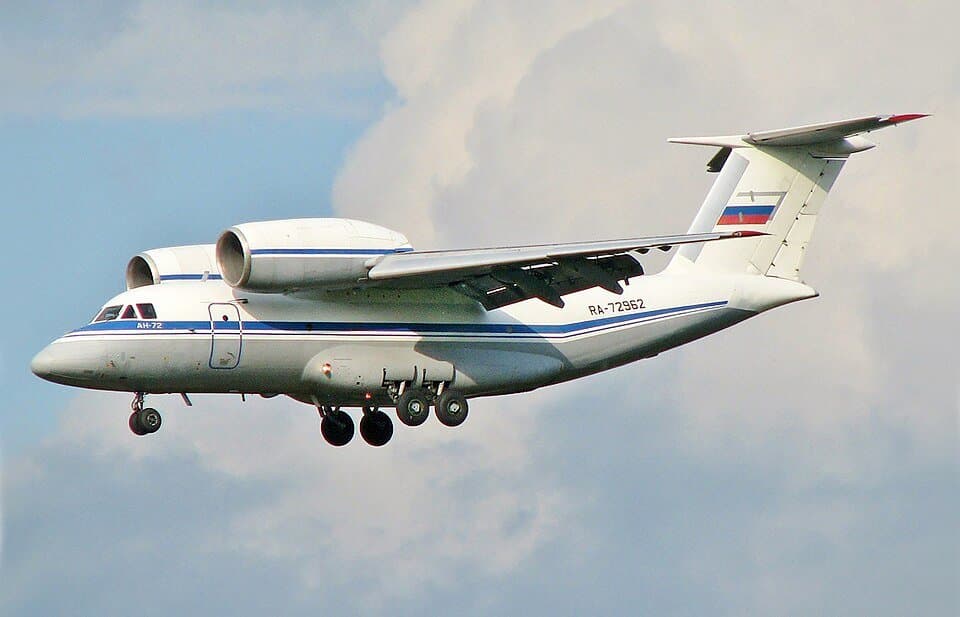
Measured figures
An-72 · Length
Single source28.07 m (92 ft 1 in)[source]
Configuration
| Specification | Airbus A330 | Antonov An-72 |
|---|---|---|
| Crew | — | five[source] |
| Role | Wide-body airliner[source] | — |
| National origin | Multi-national[source] | Soviet Union[source] |
| Manufacturer | Airbus[source] | Antonov[source] |
| Status | In service[source] |
An-72 · Wingspan
Single source31.89 m (104 ft 7.5 in)[source]
An-72 · Height
Single source8.65 m (28 ft 4.5 in)[source]
Maximum; An-72 · Maximum speed
Single source700 km/h (435 mph, 378 kn)[source]
An-72 · Range
Single source4,325 km (2,688 mi, 2,336 nmi)[source]
An-72 · 2 × Lotarev D-36 series 1A Turbofan thrust each
Single source2 × Lotarev D-36 series 1A Turbofan, 63.9 kN (14,330 lbf) thrust each[source]
An-72 · Wing area
Single source98.62 m 2 (1,062 sq ft)[source]
Bars compare reported quantities only. A larger figure does not make a system better; configurations and test conditions differ.
In service[source] |
| Primary users | Delta Air Lines Turkish Airlines China Eastern Airlines Cathay Pacific[source] | Russian Aerospace Forces Russian Navy Angolan Air Force Soviet Air Force (historical)[source] |
|---|
| Number built | 1,672 as of August 2026[source] | 133[source] |
|---|
| Manufactured | 1992–2020 (A330ceo) 2015–present (A330neo)[source] | 1977–2002[source] |
|---|
| Introduction date | 17 January 1994 with Air Inter[source] | — |
|---|
| First flight | 2 November 1992 ( 1992-11-02 )[source] | 31 August 1977 ( 1977-08-31 )[source] |
|---|
| Developed from | Airbus A300[source] | — |
|---|
| Variants | Airbus A330 MRTT Airbus CC-330 Husky[source] | — |
|---|
| Developed into | Airbus A330neo Airbus Beluga XL[source] | Antonov An-71 Antonov An-74[source] |
|---|
| Source measurement | The A330 shares many underpinnings with the airframe of the early A340 variants, most notably the same wing components, and by extension the same structure. However, the A330 has two main landing gear legs instead of three, lower weights, and slightly different fuselage lengths. Both airliners have fly-by-wire controls as well as a similar glass cockpit on order to increase commonality between the types. The A330 was Airbus's first airliner to offer a choice of three engines: the General Electric CF6 , Pratt & Whitney PW4000 , or the Rolls-Royce Trent 700 . The A330-300 has a range of 11,750 km (6,340 nmi; 7,300 mi) with 277 passengers, while the shorter A330-200 can cover 13,450 km (7,260 nmi; 8,360 mi) with 247 passengers. Other variants include the A330-200F dedicated freighter , the A330 MRTT military aerial refueling variant, and the ACJ330 corporate jet. The A330 MRTT was proposed as the EADS/Northrop Grumman KC-45 for the US Air Force's KC-X competition, but lost to the Boeing KC-46 in appeal after an initial win.[source]Airbus A330 · Lead; only the objects and conditions stated in this passage The first specifications for the TA9 and TA11 aircraft that could accommodate 410 passengers in a one-class layout emerged in 1982. They showed a large underfloor cargo area that could hold five cargo pallets or sixteen LD3 cargo containers in the forward, and four pallets or fourteen LD3s in the aft hold—double the capacity of the Lockheed L-1011 TriStar or DC-10, and 8.46 metres (27.8 ft) longer than the Airbus A300. By June 1985, the TA9 and TA11 had received more improvements, including the adoption of the A320 flight deck , digital fly-by-wire (FBW) control system, and side-stick control. Airbus had developed a common cockpit for their aircraft models to allow quick transition by pilots. The flight crews could transition from one type to another after only one week's training, which reduces operator costs. The two TAs would use the vertical stabiliser , rudder , and circular fuselage sections of the A300-600, extended by two barrel sections.[source]Airbus A330 · Development / Design effort; only the objects and conditions stated in this passage From the beginning of the TA9's development, a choice of engines from the three major engine manufacturers, Rolls-Royce , Pratt & Whitney , and GE Aviation , was planned. GE Aviation first offered the CF6-80C2 . However, later studies indicated that more thrust was needed to increase the initial power capability from 267 to 289 kN (60,000 to 65,000 lbf ). GE enlarged the CF6-80C2 fan from 236 to 244 centimetres (92.9 to 96.1 in) and reduced the number of fan blades from 38 to 34 to create the CF6-80E1 with a thrust of 300–320 kN (67,000–72,000 lbf).[source]Airbus A330 · Development / Design effort / Engines; only the objects and conditions stated in this passage Rolls-Royce initially wanted to use the 267 kN (60,000 lbf) Trent 600 to power Airbus's newest twinjet and the upcoming McDonnell Douglas MD-11 . However, the company later agreed to develop an engine solely for the A330, the Trent 700 , with a larger diameter and 311 kN (69,900 lbf) of thrust. The A330 became the first Airbus aircraft for which Rolls-Royce supplied engines.[source]Airbus A330 · Development / Design effort / Engines; only the objects and conditions stated in this passage Similarly, Pratt & Whitney signed an agreement that covered the development of the A330-exclusive PW4168 . The company increased the fan size from 94 in (2.39 m) to 100 in (2.54 m), enabling the engine to deliver 311 kN (69,900 lbf) of thrust. Like the CF6-80E1, 34 blades were used instead of the 38 found on the smaller PW4000 engines.[source]Airbus A330 · Development / Design effort / Engines; only the objects and conditions stated in this passage In preparation for the production of the A330 and the A340, Airbus's partners invested heavily in new facilities. In south-western England, BAe made a £ 7 million investment in a three-storey technical centre with 15,000 m 2 (161,000 sq ft) of floor area at Filton . In north Wales, BAe also spent £5 million on a new production line at its Broughton wing production plant. In Germany, Messerschmitt-Bölkow-Blohm (MBB) invested DM 400 million ($225 million) on manufacturing facilities in the Weser estuary, including at Bremen , Einswarden, Varel , and Hamburg . France saw the biggest investments, with Aérospatiale constructing a new Fr. 2.5 billion ($411 million) final-assembly plant adjacent to Toulouse-Blagnac Airport in Colomiers ; by November 1988, the pillars for the new Clément Ader assembly hall had been erected. The assembly process featured increased automation, such as robots drilling holes and installing fasteners during the wing-to-fuselage mating process.[source]Airbus A330 · Development / Production and testing; only the objects and conditions stated in this passage The first completed A330 was rolled out on 14 October 1992, with the maiden flight following on 2 November. Weighing 181,840 kg (401,000 lb), including 20,980 kg (46,300 lb) of test equipment, the A330 became the largest twinjet to have flown until the first flight of the Boeing 777 . The flight lasted five hours and fifteen minutes during which speed, height, and other flight configurations were tested. Airbus intended the test flight programme to comprise six aircraft flying a total of 1,800 hours. On 21 October 1993, the A330 received the European Joint Aviation Authorities (JAA) and the US Federal Aviation Administration (FAA) certifications simultaneously after 1,114 cumulative airborne test hours and 426 test flights. At the same time, weight tests came in favourable, showing the plane was 500 kg (1,100 lb) underweight.[source]Airbus A330 · Development / Production and testing; only the objects and conditions stated in this passage On 30 June 1994, a fatal crash occurred during certification of the Pratt & Whitney engine when an A330 crashed near Toulouse. Both pilots and the five passengers died. The flight was designed to test autopilot response during a one-engine-off worst-case scenario with the centre of gravity near its aft limit . Shortly after takeoff, the pilots had difficulty setting the autopilot, and the aircraft lost speed and crashed. An investigation by an internal branch of Direction Générale d'Aviation concluded that the accident resulted from slow response and incorrect actions by the crew during the recovery. This led to a revision of A330 operating procedures.[source]Airbus A330 · Development / Production and testing; only the objects and conditions stated in this passage In response to a decline in A330-300 sales, increased market penetration by the Boeing 767-300ER , and airline requests for increased range and smaller aircraft, Airbus developed the A330-200. Known as the A329 and A330M10 during development, the A330-200 would offer nine per cent lower operating costs than the Boeing 767-300ER. The plane was aimed at the 11,900 km (6,430 nmi ; 7,390 mi ) sector, where Airbus predicted demand for 800 aircraft between 1995 and 2015. The project, with US$450 million in expected development costs, was approved by the Airbus Industrie Supervisory Board on 24 November 1995.[source]Airbus A330 · Development / A330-200; only the objects and conditions stated in this passage The A330-200 first flew on 13 August 1997. The sixteen-month certification process involved logging 630 hours of test flights. The A330-200's first customer was ILFC; these aircraft were leased by Canada 3000 , who became the type's first operator.[source]Airbus A330 · Development / A330-200; only the objects and conditions stated in this passage As Airbus worked on its A330-200, hydraulic pump problems were reported by both A330 and A340 operators. This issue was the suspected cause of a fire that destroyed an Air France A340-200 in January 1994. On 4 January of that year, a Malaysia Airlines A330-300, while undergoing regular maintenance at Singapore Changi Airport , was consumed by a fire that started in the right-hand main undercarriage well. The incident caused US$30 million in damage, and the aircraft took six months to repair. Consequently, operators were advised to disable electrical pumps in January 1997.[source]Airbus A330 · Development / A330-200; only the objects and conditions stated in this passage In 1996, Airbus evaluated a 12-frame stretch which would be able to carry 380 passengers over almost 7,000 km (3,800 nmi; 4,300 mi), the -400, and a "super-stretch" using the A340-600 's 22-frame stretch and powered by 400 kN (90,000 lbf) engines, the -600.[source]Airbus A330 · Development / Proposed variants; only the objects and conditions stated in this passage In February 2000, it was reported that a 250-seat A330-100 replacement for the A300/A310 could be launched by year end for 2003 deliveries. Shortened and keeping its fly-by-wire cockpit and systems, with a cleaner A300-600 wing with sealed control surfaces and winglets and at least two new engine types among the GE CF6 -80, the PW4000 and the A340-500/600's Trent 500 aimed for 5% better SFC than the A300-600. Its 44.8 m (147 ft) wing allowed a 173 t (381,000 lb) MTOW and 4,200 nmi (7,770 km; 4,830 mi) range. In May, the 210-260 seat design had evolved towards keeping the A330 60.3 m (198 ft) span wing and engines for a 195 t MTOW and 4,500 nmi (8,300 km; 5,200 mi) range. Interested customers included Singapore Airlines, Lufthansa and Hapag-Lloyd.[source]Airbus A330 · Development / Proposed variants; only the objects and conditions stated in this passage Announced in July at Farnborough Air Show , the -500 first flight was targeted for early 2003 and introduction in early 2004. ILFC would take ten if it was launched and CIT was interested too. The eight-frame shrink would carry 222 in three classes or 266 in two classes. Its initial 13,000 km (7,000 nmi; 8,100 mi) range would be followed by derated versions for 8,000 km (4,300 nmi; 5,000 mi). The market was lukewarm as airlines like Lufthansa, Hapag-Lloyd and Singapore Airlines were unimpressed by the long-range A330-500, favouring a more refined short-range design. Lack of airline demand made lessors interest wane and as ILFC would order as 30 -500s, it would be with converting rights to larger A330-200/300.[source]Airbus A330 · Development / Proposed variants; only the objects and conditions stated in this passage To compete with Boeing's 7E7 (later 787), Airbus offered a minimum-change derivative called the A330-200 Lite in 2004. As the name indicated, this proposed variant would have had a lower maximum takeoff weight of 202 tonnes (445,000 lb), coupled with de-rated engines, giving a range of 7,400 km (4,000 nmi; 4,600 mi). It was aimed at Singapore Airlines , who had looked to replace its Airbus A310-300s. The variant was also to be a replacement for Airbus A300-600Rs and early Boeing 767s. Airlines, however, were not satisfied with the compromised aircraft; the company instead proceeded with an entirely new aircraft, the A350 XWB .[source]Airbus A330 · Development / Proposed variants; only the objects and conditions stated in this passage Responding to lagging A300-600F and A310F sales, Airbus began marketing the Airbus A330-200F, a freighter derivative of the A330-200, around 2001. The freighter has a range of 7,400 km (4,000 nmi; 4,600 mi) with a 65 tonnes (140,000 lb) payload, or 5,900 km (3,200 nmi; 3,700 mi) with 70 tonnes (150,000 lb). The plane uses the same nosegear as the passenger version; however, it is attached lower in the fuselage and housed in a distinctive bulbous "blister fairing". This raises the aircraft's nose so that the cargo deck is level during loading, as the standard A330's landing gear results the plane having a nose-down attitude while on the ground.[source]Airbus A330 · Development / Further developments; only the objects and conditions stated in this passage The A330-200F made its maiden flight on 5 November 2009. This marked the start of a four-month, 180-hour certification programme. JAA and FAA certifications were expected by March the following year although approval by the JAA was delayed until April. The first delivery was subsequently made to the Etihad Airways cargo division, Etihad Cargo, in July 2010.[source]Airbus A330 · Development / Further developments; only the objects and conditions stated in this passage On 25 September 2013, at the Aviation Expo China (Beijing Airshow), Airbus announced a new lower weight A330-300 variant, optimised for use on domestic and regional routes in high growth markets with large populations and concentrated traffic flows; China and India were recognised as prime targets. This variant could carry up to 400 passengers. The increased efficiency, however, comes more from the installation of additional seats than any weight reduction. On relatively short, yet congested routes, the A330 competes against single-aisle jetliners. While the A330's operating costs in these conditions are not far above those of the Boeing 737 or Airbus A321, the A320neo and 737 MAX promise more efficiency. Where the frequency of flights cannot be increased, using larger aircraft, such as the A330, is the only available option to increase capacity. The first customer for the A330 Regional was announced as Saudia at the 2015 Paris Air Show. In 2018, the unit cost of an A330-200 was US$238.5M, US$264.2M for an A330-300 and US$241.7M for an A330-200F.[source]Airbus A330 · Development / Further developments; only the objects and conditions stated in this passage The A330neo ("neo" for "New Engine Option") is a development from the initial A330 (now A330 ceo — "Current Engine Option"). A new version with modern engines developed for the Boeing 787 was called for by owners of the current A330. It was launched in July 2014 at the Farnborough Airshow , promising 14% better fuel economy per seat . It will use the larger Rolls-Royce Trent 7000 exclusively. Its two versions are based on the A330-200 and -300: the -800 should cover 8,100 nmi (15,000 km; 9,320 mi) with 257 passengers while the -900 should cover 7,350 nmi (13,610 km; 8,460 mi) with 287 passengers. The -900 made its first flight on 19 October 2017, received its EASA type certificate on 26 September 2018, and was first delivered to TAP Air Portugal on 26 November. The -800 made its first flight on 6 November 2018, aiming for a mid 2019 type certification and delivery in the first half of 2020.[source]Airbus A330 · Development / New Engine Option; only the objects and conditions stated in this passage Airbus announced in February 2011 that it intended to raise production rates from seven-and-a-half/eight per month to nine per month in 2012, and ten in 2013. Production increased to ten aircraft per month in April 2013, the highest for any Airbus wide-body aircraft. In 2012, Airbus expected the A330 to continue selling until at least 2020, with the A350-900 expected to replace the A330-300.[source]Airbus A330 · Development / Production; only the objects and conditions stated in this passage The A330 is a medium-size, wide-body aircraft, with two engines suspended on pylons under the wings. A two-wheel nose undercarriage and two four-wheel bogie main legs built by Messier-Dowty support the aircraft on the ground. Its MTOW grew from 212 tonnes (467,000 lb) at introduction to 242 tonnes (534,000 lb) in 2015, enhancing its payload-range performance. John Leahy states that originally the A330 was intentionally being held down in takeoff weight and performance in order to avoid overlapping with the A340.[source]Airbus A330 · Design; only the objects and conditions stated in this passage The wings were designed and manufactured by BAe, which developed a long slender wing with a very high aspect ratio to provide high aerodynamic efficiency. The wing is swept back at 30 degrees and, along with other design features, allows a maximum operating Mach number of 0.86. To reach a long span and high aspect ratio without a large weight penalty, the wing has relatively high thickness-to-chord ratio of 11.8% or 12.8%. Jet airliners have thickness-to-chord ratios ranging from 9.4% ( MD-11 or Boeing 747 ) to 13% ( Avro RJ or 737 Classic ). Each wing also has a 2.74 m (9 ft 0 in) tall winglet instead of the wingtip fences found on earlier Airbus aircraft.[source]Airbus A330 · Design; only the objects and conditions stated in this passage The shared wing design with the A340 allowed the A330 to incorporate aerodynamic features developed for the former aircraft. The failure of International Aero Engines ' radical ultra-high-bypass V2500 "SuperFan", which had promised around 15 per cent fuel burn reduction for the A340, led to multiple enhancements including wing upgrades to compensate. Originally designed with a 56 m (180 ft) span , the wing was later extended to 58.6 m (190 ft) and finally to 60.3 m (200 ft). At 60.3 m (200 ft), the wingspan is similar to that of the larger Boeing 747-200 , but with 35 per cent less wing area.[source]Airbus A330 · Design; only the objects and conditions stated in this passage The A330 and A340 fuselage is based on that of the Airbus A300-600 , with many common parts, and has the same external and cabin width: 5.64 m (19 ft) and 5.26 m (17 ft). Typical seating arrangements are 2–2–2 six-abreast in business class and 2–4–2 eight-abreast in economy class . The fin, rudder, elevators, horizontal tail plane (used as fuel tank), flaps, ailerons, and spoilers are made of composite materials , making 10% of the structure weight. When necessary, the A330 uses the Honeywell 331–350C auxiliary power unit (APU) to provide pneumatics and electrical power.[source]Airbus A330 · Design; only the objects and conditions stated in this passage The plans were for all three engine types to enter service with 90-minute approval, before increasing to 120 minutes after the total A330 fleet accumulated 25,000 flight hours, and then to 180 minutes after 50,000 flight hours, in 1995.[source]Airbus A330 · Operational history; only the objects and conditions stated in this passage As of June 2026 , the global A330 fleet of 1,412 aircraft had 13.5 years average aircraft age (≈ 3.6 years for A330neo), opened more than 470 new city pairs since the launch of the Boeing 787 in 2011, and accumulated more than 74 million flight hours since its entry into service with 99.0% operational reliability in the last 3 months.[source]Airbus A330 · Operational history; only the objects and conditions stated in this passage The A330-200 is a shortened, longer-range variant, which entered service in 1998 with Canada 3000 . The typical range with 253 passengers in a three-class configuration is 13,400 km (7,240 nmi; 8,330 mi). The A330-200 is ten fuselage frames shorter than the original −300, with a length of 58.82 m (193 ft 0 in). To compensate for the smaller moment arm of the shorter fuselage, the vertical stabiliser height of the -200 was increased by 104 cm (40.9 in). The −200's wing was also modified; structural strengthening of the wing allowed the maximum takeoff weight of the −200 to be increased to 229.8 tonnes (507,000 lb). The −200 is offered with three engine types similar to those found on the −300, namely the General Electric CF6-80E , Pratt & Whitney PW4000 , or Rolls-Royce Trent 700 . Airbus also boosted fuel capacity to 139,090 L (36,740 US gal ; 30,600 imp gal ) by adding the centre section fuel tank, standard in the A340.[source]Airbus A330 · Variants / A330ceo / A330-200; only the objects and conditions stated in this passage A new vertical stabiliser was introduced in 2004 beginning with MSN 555. This newer fin is shorter in height by 50 cm (20 in) and was derived from the design of the vertical stabiliser of the A340-500 and -600, later becoming standard on all new A330-200s.[source]Airbus A330 · Variants / A330ceo / A330-200; only the objects and conditions stated in this passage In 2008, Airbus released plans for a higher gross weight version of the A330-200 to more effectively compete against the Boeing 787 Dreamliner. The new-build A330-200HGW had a 5-tonne increase in Maximum Takeoff Weight , allowing a 560-kilometre (300 nmi; 350 mi) range increase and a 3.4-tonne (7,500 lb) payload increase. Korean Air became the first customer on 27 February 2009 with an order for six −200HGWs. Deliveries of the first aircraft started in 2010.[source]Airbus A330 · Variants / A330ceo / A330-200; only the objects and conditions stated in this passage In mid 2012, Airbus proposed another version of the −200 with the maximum gross weight increased by 2 t (4,400 lb) to 240 t (530,000 lb). This version had its range extended by 270 nmi (500 km; 310 mi) and carried 2.5 t (5,500 lb) more payload. It saw engine and aerodynamic improvements reducing its fuel burn by about 2%. In November 2012, it was announced that the gross weight was to be further increased to 242 t (534,000 lb) with the range extended by 350 nmi (650 km; 400 mi) over the 238 t (525,000 lb) version. It was certified by the EASA on 8 September 2015.[source]Airbus A330 · Variants / A330ceo / A330-200; only the objects and conditions stated in this passage As a result of its vastly increased range while still maintaining the fuel efficiency of the larger A330-300, the A330-200 came into internal competition with the initial A340 variants; the A330-200 proved much more popular than the A340-200 which carried fewer passengers and its only advantage was an extra range of 2,000 miles (3,200 km) that most airline routes did not need; the A330-200 managed to approach (though not match) the range of the A340-300 which did have a higher passenger capacity. This in turn led to Airbus making significant changes for subsequent A340 variants for significantly increased capacity and further range to distinguish the resultant A340-500/600 from the A330 family. The A330−200 competes with the Boeing 767-400ER and 787-8 .[source]Airbus A330 · Variants / A330ceo / A330-200; only the objects and conditions stated in this passage The A330-200F is an all-cargo derivative of the A330-200 capable of carrying 65 t (140,000 lb) over 7,400 km (4,000 nmi; 4,600 mi) or 70 t (150,000 lb) up to 5,900 km (3,200 nmi; 3,700 mi). To overcome the standard A330's nose-down body angle on the ground, the A330F uses a revised nose undercarriage layout to provide a level deck during cargo loading. The normal A330-200 undercarriage is used, but its attachment points are lower in the fuselage, thus requiring a distinctive blister fairing on the nose to accommodate the retracted nose gear. Power is provided by two Pratt & Whitney PW4000 or Rolls-Royce Trent 700 engines. General Electric does not offer an engine for the A330-200F.[source]Airbus A330 · Variants / A330ceo / A330-200F; only the objects and conditions stated in this passage Unlike the passenger variant, the A330-200F does not offer a centre tank as a standard equipment in order to save the weight of the inerting system, reducing fuel capacity by 41,560 litres. However, it is still offered as an optional equipment per customer needs.[source]Airbus A330 · Variants / A330ceo / A330-200F; only the objects and conditions stated in this passage Powered by two General Electric CF6-80E1 , Pratt & Whitney PW4000 , or Rolls-Royce Trent 700 engines, the 63.69 m (208 ft 11 in) long −300 has a range of 11,750 km (6,340 nmi; 7,300 mi), typically carries 277 passengers with a 440 exit limit and 32 LD3 containers. It received European and American certification on 21 October 1993 after 420 test flights over 1,100 hours. The −300 entered service on 16 January 1994. The A330-300 is based on a stretched A300 fuselage but with new wings, stabilisers and fly-by-wire systems.[source]Airbus A330 · Variants / A330ceo / A330-300; only the objects and conditions stated in this passage In 2010, Airbus offered a new version of the −300 with the maximum gross weight increased by 2 tonnes to 235 tonnes. This enabled 120 nmi (220 km; 140 mi) extension of the range as well as 1.2-tonne increase in payload. In mid 2012, Airbus proposed another increase of the maximum gross weight to 240 tonnes. It is planned to be implemented by mid 2015. This −300 version will have the range extended by 400 nmi (740 km; 460 mi) and will carry 5 tonnes more payload. It will include engine and aerodynamic improvements reducing its fuel burn by about 2%. In November 2012, it was further announced that the gross weight will increase from 235 to 242 tonnes, and the range will increase by 500 nmi (926 km; 575 mi) to 6,100 nmi (11,300 km; 7,020 mi). Airbus is also planning to activate the central fuel tank for the first time for the −300 model.[source]Airbus A330 · Variants / A330ceo / A330-300; only the objects and conditions stated in this passage As of December 2020, a total of 779 of the -300 had been ordered, 771 of which had been delivered, with 742 in operation. The 2015 list price is $264 million. The closest competitors have been the Boeing 777-200/200ER and 787-9 .[source]Airbus A330 · Variants / A330ceo / A330-300; only the objects and conditions stated in this passage In 2000, it was reported that Airbus was studying an A330-300 version with a higher gross weight. It was named A330-300HGW and had a takeoff weight of 240 tonnes (530,000 lb), 7 tonnes (15,000 lb) greater than the -300's weight at the time. The version would have a strengthened wing and additional fuel capacity from a 41,600-litre (11,000 US gal; 9,150 imp gal) centre section fuel tank. The A330-300HGW's range was increased to over 11,000 km (5,940 nmi; 6,840 mi). Among those that showed interest was leasing company ILFC, which sought airliners that could fly from the US West Coast to Europe.[source]Airbus A330 · Variants / A330ceo / A330-300HGW; only the objects and conditions stated in this passage The 240-tonne A330 reappeared years later when Airbus announced at the 2012 Farnborough Airshow that it would be an available option for both the A330-300 and the A330-200. In November 2012, the maximum take off weight was further increased to 242 tonnes. The package became available starting from MSN 1627. The first of these aircraft was delivered to Delta Air Lines on 28 May 2015.[source]Airbus A330 · Variants / A330ceo / A330-300HGW; only the objects and conditions stated in this passage In September 2013, Airbus announced a version of the A330-300, named A330 Regional or A330-300 Regional . The A330 Regional has seating for up to around 400 passengers, with reduced engine thrust, reduced maximum takeoff weight of 199 t (439,000 lb), and reduced range of 2,700 nautical miles (5,000 km; 3,110 mi). It is said that the maximum takeoff weight of these aircraft is an "easy upgrade to 242 t (534,000 lb)", which is the extended range version with range of 6,350 nmi (11,800 km; 7,310 mi). It is said to provide up to 26% lower operating costs than the longer range version A330-300.[source]Airbus A330 · Variants / A330ceo / A330 Regional; only the objects and conditions stated in this passage The A330-300P2F, targeted towards operators with lower density express delivery and e-commerce loads, can carry up to 62 t (137,000 lb) over 3,650 nmi (6,760 km; 4,200 mi). Following flight tests in October 2017 and the awarding of the EASA supplemental type certificate (STC) in November, the first A330-300P2F was delivered to DHL on 1 December.[source]Airbus A330 · Variants / A330ceo / A330P2F; only the objects and conditions stated in this passage The A330-200P2F can carry 61 t (134,000 lb) over 4,250 nmi (7,870 km; 4,890 mi). Following flight tests in June 2018, and the awarding of the EASA STC in July, the first was delivered to Egyptair Cargo on 3 August 2018.[source]Airbus A330 · Variants / A330ceo / A330P2F; only the objects and conditions stated in this passage The Airbus A330-900 maintains the A330-300's fuselage dimensions with ten more seats thanks to cabin optimisation. With modern Trent 7000 engines and redesigned winglets , it should burn 14% less fuel per seat than the A330-300 over a distance of 4,000 nmi (7,400 km; 4,600 mi). It travels 7,350 nmi (13,610 km; 8,460 mi) with 287 passengers in a standard configuration. The A330-900 made its maiden flight on 19 October 2017 and received its EASA type certificate on 26 September 2018; it entered service with its launch customer, TAP Air Portugal , on 15 December 2018.[source]Airbus A330 · Variants / A330neo / A330-900; only the objects and conditions stated in this passage The A330-200 is available as an ultra-long-range Airbus Corporate Jet known as the A330-200 Prestige, with a range of 15,400 km (8,300 nmi; 9,600 mi) and a capacity of 50 passengers.[source]Airbus A330 · Variants / Corporate jet variants / ACJ330; only the objects and conditions stated in this passage A corporate jet version of the new A330neo capable of flying 25 passengers 19,260 km (10,400 nmi; 11,970 mi) or 21 hours, enough to fly non-stop from Europe to Australia.[source]Airbus A330 · Variants / Corporate jet variants / ACJ330neo; only the objects and conditions stated in this passage Its average sector is 2,000 nmi (3,700 km; 2,300 mi); the longest flight for the -200 was 6,000 nmi (11,000 km; 6,900 mi), from Buenos Aires to Rome, by Aerolíneas Argentinas , and 5,000 nmi (9,300 km; 5,800 mi), from Paris to Reunion, by Corsair and French Blue for the -300.[source]Airbus A330 · Operators; only the objects and conditions stated in this passage As of June 2024 , the Airbus A330 has been involved in 46 aviation accidents and incidents , including 14 hull-losses (10 due to flight related accidents and 4 due to criminal related accidents), for a total of 339 fatalities. The deadliest occurred on 1 June 2009, when Air France Flight 447 crashed into the Atlantic Ocean, killing all 228 people on board.[source]Airbus A330 · Accidents and incidents; only the objects and conditions stated in this passage | — |
|---|
| Type | — | Transport aircraft[source] |
|---|
| Capacity | — | up to 52 passengers or 10 tonnes of cargo[source] |
|---|
| Service ceiling | — | 10 000 м[source] |
|---|
| Reported operators | — |
|
|---|