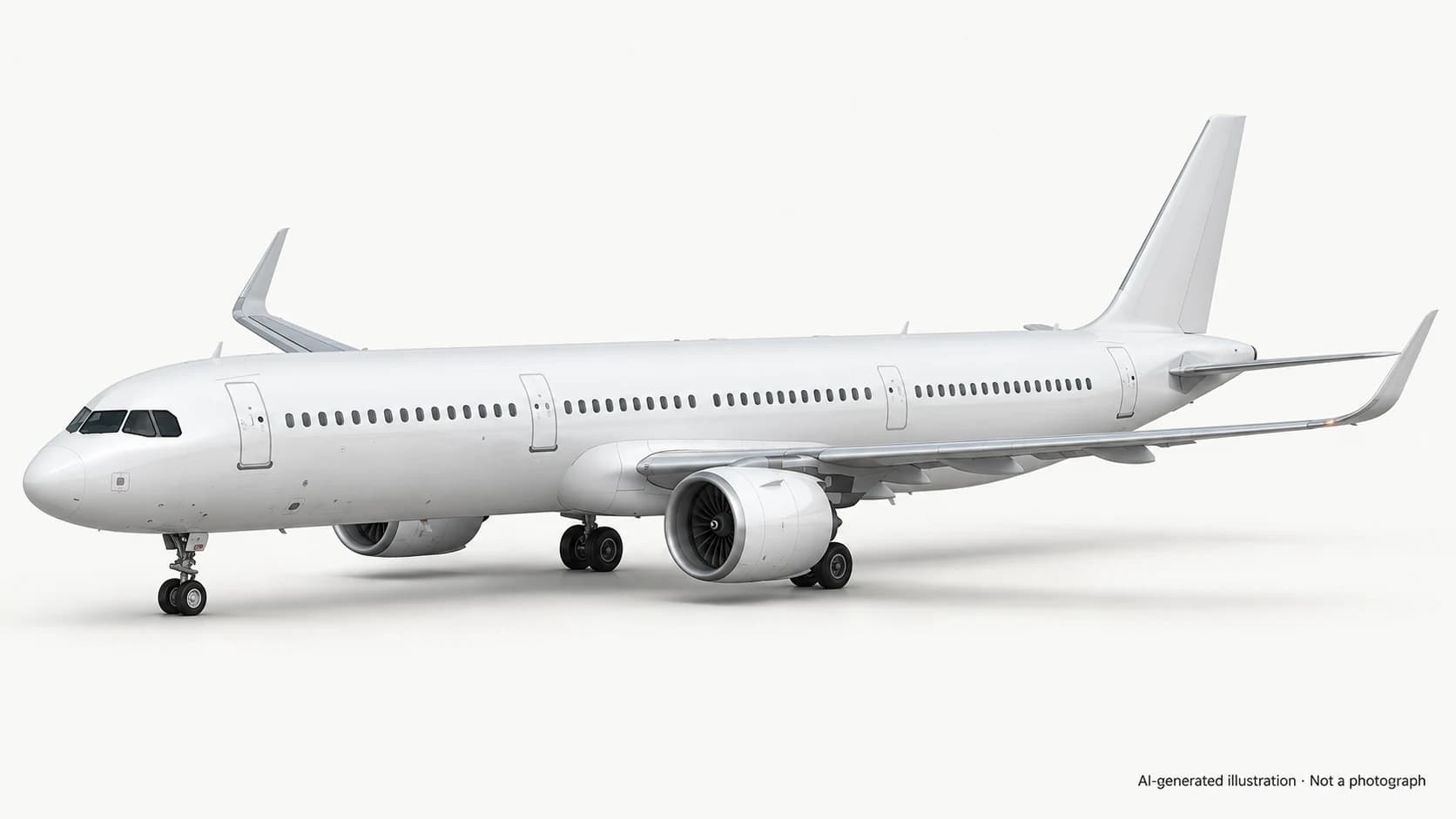
AI-generated illustration · Not a photograph
Credit
ForceTally · AI-generated illustration · Not a photograph · AI-generated · OpenAI output terms · Source ↗ · Modified


Preparing your view.
At a glance
Measured figures
Length
Single source44.51 m (146 ft)[source]
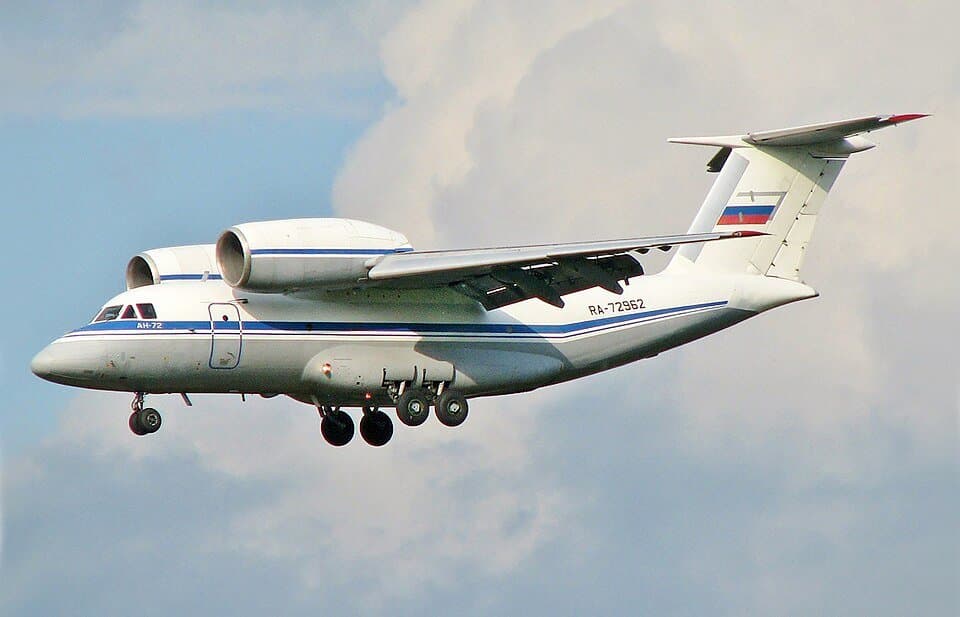
An-72 · Length
Single sourceConfiguration
| Specification | Airbus A321neo | Antonov An-72 |
|---|---|---|
| Crew | Two[source] | five[source] |
| Type | Single-aisle airliner[source] | Transport aircraft[source] |
| National origin | Multi-national[source] | Soviet Union[source] |
| Manufacturer | Airbus[source] | Antonov |
28.07 m (92 ft 1 in)[source]
Maximum; Cruise: Mach 0.78 (
Single sourceMaximum; ) Max.: Mach 0.82 (
Single sourceMaximum; Speed · source measurement 2
Single sourceMaximum; Speed · source measurement 4
Single sourceMaximum; Speed · source measurement 5
Single sourceMaximum; Speed · source measurement 6
Single sourceCruise: Mach 0.78 (450 kn; 833 km/h; 518 mph) Max.: Mach 0.82 (473 kn; 876 km/h; 544 mph)[source]
Maximum; An-72 · Maximum speed
Single source700 km/h (435 mph, 378 kn)[source]
An-72 · Range
Single source4,325 km (2,688 mi, 2,336 nmi)[source]
An-72 · 2 × Lotarev D-36 series 1A Turbofan thrust each
Single source2 × Lotarev D-36 series 1A Turbofan, 63.9 kN (14,330 lbf) thrust each[source]
Maximum payload
Single source25 t (55,100 lb)[source]
An-72 · Wing area
Single source98.62 m 2 (1,062 sq ft)[source]
Bars compare reported quantities only. A larger figure does not make a system better; configurations and test conditions differ.
| Status | In service[source] | In service[source] |
|---|
| Primary users | Wizz Air IndiGo American Airlines Delta Air Lines[source] | Russian Aerospace Forces Russian Navy Angolan Air Force Soviet Air Force (historical)[source] |
|---|
| Number built | 1,752 as of June 2025[source] | 133[source] |
|---|
| Manufactured | 2014–present[source] | 1977–2002[source] |
|---|
| Introduction date | 31 May 2017, with Virgin America[source] | — |
|---|
| First flight | 9 February 2016[source] | 31 August 1977 ( 1977-08-31 )[source] |
|---|
| Developed from | Airbus A321 Airbus A320neo family[source] | — |
|---|
| Wing geometry | 122.4 m 2 (1,318 ft 2 ) area, 25° sweep[source] | — |
|---|
| Operating empty weight | 50.1 t (110,500 lb)[source] | — |
|---|
| Fuel capacity | 23,490 L (6,210 US gal)[source] | — |
|---|
| Role | narrow-body single-aisle airliner created[source] | — |
|---|
| Source measurement | The Airbus A321neo is a narrow-body single-aisle airliner created by Airbus . The A321neo ( neo being an acronym for "new engine option") was developed from the Airbus A321 and is part of the Airbus A320neo family , alongside the A319neo and A320neo , being the longest member of the family. It typically seats 180 to 220 passengers in a two-class configuration, with up to 244 passengers in a high-density arrangement.[source]Airbus A321neo · Lead; only the objects and conditions stated in this passage The A321neo was announced by Airbus in December 2010, as an improvement and replacement to the A321ceo. Fitted with new engines and sharklets as standard, the A321neo has the longest fuselage of any Airbus narrow-body airliner in commercial use. Available with either CFM International LEAP-1A or Pratt & Whitney PW1100G-JM engines, Airbus advertises a 20% increase in fuel efficiency per passenger, with 500 nautical miles (930 km; 580 mi) more range, or 2 tonnes (4,400 lb) more of payload. Boeing introduced a new generation of their competing narrowbody family, the 737 MAX , nine days before the introduction of the A321neo.[source]Airbus A321neo · Lead; only the objects and conditions stated in this passage The A321neo has the same overall length as the A321ceo, with an increased fuel efficiency and performance rating. The A321neo has a range of 3,995 nautical miles (7,399 km), with an MTOW (maximum take-off weight) of 97 tonnes (214,000 lb), and its engine has 109 to 156 kN (24,500 to 35,000 lb) of thrust .[source]Airbus A321neo · Lead; only the objects and conditions stated in this passage The first flight of the Airbus A321neo took place in Hamburg. The prototype, registered D-AVXB and equipped with CFM International LEAP-1A engines, was flown by test pilots Martin Scheuermann and Bernardo Saez Benito Hernandez. The flight lasted 29 minutes, and performed various tests during that time. AerCap was the first customer to order the aircraft on 27 April 2011, with IndiGo being the first airline to order the aircraft, on 22 June 2011, ordering 304 of the type. The first A321neo entered commercial service with Virgin America in May 2017, who merged with Alaska Airlines in 2018; the latter also acquired all of Virgin's aircraft.[source]Airbus A321neo · Development; only the objects and conditions stated in this passage Hawaiian's first two A321neos were planned to have been delivered in 2017 before its upcoming winter peak season but were postponed to early 2018, a "frustrating" and "irritating" delay, with another nine in 2018, mostly in the first half. They are intended to open up thinner routes to the U.S. mainland not viable with its widebodies , such as Portland to Maui , or better matched and allowing two routes to be expanded to daily service instead of seasonal, bypassing its Honolulu hub for half of the A321neo fleet.[source]Airbus A321neo · Development / Delivery delays; only the objects and conditions stated in this passage Well suited for 2,100–2,300 nmi (3,900–4,300 km; 2,400–2,600 mi) routes to the US West Coast , Hawaiian's 189-seat A321neos are more efficient than the competing narrow-body aircraft and even have slightly lower per-seat costs than its 294-seat A330-200s .[source]Airbus A321neo · Development / Delivery delays; only the objects and conditions stated in this passage In higher-density configurations, maximum seating capacity increases from 220 to a theoretical exit limit of 250 passengers, although such a configuration has not been certified. Certification limits vary by regulator. The European Union Aviation Safety Agency (EASA) permits up to 244 passengers when using larger Type C* doors at both ends with dual lane slides, removing bulkhead walls, and relocating flight attendant jump seats to be deployed in front of the lavatory doors. The Federal Aviation Administration (FAA), by contrast, does not recognize these enhanced Type C* and Type III+ exit types and classifies them as standard Type C and Type III exits, limiting capacity to 200 passengers under existing rules. Airbus has sought similar recognition from the FAA to allow higher seating capacities.[source]Airbus A321neo · Design / Aircraft Cabin Flex (ACF); only the objects and conditions stated in this passage When equipped to carry 240 passengers, fuel efficiency per seat is improved by approximately 6%. Combined with new engines and sharklets, Airbus projected a fuel burn reduction exceeding 20%. The modifications add about 100 kg (220 lb) to the aircraft's weight.[source]Airbus A321neo · Design / Aircraft Cabin Flex (ACF); only the objects and conditions stated in this passage The A321neo is available in multiple variants differentiated by fuel capacity. The A321neo can be configured with up to three optional auxiliary centre tanks (ACTs), including one in the forward cargo hold and up to two in the aft cargo hold, occupying space otherwise available for cargo. Aircraft equipped with three ACTs are designated A321LR (Long Range) .[source]Airbus A321neo · Variants; only the objects and conditions stated in this passage The neo empty weight is 1.8 t (4,000 lb) greater than the ceo, due to its new engines and associated airframe modifications: engine pylons, wing structure and bleed and oil systems were adapted. At the same maximum weight, it reaches FL310 30 nmi (35 mi; 56 km) and 4 minutes earlier than the ceo.[source]Airbus A321neo · Variants / A321neo; only the objects and conditions stated in this passage At FL330 (10,000 m or 33,000 ft), ISA −2 °C (28 °F) and 67 t (148,000 lb), it burns 2,200 kilograms per hour (4,850 lb/h) at Mach 0.76 (819 km/h; 509 mph; 442 kn) long-range cruise or 2,440 kg/h (5,400 lb/h) at Mach 0.80 (862 km/h; 536 mph; 465 kn) high-speed cruise. To offer similar takeoff performance, pitch response to stick input is a rate-command to hit the 3° per second rotation rate to capture the right pitch attitude and there is an "electronic tail bumper" preventing a tailstrike if the stick is less than three-quarters of the way aft; additional thrust, slower rotation and lift-off speeds require more rudder authority and its maximum deflection went from 25° to 30°.[source]Airbus A321neo · Variants / A321neo; only the objects and conditions stated in this passage In October 2014, Airbus started marketing a 164-seat, 97 t (214,000 lb) MTOW variant with up to three optional removable auxiliary fuel tanks (ACT) called the A321neoLR (Long Range) with 100 nmi (190 km; 120 mi) more operational range than a Boeing 757 -200 configured with 169 seats, 27% lower trip costs and 24% lower per seat costs; it was scheduled for introduction in the second half of 2018, two years after the A321neo.[source]Airbus A321neo · Variants / A321LR; only the objects and conditions stated in this passage Airbus launched the A321LR on 13 January 2015 with Air Lease Corporation as the launch customer, hoping to sell 1,000 examples of the variant. The initial layout of 164 seats (20 in business, 30 in premium economy and 114 in economy) was replaced by a two-class 206-seat configuration (16 in business and 190 in economy). Range is 4,000 nmi (7,400 km; 4,600 mi), 500 nmi (930 km; 580 mi) greater than the regular 93.5t MTOW A321neo, making it the first version of the A320 family to have true transatlantic capability, thus replacing the Boeing 757 in the middle of the market. The A321LR has the Cabin Flex layout and was to be first delivered in Q4 2018.[source]Airbus A321neo · Variants / A321LR; only the objects and conditions stated in this passage Certification was aimed for the second quarter of 2018, with a programme including tests with one, two, three, or no additional centre tanks and a transatlantic flight on 13 February. Test flights included a LEAP-powered, long range 4,100 nmi (7,600 km; 4,700 mi) flight by great circle distance , flown in near 11 hours and the equivalent of 162 passengers over 4,700 nmi (8,700 km; 5,400 mi) including headwinds, with 5 crew and 11 technicians. Airbus announced its joint FAA/EASA certification on 2 October 2018, including ETOPS up to 180 minutes, allowing any transatlantic route.[source]Airbus A321neo · Variants / A321LR; only the objects and conditions stated in this passage On 13 November 2018, Arkia received the first A321LR, featuring 220 seats in a single-class and to be deployed to London , Paris, Barcelona for up to 5-hour sectors, or to Zanzibar and the Seychelles, saying it is the first narrow-body more efficient than the 757-300 it operates.[source]Airbus A321neo · Variants / A321LR; only the objects and conditions stated in this passage On 13 April 2019, the UAE branch of Air Arabia received its first of the six A321LRs (WV072) with 97 t (214,000 lb) MTOW, these aircraft are expected to be used on long-haul routes departing from Sharjah to Nairobi , Bangkok , Phuket , Milan Bergamo and Kuala Lumpur , the longest being SHJ-KUL with over 7 hours of air time when returning to the UAE.[source]Airbus A321neo · Variants / A321LR; only the objects and conditions stated in this passage On 24 October 2022, Sichuan Airlines received its first A321LR, a total of six have been ordered, they are mainly designated to operate the nonstop Chengdu Tianfu — Malé and Chengdu Tianfu — Tokyo Narita route, which can take over 6 hours on some segments during the winter season, it is the first Chinese airline to receive this type.[source]Airbus A321neo · Variants / A321LR; only the objects and conditions stated in this passage In January 2018, Airbus stated that it was studying an A321LR variant with a further increased MTOW, requiring strengthened landing gear. With a lower-density cabin, it was expected to fly almost 5,000 nmi (9,300 km; 5,800 mi) The proposed A321XLR (Xtra Long Range) with a range extended to 4,500 nmi (8,300 km; 5,200 mi) was to be launched in 2019 to enter service in 2021 or 2022. Integrated in the fuselage to save weight, the centre fuel tank was to be enlarged. As of July 2018 , about 200–300 nmi (370–560 km; 230–350 mi) of the targeted range increase had already been secured; additional work was needed to achieve the remaining 200 nmi (370 km; 230 mi).[source]Airbus A321neo · Variants / A321XLR; only the objects and conditions stated in this passage In October 2018, the A321XLR was proposed to Air Transat and AerCap : Air Transat could reach Southern European destinations such as Split, Croatia from Montreal and Toronto . In November, Airbus indicated that, compared to the A321LR, the A321XLR would have an increase to 100 t (220,000 lb) in MTOW and an increase of 700 nmi (1,300 km; 810 mi) in range, with the same wing and engines, increased fuel capacity and strengthened landing gear. In January 2019, Air Canada expressed interest in using narrow-body aircraft for transatlantic routes and said it was considering options including the A321XLR and the Boeing 737 MAX .[source]Airbus A321neo · Variants / A321XLR; only the objects and conditions stated in this passage In 2018, analysts reported that competing with the Boeing NMA concept airliner could require stretching the A321neo by one or two rows: its take-off weight could be increased to 100 t (220,000 lb) by tweaking its wing and strengthening its landing gear, requiring more engine thrust; or it could receive a lighter and larger new wing, more costly to develop but with the same thrust. A stretch would probably involve fore and aft plugs to keep its centre of gravity , but tailstrike clearance could constrain field speed and performance, while further cabin crew would be needed over 250 seats. The NMA project has been suspended since 2022, leaving no forthcoming competitor for the potential stretch variant of the A321neo.[source]Airbus A321neo · Variants / A321XLR / Potential stretch; only the objects and conditions stated in this passage The A321XLR was officially launched at the Paris Air Show on 17 June 2019, with deliveries at that time expected from 2023. Its design offers 4,700 nmi (8,700 km; 5,400 mi) of range and features a new permanent rear centre tank (RCT) for more fuel, strengthened landing gear for a 101 t (223,000 lb) MTOW, and an optimised wing trailing-edge flap to preserve take-off performance. The RCT will hold 12,900 L (3,400 US gal) of fuel, the equivalent of four 3,121 L (824 US gal) current Additional Centre Tanks (ACTs), yet has a weight equivalent to a single ACT and takes up the cargo hold space of two; a forward ACT can also be fitted if necessary. As the sharklets lowered take-off and landing speeds, the switch from a double- slotted to single-slotted inboard flap will reduce complexity, weight and drag. The FMS can set intermediate flap positions. The revised design could be applied to other A321neo variants.[source]Airbus A321neo · Variants / A321XLR / Commercial launch; only the objects and conditions stated in this passage On 29 October 2019, IndiGo placed a firm order for 300 A320neo family aircraft, including 69 A321XLR. On 3 December 2019, United Airlines announced an order to purchase 50 new Airbus A321XLR aircraft, with deliveries beginning in 2024, to replace their Boeing 757–200 fleet. Valued at $7.1 billion before discounts ($142M each), United plans to use these aircraft for additional destinations in Europe from its East Coast hubs in Washington, DC and Newark. In April 2020, 450 orders for the XLR had been received from 24 customers. In March 2023, 465 orders for the A321XLR were received. In July 2023, Icelandair ordered 13 XLR.[source]Airbus A321neo · Variants / A321XLR / Commercial launch; only the objects and conditions stated in this passage The XLR needs 10–15% more work than an ACF, itself requiring 30% more work than a standard A321neo. Engines used for now generate 150 kN (33,000 lb) of thrust and could be sufficient, and no more than the 160 kN (35,000 lb) already certified are needed for the XLR. The XLR is a low-risk, high-commonality variant but more substantial upgrades could include a composite wing or a stretch.[source]Airbus A321neo · Variants / A321XLR / Manufacturing; only the objects and conditions stated in this passage | — |
|---|
| Developed into | — | Antonov An-71 Antonov An-74[source] |
|---|
| Capacity | — | up to 52 passengers or 10 tonnes of cargo[source] |
|---|
| Reported operators | — |
|
|---|