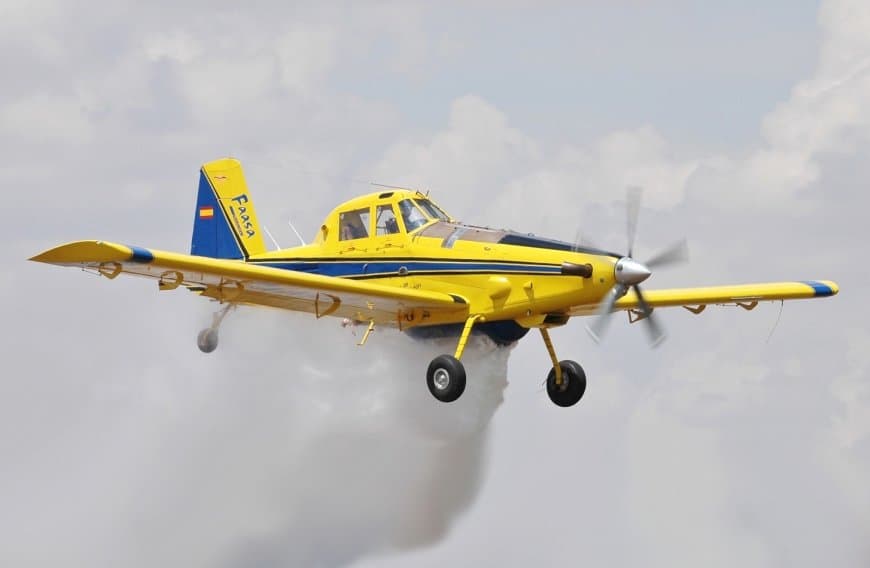

Credit
Daniel VA · CC BY-SA 4.0 · Resized · CC BY-SA 4.0 · Source ↗ · Modified


Preparing your view.
BSupport aircraft
American four- to six-seat twin-engined general aviation light aircraft ,
At a glance
Measured figures
AT-802 · Length
Single source35 ft 11 in (10.95 m)[source]
PA-23-250F, normally aspirated · Length
Single sourceConfiguration
| Specification | Air Tractor AT-802 | Piper PA-23 |
|---|---|---|
| Type | Agricultural / Fire-fighting aircraft[source] | Twin-engined light piston utility[source] |
| National origin | United States[source] | United States[source] |
| Manufacturer | Air Tractor[source] | Piper Aircraft[source] |
| Status | Active[source] | — |
31 ft 2 + 3 ⁄ 4 in (9.519 m)[source]
Empty; AT-802 · Empty weight
Single sourceMaximum take-off; AT-802 · Max takeoff weight
Single source6,505 lb (2,951 kg)[source]
16,000 lb (7,257 kg)[source]
Empty; PA-23-250F, normally aspirated · Empty weight
Single sourceMaximum take-off; PA-23-250F, normally aspirated · Max takeoff weight
Single sourceCruise; AT-802 · at 8,000 ft (2,440 m)
Single source221 mph (356 km/h, 192 kn) at 8,000 ft (2,440 m)[source]
AT-802 · 1 × Pratt & Whitney PT6A -67AG turboprop , 1,350 shp (
Single source1 × Pratt & Whitney PT6A -67AG turboprop , 1,350 shp (1,010 kW)[source]
PA-23-250F, normally aspirated · 2 × Lycoming IO-540 -C4B5 normally aspirated air-cooled flat-six piston engines each
Single source2 × Lycoming IO-540 -C4B5 normally aspirated air-cooled flat-six piston engines , 250 hp (190 kW) each[source]
Bars compare reported quantities only. A larger figure does not make a system better; configurations and test conditions differ.
| Manufactured | 1990–present[source] | 1952–1981[source] |
|---|
| First flight | 1990[source] | 2 March 1952[source] |
|---|
| Variant | L3Harris OA-1K Skyraider II[source] | — |
|---|
| Capacity | 820 US gal (683 imp gal; 3,104 L)[source] | 5 passengers[source] |
|---|
| Aspect ratio | 8.8:1[source] | 6.8:1[source] |
|---|
| Airfoil | NACA 4415[source] | USA 35B (modified)[source] |
|---|
| Stall speed | 91 mph (146 km/h, 79 kn) (power off, flaps down)[source] | 68 mph (109 km/h, 59 kn) (flaps down)[source] |
|---|
| Number built | — | 6,976[source] |
|---|
| Introduction date | — | 1954[source] |
|---|
| Fuel capacity | — | 140 US gal (120 imp gal; 530 L) usable fuel (normal), optional extra tanks with 40 US gal (33 imp gal; 150 L)[source] |
|---|
| Propellers | — | 2-bladed Hartzell HC-E2YK-2RB constant-speed propellers[source] |
|---|
| Never exceed speed | — | 277 mph (446 km/h, 241 kn)[source] |
|---|
| Takeoff distance to 50 ft (15 m) | — | 1,695 ft (517 m)[source] |
|---|
| Landing distance from 50 ft (15 m) | — | 1,695 ft (517 m)[source] |
|---|
| Role | — | American four- to six-seat twin-engined general aviation light aircraft ,[source] |
|---|
| Source measurement | — | The PA-23 was the first twin-engined Piper aircraft, and was developed from a proposed "Twin Stinson" design, inherited when Piper bought the Stinson Division of the Consolidated Vultee Aircraft Corporation . The prototype PA-23 was a four-seat, low-wing, all-metal monoplane with a twin tail , powered by two 125 hp Lycoming O-290 -D piston engines; it first flew on March 2, 1952. The aircraft performed poorly, so it was redesigned with a single vertical stabilizer and an all-metal rear fuselage and more powerful 150 hp Lycoming O-320 -A engines.[source]Piper PA-23 · Design and development; only the objects and conditions stated in this passage Two new prototypes of the redesigned aircraft, named Apache , were built in 1953 and entered production in 1954; 1,231 Apaches were built. In 1958, the Apache 160 was produced with upgraded 160 hp (119 kW) engines; 816 were built. The Apache 160 was superseded in 1962 by the Aztec-derived 235 hp (175 kW) Apache 235 . With a 1962 price of $45,000, the Apache 235 featured the Aztec's engines and swept tail surfaces (119 built).[source]Piper PA-23 · Design and development / Apache; only the objects and conditions stated in this passage In 1959, Piper produced an upgraded version with 250 hp (186 kW) Lycoming O-540 engines and a swept vertical tail as the PA-23-250, and named it Aztec . The first models came in a five-seat configuration. In 1961, a longer-nosed variant, the Aztec B, entered production. Later Aztecs were equipped with Lycoming IO-540 fuel-injected engines and six-seat capacity, and remained in production until 1982. Turbocharged versions of the later models could fly at higher altitudes.[source]Piper PA-23 · Design and development / Aztec; only the objects and conditions stated in this passage PA-23 powered by two 160 hp O-320-B engines[source]Piper PA-23 · Variants / Apache; only the objects and conditions stated in this passage Apache with five seats and 235 hp O-540 engines, 118 built[source]Piper PA-23 · Variants / Apache; only the objects and conditions stated in this passage Apache G with modified rear fuselage, new fin and rudder and 250hp Lycoming O-540-A1D engines, 4811 built (including subvariants)[source]Piper PA-23 · Variants / Aztec; only the objects and conditions stated in this passage Aztec variant with gross weight reduced from 5,200 lb (2,400 kg) to 4,995 lb (2,266 kg). Produced in the late 1960s and early 1970s exclusively for the United Kingdom market.[source]Piper PA-23 · Variants / Aztec; only the objects and conditions stated in this passage On 18 April 1974, Aztec G-AYDE collided with Court Line Flight 95 , a BAC One-Eleven , at London Luton Airport after the pilot of the Aztec entered the active runway without clearance. He was killed and his passenger was injured. All 91 people on board the One-Eleven successfully evacuated after the takeoff was aborted.[source]Piper PA-23 · Accidents and incidents; only the objects and conditions stated in this passage Capacity: 5 passengers[source]Piper PA-23 · Specifications (PA-23-250F, normally aspirated); only the objects and conditions stated in this passage Length: 31 ft 2 + 3 ⁄ 4 in (9.519 m)[source]Piper PA-23 · Specifications (PA-23-250F, normally aspirated); only the objects and conditions stated in this passage Wingspan: 37 ft 2 + 1 ⁄ 2 in (11.341 m)[source]Piper PA-23 · Specifications (PA-23-250F, normally aspirated); only the objects and conditions stated in this passage Height: 10 ft 4 in (3.15 m)[source]Piper PA-23 · Specifications (PA-23-250F, normally aspirated); only the objects and conditions stated in this passage Wing area: 207.56 sq ft (19.283 m 2 )[source]Piper PA-23 · Specifications (PA-23-250F, normally aspirated); only the objects and conditions stated in this passage Empty weight: 3,180 lb (1,442 kg)[source]Piper PA-23 · Specifications (PA-23-250F, normally aspirated); only the objects and conditions stated in this passage Max takeoff weight: 5,200 lb (2,359 kg)[source]Piper PA-23 · Specifications (PA-23-250F, normally aspirated); only the objects and conditions stated in this passage Powerplant: 2 × Lycoming IO-540 -C4B5 normally aspirated air-cooled flat-six piston engines , 250 hp (190 kW) each[source]Piper PA-23 · Specifications (PA-23-250F, normally aspirated); only the objects and conditions stated in this passage Maximum speed: 215 mph (346 km/h, 187 kn)[source]Piper PA-23 · Specifications (PA-23-250F, normally aspirated); only the objects and conditions stated in this passage Cruise speed: 172 mph (277 km/h, 149 kn) at 10,200 ft (3,100 m) (long-range cruise)[source]Piper PA-23 · Specifications (PA-23-250F, normally aspirated); only the objects and conditions stated in this passage Stall speed: 68 mph (109 km/h, 59 kn) (flaps down)[source]Piper PA-23 · Specifications (PA-23-250F, normally aspirated); only the objects and conditions stated in this passage Never exceed speed : 277 mph (446 km/h, 241 kn)[source]Piper PA-23 · Specifications (PA-23-250F, normally aspirated); only the objects and conditions stated in this passage Range: 1,519 mi (2,445 km, 1,320 nmi) at long-range cruise[source]Piper PA-23 · Specifications (PA-23-250F, normally aspirated); only the objects and conditions stated in this passage Service ceiling: 18,950 ft (5,780 m) (absolute ceiling)[source]Piper PA-23 · Specifications (PA-23-250F, normally aspirated); only the objects and conditions stated in this passage Rate of climb: 1,400 ft/min (7.1 m/s)[source]Piper PA-23 · Specifications (PA-23-250F, normally aspirated); only the objects and conditions stated in this passage Takeoff distance to 50 ft (15 m): 1,695 ft (517 m)[source]Piper PA-23 · Specifications (PA-23-250F, normally aspirated); only the objects and conditions stated in this passage Landing distance from 50 ft (15 m): 1,695 ft (517 m)[source]Piper PA-23 · Specifications (PA-23-250F, normally aspirated); only the objects and conditions stated in this passage |
|---|