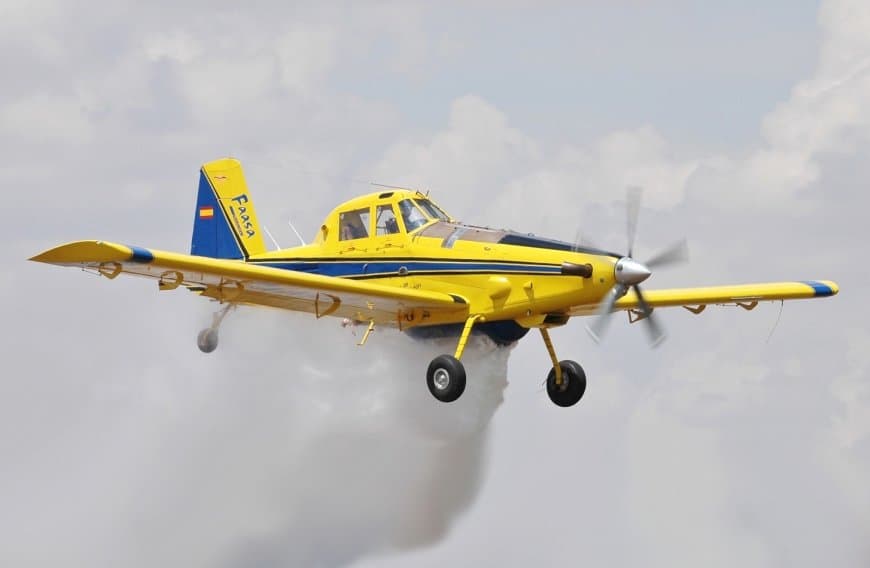

Credit
Daniel VA · CC BY-SA 4.0 · Resized · CC BY-SA 4.0 · Source ↗ · Modified


Preparing your view.
At a glance
Measured figures
AT-802 · Length
Single source35 ft 11 in (10.95 m)[source]
1978 Cessna 180 II landplane · Length
Single sourceConfiguration
| Specification | Air Tractor AT-802 | Cessna 180 Skywagon |
|---|---|---|
| Crew | One or Two (AT-802A – single-seat)[source] | one[source] |
| Type | Agricultural / Fire-fighting aircraft[source] | Light utility aircraft[source] |
| National origin | United States[source] | — |
| Manufacturer | Air Tractor[source] | Cessna[source] |
25 ft 9 in (7.85 m)[source]
Empty; AT-802 · Empty weight
Single sourceMaximum take-off; AT-802 · Max takeoff weight
Single source6,505 lb (2,951 kg)[source]
16,000 lb (7,257 kg)[source]
Empty; 1978 Cessna 180 II landplane · Empty weight
Single sourceGross; 1978 Cessna 180 II landplane · Gross weight
Single sourceCruise; AT-802 · at 8,000 ft (2,440 m)
Single source221 mph (356 km/h, 192 kn) at 8,000 ft (2,440 m)[source]
Bars compare reported quantities only. A larger figure does not make a system better; configurations and test conditions differ.
| Status | Active[source] | — |
|---|
| Manufactured | 1990–present[source] | 1953–1981[source] |
|---|
| First flight | 1990[source] | May 26, 1952[source] |
|---|
| Variant | L3Harris OA-1K Skyraider II[source] | — |
|---|
| Capacity | 820 US gal (683 imp gal; 3,104 L)[source] | five passengers[source] |
|---|
| Aspect ratio | 8.8:1[source] | — |
|---|
| Airfoil | NACA 4415[source] | — |
|---|
| Stall speed | 91 mph (146 km/h, 79 kn) (power off, flaps down)[source] | 48 kn (55 mph, 89 km/h)[source] |
|---|
| Number built | — | 6,193[source] |
|---|
| Introduction date | — | 1953[source] |
|---|
| Variants | — | St-Just Cyclone St-Just Super-Cyclone[source] |
|---|
| Developed into | — | Cessna 182 Skylane Cessna 185 Skywagon[source] |
|---|
| Propellers | — | 2-bladed constant speed, 6 ft 10 in (2.08 m) diameter[source] |
|---|
| Wing loading | — | 16.1 lb/sq ft (79 kg/m 2 )[source] |
|---|
| Source measurement | — | The Cessna 180 gained recognition as the aircraft chosen by Geraldine Mock , the first woman pilot to successfully fly around the world. The flight was made in 1964 in her 1953 model, the Spirit of Columbus (N1538C), as chronicled in her 1970 book Three-Eight Charlie . The Cessna factory obtained the aircraft and kept it at the Pawnee (Wichita, Kansas) manufacturing plant after the epic flight, suspended from the ceiling over one of the manufacturing lines. It is currently on display at the National Air and Space Museum .[source]Cessna 180 Skywagon · Operational history / Record flight; only the objects and conditions stated in this passage Introduced for the 1953 model year with four seats, all-metal construction, a 225 hp (168 kW) Continental O-470-A engine driving a constant-speed propeller , a squared vertical tail (as opposed to previous types' rounded tails), "Para-Lift" flaps, spring steel landing gear with a steerable tail wheel, and a gross weight of 2,550 lb (1,157 kg). The 1954 model year introduced a 225 hp (168 kW) O-470-J engine and interior refinements. 1956 introduced a 230 hp (172 kW) O-470-K engine with a new air intake duct. Certified on 23 December 1952. 641 (1953), 620 (1954), 891 (1955), and 512 (1956) built.[source]Cessna 180 Skywagon · Variants; only the objects and conditions stated in this passage Introduced for the 1957 model year with revised instrument panel, improved tailwheel steering, a new parking brake, and an increased gross weight of 2,650 lb (1,202 kg). Certified on 17 December 1956. 694 total built; 444 (1957) and 250 (1958).[source]Cessna 180 Skywagon · Variants; only the objects and conditions stated in this passage 1960 model year with a revised cowling with a new front-mounted intake filter. Powered by a 230 hp (172 kW) Continental O-470-K (also certified for the O-470-L or O-470-R). Certified on 8 July 1959. 251 built.[source]Cessna 180 Skywagon · Variants; only the objects and conditions stated in this passage 1961 model year with a 230 hp (172 kW) Continental O-470-L engine (also certified for the O-470-R) and a redesigned instrument panel. Certified on 14 June 1960. 152 built.[source]Cessna 180 Skywagon · Variants; only the objects and conditions stated in this passage 1962 model year with a 230 hp (172 kW) Continental O-470-R engine (also certified for the O-470-L), redesigned 65 US gal (246 L) fuel tanks or optional 84 US gal (318 L) tanks, and new wingtips. Certified on 21 September 1961. 112 built.[source]Cessna 180 Skywagon · Variants; only the objects and conditions stated in this passage 180G[source]Cessna 180 Skywagon · Variants; only the objects and conditions stated in this passage 1964 model year with the larger fuselage (minus the firewall), wings, and landing gear of the Model 185 , an alternator, and provisions for an extra utility seat, bringing total capacity to six people. Gross weight was increased to 2,800 lb (1,270 kg). These changes made the 180 largely identical to the 185, with the smaller dorsal fairing of the former being the primary external difference between the two models. Certified on 19 July 1963. 133 built.[source]Cessna 180 Skywagon · Variants; only the objects and conditions stated in this passage 180H[source]Cessna 180 Skywagon · Variants; only the objects and conditions stated in this passage Introduced for the 1965 model year with the firewall of the 185, a redesigned instrument panel, and an improved fuel strainer. The 1966 model year featured improved door latches. 1967 introduced a pointed propeller spinner, increased stowage area, an Aeroflash rotating beacon, and an optional door on the left side. 1968 introduced new seat belts and stowable rudder pedals on the right side. Beginning in 1969, Cessna used the marketing name Skywagon to refer to the 180. 1970 introduced new wingtips and an optional external cargo pack with a capacity of 300 lb (136 kg). Certified on 17 June 1964. 839 total built; 162 (1965), 167 (1966), 101 (1967), 118 (1968), 110 (1969), 72 (1970), 46 (1971), and 63 (1972) built.[source]Cessna 180 Skywagon · Variants; only the objects and conditions stated in this passage Introduced for the 1973 model year with a new "Camber-Lift" wing with a redesigned leading edge, a revised instrument panel, and nose-mounted landing/taxi lights. The 1974 model year introduced optional cabin door bubble windows for improved downward visibility. 1975 introduced a 230 hp (172 kW) Continental O-470-S engine. Certified on 13 October 1972. 100 (1973), 116 (1974), 120 (1975), and 150 (1976).[source]Cessna 180 Skywagon · Variants; only the objects and conditions stated in this passage Introduced for the 1977 model year with a 230 hp (172 kW) Continental O-470-U engine for which AVGAS 100 or 100LL is specified (previous engines were designed for AVGAS 80, formerly called 80/87), a strengthened tailwheel, and rearranged flight instruments in a "T" configuration. The smaller dorsal fairing of previous models was replaced with the larger 185-style fairing. The 1978 model year introduced the Skywagon II with a preferred options package. All subsequent model years featured only minor changes. Certified on 19 August 1976. 433 total built; 135 (1977), 95 (1978), 115 (1979), 52 (1980), and 36 (1981).[source]Cessna 180 Skywagon · Variants; only the objects and conditions stated in this passage Eight 180E and nine 180H aircraft acquired by the United States military for export.[source]Cessna 180 Skywagon · Variants / Military variants; only the objects and conditions stated in this passage Capacity: five passengers[source]Cessna 180 Skywagon · Specifications (1978 Cessna 180 II landplane); only the objects and conditions stated in this passage Length: 25 ft 9 in (7.85 m)[source]Cessna 180 Skywagon · Specifications (1978 Cessna 180 II landplane); only the objects and conditions stated in this passage Wingspan: 35 ft 10 in (10.92 m)[source]Cessna 180 Skywagon · Specifications (1978 Cessna 180 II landplane); only the objects and conditions stated in this passage Height: 7 ft 9 in (2.36 m)[source]Cessna 180 Skywagon · Specifications (1978 Cessna 180 II landplane); only the objects and conditions stated in this passage Wing area: 174 sq ft (16.2 m 2 )[source]Cessna 180 Skywagon · Specifications (1978 Cessna 180 II landplane); only the objects and conditions stated in this passage Empty weight: 1,700 lb (771 kg)[source]Cessna 180 Skywagon · Specifications (1978 Cessna 180 II landplane); only the objects and conditions stated in this passage Gross weight: 2,800 lb (1,270 kg)[source]Cessna 180 Skywagon · Specifications (1978 Cessna 180 II landplane); only the objects and conditions stated in this passage Powerplant: 1 × Continental O-470-U , 230 hp (170 kW)[source]Cessna 180 Skywagon · Specifications (1978 Cessna 180 II landplane); only the objects and conditions stated in this passage Propellers: 2-bladed constant speed, 6 ft 10 in (2.08 m) diameter[source]Cessna 180 Skywagon · Specifications (1978 Cessna 180 II landplane); only the objects and conditions stated in this passage Maximum speed: 148 kn (170 mph, 274 km/h)[source]Cessna 180 Skywagon · Specifications (1978 Cessna 180 II landplane); only the objects and conditions stated in this passage Cruise speed: 142 kn (163 mph, 263 km/h)[source]Cessna 180 Skywagon · Specifications (1978 Cessna 180 II landplane); only the objects and conditions stated in this passage Stall speed: 48 kn (55 mph, 89 km/h)[source]Cessna 180 Skywagon · Specifications (1978 Cessna 180 II landplane); only the objects and conditions stated in this passage Range: 890 nmi (1,020 mi, 1,650 km)[source]Cessna 180 Skywagon · Specifications (1978 Cessna 180 II landplane); only the objects and conditions stated in this passage Service ceiling: 17,700 ft (5,400 m)[source]Cessna 180 Skywagon · Specifications (1978 Cessna 180 II landplane); only the objects and conditions stated in this passage Rate of climb: 1,100 ft/min (5.6 m/s)[source]Cessna 180 Skywagon · Specifications (1978 Cessna 180 II landplane); only the objects and conditions stated in this passage |
|---|