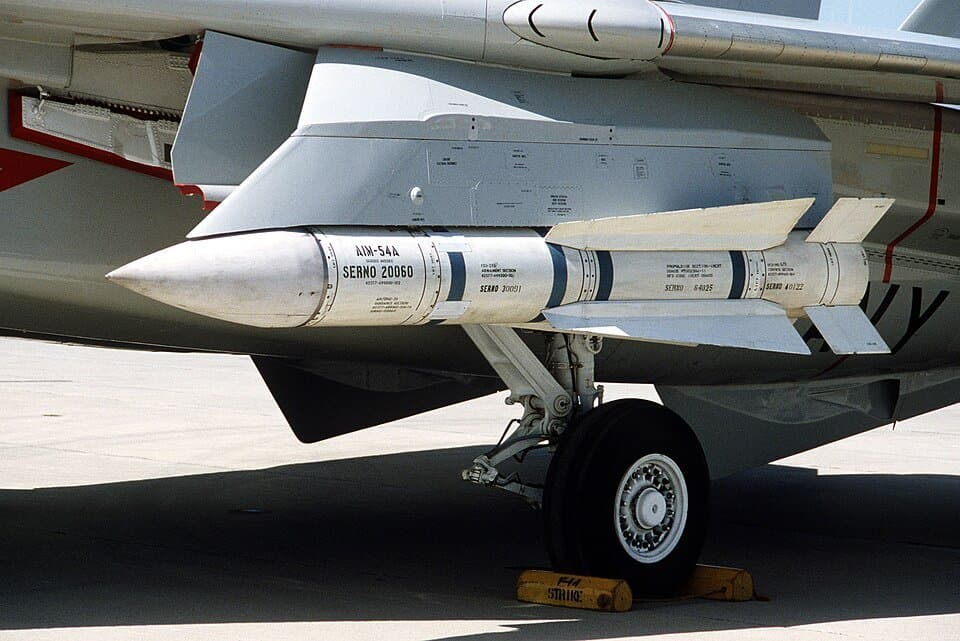

Credit
Don S. Montgomery, USN · Public domain · Resized · Public domain · Source ↗ · Modified


Preparing your view.
At a glance
AIM-54 Phoenixlarger figure on 2 of 3
Kh-23 Gromlarger figure on 1 of 3
Counts only measures both sources give with the same scope. A larger figure is not a better system.
Measured figures
Length
Single source12 ft 9 + 1 ⁄ 2 in (3.9 m)[source]
A921
Single sourceConfiguration
| Specification | AIM-54 Phoenix | Kh-23 Grom |
|---|---|---|
| Type | Long range BVR air-to-air missile[source] | Tactical air-to-surface missile[source] |
| Place of origin | United States[source] | Soviet Union[source] |
| In service | 1974–present[source] | Kh-66 :20 June 1968 Kh-23 :1973 Kh-23M :1974[source] |
| Used by | United States Navy (former) Iranian Air Force[source] |
A921 :3.525 m (11 ft 7 in)[source]
Maximum; AIM-54A/B - Mach 4.3 (
Single sourceMaximum; ) AIM-54C – Mach 5 (
Single sourceMaximum; Maximum speed · source measurement 3
Single sourceMaximum; Maximum speed · source measurement 4
Single sourceAIM-54A/B - Mach 4.3 (1,460 m/s; 4,800 ft/s) AIM-54C – Mach 5 (1,700 m/s; 5,600 ft/s)[source]
Maximum; Maximum speed
Single source2,160–2,700 km/h (1,340–1,680 mph)[source]
Bars compare reported quantities only. A larger figure does not make a system better; configurations and test conditions differ.
FSU, Warsaw Pact, Iraq, India[source] |
| Designer | Hughes Aircraft Company[source] | Yurii N. Korolyov[source] |
|---|
| Designed | 1960–1966[source] | — |
|---|
| Manufacturer | Hughes Aircraft Company Raytheon Corporation[source] | Zvezda-Strela[source] |
|---|
| Unit cost | US$ 477,131 (1974 FY)[source] | — |
|---|
| Produced | 1966-1993[source] | — |
|---|
| Warhead | AIM-54A/B - HE continuous rod AIM-54C – HE Mk 82; WDU‐29/B continuous rod[source] | — |
|---|
| Detonation mechanism | Proximity fuze[source] | — |
|---|
| Engine | Solid propellant rocket motor[source] | Solid fuel rocket[source] |
|---|
| Flight ceiling | 103,500 ft (31.5 km)[source] | — |
|---|
| Guidance system | Semi-active radar homing and terminal phase active radar homing[source] | Kh-66: Line-Of-Sight Beam riding Kh-23: Radio command guidance Grom-B : TV guidance[source] |
|---|
| Launch platform | Grumman F-14 Tomcat[source] | Yak-38 , MiG-21 PFM, MiG-23 , MiG-27 , Su-17 M3/20/22/22M3/M4,[source] |
|---|
| References | Janes[source] | — |
|---|
| Former operator · Afghanistan | — | Afghanistan[source] |
|---|
| Former operator · Algeria | — | Algeria[source] |
|---|
| Former operator · Angola | — | Angola[source] |
|---|
| Former operator · Azerbaijan | — | Azerbaijan[source] |
|---|
| Former operator · Belarus | — | Belarus[source] |
|---|
| Former operator · Bulgaria | — | Bulgaria[source] |
|---|
| Former operator · Cambodia | — | Cambodia[source] |
|---|
| Former operator · Congo | — | Congo[source] |
|---|
| Former operator · Cuba | — | Cuba[source] |
|---|
| Former operator · Czechoslovakia | — | Czechoslovakia[source] |
|---|
| Former operator · Czech Republic | — | Czech Republic[source] |
|---|
| Former operator · East Germany | — | East Germany[source] |
|---|
| Former operator · Egypt | — | Egypt[source] |
|---|
| Former operator · Finland | — | Finland[source] |
|---|
| Former operator · Georgia | — | Georgia[source] |
|---|
| Former operator · Germany | — | Germany[source] |
|---|
| Former operator · Hungary | — | Hungary[source] |
|---|
| Former operator · India | — | India[source] |
|---|
| Former operator · Iraq | — | Iraq[source] |
|---|
| Former operator · Kazakhstan | — | Kazakhstan[source] |
|---|
| Former operator · Libya | — | Libya[source] |
|---|
| Former operator · Nigeria | — | Nigeria[source] |
|---|
| Former operator · Poland | — | Poland[source] |
|---|
| Former operator · Romania | — | Romania[source] |
|---|
| Former operator · Serbia | — | Serbia[source] |
|---|
| Former operator · Slovakia | — | Slovakia[source] |
|---|
| Former operator · Soviet Union | — | Soviet Union[source] |
|---|
| Former operator · Sudan | — | Sudan[source] |
|---|
| Former operator · Syria | — | Syria[source] |
|---|
| Former operator · Ukraine | — | Ukraine[source] |
|---|
| Former operator · Vietnam | — | Vietnam[source] |
|---|
| Former operator · Yugoslavia | — | Yugoslavia[source] |
|---|
| Role | — | family of early Soviet tactical air-to-surface missiles[source] |
|---|
| Source measurement | — | The Zvezda Kh-66 and Kh-23 Grom ( Russian : Х -23 Гром 'Thunder'; NATO : AS-7 'Kerry' ) are a family of early Soviet tactical air-to-surface missiles with a range of 10 km. They were intended for use against small ground or naval targets. The Kh-66 was effectively a heavy-warhead, beam-riding version of the K-8 (AA-3 'Anab') air-to-air missile rushed into service in Vietnam in 1968. The Kh-23 was an improved Kh-66 with command-guidance, similar to the AGM-12 Bullpup .[source]Kh-23 Grom · Lead; only the objects and conditions stated in this passage The resulting weapon used the body of a K-8 (AA-3 'Anab') , K-5 guidance and propulsion systems, but increased the warhead from 13 kg (29 lb) to 100 kg (220 lb). This had the big advantage of allowing the new weapon to be fitted to any aircraft capable of firing the K-5. Design began in 1966, so the project was known as Kh-66 or Izdeliye 66 ('Article 66'). The Kh-66 was a beam-riding weapon that was first tested on the MiG-21PFM , with the first launches of the missile in September 1966. It entered production in 1968 for that aircraft. The Kh-66 was only an interim solution as it required the launch aircraft to dive towards the target to maintain lock on the target. It entered service on 20 June 1968 .The reason it was only carried on the MIG-21PFM was, since it was a beam-riding missile, it was paired with a radar, the RP-21M, which other aircraft did not have.[source]Kh-23 Grom · Development; only the objects and conditions stated in this passage Meanwhile, Korolyov took over work on the Kh-23 project intended for carriage on the Soviet Union's new MiG-23. The Kh-23 became a development of the Kh-66 design with an improved propellant and new Delta-R1M guidance system. The main practical difference was that it was a line-of-sight radio-command weapon similar to the Bullpup, allowing it to be fired in level flight (unlike the Kh-66). The first ten were tested in early 1968, but significant delays were caused by problems with unreliable guidance which was eventually traced to the smoke generator which interfered with the antenna. Once the receiver had been moved to a tail extension, the government tested the missile on the MiG-23 and MiG-23B between 20 March 1970 and 3 October 1973. and it entered service in 1973. A laser-guided version of the Kh-23, the Kh-25, became the basis for the AS-10 'Karen' family of missiles. Technology from these was 'backported' to the Kh-23 to create the Kh-23M in 1974.[source]Kh-23 Grom · Development; only the objects and conditions stated in this passage The Kh-66 entered production for the MiG-21 in 1968, and the Kh-23 was certified for the MiG-23 'Flogger' in 1973.[source]Kh-23 Grom · Operational history; only the objects and conditions stated in this passage Kh-23M - improved Kh-23 with technology from the Kh-25 family[source]Kh-23 Grom · Variants; only the objects and conditions stated in this passage |
|---|
| Reported operators |
|
|
|---|