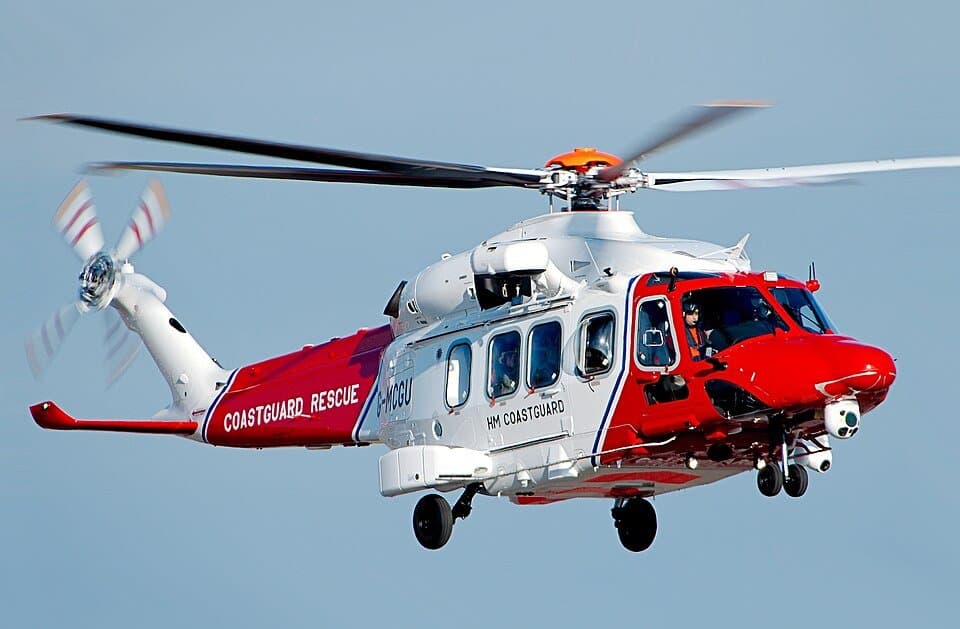

Credit
Airwolfhound · CC BY-SA 2.0 · Resized · CC BY-SA 2.0 · Source ↗ · Modified


Preparing your view.

At a glance
Measured figures
AW189 · Length
Single source17.60 m (57 ft 9 in)[source]
Configuration
| Specification | AgustaWestland AW189 | Bell 214ST |
|---|---|---|
| Type | Super-medium-lift helicopter[source] | Medium-lift helicopter[source] |
| National origin | Italy[source] | United States[source] |
| Manufacturer | Leonardo S.p.A. Finmeccanica AgustaWestland[source] | Bell Helicopter[source] |
| Status | In service[source] | Production completed |
214ST · Length
49 ft 4 in (15.03 m)[source]
214ST · Wingspan
Single source52 ft 0 in (15.85 m)[source]
AW189 · Main rotor diameter
Single sourceRotor diameter
Single source14.60 m (47 ft 11 in)[source]
14.60 m[source]
Bell 214ST · main rotor diameter only; not tail rotor and not unrelated Bell214 BigLifter · Bell 214ST · main rotor diameter only; not tail rotor and not unrelated Bell214 BigLifter · source measurement 1
Single sourceBell 214ST · main rotor diameter only; not tail rotor and not unrelated Bell214 BigLifter · Bell 214ST · main rotor diameter only; not tail rotor and not unrelated Bell214 BigLifter · source measurement 2
Single sourceGross; AW189 · Gross weight
Single sourceGross; Max gross weight · Max gross weight
Single sourceMaximum take-off; AW189 · Weights (MTOW) · standard max gross weight
Single source8,300 kg (18,300 lb)[source]
8,300 kg[source]Max gross weight
8,300 kg[source]AW189 · Weights (MTOW) · standard max gross weight
Empty; 214ST · Empty weight
Single sourceMaximum take-off; 214ST · Max takeoff weight
Single sourceAW189 · 2 × General Electric CT7-2E1 turboshaft engine each
Single source2 × General Electric CT7-2E1 turboshaft engine , 1,492 kW (2,000 hp) each[source]
214ST · 2 × General Electric CT7-2A turboshaft , 1,625 shp ( ) each
Single source2 × General Electric CT7-2A turboshaft , 1,625 shp (1,215 kW) each[source]
214ST · 1,780 ft/min (
Single source1,780 ft/min (9.04 m/s)[source]
Bars compare reported quantities only. A larger figure does not make a system better; configurations and test conditions differ.
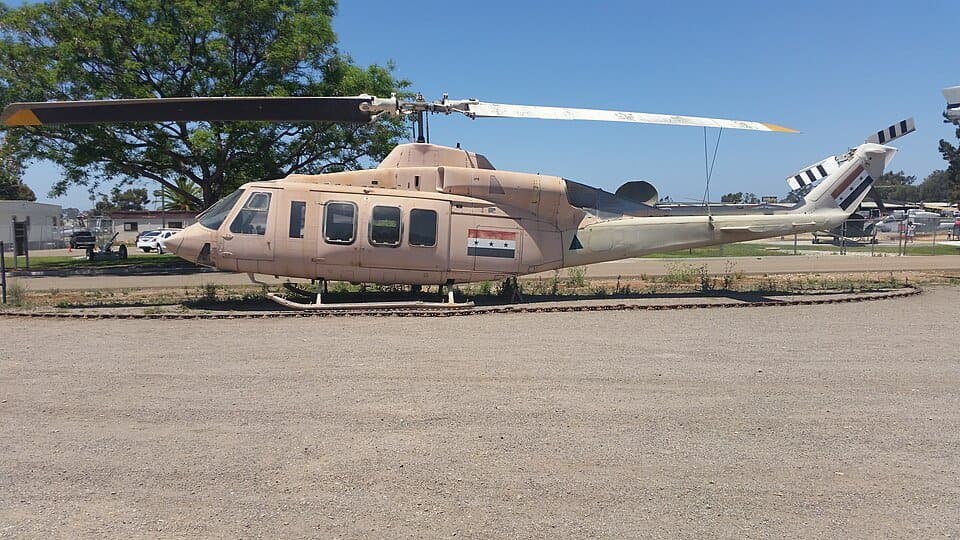
| Primary users | Bristow Helicopters Gulf Helicopters[source] | Peruvian Air Force Royal Brunei Air Force Royal Thai Navy Iraqi Air Force (historical)[source] |
|---|
| Number built | 70+[source] | 96[source] |
|---|
| Manufactured | 2011–present[source] | 1979–1993[source] |
|---|
| Introduction date | February 2014[source] | 1982[source] |
|---|
| First flight | 21 December 2011[source] | 21 July 1979[source] |
|---|
| Developed from | AgustaWestland AW149[source] | Bell 214[source] |
|---|
| Capacity | Up to 19 passengers[source] | Internal: 16 or 17 passengers or equivalent cargo; External: 8,000 lb (3,630 kg) sling load[source] |
|---|
| Fuel capacity | 2,063 litres (2,569 L with belly tank)[source] | — |
|---|
| Role | twin-engined, super-medium-lift helicopter[source] | medium-lift, twin-engine helicopter descended[source] |
|---|
| Source measurement | On 20 June 2011, development of the eight-tonne twin-engine AW189 was formally announced by AgustaWestland at the Paris International Air Show ; at the time, the company planned to have the new rotorcraft certified by 2013 and in service in 2014. The AW189 is a civil-orientated version of the military AW149 , which in turn is an enlarged development of the AW139 ; in 2011, AgustaWestland CEO Bruno Spagnolini stated that: "The AW139 and the AW189 are two very different aircraft but they both share the same general concept in architecture". AgustaWestland stated it aimed to sell the AW189 for offshore helicopter support, search and rescue (SAR), and passenger transport roles.[source]AgustaWestland AW189 · Development; only the objects and conditions stated in this passage In October 2017, Leonardo announced the development of the AW189K variant, powered by two 2500 hp Aneto-1K turboshafts produced by Safran Helicopter Engines . EASA certification for the AW189K was initially expected in late 2018 this was eventually achieved in June 2020; hot and high operations would benefit from the additional 500shp (370 kW) per engine and the Aneto's specific fuel consumption was planned to be 10% lower than the replaced CT7s . Gulf Helicopters was the launch customer of the AW189K.[source]AgustaWestland AW189 · Development; only the objects and conditions stated in this passage Of particular importance to the type's use for offshore operations, such as search and rescue and services to the oil and gas industries, the main gearbox has been designed to provide for a 50-minute run-dry capacity, in excess of requirements and a unique feature to the AW189.[source]AgustaWestland AW189 · Design; only the objects and conditions stated in this passage Dependent on the configuration, the AW189's cabin can accommodate up to 19 passengers and two crew members on crashworthy seats.[source]AgustaWestland AW189 · Design; only the objects and conditions stated in this passage CHC Helicopter (2 in service) With CHC Helicopter in Karratha, Western Australia[source]AgustaWestland AW189 · Operators / Civilian; only the objects and conditions stated in this passage Indonesian National Police (2 in service. One of them was used as a presidential helicopter starting in May 2025)[source]AgustaWestland AW189 · Operators / Civilian; only the objects and conditions stated in this passage Bristow Helicopters (Irish Coast Guard) (6 in service)[source]AgustaWestland AW189 · Operators / Civilian; only the objects and conditions stated in this passage CHC Helicopter (CHC Helikopter Service)(2 in service, 1 on order)[source]AgustaWestland AW189 · Operators / Civilian; only the objects and conditions stated in this passage Royal Thai Police (4 in service)[source]AgustaWestland AW189 · Operators / Civilian; only the objects and conditions stated in this passage Bristow Group (HM Coastguard) (11 in service)[source]AgustaWestland AW189 · Operators / Civilian; only the objects and conditions stated in this passage Capacity: Up to 19 passengers[source]AgustaWestland AW189 · Specifications (AW189); only the objects and conditions stated in this passage Length: 17.60 m (57 ft 9 in)[source]AgustaWestland AW189 · Specifications (AW189); only the objects and conditions stated in this passage Height: 5.06 m (16 ft 7 in)[source]AgustaWestland AW189 · Specifications (AW189); only the objects and conditions stated in this passage Wing area: 53.3 m 2 (574 sq ft)[source]AgustaWestland AW189 · Specifications (AW189); only the objects and conditions stated in this passage Gross weight: 8,300 kg (18,300 lb)[source]AgustaWestland AW189 · Specifications (AW189); only the objects and conditions stated in this passage Fuel capacity: 2,063 litres (2,569 L with belly tank)[source]AgustaWestland AW189 · Specifications (AW189); only the objects and conditions stated in this passage Powerplant: 2 × General Electric CT7-2E1 turboshaft engine , 1,492 kW (2,000 hp) each[source]AgustaWestland AW189 · Specifications (AW189); only the objects and conditions stated in this passage Main rotor diameter: 14.60 m (47 ft 11 in)[source]AgustaWestland AW189 · Specifications (AW189); only the objects and conditions stated in this passage Maximum speed: 313 km/h (194 mph, 169 kn)[source]AgustaWestland AW189 · Specifications (AW189); only the objects and conditions stated in this passage Cruise speed: 267–278 km/h (166–173 mph, 144–150 kn)[source]AgustaWestland AW189 · Specifications (AW189); only the objects and conditions stated in this passage Range: 370–907 km (230–490 mi, 200–430 nmi)[source]AgustaWestland AW189 · Specifications (AW189); only the objects and conditions stated in this passage Service ceiling: 3,000 m (10,000 ft)[source]AgustaWestland AW189 · Specifications (AW189); only the objects and conditions stated in this passage | The Bell 214ST was originally developed during the 1970s and early 1980s as a military project from the Bell 214B BigLifter, specifically for production in Iran and the development by Bell was funded by the Iranian government. The fundamental difference was the replacement of the Model 214's single Lycoming LTC-4 turboshaft engine with two 1,625 shp (1,212 kW) General Electric T700 engines, to improve the helicopter's hot and high performance and improve safety. An interim twin-engine conversion of a Model 214 flew on 15 February 1977 in Texas , Testing was successful, and Bell decided to press forward with a definitive twin-engine Bell 214ST, with a fuselage stretched by 30 in (76 cm) and a revised main rotor of greater diameter. Iran changed its production plans, with 50 Bell 214A and 350 Bell 214STs to be built at the new production plant to be set up at Isfahan , Iran.[source]Bell 214ST · Design and development; only the objects and conditions stated in this passage The Bell 214ST included major design changes from the Bell 214. The Bell 214ST has a larger, stretched fuselage with seating for 16-18 passengers, and two 1,625 shp (1,212 kW) GE CT7-2A engines. The helicopter introduced some ground-breaking innovations for Bell, including a one-hour run-dry transmission, fiberglass rotor blades, elastomeric rotorhead bearings, and the option of either skid or wheeled landing gear. The helicopter has a cockpit door and a large cabin door on each side. The 214ST has a fuel capacity of 435 US gallons (1,650 L). An auxiliary fuel system could be added.[source]Bell 214ST · Design and development; only the objects and conditions stated in this passage Capacity: Internal: 16 or 17 passengers or equivalent cargo; External: 8,000 lb (3,630 kg) sling load[source]Bell 214ST · Specifications (214ST); only the objects and conditions stated in this passage Length: 49 ft 4 in (15.03 m)[source] |
|---|
| Propulsion | 2 x General Electric CT7-2E1 Turboshafts with FADEC[source] | — |
|---|
15,85 m 52 ft 0 in[source]Bell 214ST · main rotor diameter only; not tail rotor and not unrelated Bell214 BigLifter
Wingspan: 52 ft 0 in (15.85 m)[source]Bell 214ST · Specifications (214ST); only the objects and conditions stated in this passage
Height: 15 ft 11 in (4.84 m)[source]Bell 214ST · Specifications (214ST); only the objects and conditions stated in this passage
Wing area: 2,124 sq ft (107.3 m 2 )[source]Bell 214ST · Specifications (214ST); only the objects and conditions stated in this passage
Empty weight: 9,481 lb (4,300 kg)[source]Bell 214ST · Specifications (214ST); only the objects and conditions stated in this passage
Max takeoff weight: 17,500 lb (7,938 kg)[source]Bell 214ST · Specifications (214ST); only the objects and conditions stated in this passage
Powerplant: 2 × General Electric CT7-2A turboshaft , 1,625 shp (1,215 kW) each[source]Bell 214ST · Specifications (214ST); only the objects and conditions stated in this passage
Maximum speed: 143 kn (165 mph, 264 km/h)[source]Bell 214ST · Specifications (214ST); only the objects and conditions stated in this passage
Cruise speed: 140 kn (161 mph, 259 km/h)[source]Bell 214ST · Specifications (214ST); only the objects and conditions stated in this passage
Range: 435 nmi (500 mi, 858 km)[source]Bell 214ST · Specifications (214ST); only the objects and conditions stated in this passage
Service ceiling: 10,400 ft (3,170 m) ; ceiling for hover in ground effect[source]Bell 214ST · Specifications (214ST); only the objects and conditions stated in this passage
Rate of climb: 1,780 ft/min (9.04 m/s)[source]Bell 214ST · Specifications (214ST); only the objects and conditions stated in this passage