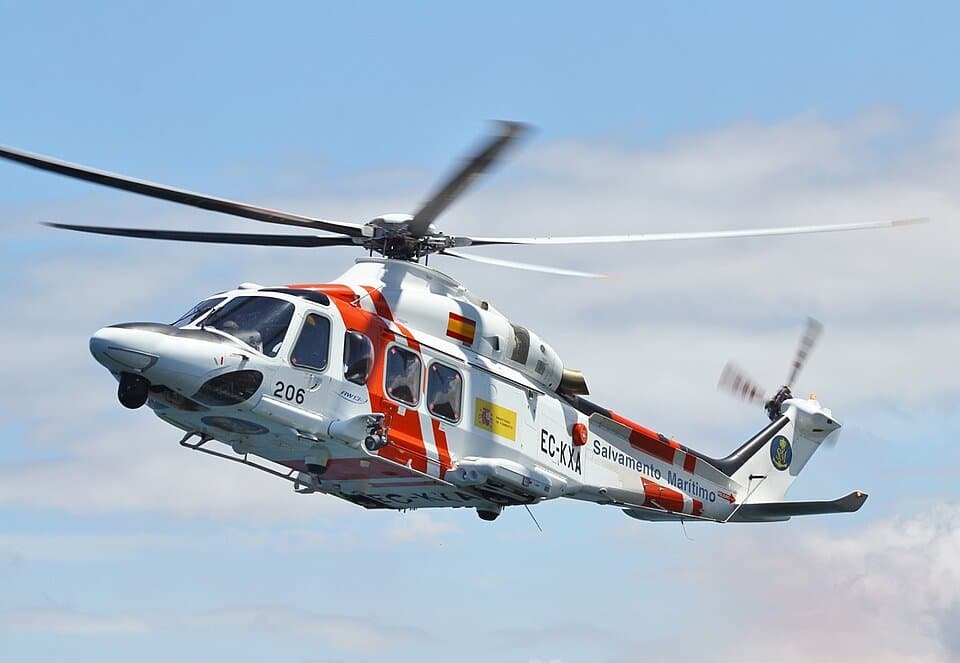


Credit
Contando Estrelas · CC BY-SA 4.0 · Resized · CC BY-SA 4.0 · Source ↗ · Modified


Preparing your view.

At a glance
True scale
Side by side. From every angle. A human reference for perspective.
3.18 MB · Loads when you open it| Model | Length | Width / span | Height |
|---|---|---|---|
| AgustaWestland AW139 | ≈ 15.1 m | ≈ 13.6 m (Width) | ≈ 5.56 m |
| Sikorsky S-70 | ≈ 19.76 m | ≈ 18.33 m (Width) | ≈ 5.76 m |
Scaled uniformly so that the fuselage matches the sourced 13.53 m ab139/aw139 fuselage only; not overall aircraft dimensions including rotors · ab139/aw139 fuselage only; not overall aircraft dimensions including rotors · ab139/aw139 fuselage length. Not an official model or a measured survey.
ForceTally · All rights reserved
Scaled uniformly to the sourced length of 19.76 m. Not an official model or a measured survey.
ForceTally · All rights reserved
The human reference is a generic 1.75 m figure. Models describe external size, not combat performance.
Measured figures
AB139/AW139 fuselage only; not overall aircraft dimensions including rotors · AB139/AW139 fuselage only; not overall aircraft dimensions including rotors · AB139/AW139 fuselage
Single sourceAB139/AW139 Long Nose fuselage only; source-named alternative, not rotor-to-tail overall length · AB139/AW139 Long Nose fuselage only; source-named alternative, not rotor-to-tail overall length · AB139/AW139 Long Nose fuselage · for Long Nose
Configuration
| Specification | AgustaWestland AW139 | Sikorsky S-70 |
|---|---|---|
| Type | Medium-lift SAR / utility helicopter[source] | Medium-lift transport/ utility helicopter[source] |
| National origin | Italy / UK[source] | United States[source] |
| Manufacturer | AgustaWestland Leonardo[source] | Sikorsky Aircraft[source] |
| Status | In production[source] | In service |
AW139 · Length
Single source16.66 m (54 ft 8 in)[source]
13.53 m[source]AB139/AW139 fuselage only; not overall aircraft dimensions including rotors
13.73 m for Long Nose[source]AB139/AW139 Long Nose fuselage only; source-named alternative, not rotor-to-tail overall length
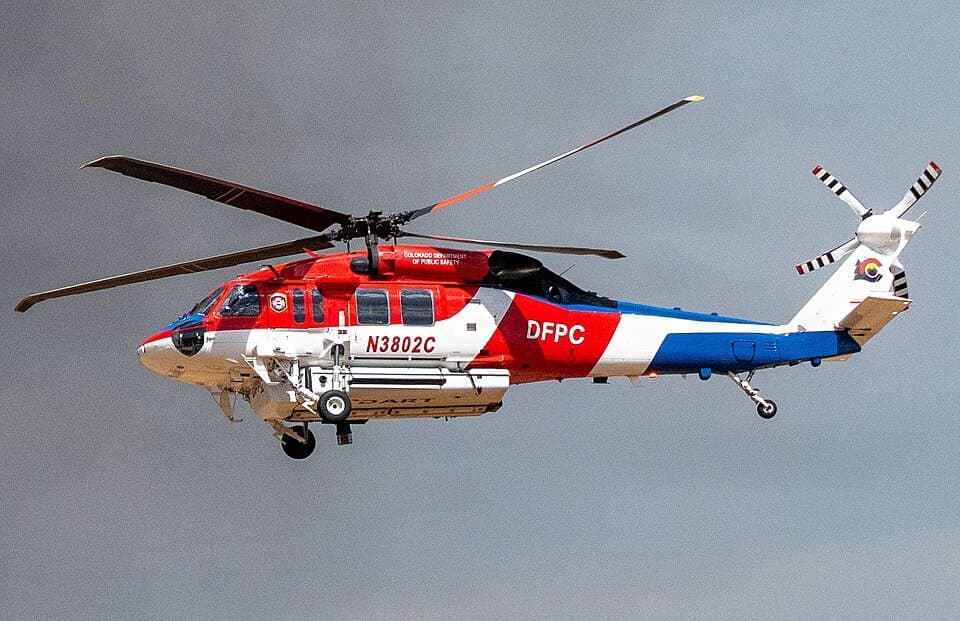
S-70i · from forward tip main rotor to rear tip tail rotor
Single source64 ft 10 in (19.76 m) from forward tip main rotor to rear tip tail rotor[source]
AB139/AW139 fuselage only; not overall aircraft dimensions including rotors · AB139/AW139 fuselage only; not overall aircraft dimensions including rotors · AB139/AW139 fuselage
Single sourceAW139 · Height
Single source4.98 m (16 ft 4 in)[source]
3.72 m[source]AB139/AW139 fuselage only; not overall aircraft dimensions including rotors
S-70i · Height
Single source17 ft 6 in (5.33 m)[source]
Gross; AW139 · for
Single sourceGross; AW139 · Gross weight
Single sourceGross; AW139 · version
Single sourceMaximum take-off; AB139/AW139 · standard maximum take-off mass; higher MTOM requires the specific Note 6 kit and RFM supplement · AB139/AW139 · standard maximum take-off mass; higher MTOM requires the specific Note 6 kit and RFM supplement · AB139/AW139 · see Note 6
Single source6,400 kg (14,110 lb) (7,000 kg (15,000 lb) for 7 t version)[source]
6 400 kg (see Note 6)[source]AB139/AW139 · standard maximum take-off mass; higher MTOM requires the specific Note 6 kit and RFM supplement
MTOM up to 6 800 kg[source]AB139/AW139 only when kit P/N 4G0000F0011 is installed per RFM139G0290X002 Supplement 50; source-stated MTOM upper limit
MTOM up to 7 000 kg[source]AB139/AW139 only when kit P/N 4G0000F00311 is installed per RFM139G0290X002 Supplement 90; source-stated MTOM upper limit
Empty; S-70i · Empty weight
Single sourceGross; S-70i · Gross weight
Single sourceAW139 · 2 × Pratt & Whitney Canada PT6C-67C turboshaft engine each
Single source2 × Pratt & Whitney Canada PT6C-67C turboshaft engine , 1,142 kW (1,531 hp) each[source]
S-70i · 2 × General Electric T700-GE-701D turboshaft engines, 1,940 shp ( ) each
Single source2 × General Electric T700-GE-701D turboshaft engines, 1,940 shp (1,450 kW) each[source]
AW139 · Endurance
Single source5 hours 13 minutes[source]
Bars compare reported quantities only. A larger figure does not make a system better; configurations and test conditions differ.
| Primary users | Italian Air Force CHC Helicopter Irish Air Corps United Arab Emirates Air Force[source] | U.S. Customs and Border Protection U.S. Drug Enforcement Administration See Operators section for others[source] |
|---|
| Number built | 1200+ as of July 2024[source] | — |
|---|
| Manufactured | 2001–present[source] | 1970s–present[source] |
|---|
| Introduction date | 2003[source] | 1979[source] |
|---|
| First flight | 3 February 2001 ( 2001-02-03 )[source] | October 1974[source] |
|---|
| Variant | Boeing MH-139 Grey Wolf[source] | — |
|---|
| Developed into | AgustaWestland AW149[source] | Sikorsky S-92[source] |
|---|
| Capacity | up to 15 passengers, depending on configuration[source] | 11 foldable seats for troops (+12th seat quick install option) / 6 stretchers / 9,000 lb (4,082 kg) external slung load[source] |
|---|
| Fuel capacity | 1,568 L (414 US gal)[source] | 360 US gal (300 imp gal; 1,363 L)[source] |
|---|
| Role | 15-seat medium-sized twin-engined helicopter[source] | — |
|---|
| Source measurement | In April 2008, AgustaWestland revealed that it was in the process of certifying an increase in the AW139's max gross weight to 14,991 lb (6,800 kg), to better compete in long-range markets served by helicopters such as the larger Sikorsky S-92 and Eurocopter EC225 . In 2007, a second production line at the United States AgustaWestland Aerospace plant in Philadelphia , Pennsylvania was established. The Philadelphia plant produced its 200th AW139 in September 2014, at which point U.S. production was intended to reach 40 units per year in the near future. By 2011, AgustaWestland was producing 90 AW139s per year. 9.5% of the company's overall revenue in 2010 was attributed to the type. By 2013, a combined total of 720 AW139s had been sold to over 200 operators in 60 countries.[source]AgustaWestland AW139 · Development / Origins; only the objects and conditions stated in this passage During 2015, AgustaWestland unveiled an AW139 model with an increased gross weight of seven tonnes , enabling a range of 305 km while carrying 12 passengers. Existing AW139s can be rebuilt to the newer heavy-weight model. This heavier airframe comes at the expense of decreased hot and high performance. In November 2015, AgustaWestland demonstrated a 60-minute "run-dry" test (no oil) of an AW139's main gearbox, 30 minutes greater than any other certified rotorcraft at the time.[source]AgustaWestland AW139 · Development / Further development; only the objects and conditions stated in this passage The AW139 is a conventional twin-engine multi-role helicopter. It has a five-bladed fully articulated main rotor with a titanium hub and composite blades and a four-bladed articulated tail rotor. It is fitted with retractable tricycle landing gear , the two aft wheels retracting into external sponsons which are also used to house emergency equipment. It is flown by a crew of two pilots, with up to 15 passengers accommodated in three rows of five. The AW139 had been aimed at a vacant niche in the market, sitting below larger types such as the Eurocopter AS332 Super Puma and Sikorsky S-92 , and above smaller ones like the Bell 412 and Eurocopter EC155 . Rotor & Wing has described the AW139's flying attitude as 'docile and predictable'.[source]AgustaWestland AW139 · Design; only the objects and conditions stated in this passage The AW139 cockpit is based on the modular Honeywell Primus EPIC avionics system incorporating a four LCD screen glass cockpit . Although an option on early models, most aircraft include a four-axis autopilot, which allows higher levels of automation and safety and enables advanced functions such as auto-hover. This level of automation has allowed certification for single-pilot operations under instrument flight rules conditions (SPIFR), and the cockpit can optionally be modified for compatibility with night vision goggles . The latest version of the Primus EPIC avionics systems includes a synthetic vision system . Pilot training for the type is available via advanced Level D Full Flight Simulators. The AW139 has "the largest cabin in its class", containing up to 15 passengers or four litters and accompanying medics. An additional baggage compartment is used to stow equipment to keep the main cabin clear for use.[source]AgustaWestland AW139 · Design; only the objects and conditions stated in this passage In the North American market, CHC Helicopter was the first operator of the type. In 2012, CHC became the largest operator of the AW139 in the world, at that point operating a fleet of 44 in search and rescue, emergency medical service and offshore transport missions. In 2015, responsibility for the maintenance of CHC's AW139 fleet was reorganized under their maintenance, repair and overhaul services (MRO) division, Heli-One . Early activities have included post-delivery modifications and engine overhauls. Heli-One has endeavoured to expand the scope of its MRO in coordination with Leonardo Helicopters, becoming an authorized component repair center by the company, and become approved to perform main gearbox work in April 2021.[source]AgustaWestland AW139 · Operational history; only the objects and conditions stated in this passage Numerous AW139s have been produced for operators in Russia, mainly via the HeliVert initiative. In September 2014, Exclases Russia ordered three in VIP configurations. During December 2021, it was announced that HeliVert had supplied four AW139s to the Russian state-owned defense conglomerate Rostec . In March 2022, shortly following the Russian invasion of Ukraine , Leonardo Helicopters suspended its business in Russia and restricted the support available to existing operators of the type in the country.[source]AgustaWestland AW139 · Operational history; only the objects and conditions stated in this passage Military variant from Boeing in partnership with Leonardo . It was selected by the United States Air Force to replace its UH-1N fleet. The USAF accepted its first MH-139 in December 2019 and named it "Grey Wolf".[source]AgustaWestland AW139 · Variants; only the objects and conditions stated in this passage On 19 August 2011, a Petrobras operated AW139 crashed in the sea at the Campos Basin in Brazil after taking off from an offshore oil platform, killing all four people on board.[source]AgustaWestland AW139 · Notable accidents; only the objects and conditions stated in this passage On 13 March 2014, Haughey Air AW139 (registration G-LBAL) crashed shortly after takeoff from Gillingham, Norfolk , United Kingdom, killing all four people on board.[source]AgustaWestland AW139 · Notable accidents; only the objects and conditions stated in this passage On 4 July 2019, seven people died when AW139 N32CC crashed off of a small Bahamian island at 2 am. The helicopter was found underwater hours later, about a mile offshore. A billionaire coal baron from Beckley, West Virginia , Chris Cline , his daughter Kameron and five others were onboard headed to Florida due to a medical emergency involving one of the passengers.[source]AgustaWestland AW139 · Notable accidents; only the objects and conditions stated in this passage Capacity: up to 15 passengers, depending on configuration[source]AgustaWestland AW139 · Specifications (AW139); only the objects and conditions stated in this passage Length: 16.66 m (54 ft 8 in)[source]AgustaWestland AW139 · Specifications (AW139); only the objects and conditions stated in this passage Width: 2.26 m (10 ft 0 in)[source]AgustaWestland AW139 · Specifications (AW139); only the objects and conditions stated in this passage Height: 4.98 m (16 ft 4 in)[source]AgustaWestland AW139 · Specifications (AW139); only the objects and conditions stated in this passage Gross weight: 6,400 kg (14,110 lb) (7,000 kg (15,000 lb) for 7 t version)[source]AgustaWestland AW139 · Specifications (AW139); only the objects and conditions stated in this passage Powerplant: 2 × Pratt & Whitney Canada PT6C-67C turboshaft engine , 1,142 kW (1,531 hp) each[source]AgustaWestland AW139 · Specifications (AW139); only the objects and conditions stated in this passage Main rotor diameter: 13.80 m (45 ft 3 in)[source]AgustaWestland AW139 · Specifications (AW139); only the objects and conditions stated in this passage Maximum speed: 310 km/h (193 mph, 167 kn)[source]AgustaWestland AW139 · Specifications (AW139); only the objects and conditions stated in this passage Cruise speed: 306 km/h (191 mph, 165 kn)[source]AgustaWestland AW139 · Specifications (AW139); only the objects and conditions stated in this passage Range: 1,061 km (659 mi, 573 nmi)[source]AgustaWestland AW139 · Specifications (AW139); only the objects and conditions stated in this passage Endurance: 5 hours 13 minutes[source]AgustaWestland AW139 · Specifications (AW139); only the objects and conditions stated in this passage Service ceiling: 6,096 m (20,000 ft)[source]AgustaWestland AW139 · Specifications (AW139); only the objects and conditions stated in this passage Rate of climb: 10.9 m/s (2,140 ft/min)[source]AgustaWestland AW139 · Specifications (AW139); only the objects and conditions stated in this passage | — |
|---|
| Overall length | 16.66 m (54 ft 08 in)[source] | — |
|---|
| Powerplant | two free turbine turboshaft engines[source] | — |
|---|
| Variants | — | Sikorsky UH-60 Black Hawk Sikorsky SH-60 Seahawk Sikorsky HH-60 Pave Hawk Sikorsky MH-60 Jayhawk Mitsubishi H-60[source] |
|---|
| Main rotor area | — | 2,262.33 sq ft (210.177 m 2 )[source] |
|---|
| Blade section | — | - root: SC1095/SC1095R8; tip: Sikorsky SC1095[source] |
|---|
| Specific fuel consumption | — | 0.462 lb/hp/h (0.0781 kg/kW/ks)[source] |
|---|
Maximum take-off; S-70i · or
Single sourceMaximum take-off; S-70i · with external load
Single source