FORCETALLY
Loading the evidence…
Preparing your view.


Preparing your view.


At a glance
Measured figures
AW119Kx · Length
Single source12.92 m (42 ft 5 in)[source]
206B Jetranger II · including rotors
Configuration
| Specification | AgustaWestland AW119 Koala | Bell 206 |
|---|---|---|
| Type | Utility helicopter[source] | Multipurpose utility helicopter[source] |
| Manufacturer | Leonardo , previously Finmeccanica, AgustaWestland , Agusta[source] | Bell Helicopter[source] |
| Status | In production[source] | In service[source] |
| Primary users | State of Mexico Government Finnish Border Guard Portuguese Air Force United States Navy[source] |
38 ft 9.5 in (11.824 m) including rotors[source]
Empty; AW119Kx · Empty weight
Single sourceMaximum take-off; AW119Kx · Max takeoff weight
Single source1,483 kg (3,269 lb)[source]
2,850 kg (6,283 lb)[source]
Empty; 206B Jetranger II · Empty weight
Single sourceMaximum take-off; 206B Jetranger II · Max takeoff weight
Single sourceCruise; AW119Kx · Cruise speed
Single source244 km/h (152 mph, 132 kn)[source]
AW119Kx · 1 × Pratt & Whitney Canada PT6 B-37A turboshaft engine 917shp
Single source1 × Pratt & Whitney Canada PT6 B-37A turboshaft engine, 747 kW (1,002 hp) 917shp[source]
206B Jetranger II · 1 × Allison 250-C20 turboshaft engine
Single source1 × Allison 250-C20 turboshaft engine, 400 hp (298 kW)[source]
AW119Kx · Endurance
Single source5 h 20 min[source]
Bars compare reported quantities only. A larger figure does not make a system better; configurations and test conditions differ.
| — |
| Number built | ~300 (2018)[source] | 7,300[source] |
|---|
| Manufactured | 2000–present[source] | 1962–2017[source] |
|---|
| Introduction date | 2000[source] | 1967[source] |
|---|
| First flight | February 1995[source] | December 8, 1962 (206) January 10, 1966 (206A)[source] |
|---|
| Developed from | AgustaWestland AW109[source] | Bell YOH-4[source] |
|---|
| Capacity | 6-7 passengers or 1,400 kg (3,086 lb) sling load[source] Crew 1-2 Passengers Up to 6[source] | 4 passengers[source] |
|---|
| Fuel capacity | 3-cell fuel system 605 L (160 US gal) 4-cell fuel system 711 L (188 US gal) 5-cell fuel system 870 L (230 US gal)[source] | — |
|---|
| Main rotor area | 92.1 m 2 (991 sq ft)[source] | 873 sq ft (81.1 m 2 )[source] |
|---|
| Never exceed speed | 282 km/h (175 mph, 152 kn)[source] | — |
|---|
| Role | eight-seat utility helicopter powered[source] | family of two-bladed, single- and twin-engined helicopters ,[source] |
|---|
| Source measurement | During March 2012, Indian Rotorcraft broke ground on a 40,000m 2 new facility adjacent to Rajiv Gandhi International Airport , Hyderabad , India; The first helicopters to be manufactured by the joint venture is slated to be the AgustaWestland AW119 Ke; other types, such as the AgustaWestland AW101 , are likely to follow in the future.[source]AgustaWestland AW119 Koala · Development; only the objects and conditions stated in this passage The AW119 employs a four-bladed fully articulated main rotor; the composite rotor blades are designed to produce maximum lift with minimum noise, and feature tip caps to reduce noise and elastomeric bearings with no lubrication requirements. Aluminium honeycomb structural panels are used throughout the airframe, which absorb both noise and vibration, thus requiring no additional vibration absorption systems to be employed. The PT6B-37A powerplant of the AW119, located in the same area as the AW109's engines, is capable of providing high power margins along with generous speeds and endurance. According to AgustaWestland, the AW119 retains the system redundancy of dual engine helicopters, such as the hydraulics and the dual independent stability augmentation systems. The gearbox has a 30-minute dry run capability.[source]AgustaWestland AW119 Koala · Design; only the objects and conditions stated in this passage The AW119 Koala has been used for various roles, including utility, emergency medical services (EMS), offshore, law enforcement , and executive transport. A key selling point of the type is its wide-body fuselage, which allows for up to seven passengers to be seated in a three-abreast configuration in the cabin; for the EMS mission, up to two stretchers along with medical attendants and full emergency medical equipment suite can be accommodated, whereas most similar-sized helicopters can only carry one. The unobstructed cabin area and separate baggage compartment can be rapidly reconfigured to suit a range of different missions and roles. Several different cabin interiors may be adopted to accommodate different missions and operations, such as executive/VIP, EMS, and utility options; the cockpit can also be isolated from the cabin. The AW119 has been promoted as possessing the largest cabin in its class; the reported cabin volume is approximately 30% greater than other rotorcraft in its class.[source]AgustaWestland AW119 Koala · Design; only the objects and conditions stated in this passage A wide range of avionics have been integrated upon the AW119, which are typically housed within the rotorcraft's nose. Initial production models featured conventional flight instruments; the Garmin G1000 glass cockpit is integrated on the newer AW119Kx variant, which is claimed to improve situational awareness, reduce pilot workload, and increase safety. Primary flight and other key information is displayed to the pilots upon two large 10.4 inch multi-function displays in the cockpit; an independently powered stand-by display is also present in case of system failure. Other avionics used include a 3-axis aircraft flight control system (AFCS), Synthetic Vision System (SVS), Highway In The Sky (HITS) depiction, moving map display , radio altimeter , VOR / ILS / GPS / WAAS navigation, Aural Warning Generator, and embedded Helicopter Terrain Avoidance Warning System (HTAWS).[source]AgustaWestland AW119 Koala · Design; only the objects and conditions stated in this passage A variety of equipment can be equipped, dependent on operator choice and role; these include an external hoist, dual cargo hook , dual flight controls , baggage compartment extension, snow skis, windshield wipers, rotor brake, multi-band radios , active noise reduction headsets, soundproofing , oxygen systems, loud speakers , search lights, retractable landing light, emergency floatation equipment, reinforced windshield, wire strike protection system , rappelling kit, fire fighting belly tank, and a forward looking infrared (FLIR) camera. Three fuel tanks, located behind the rear seats in the cabin, are installed as standard; up to two additional optional tanks can be fitted for a total of five, providing a flight endurance of nearly six hours.[source]AgustaWestland AW119 Koala · Design; only the objects and conditions stated in this passage The TH-119 was selected as the successor of the TH-57 in January 2020, receiving the US military designation TH-73A. The US Navy expects up to 130 units to be acquired, with 32 ordered in January and an additional 36 in November 2020. In August 2021, the TH-73 was named "Thrasher" for the brown thrasher , a bird common in the southeast US; the first example of the type was delivered on August 6.[source]AgustaWestland AW119 Koala · Operational history; only the objects and conditions stated in this passage A119 - designation for the original production version; maximum take-off weight: 2,720 kg (5,997 lb). AW119 - designation for the A119 following the merger of Agusta and Westland Helicopters .[source]AgustaWestland AW119 Koala · Variants; only the objects and conditions stated in this passage AW119 MkII - improved version, featuring redesigned rotors, greater payload, and better fuel efficiency; maximum take-off weight: 2,850 kg (6,283 lb). AW119 Ke - marketing designation for the AW119 MkII (Koala Enhanced). AW119 Kx - successor to the Ke model with Garmin G1000H avionic suite, produced in Philadelphia , USA and Hyderabad , India. TH-73A Thrasher - military training variant for the US Navy[source]AgustaWestland AW119 Koala · Variants; only the objects and conditions stated in this passage Bangladesh Air Force - 2 in service as of 2019, operated by the 18th Squadron Rotary Training wing .[source]AgustaWestland AW119 Koala · Operators; only the objects and conditions stated in this passage Finnish Border Guard - 4 in operation.[source]AgustaWestland AW119 Koala · Operators; only the objects and conditions stated in this passage State Border Guard - 2 in operation[source]AgustaWestland AW119 Koala · Operators; only the objects and conditions stated in this passage Turkish Land Forces - 2 in service.(13 on order)[source]AgustaWestland AW119 Koala · Operators; only the objects and conditions stated in this passage Capacity: 6-7 passengers or 1,400 kg (3,086 lb) sling load[source]AgustaWestland AW119 Koala · Specifications (AW119Kx); only the objects and conditions stated in this passage Length: 12.92 m (42 ft 5 in)[source]AgustaWestland AW119 Koala · Specifications (AW119Kx); only the objects and conditions stated in this passage Height: 3.60 m (11 ft 10 in)[source]AgustaWestland AW119 Koala · Specifications (AW119Kx); only the objects and conditions stated in this passage Empty weight: 1,483 kg (3,269 lb)[source]AgustaWestland AW119 Koala · Specifications (AW119Kx); only the objects and conditions stated in this passage Max takeoff weight: 2,850 kg (6,283 lb)[source]AgustaWestland AW119 Koala · Specifications (AW119Kx); only the objects and conditions stated in this passage Powerplant: 1 × Pratt & Whitney Canada PT6 B-37A turboshaft engine, 747 kW (1,002 hp) 917shp[source]AgustaWestland AW119 Koala · Specifications (AW119Kx); only the objects and conditions stated in this passage Main rotor diameter: 10.83 m (35 ft 6 in)[source]AgustaWestland AW119 Koala · Specifications (AW119Kx); only the objects and conditions stated in this passage Main rotor area: 92.1 m 2 (991 sq ft)[source]AgustaWestland AW119 Koala · Specifications (AW119Kx); only the objects and conditions stated in this passage Cruise speed: 244 km/h (152 mph, 132 kn)[source]AgustaWestland AW119 Koala · Specifications (AW119Kx); only the objects and conditions stated in this passage Never exceed speed : 282 km/h (175 mph, 152 kn)[source]AgustaWestland AW119 Koala · Specifications (AW119Kx); only the objects and conditions stated in this passage Range: 954 km (593 mi, 515 nmi)[source]AgustaWestland AW119 Koala · Specifications (AW119Kx); only the objects and conditions stated in this passage Endurance: 5 h 20 min[source]AgustaWestland AW119 Koala · Specifications (AW119Kx); only the objects and conditions stated in this passage Service ceiling: 4,572 m (15,000 ft)[source]AgustaWestland AW119 Koala · Specifications (AW119Kx); only the objects and conditions stated in this passage Rate of climb: 9.1 m/s (1,790 ft/min)[source]AgustaWestland AW119 Koala · Specifications (AW119Kx); only the objects and conditions stated in this passage | When the YOH-4A was eliminated by the Army, Bell went about marketing the aircraft. In addition to the image problem, the helicopter lacked cargo space and only provided cramped seating for three passengers. The solution was a redesigned fuselage, sleeker and aesthetically appealing, adding 16 ft 3 (0.45 m 3 ) of cargo space in the process. A Bell executive contributed to the redesign by drawing two lines on a sketch extending the fuselage to where it meets the tail. The redesign was designated Bell 206A, and Bell President Edwin J. Ducayet named it the JetRanger , denoting an evolution from the popular Model 47J Ranger .[source]Bell 206 · Development / JetRanger; only the objects and conditions stated in this passage The 206L LongRanger is a stretched variant with seating for seven. The fuselage, stretched a total of 30 inches (760 mm), adds two rear-facing seats between the front and rear seats. Since 1975, Bell has produced more than 1,700 LongRangers across all variants. In 1981, a military version, the 206L TexasRanger was released. The original 206L used an Allison 250 -C20R engine, and a series of model upgrades replaced this engine with more powerful versions; the 206L-1 used a 250-C28, and the 206L-3 and 206L-4 used the 250-C30P.[source]Bell 206 · Development / LongRanger; only the objects and conditions stated in this passage In both applications, the 250-C30P is derated from 650 hp for takeoff and 501 hp continuous. The 206L-3 is transmission-limited to 435 hp for take-off, and the 206L-4 is transmission-limited to 495 hp. The derating of the C30P produces an advantage in hot-day and high-altitude operations, as it can produce the rated horsepower at higher altitudes and temperatures where applications that use the maximum rating of the engine at sea level suffer accelerated performance deterioration with increases in temperature and altitude. The 206L-3 and L-4 have not been offered in a twin configuration under those model designations.[source]Bell 206 · Development / LongRanger; only the objects and conditions stated in this passage In 2007, Bell announced an upgrade program for the 206L-1 and 206L-3 designed to modify the aircraft to the 206L-4 configuration; modified aircraft are designated 206L-1+ and 206L-3+. Modifications include strengthened structural components (including a new tailboom), improved transmission, upgraded engine for the L-1, all of which result in a maximum gross weight increase of 300 pounds and increased performance. |
|---|
| Powerplant | 1 x Pratt & Whitney Canada PT6B-37A[source] | — |
|---|
| Country of origin | Italien[source]Country of design · Entwurfsland Italy[source]Inventory Origin column; table 1, row 23, cell 2; revision 1377799947; retrieved 2026-10-02 Italy[source]Inventory Origin column; table 2, row 32, cell 2; revision 1377680590; retrieved 2026-10-02 | — |
|---|
| National origin | — | United States / Canada[source] |
|---|
| Variants | — | Bell OH-58 Kiowa Bell 407[source] |
|---|
| Developed into | — | Bell 400 TwinRanger[source] |
|---|
| Fuselage length | — | 31 ft 2 in (9.50 m)[source] |
|---|
| Interior dimensions | — | 7 ft 2 in (2.18 m) length, by 4 ft 2 in (1.27 m) width, by 4 ft 3 in (1.30 m) height, plus 16 ft 3 (453 L) baggage compartment[source] |
|---|
| Blade section | — | – NACA 0012 mod (11.3%)[source] |
|---|
| Maximum speed at 5,000 ft | — | 116 kn (133 mph; 215 km/h) at MTOW[source] |
|---|
| Disk loading | — | 4 lb/sq ft (20 kg/m 2 )[source] |
|---|
| Power/mass | — | 0.09 hp/lb (0.15 kW/kg)[source] |
|---|
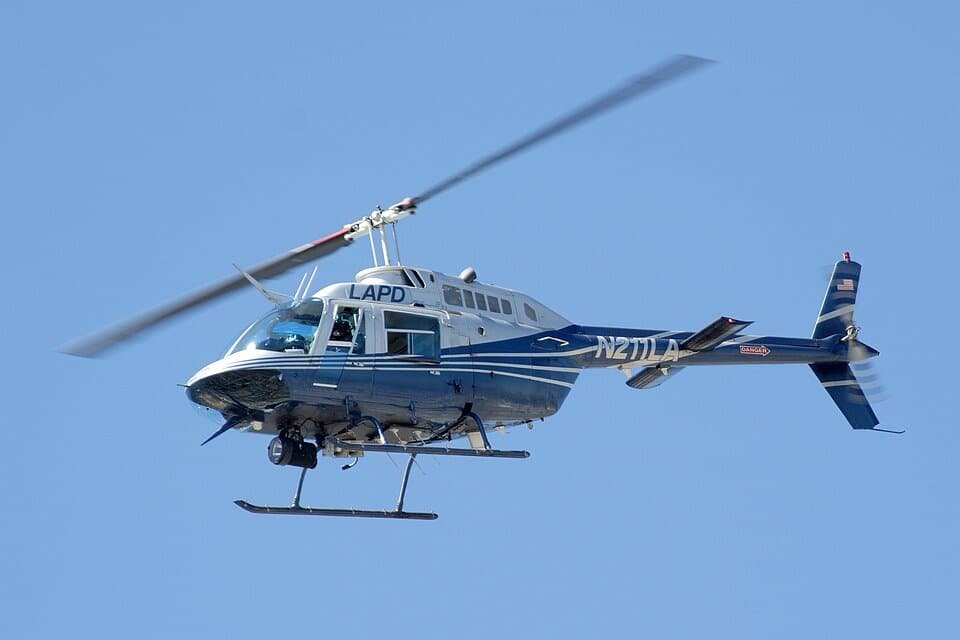
The basic shape and design of the JetRanger remained unchanged since 1967, but Bell introduced the 206B JetRanger II in 1971. In 1977, the 206B-3 JetRanger III was introduced with its modified tail rotor and more powerful engine. The JetRanger is popular with news media for traffic and news reporting. The LongRanger is commonly used as an air ambulance and as a corporate transport. On September 1, 1982, pilots H. Ross Perot, Jr. and Jay Coburn departed Dallas, Texas in the " Spirit of Texas ", a Bell 206L-1 (N3911Z). They returned on 30 September, 29 days and 3 hours later, completing the first around-the-world helicopter flight.[source]Bell 206 · Operational history; only the objects and conditions stated in this passage
On July 22, 1994, Ron Bower landed his 206B-3 (N206AJ) at Hurst, Texas , setting a new record for around-the-world flight by a helicopter. Bower had departed on June 24 and returned 24 days, 4 hours, 36 minutes and 24 seconds later, averaging 35.62 knots (40.99 mph; 65.97 km/h). Bower had added a 91-US-gallon (340 L) auxiliary fuel tank, which doubled the JetRanger III's range.[source]Bell 206 · Operational history; only the objects and conditions stated in this passage
Upgraded Allison 250-C20J engine and added 2 inches (51 mm) to tail rotor diameter for yaw control.[source]Bell 206 · Variants / Civilian; only the objects and conditions stated in this passage
137 commercial Bell 206B-3s purchased in 1993 as the primary and instrument helicopter trainer for the US Army at Fort Rucker , Alabama. 35 in VFR configuration and 102 in IFR configuration. The US Army has 181 units as of 2026, of which 121 are in VFR configuration and 60 are in IFR configuration. All TH-67s display US registrations ("N" numbers) and are operated as public use aircraft.[source]Bell 206 · Variants / Military; only the objects and conditions stated in this passage
Capacity: 4 passengers[source]Bell 206 · Specifications (206B Jetranger II); only the objects and conditions stated in this passage
Length: 38 ft 9.5 in (11.824 m) including rotors[source]Bell 206 · Specifications (206B Jetranger II); only the objects and conditions stated in this passage
Fuselage length: 31 ft 2 in (9.50 m)[source]Bell 206 · Specifications (206B Jetranger II); only the objects and conditions stated in this passage
Height: 9 ft 6.5 in (2.908 m)[source]Bell 206 · Specifications (206B Jetranger II); only the objects and conditions stated in this passage
Interior dimensions: 7 ft 2 in (2.18 m) length, by 4 ft 2 in (1.27 m) width, by 4 ft 3 in (1.30 m) height, plus 16 ft 3 (453 L) baggage compartment[source]Bell 206 · Specifications (206B Jetranger II); only the objects and conditions stated in this passage
Empty weight: 1,455 lb (660 kg)[source]Bell 206 · Specifications (206B Jetranger II); only the objects and conditions stated in this passage
Max takeoff weight: 3,200 lb (1,451 kg)[source]Bell 206 · Specifications (206B Jetranger II); only the objects and conditions stated in this passage
Powerplant: 1 × Allison 250-C20 turboshaft engine, 400 hp (298 kW)[source]Bell 206 · Specifications (206B Jetranger II); only the objects and conditions stated in this passage
Main rotor diameter: 33 ft 4 in (10.16 m)[source]Bell 206 · Specifications (206B Jetranger II); only the objects and conditions stated in this passage
Main rotor area: 873 sq ft (81.1 m 2 )[source]Bell 206 · Specifications (206B Jetranger II); only the objects and conditions stated in this passage
Maximum speed: 122 kn (140 mph, 226 km/h) at MTOW (sea level)[source]Bell 206 · Specifications (206B Jetranger II); only the objects and conditions stated in this passage
Maximum speed at 5,000 ft: 116 kn (133 mph; 215 km/h) at MTOW[source]Bell 206 · Specifications (206B Jetranger II); only the objects and conditions stated in this passage
Cruise speed: 120 kn (140 mph, 220 km/h) at MTOW, 5,000 feet[source]Bell 206 · Specifications (206B Jetranger II); only the objects and conditions stated in this passage
Range: 337 nmi (388 mi, 624 km) at MTOW, 5,000 feet, cruise speed, no reserves[source]Bell 206 · Specifications (206B Jetranger II); only the objects and conditions stated in this passage
Service ceiling: 20,000 ft (6,100 m) at MTOW[source]Bell 206 · Specifications (206B Jetranger II); only the objects and conditions stated in this passage
Rate of climb: 1,350 ft/min (6.9 m/s)[source]Bell 206 · Specifications (206B Jetranger II); only the objects and conditions stated in this passage