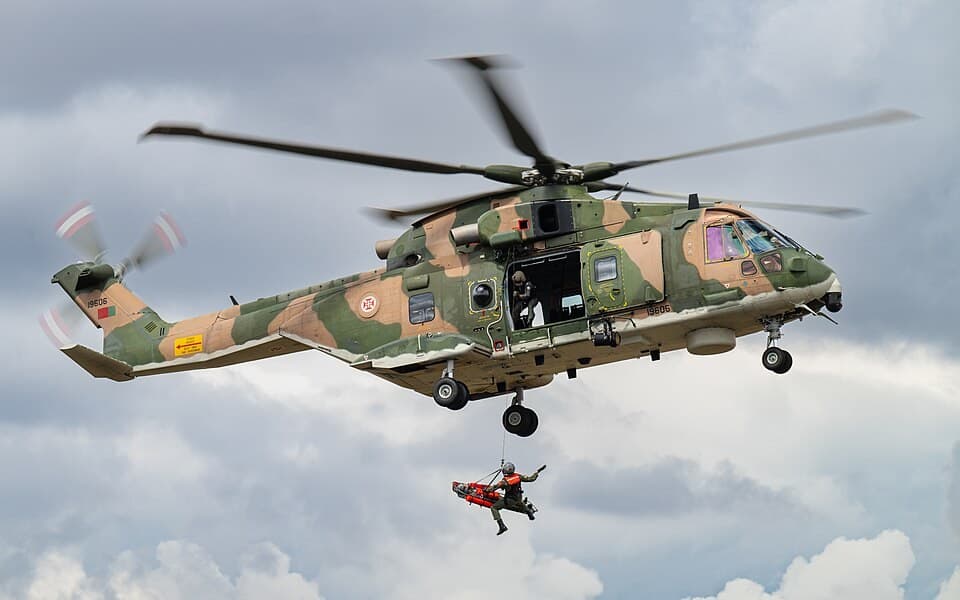


AHelicopters
AgustaWestland AW101
Anti-submarine warfare , medium-lift transport , search and rescue and utility helicopter


Preparing your view.
AHelicopters
Anti-submarine warfare , medium-lift transport , search and rescue and utility helicopter
At a glance
Measured figures
Merlin HM1 · 3 × Rolls-Royce Turbomeca RTM322-01 turboshaft engines each (take-off power)
Single source3 × Rolls-Royce Turbomeca RTM322-01 turboshaft engines, 1,566 kW (2,100 hp) each (take-off power)[source]
H225 · 2 × Turbomeca Makila 2A1 turboshaft engines each
Single source2 × Turbomeca Makila 2A1 turboshaft engines, 1,776 kW (2,382 hp) each[source]
Merlin HM1 · Endurance
Single source5 hours[source]
H225 · 1,710 ft/min
Single source8.7 m/s (1,710 ft/min)[source]
Bars compare reported quantities only. A larger figure does not make a system better; configurations and test conditions differ.
Configuration
| Specification | AgustaWestland AW101 | Eurocopter EC225 Super Puma |
|---|---|---|
| Type | Anti-submarine warfare , medium-lift transport , search and rescue and utility helicopter[source] | Passenger transport helicopter[source] |
| National origin | Italy United Kingdom[source] | Multinational[source] |
| Manufacturer | Agusta Westland Helicopters AgustaWestland Finmeccanica Leonardo S.p.A.[source] | Eurocopter Airbus Helicopters[source] |
| Status | In service[source] | — |
| Primary users | Royal Navy Royal Air Force (historical) Polish Navy Royal Norwegian Air Force Italian Navy[source] | — |
| Manufactured | 1990s–present[source] | 1999–present[source] |
| Introduction date | 1999[source] | December 2004[source] |
| First flight | 9 October 1987[source] | 27 November 2000[source] |
| Variants | AgustaWestland CH-149 Cormorant Lockheed Martin VH-71 Kestrel[source] | — |
| Capacity | 26 troops (38 passengers) or 5 tonnes of payload or 4 stretchers (with sonar array removed) for Merlin HM1; 30 seated troops or 45 standing fully equipped combat troops, or 3,050 kg (6,724 lb) of internal payload, 5,520 kg (12,169 lb) of external payload, or 16 stretchers for AW101[source] | 24 passengers + 1 cabin attendant[source] |
| Main rotor area | 271.51 m 2 (2,922.5 sq ft) root: RAE 9651; tip: RAE 9645/RAE 9634[source] | 206.15 m 2 (2,219.0 sq ft)[source] |
| Never exceed speed | 309 km/h (192 mph, 167 kn)[source] | 324 km/h (201 mph, 175 kn)[source] |
| Bombs | 4× Sting Ray homing torpedoes or Mk 11 depth charges[source] | — |
| Role | medium-lift helicopter in military and civil use[source] | long-range passenger transport helicopter[source] |
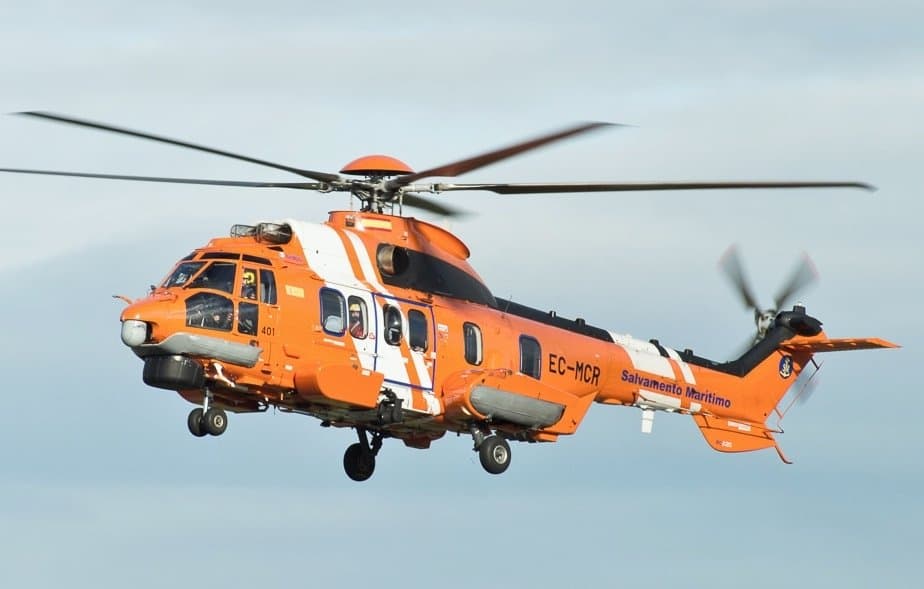
| Source measurement | The AW101 follows a conventional design layout, but makes use of advanced technologies, such as the design of the rotor blades, avionics systems, and extensive use of composite materials. The fuselage structure is modular and comprises an aluminium–lithium alloy , designed to be both light and damage-resistant. The AW101 is designed for operating in extreme weather conditions; it is fitted with a de-icing system and rated to operate in temperatures ranging between −45 and +50 °C. The aircraft's control systems allow the AW101 to maintain a stable hover in 74 km/h (40 kn) crosswinds .[source]AgustaWestland AW101 · Design / Overview; only the objects and conditions stated in this passage An active vibration control system, known as the active control of structural response system , reduces airframe vibration by up to 80%, increasing crew comfort and minimising buildup of stress on the airframe. The cockpit is fitted with armoured seats for the crew, and can withstand an impact velocity of over 10 m/s. Dual flight controls are provided, though the AW101 can be flown by a single person. The pilots' instrument displays include six full-colour high-definition screens and an optional mission display; a digital map or forward looking infrared (FLIR) display can also be installed.[source]AgustaWestland AW101 · Design / Overview; only the objects and conditions stated in this passage The AW101 is powered by three turboshaft engines. Initially the Rolls-Royce Turbomeca RTM322 producing 2,035 to 2,160 shp (1,517 to 1,611 kW) and the General Electric CT7 producing 1,960 to 2,329 shp (1,462 to 1,737 kW) were the two available engine types, but by 2020 new aircraft were only being sold with the CT7-8E. The RTM322 powerplant was specifically developed for the AW101; it was subsequently adopted on the AgustaWestland WAH-64 Apache and the NHIndustries NH90 helicopters. According to Rolls-Royce, about 80% of AW101s use the RTM322[source]AgustaWestland AW101 · Design / Powerplant; only the objects and conditions stated in this passage The engines power an 18.59 m (61 ft 0 in) diameter five-bladed main rotor. The rotor blades are constructed from carbon/glass with nomex honeycomb and rohacell foam, edged with titanium alloy in a sandwich construction . The shaping of the main rotor blades is derived from the BERP rotor blades first used on the Westland Lynx . This blade design improves aerodynamic efficiency at the blade tip and reduces the acoustic signature . Improved BERP IV rotors have since been developed; when installed this increases the AW101's maximum take-off weight.[source]AgustaWestland AW101 · Design / Powerplant; only the objects and conditions stated in this passage The fuselage has a volume of 31.91 cubic metres (1,127 cu ft) and the cargo compartment is 6.5 metres (21 ft) in length, 2.3 metres (7 ft 7 in) wide and 1.91 metres (6 ft 3 in) high. The military version of the AW101 can accommodate up to 24 seated or 45 standing combat troops and their equipment. Alternative loads include a medical team and 16 stretchers, and cargo pallets.[source]AgustaWestland AW101 · Design / Crew and cargo; only the objects and conditions stated in this passage The ramp, 1.91 by 2.3 metres (6 ft 3 in × 7 ft 7 in), can take a 3,050-kilogram (6,720 lb) load, allowing it to carry vehicles such as Land Rovers . The ramp and cabin floor are fitted with flush tie-down points. A cargo hook under the fuselage can carry external loads of 5,440 kilograms (11,990 lb) via the use of a semi-automatic cargo release unit (SACRU). A rescue hoist and a hover trim controller are fitted at the cargo door. An optional cargo winch can be installed near to the rear ramp.[source]AgustaWestland AW101 · Design / Crew and cargo; only the objects and conditions stated in this passage The Merlin HM1 has been cleared to operate from the Royal Navy's aircraft carriers , amphibious assault ships , Type 23 frigates , Type 45 destroyer and several Royal Fleet Auxiliary (RFA) vessels including the Fort Victoria class . 30 aircraft have been upgraded to Merlin HM2 standard under the £750m Merlin Capability Sustainment Programme; Lockheed Martin UK delivered the final HM2 on 11 July 2016.[source]AgustaWestland AW101 · Operational history / Royal Navy; only the objects and conditions stated in this passage The HM2 achieved IOC on 30 June 2014 after flying 480 hours from Illustrious during Exercise Deep Blue earlier that month.[source]AgustaWestland AW101 · Operational history / Royal Navy; only the objects and conditions stated in this passage Six of the Merlins were in the ASW role and three in the AEW role, with the Crowsnest system having formally reached full operating capability.[source]AgustaWestland AW101 · Operational history / Royal Navy; only the objects and conditions stated in this passage In 2012, the RAF's Merlin HC3/3A fleet began to be transferred to the Royal Navy for use by the Commando Helicopter Force. Royal Navy personnel worked alongside RAF crew at Benson to build experience during the transition. The £454m Merlin Life Sustainment Programme resulted in 25 HC3/3A airframes being fitted with the cockpit electronics of the HM2, folding tails and main rotor heads, strengthened landing gear, deck lashing mounting points, obsolescence updates, fast-roping points and a common emergency egress system. The first HC4 began flight trials in September 2017, with an IOC in mid-2018; an interim folding main rotor head will be fitted to some HC3 for shipborne operations prior to the HC4 upgrade.[source]AgustaWestland AW101 · Operational history / Royal Air Force; only the objects and conditions stated in this passage Danish AW101s have a higher gross weight capacity of 15,600 kg and were, as delivered, coated in a paint designed to reduce the aircraft's infrared signature . In the SAR role, RDAF AW101s have a crew of six and were initially painted yellow to distinguish themselves from AW101 allocated to military duties, but were later painted green, and all 14 AW101s are used for SAR and troop transport.[source]AgustaWestland AW101 · Operational history / Royal Danish Air Force; only the objects and conditions stated in this passage The first AW101 was delivered in November 2017. The Norwegian AW101s officially started operating in the rescue role on 1 September 2020. The Sea King was phased out in December 2023, after 47 years of service as rescue helicopter in the Royal Norwegian Air force, and replaced with the AW101. The AW101 is named SAR Queen in Norwegian service, and performed the 486 nmi (900 km) flight from Mainland Bodø to Jan Mayensfield using two engines, and then back, in 2025.[source]AgustaWestland AW101 · Operational history / Royal Norwegian Air Force; only the objects and conditions stated in this passage In 2002, AgustaWestland, Kawasaki and Marubeni entered a general agreement for cooperation; Kawasaki began the assembly of both the CH-101 and the MCH-101 in 2003. Kawasaki also began licensed production of the RTM322 engines in 2005. In a separate agreement between Marubeni and AgustaWestland, a supply depot was established in Japan to support the MCH-101 and CH-101 fleets. The first MCH-101 was delivered to the JMSDF on 3 March 2006.[source]AgustaWestland AW101 · Operational history / Japan Maritime Self-Defense Force; only the objects and conditions stated in this passage The MCH-101 will replace the MH-53E (S-80-M-1) in the AMCM role. The CH-101 will operate in the transport/support role for Antarctic expeditions , replacing the Sikorsky S-61A , and will be working in coordination with the Ministry of Education, Culture, Sports, Science and Technology .[source]AgustaWestland AW101 · Operational history / Japan Maritime Self-Defense Force; only the objects and conditions stated in this passage Length: 19.53 m (64 ft 1 in) fuselage[source]AgustaWestland AW101 · Specifications (Merlin HM1); only the objects and conditions stated in this passage Height: 6.62 m (21 ft 9 in)[source]AgustaWestland AW101 · Specifications (Merlin HM1); only the objects and conditions stated in this passage Empty weight: 10,500 kg (23,149 lb)[source]AgustaWestland AW101 · Specifications (Merlin HM1); only the objects and conditions stated in this passage Max takeoff weight: 15,600 kg (34,392 lb)[source]AgustaWestland AW101 · Specifications (Merlin HM1); only the objects and conditions stated in this passage Powerplant: 3 × Rolls-Royce Turbomeca RTM322-01 turboshaft engines, 1,566 kW (2,100 hp) each (take-off power)[source]AgustaWestland AW101 · Specifications (Merlin HM1); only the objects and conditions stated in this passage Main rotor diameter: 18.59 m (61 ft 0 in)[source]AgustaWestland AW101 · Specifications (Merlin HM1); only the objects and conditions stated in this passage Main rotor area: 271.51 m 2 (2,922.5 sq ft) root: RAE 9651; tip: RAE 9645/RAE 9634[source]AgustaWestland AW101 · Specifications (Merlin HM1); only the objects and conditions stated in this passage Cruise speed: 278 km/h (173 mph, 150 kn)[source]AgustaWestland AW101 · Specifications (Merlin HM1); only the objects and conditions stated in this passage Never exceed speed : 309 km/h (192 mph, 167 kn)[source]AgustaWestland AW101 · Specifications (Merlin HM1); only the objects and conditions stated in this passage Range: 1,389 km (863 mi, 750 nmi)[source]AgustaWestland AW101 · Specifications (Merlin HM1); only the objects and conditions stated in this passage Endurance: 5 hours[source]AgustaWestland AW101 · Specifications (Merlin HM1); only the objects and conditions stated in this passage Service ceiling: 4,575 m (15,010 ft)[source]AgustaWestland AW101 · Specifications (Merlin HM1); only the objects and conditions stated in this passage | The Airbus Helicopters H225 (formerly Eurocopter EC225 Super Puma ) is a long-range passenger transport helicopter developed by Eurocopter as the next generation of the civilian Super Puma family. It is a twin-engined aircraft and can carry up to 24 passengers along with two crew and a cabin attendant, dependent on customer configuration. The helicopter is marketed for offshore support and VIP passenger transport duties, as well as public service missions.[source]Eurocopter EC225 Super Puma · Lead; only the objects and conditions stated in this passage In February 2014, Airbus Helicopters announced at Heli-Expo 2014 the development of an improved variant, the EC225e. The EC225e features numerous changes including new avionics systems, such as the TCAS II collision avoidance system, an automatic identification system, and a specialized rig-approach system; it was also intended to feature an improved Turbomeca Makila 2B engine to increase the EC225e's maximum takeoff weight by 550 kg, and an additional fuel tank in the rear baggage compartment to extend its range to 300 nautical miles with up to ten passengers on board. Some, but not all, modifications can be retrofitted onto existing EC225s. In the same announcement, in February 2014, Lease Corporation International said that they had placed a $645 million order for 15 EC225e (along with 6 Airbus Helicopters EC175 ) helicopters as the launch customer. In February 2016, the Makila 2B engine was dropped from the EC225e as a cost reduction measure, development of the other structural and avionics aspects is proceeding.[source]Eurocopter EC225 Super Puma · Development; only the objects and conditions stated in this passage A key safety feature of the aircraft's main gear box (MGB) is an emergency oil spraying sub-system present in the lubrication system; this is designed to exceed the JAR 29 Standard's requirements of a 30-minute running time in the event of the loss of MGB oil pressure, and has demonstrated up to 50-minute running time. The engine also incorporates a "blade shedding" system to ensure engine integrity during an overspeed instance. Energy absorbent self-sealing fuel tanks are contained in the aircraft's sponsons , along with other equipment such as downward-facing illumination and navigation lighting fixtures. The transmission can accommodate more power than the maximum output of the engines; however two aircraft were lost in 2012 due to the cracking of the bevel gear shaft, a gearbox component. In response, the design of the transmission was modified in 2013, and the onboard health and usage monitoring system (HUMS) was upgraded to provide real-time monitoring of the bevel gear shaft against the threat of crack formation.[source]Eurocopter EC225 Super Puma · Design; only the objects and conditions stated in this passage In terms of cockpit equipment and avionics, the H225 is equipped with a full glass cockpit with active-matrix liquid crystal displays ; these include four 6-inch by 8-inch multi-functional displays as the predominant instrumentation for key flight information, two 4-inch by 5-inch monitors for displaying aircraft parameters, and a 3-inch screen for backup. The advanced helicopter cockpit and avionics system is described as serving to reduce pilot and crew workload, being used to display flight management and sub-systems information and is complete with a four-axis digital autopilot. During a typical flight, the pilot programs the route into the aircraft and then monitors it, as opposed to direct continuous control of the flight; the need for paper charts has been eliminated by these systems. Under autopilot, the automatic flight control system acts to prevent pilot actions from exceeding the established flight envelope; the H225 remains flyable with all automatic systems disabled. From initiating the startup sequence to being ready to takeoff only takes three minutes.[source]Eurocopter EC225 Super Puma · Design; only the objects and conditions stated in this passage There are currently a total of four principal configurations designed by Airbus Helicopters for the H225. The passenger transport version has a crash-worthy seating arrangement for up to 19 passengers with a high-density seating arrangement accommodating up to 28 passengers available to be fitted. The VIP transport version has a large lounge with seating for up to 12 passengers and a cabin attendant. The emergency medical services (EMS) configuration has medical units for six stretchers and four seats for medical workers. The search and rescue (SAR) configuration allows space for search and rescue equipment with an operator seat, hoistman seat and up to eight rescue seats and three stretchers. While a single pilot is capable of controlling the aircraft under visual meteorical conditions, two pilots are used in a typical crew complement and, dependent on role, a cabin attendant or flight engineer may also be present.[source]Eurocopter EC225 Super Puma · Design; only the objects and conditions stated in this passage Icelandic Coast Guard — received 2 H225s in 2019 and 1 in 2021.[source]Eurocopter EC225 Super Puma · Operators / Military operators; only the objects and conditions stated in this passage 18 February 2009: G-REDU, an EC225 LP operated by Bond Offshore Helicopters . During a night visual approach to the ETAP platform, the helicopter descended and impacted the surface of the sea. The crew's perception of the helicopter's position and orientation relative to the platform during the final approach was erroneous. All 18 people on board survived the controlled flight into terrain (water) .[source]Eurocopter EC225 Super Puma · Accidents and incidents; only the objects and conditions stated in this passage 10 May 2012: G-REDW, an EC225 LP, carried out a controlled ditching following indications of a failure of the main gearbox (MGB) lubrication system and a subsequent failure indication warning on the emergency lubrication system. An investigation by the Air Accidents Investigation Branch (AAIB) identified a 360° circumferential crack in the bevel gear vertical shaft in the main gearbox, in the vicinity of a manufacturing weld, causing disengagement of the drive to both mechanical oil pumps.[source]Eurocopter EC225 Super Puma · Accidents and incidents; only the objects and conditions stated in this passage 22 October 2012: G-CHCN, an EC225 LP of CHC Scotia, ditched in the North Sea 32 miles south west of Shetland whilst en route from Aberdeen to the West Phoenix drilling rig. All 19 on board were rescued. A special bulletin issued by the Air Accidents Investigation Branch (AAIB) said the main and standby oil pumps were not working; a 360-degree crack found on the bevel gear vertical shaft of the gearbox had prevented the oil pump gears from being driven. A worldwide grounding of the type was initiated in response. In both of the 2012 incidents, although the main gearbox lubrication system had failed, the backup system was working correctly but displaying an erroneous warning light, due to an incorrect specification of a pressure switch, which led to the helicopters being ditched.[source]Eurocopter EC225 Super Puma · Accidents and incidents; only the objects and conditions stated in this passage 29 April 2016: LN-OJF , an EC225 LP of CHC Helikopter Service , crashed at an islet near Turøy in the Bergen archipelago, en route to Bergen Airport, Flesland , from the Gullfaks B platform in the North Sea. The helicopter was carrying 11 passengers and 2 crew members; everyone on board died. Eyewitnesses reported that the main rotor separated from the hull immediately before the crash. Due to the crash, all commercial flights by EC225 helicopters, excluding search and rescue flights, were grounded by both Norwegian and British civil aviation authorities. The subsequent investigation concluded that a gear in the main rotor gearbox had failed due to a fatigue crack that had propagated under-surface, escaping detection. As a result of the incident the German Defence Ministry had also decided to ground 3 AS532 Helicopter in government use which were manufactured by the same company.[source]Eurocopter EC225 Super Puma · Accidents and incidents; only the objects and conditions stated in this passage 18 January 2023: an EC225 carrying the Minister of Internal Affairs of Ukraine , Denys Monastyrsky , his deputy Yevhen Yenin and state secretary Yurii Lubkovych , crashed at a kindergarten in Brovary , a suburb of Kyiv , Ukraine . The crash killed 14 people, including Monastyrsky, Yenin and Lubkovych; a child was also among the fatalities, while 25 others were injured.[source]Eurocopter EC225 Super Puma · Accidents and incidents; only the objects and conditions stated in this passage Capacity: 24 passengers + 1 cabin attendant[source]Eurocopter EC225 Super Puma · Specifications (H225); only the objects and conditions stated in this passage Length: 19.5 m (64 ft 0 in)[source]Eurocopter EC225 Super Puma · Specifications (H225); only the objects and conditions stated in this passage Height: 4.97 m (16 ft 4 in)[source]Eurocopter EC225 Super Puma · Specifications (H225); only the objects and conditions stated in this passage Empty weight: 5,256 kg (11,587 lb)[source]Eurocopter EC225 Super Puma · Specifications (H225); only the objects and conditions stated in this passage Gross weight: 11,000 kg (24,251 lb)[source]Eurocopter EC225 Super Puma · Specifications (H225); only the objects and conditions stated in this passage Max takeoff weight: 11,200 kg (24,692 lb)[source]Eurocopter EC225 Super Puma · Specifications (H225); only the objects and conditions stated in this passage Powerplant: 2 × Turbomeca Makila 2A1 turboshaft engines, 1,776 kW (2,382 hp) each[source]Eurocopter EC225 Super Puma · Specifications (H225); only the objects and conditions stated in this passage Main rotor diameter: 16.2 m (53 ft 2 in)[source]Eurocopter EC225 Super Puma · Specifications (H225); only the objects and conditions stated in this passage Main rotor area: 206.15 m 2 (2,219.0 sq ft)[source]Eurocopter EC225 Super Puma · Specifications (H225); only the objects and conditions stated in this passage Maximum speed: 275.5 km/h (171.2 mph, 148.8 kn)[source]Eurocopter EC225 Super Puma · Specifications (H225); only the objects and conditions stated in this passage Cruise speed: 260.5 km/h (161.9 mph, 140.7 kn)[source]Eurocopter EC225 Super Puma · Specifications (H225); only the objects and conditions stated in this passage Never exceed speed : 324 km/h (201 mph, 175 kn)[source]Eurocopter EC225 Super Puma · Specifications (H225); only the objects and conditions stated in this passage Range: 857 km (533 mi, 463 nmi)[source]Eurocopter EC225 Super Puma · Specifications (H225); only the objects and conditions stated in this passage Ferry range: 985 km (612 mi, 532 nmi)[source]Eurocopter EC225 Super Puma · Specifications (H225); only the objects and conditions stated in this passage Service ceiling: 5,900 m (19,400 ft)[source]Eurocopter EC225 Super Puma · Specifications (H225); only the objects and conditions stated in this passage Rate of climb: 8.7 m/s (1,710 ft/min)[source]Eurocopter EC225 Super Puma · Specifications (H225); only the objects and conditions stated in this passage |
| Primary user | — | CHC Helicopter[source] |
| Number built | — | 170+ (as of 2016 )[source] |
| Developed from | — | Eurocopter AS332 Super Puma[source] |
| Variant | — | Eurocopter EC725[source] |