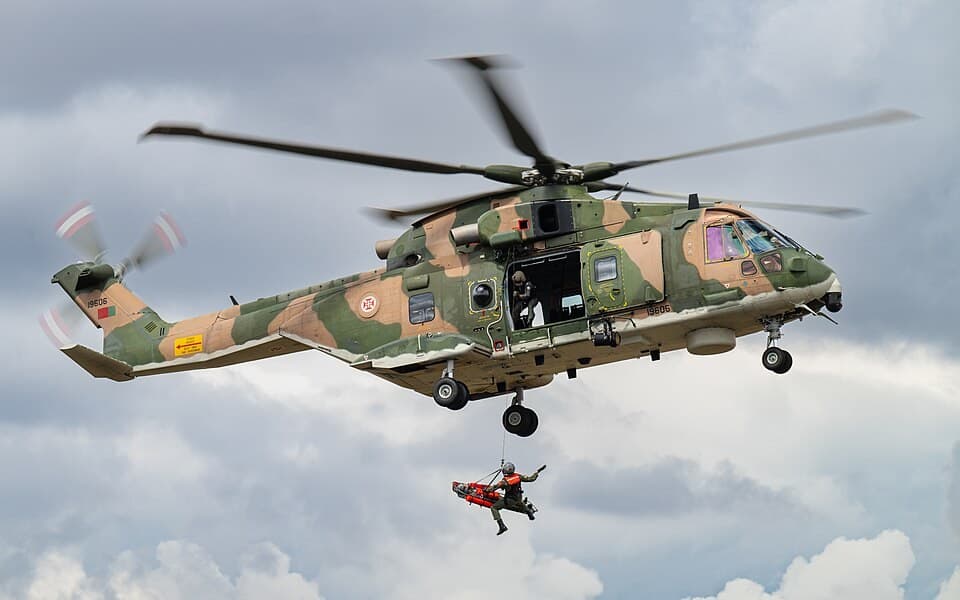


AHelicopters
AgustaWestland AW101
Anti-submarine warfare , medium-lift transport , search and rescue and utility helicopter


Preparing your view.
AHelicopters
Anti-submarine warfare , medium-lift transport , search and rescue and utility helicopter
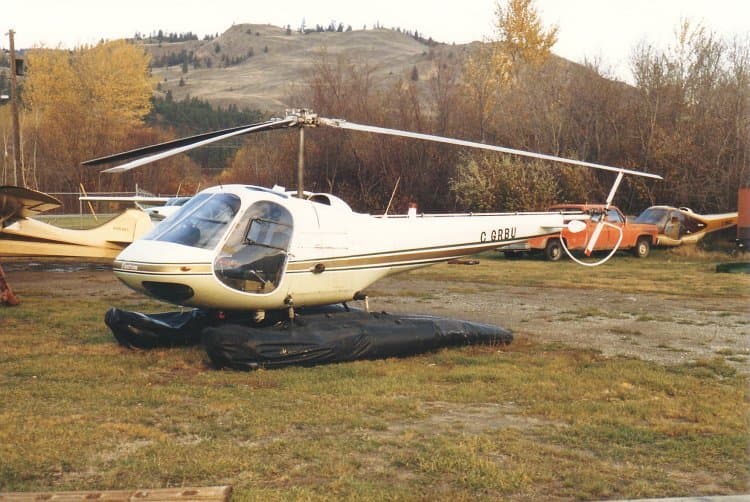

At a glance
Measured figures
Merlin HM1 · fuselage
Single sourceOfficial specification · aw101; 22.83 m
Manufacturer claimConfiguration
| Specification | AgustaWestland AW101 | Enstrom F-28 |
|---|---|---|
| Type | Anti-submarine warfare , medium-lift transport , search and rescue and utility helicopter[source] | Light helicopter[source] |
| National origin | Italy United Kingdom[source] | — |
| Manufacturer | Agusta Westland Helicopters AgustaWestland Finmeccanica Leonardo S.p.A.[source] | Enstrom Helicopter Corporation[source] |
| Status | In service[source] | — |
| Primary users | Royal Navy Royal Air Force (historical) Polish Navy Royal Norwegian Air Force Italian Navy |
19.53 m (64 ft 1 in) fuselage[source]
F28F · Length
Single source29 ft 3 in (8.92 m)[source]
Empty; Merlin HM1 · Empty weight
Single sourceMaximum take-off; Merlin HM1 · Max takeoff weight
Single sourceOfficial specification · aw101; 15,600 kg
Manufacturer claim10,500 kg (23,149 lb)[source]
15,600 kg (34,392 lb)[source]
Empty; F28F · Empty weight
Single sourceMaximum take-off; F28F · Max takeoff weight
Single sourceMerlin HM1 · 3 × Rolls-Royce Turbomeca RTM322-01 turboshaft engines each (take-off power)
Single source3 × Rolls-Royce Turbomeca RTM322-01 turboshaft engines, 1,566 kW (2,100 hp) each (take-off power)[source]
F28F · 1 × Lycoming HIO-360-F1AD four-cylinder, direct-drive, horizontally opposed, air-cooled, piston aircraft engine
Single source1 × Lycoming HIO-360-F1AD four-cylinder, direct-drive, horizontally opposed, air-cooled, piston aircraft engine, 225 hp (168 kW)[source]
F28F · 1,450 ft/min (
Single source1,450 ft/min (7.4 m/s)[source]
Bars compare reported quantities only. A larger figure does not make a system better; configurations and test conditions differ.
| — |
| Manufactured | 1990s–present[source] | 1965-present[source] |
|---|
| Introduction date | 1999[source] | 1965[source] |
|---|
| First flight | 9 October 1987[source] | — |
|---|
| Variants | AgustaWestland CH-149 Cormorant Lockheed Martin VH-71 Kestrel[source] | Enstrom TH180 Spitfire Mark I[source] |
|---|
| Capacity | 26 troops (38 passengers) or 5 tonnes of payload or 4 stretchers (with sonar array removed) for Merlin HM1; 30 seated troops or 45 standing fully equipped combat troops, or 3,050 kg (6,724 lb) of internal payload, 5,520 kg (12,169 lb) of external payload, or 16 stretchers for AW101[source] | two passengers[source] |
|---|
| Main rotor area | 271.51 m 2 (2,922.5 sq ft) root: RAE 9651; tip: RAE 9645/RAE 9634[source] | 804 sq ft (74.7 m 2 ) NACA 0013.5[source] |
|---|
| Never exceed speed | 309 km/h (192 mph, 167 kn)[source] | — |
|---|
| Bombs | 4× Sting Ray homing torpedoes or Mk 11 depth charges[source] | — |
|---|
| Role | medium-lift helicopter in military and civil use[source] | — |
|---|
| Source measurement | The AW101 follows a conventional design layout, but makes use of advanced technologies, such as the design of the rotor blades, avionics systems, and extensive use of composite materials. The fuselage structure is modular and comprises an aluminium–lithium alloy , designed to be both light and damage-resistant. The AW101 is designed for operating in extreme weather conditions; it is fitted with a de-icing system and rated to operate in temperatures ranging between −45 and +50 °C. The aircraft's control systems allow the AW101 to maintain a stable hover in 74 km/h (40 kn) crosswinds .[source]AgustaWestland AW101 · Design / Overview; only the objects and conditions stated in this passage An active vibration control system, known as the active control of structural response system , reduces airframe vibration by up to 80%, increasing crew comfort and minimising buildup of stress on the airframe. The cockpit is fitted with armoured seats for the crew, and can withstand an impact velocity of over 10 m/s. Dual flight controls are provided, though the AW101 can be flown by a single person. The pilots' instrument displays include six full-colour high-definition screens and an optional mission display; a digital map or forward looking infrared (FLIR) display can also be installed.[source]AgustaWestland AW101 · Design / Overview; only the objects and conditions stated in this passage The AW101 is powered by three turboshaft engines. Initially the Rolls-Royce Turbomeca RTM322 producing 2,035 to 2,160 shp (1,517 to 1,611 kW) and the General Electric CT7 producing 1,960 to 2,329 shp (1,462 to 1,737 kW) were the two available engine types, but by 2020 new aircraft were only being sold with the CT7-8E. The RTM322 powerplant was specifically developed for the AW101; it was subsequently adopted on the AgustaWestland WAH-64 Apache and the NHIndustries NH90 helicopters. According to Rolls-Royce, about 80% of AW101s use the RTM322[source]AgustaWestland AW101 · Design / Powerplant; only the objects and conditions stated in this passage The engines power an 18.59 m (61 ft 0 in) diameter five-bladed main rotor. The rotor blades are constructed from carbon/glass with nomex honeycomb and rohacell foam, edged with titanium alloy in a sandwich construction . The shaping of the main rotor blades is derived from the BERP rotor blades first used on the Westland Lynx . This blade design improves aerodynamic efficiency at the blade tip and reduces the acoustic signature . Improved BERP IV rotors have since been developed; when installed this increases the AW101's maximum take-off weight.[source]AgustaWestland AW101 · Design / Powerplant; only the objects and conditions stated in this passage The fuselage has a volume of 31.91 cubic metres (1,127 cu ft) and the cargo compartment is 6.5 metres (21 ft) in length, 2.3 metres (7 ft 7 in) wide and 1.91 metres (6 ft 3 in) high. The military version of the AW101 can accommodate up to 24 seated or 45 standing combat troops and their equipment. Alternative loads include a medical team and 16 stretchers, and cargo pallets.[source]AgustaWestland AW101 · Design / Crew and cargo; only the objects and conditions stated in this passage The ramp, 1.91 by 2.3 metres (6 ft 3 in × 7 ft 7 in), can take a 3,050-kilogram (6,720 lb) load, allowing it to carry vehicles such as Land Rovers . The ramp and cabin floor are fitted with flush tie-down points. A cargo hook under the fuselage can carry external loads of 5,440 kilograms (11,990 lb) via the use of a semi-automatic cargo release unit (SACRU). A rescue hoist and a hover trim controller are fitted at the cargo door. An optional cargo winch can be installed near to the rear ramp.[source]AgustaWestland AW101 · Design / Crew and cargo; only the objects and conditions stated in this passage The Merlin HM1 has been cleared to operate from the Royal Navy's aircraft carriers , amphibious assault ships , Type 23 frigates , Type 45 destroyer and several Royal Fleet Auxiliary (RFA) vessels including the Fort Victoria class . 30 aircraft have been upgraded to Merlin HM2 standard under the £750m Merlin Capability Sustainment Programme; Lockheed Martin UK delivered the final HM2 on 11 July 2016.[source]AgustaWestland AW101 · Operational history / Royal Navy; only the objects and conditions stated in this passage The HM2 achieved IOC on 30 June 2014 after flying 480 hours from Illustrious during Exercise Deep Blue earlier that month.[source]AgustaWestland AW101 · Operational history / Royal Navy; only the objects and conditions stated in this passage Six of the Merlins were in the ASW role and three in the AEW role, with the Crowsnest system having formally reached full operating capability.[source]AgustaWestland AW101 · Operational history / Royal Navy; only the objects and conditions stated in this passage In 2012, the RAF's Merlin HC3/3A fleet began to be transferred to the Royal Navy for use by the Commando Helicopter Force. Royal Navy personnel worked alongside RAF crew at Benson to build experience during the transition. The £454m Merlin Life Sustainment Programme resulted in 25 HC3/3A airframes being fitted with the cockpit electronics of the HM2, folding tails and main rotor heads, strengthened landing gear, deck lashing mounting points, obsolescence updates, fast-roping points and a common emergency egress system. The first HC4 began flight trials in September 2017, with an IOC in mid-2018; an interim folding main rotor head will be fitted to some HC3 for shipborne operations prior to the HC4 upgrade.[source]AgustaWestland AW101 · Operational history / Royal Air Force; only the objects and conditions stated in this passage Danish AW101s have a higher gross weight capacity of 15,600 kg and were, as delivered, coated in a paint designed to reduce the aircraft's infrared signature . In the SAR role, RDAF AW101s have a crew of six and were initially painted yellow to distinguish themselves from AW101 allocated to military duties, but were later painted green, and all 14 AW101s are used for SAR and troop transport.[source]AgustaWestland AW101 · Operational history / Royal Danish Air Force; only the objects and conditions stated in this passage The first AW101 was delivered in November 2017. The Norwegian AW101s officially started operating in the rescue role on 1 September 2020. The Sea King was phased out in December 2023, after 47 years of service as rescue helicopter in the Royal Norwegian Air force, and replaced with the AW101. The AW101 is named SAR Queen in Norwegian service, and performed the 486 nmi (900 km) flight from Mainland Bodø to Jan Mayensfield using two engines, and then back, in 2025.[source]AgustaWestland AW101 · Operational history / Royal Norwegian Air Force; only the objects and conditions stated in this passage In 2002, AgustaWestland, Kawasaki and Marubeni entered a general agreement for cooperation; Kawasaki began the assembly of both the CH-101 and the MCH-101 in 2003. Kawasaki also began licensed production of the RTM322 engines in 2005. In a separate agreement between Marubeni and AgustaWestland, a supply depot was established in Japan to support the MCH-101 and CH-101 fleets. The first MCH-101 was delivered to the JMSDF on 3 March 2006.[source]AgustaWestland AW101 · Operational history / Japan Maritime Self-Defense Force; only the objects and conditions stated in this passage The MCH-101 will replace the MH-53E (S-80-M-1) in the AMCM role. The CH-101 will operate in the transport/support role for Antarctic expeditions , replacing the Sikorsky S-61A , and will be working in coordination with the Ministry of Education, Culture, Sports, Science and Technology .[source]AgustaWestland AW101 · Operational history / Japan Maritime Self-Defense Force; only the objects and conditions stated in this passage Length: 19.53 m (64 ft 1 in) fuselage[source]AgustaWestland AW101 · Specifications (Merlin HM1); only the objects and conditions stated in this passage Height: 6.62 m (21 ft 9 in)[source]AgustaWestland AW101 · Specifications (Merlin HM1); only the objects and conditions stated in this passage Empty weight: 10,500 kg (23,149 lb)[source]AgustaWestland AW101 · Specifications (Merlin HM1); only the objects and conditions stated in this passage Max takeoff weight: 15,600 kg (34,392 lb)[source]AgustaWestland AW101 · Specifications (Merlin HM1); only the objects and conditions stated in this passage Powerplant: 3 × Rolls-Royce Turbomeca RTM322-01 turboshaft engines, 1,566 kW (2,100 hp) each (take-off power)[source]AgustaWestland AW101 · Specifications (Merlin HM1); only the objects and conditions stated in this passage Main rotor diameter: 18.59 m (61 ft 0 in)[source]AgustaWestland AW101 · Specifications (Merlin HM1); only the objects and conditions stated in this passage Main rotor area: 271.51 m 2 (2,922.5 sq ft) root: RAE 9651; tip: RAE 9645/RAE 9634[source]AgustaWestland AW101 · Specifications (Merlin HM1); only the objects and conditions stated in this passage Cruise speed: 278 km/h (173 mph, 150 kn)[source]AgustaWestland AW101 · Specifications (Merlin HM1); only the objects and conditions stated in this passage Never exceed speed : 309 km/h (192 mph, 167 kn)[source]AgustaWestland AW101 · Specifications (Merlin HM1); only the objects and conditions stated in this passage Range: 1,389 km (863 mi, 750 nmi)[source]AgustaWestland AW101 · Specifications (Merlin HM1); only the objects and conditions stated in this passage Endurance: 5 hours[source]AgustaWestland AW101 · Specifications (Merlin HM1); only the objects and conditions stated in this passage Service ceiling: 4,575 m (15,010 ft)[source]AgustaWestland AW101 · Specifications (Merlin HM1); only the objects and conditions stated in this passage | — |
|---|
| Developed into | — | Enstrom 480[source] |
|---|
| Country of origin | — | Vereinigte Staaten[source]Country of design · Entwurfsland |
|---|