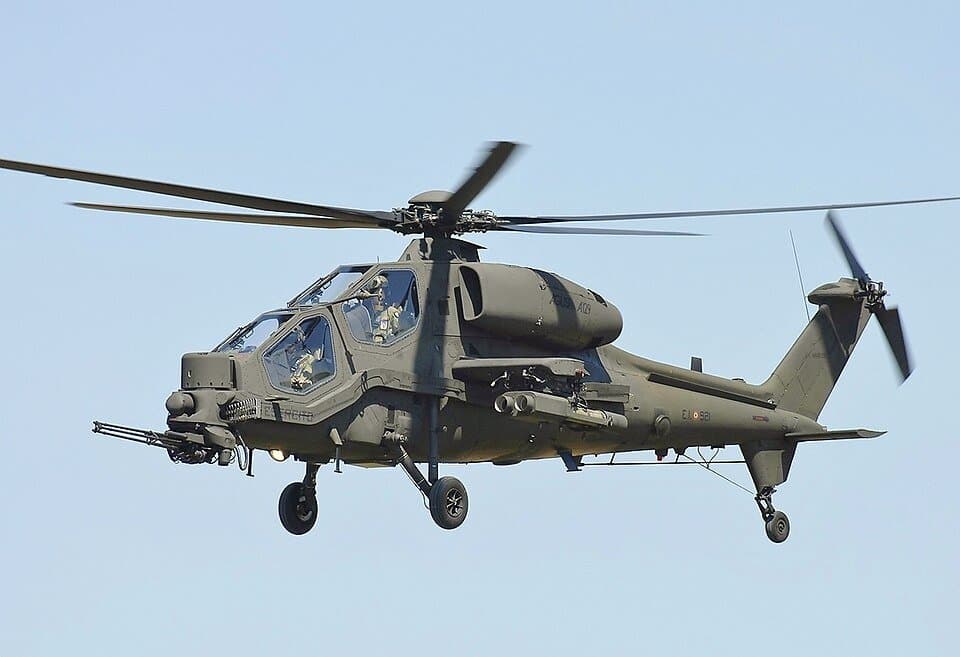

Credit
Aldo Bidini · CC BY-SA 4.0 · Resized · CC BY-SA 4.0 · Source ↗ · Modified


Preparing your view.
At a glance
True scale
Side by side. From every angle. A human reference for perspective.
3.10 MB · Loads when you open it| Model | Length | Width / span | Height |
|---|---|---|---|
| Agusta A129 Mangusta | ≈ 12.28 m | ≈ 10.25 m (Width) | ≈ 3.94 m |
| Mil Mi-28 | ≈ 17.01 m | ≈ 15.04 m (Width) | ≈ 4.21 m |
Scaled uniformly to the sourced length of 12.28 m. Not an official model or a measured survey.
ForceTally · All rights reserved
Scaled uniformly to the sourced length of 17.01 m. Not an official model or a measured survey.
ForceTally · All rights reserved
The human reference is a generic 1.75 m figure. Models describe external size, not combat performance.
Measured figures
A129 · Length
Single source12.28 m (40 ft 3 in)[source]
Configuration
| Specification | Agusta A129 Mangusta | Mil Mi-28 |
|---|---|---|
| Type | Attack helicopter[source] | Attack helicopter[source] |
| National origin | Italy[source] | Soviet Union Russia[source] |
| Manufacturer | Agusta[source] | Mil[source] |
| Status | In service[source] | In service[source] |
excluding rotors
17.01 m (55 ft 10 in) excluding rotors[source]
stub wings
Single source4.88 m (16 ft 0 in) stub wings[source]
10-minute loiter with 5% reserve
Single source200 km (120 mi, 110 nmi) 10-minute loiter with 5% reserve[source]
A129 · 2 × Rolls-Royce Gem 2-1004D (license built by Piaggio) turboshaft engines each
Single source2 × Rolls-Royce Gem 2-1004D (license built by Piaggio) turboshaft engines, 664 kW (890 hp) each[source]
2 × Klimov VK-2500 turboshaft engines each
Single source2 × Klimov VK-2500 turboshaft engines, 1,636 kW (2,194 hp) each[source]
Bars compare reported quantities only. A larger figure does not make a system better; configurations and test conditions differ.
| Primary user | Italian Army[source] | — |
|---|
| Number built | 60 (+7 prototypes and demonstrators)[source] | 190+ as of May 2025[source] |
|---|
| Introduction date | 1990[source] | 15 October 2009 (Mi-28N)[source] |
|---|
| First flight | 11 September 1983[source] | 10 November 1982[source] |
|---|
| Developed into | TAI/AgustaWestland T129 ATAK[source] | — |
|---|
| Guns | 1× 20 mm (0.787 in) M197 three-barrel Gatling-type cannon (500 rounds) in a TM197B Light Turreted Gun System (CBT version)[source] | 1× chin-mounted 30 mm Shipunov 2A42 cannon with 250 rounds (±110° horizontal fire)[source] |
|---|
| Hardpoints | 4× Hardpoints with a capacity of 1500 kg (3,307 lb), with provisions to carry combinations of: Rockets: 4× M260 rocket pods (each 7× 70 mm (2.75 in) Hydra 70 unguided rockets 4× M261 rocket pods (each 19× 70 mm (2.75 in) Hydra 70 unguided rockets Missiles: 2× missile launchers on each outboard hardpoint with up to 4× BGM-71 TOW , AGM-114 Hellfire or Spike-ER anti-tank guided missiles per launchers 2× missile launchers on each outboard hardpoint with up to 2× AIM-92 Stinger anti-aircraft missiles Other: 2× FN Herstal ETNA TMP-5 pods with 2× 7.62 mm (.30 in) FN MAG 58P machine guns (each 500 rounds) 2× FN-Herstal HMP-400LC pods with 1× 12.7 mm (.50 in) M2 machine gun (400 rounds) 2× external fuel tanks (220 Liter (52.8 gal)[source] | Two pylons under each stub wing to mount bombs, rockets, missiles, and gun pods. Main armament configurations include: 16 Ataka-V anti-tank missiles and 40 S-8 rockets , or 16 Ataka-V anti-tank missiles, and 10 S-13 rocket , or 16 Ataka-V anti-tank missiles, and two 23 mm UPK-23-250 gun pods each containing a GSh-23L with 250 rounds. Other ordnance: 9K121 Vikhr , and 9M123 Khrizantema anti-tank missiles ( 9M123VM variant for any Mi-28 variant have fire-control radar , with bonus of millimeter-wave radar ACLOS missile guidance), LMUR , 8 Igla-V and Vympel R-73 air-to-air missiles, 2 KMGU-2 mine dispensers, and a variant of 9K333 Verba air-to-air missile[source] |
|---|
| Main rotor area | 111.2 m 2 (1,197 sq ft) 5-bladed main rotor[source] | 232.35 m 2 (2,501.0 sq ft)[source] |
|---|
| Rockets | 4× M260 rocket pods (each 7× 70 mm (2.75 in) Hydra 70 unguided rockets 4× M261 rocket pods (each 19× 70 mm (2.75 in) Hydra 70 unguided rockets[source] | — |
|---|
| Missiles | 2× missile launchers on each outboard hardpoint with up to 4× BGM-71 TOW , AGM-114 Hellfire or Spike-ER anti-tank guided missiles per launchers 2× missile launchers on each outboard hardpoint with up to 2× AIM-92 Stinger anti-aircraft missiles[source] | — |
|---|
| Other | 2× FN Herstal ETNA TMP-5 pods with 2× 7.62 mm (.30 in) FN MAG 58P machine guns (each 500 rounds) 2× FN-Herstal HMP-400LC pods with 1× 12.7 mm (.50 in) M2 machine gun (400 rounds) 2× external fuel tanks (220 Liter (52.8 gal)[source] | — |
|---|
| Designer | — | Marat Tishchenko[source] |
|---|
| Primary users | — | Russian Air Force Algerian Air Force Iraqi Army Aviation Command Uganda Air Force[source] |
|---|
| Manufactured | — | 1982–present[source] |
|---|
| Fuel capacity | — | 1,337 kg (2,948 lb) / 1,720 L (450 US gal; 380 imp gal) internal fuel + up to 445 kg (981 lb) / 571 L (151 US gal; 126 imp gal) in 4x drop tanks[source] |
|---|
| Hover ceiling OGE | — | 3,600 m (11,811 ft)[source] |
|---|
| g limits | — | + 3 - 0.5[source] |
|---|
| Disk loading | — | 49.5 kg/m 2 (10.1 lb/sq ft) max[source] |
|---|
| Power/mass | — | 0.31 kW/kg (0.19 hp/lb)[source] |
|---|
Maximum take-off; Max takeoff weight
Single source