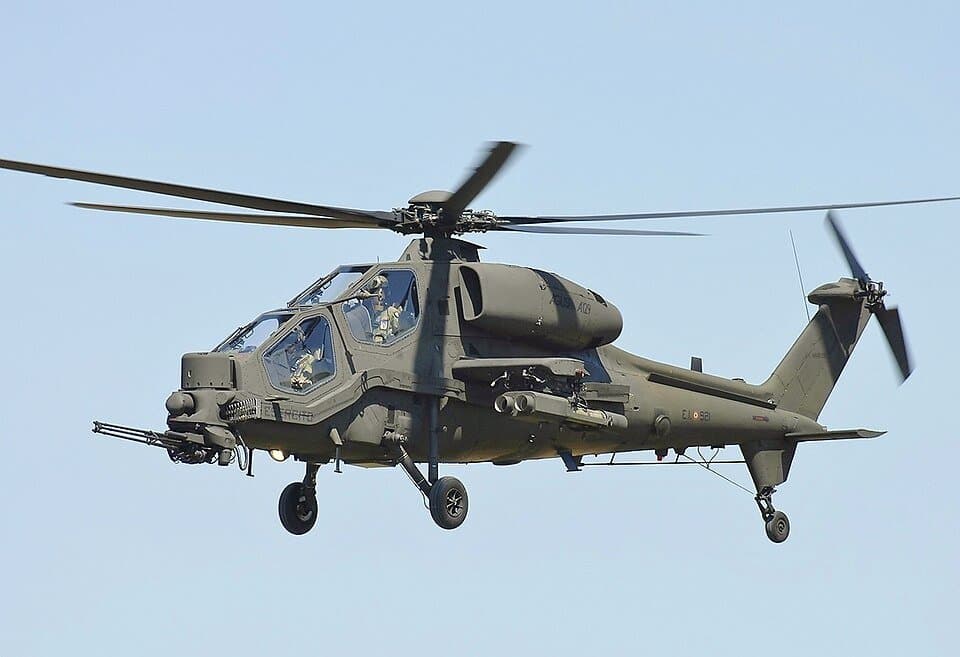

Credit
Aldo Bidini · CC BY-SA 4.0 · Resized · CC BY-SA 4.0 · Source ↗ · Modified


Preparing your view.
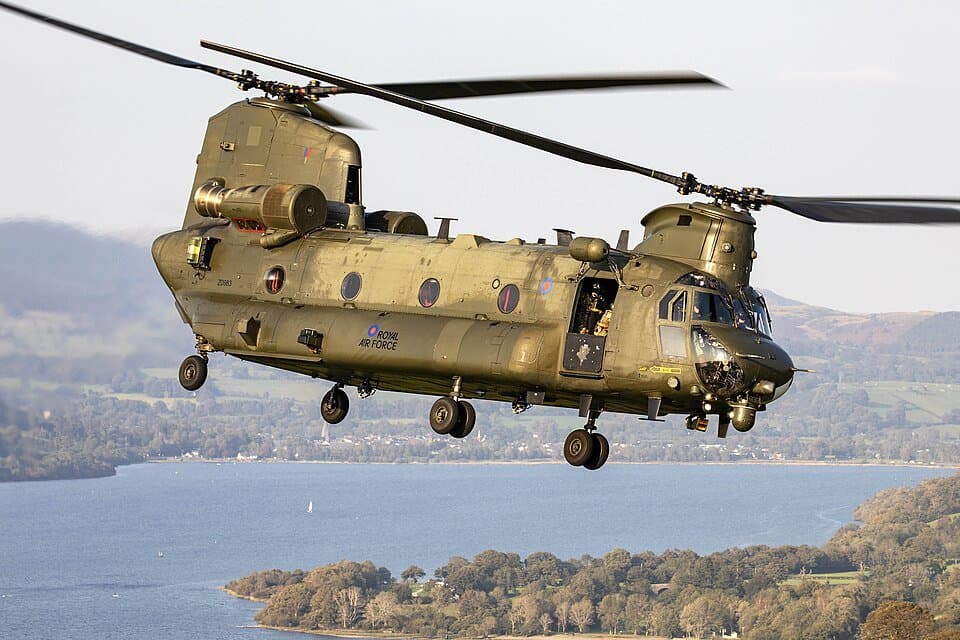

At a glance
Measured figures
A129 · Length
Single source12.28 m (40 ft 3 in)[source]
Chinook HC6A · Length
Single sourceConfiguration
| Specification | Agusta A129 Mangusta | Boeing Chinook (UK variants) |
|---|---|---|
| Type | Attack helicopter[source] | Transport helicopter[source] |
| National origin | Italy[source] | — |
| Manufacturer | Agusta[source] | Boeing Defense, Space & Security[source] |
| Status | In service[source] | In service[source] |
Chinook / RAF specification (variant not stated) · Length · Length
Single sourceA129 · Main rotor diameter
Single source11.9 m (39 ft 1 in)[source]
A129 · Crew
Single sourceChinook HC6A · pilot, copilot, two weapon system operators/loadmasters
Single source4 (pilot, copilot, two weapon system operators/loadmasters)[source]
2 Pilots, 2 Weapon System Operators[source]Chinook / RAF specification (variant not stated) · AircrewSource text · numeric interpretation needs review
Cruise; A129 · Cruise speed
Single sourceMaximum; A129 · Maximum speed
Single source278 km/h (173 mph, 150 kn)[source]
229 km/h (142 mph, 124 kn)[source]
Maximum; Chinook HC6A · Maximum speed
Single sourceMaximum; Chinook / RAF specification (variant not stated) · Maximum speed · Maximum speed
Single sourceA129 · 2 × Rolls-Royce Gem 2-1004D (license built by Piaggio) turboshaft engines each
Single source2 × Rolls-Royce Gem 2-1004D (license built by Piaggio) turboshaft engines, 664 kW (890 hp) each[source]
Chinook HC6A · 2 × Honeywell T55-GA-714A turboshaft free-turbine engines, 3,750 shp ( ) each
Single source2 × Honeywell T55-GA-714A turboshaft free-turbine engines, 3,750 shp (2,800 kW) each[source]
Bars compare reported quantities only. A larger figure does not make a system better; configurations and test conditions differ.
| Primary user | Italian Army[source] | Royal Air Force[source] |
|---|
| Number built | 60 (+7 prototypes and demonstrators)[source] | 72 (all RAF models)[source] |
|---|
| Introduction date | 1990[source] | 22 November 1980 (with RAF)[source] |
|---|
| First flight | 11 September 1983[source] | 23 March 1980 (HC1)[source] |
|---|
| Developed into | TAI/AgustaWestland T129 ATAK[source] | — |
|---|
| Guns | 1× 20 mm (0.787 in) M197 three-barrel Gatling-type cannon (500 rounds) in a TM197B Light Turreted Gun System (CBT version)[source] | 2× M134 Miniguns and 1× M60 machine gun[source] 2 x M134 Miniguns, 1 x M60 Machine Gun[source]Chinook / RAF specification (variant not stated) · Guns |
|---|
| Hardpoints | 4× Hardpoints with a capacity of 1500 kg (3,307 lb), with provisions to carry combinations of: Rockets: 4× M260 rocket pods (each 7× 70 mm (2.75 in) Hydra 70 unguided rockets 4× M261 rocket pods (each 19× 70 mm (2.75 in) Hydra 70 unguided rockets Missiles: 2× missile launchers on each outboard hardpoint with up to 4× BGM-71 TOW , AGM-114 Hellfire or Spike-ER anti-tank guided missiles per launchers 2× missile launchers on each outboard hardpoint with up to 2× AIM-92 Stinger anti-aircraft missiles Other: 2× FN Herstal ETNA TMP-5 pods with 2× 7.62 mm (.30 in) FN MAG 58P machine guns (each 500 rounds) 2× FN-Herstal HMP-400LC pods with 1× 12.7 mm (.50 in) M2 machine gun (400 rounds) 2× external fuel tanks (220 Liter (52.8 gal)[source] | — |
|---|
| Main rotor area | 111.2 m 2 (1,197 sq ft) 5-bladed main rotor[source] | 5,655.2 sq ft (525.39 m 2 )[source] |
|---|
| Rockets | 4× M260 rocket pods (each 7× 70 mm (2.75 in) Hydra 70 unguided rockets 4× M261 rocket pods (each 19× 70 mm (2.75 in) Hydra 70 unguided rockets[source] | — |
|---|
| Missiles | 2× missile launchers on each outboard hardpoint with up to 4× BGM-71 TOW , AGM-114 Hellfire or Spike-ER anti-tank guided missiles per launchers 2× missile launchers on each outboard hardpoint with up to 2× AIM-92 Stinger anti-aircraft missiles[source] | — |
|---|
| Other | 2× FN Herstal ETNA TMP-5 pods with 2× 7.62 mm (.30 in) FN MAG 58P machine guns (each 500 rounds) 2× FN-Herstal HMP-400LC pods with 1× 12.7 mm (.50 in) M2 machine gun (400 rounds) 2× external fuel tanks (220 Liter (52.8 gal)[source] | — |
|---|
| Designer | — | Boeing-Vertol[source] |
|---|
| Developed from | — | Boeing CH-47 Chinook[source] |
|---|
| Variants | — | HC1, HC1B, HC2, HC3, HC4, HC5, HC6, HC6A, HC7[source] |
|---|
| Capacity | — | 55 soldiers and up to 10 tonnes of freight or equipment[source] |
|---|
| Blade section | — | - root: Boeing VR-7; tip: Boeing VR-8[source] |
|---|
| Cockpit Avionics | — | Glass cockpit with a BAE Systems Digital Advanced Flight Control System (DAFCS), includes automatic modes such as auto-hover and auto-descend to ease pilot workload.[source] |
|---|
| Sensors | — | Electro-Optical Sensor Turret (EOST) with two infrared cameras and a low-light TV function .[source] EOST turret including two infrared cameras and a low-light TV function[source]Chinook / RAF specification (variant not stated) · Electro optics |
|---|
| Defensive Aids | — | Missile Warning Receiver, Infrared Warning Receiver, Radar Warning Receiver, Counter-measure dispensing system (flares).[source] |
|---|
| Country of origin | — | United States[source]Boeing Chinook (UK variants) · origin explicitly stated in the linked current national-inventory row; no inference from operator or shipyard |
|---|
| Powerplant | — | Two Honeywell 55-L-714A Free-Turbine engines[source]Chinook / RAF specification (variant not stated) · Powerplant |
|---|
| Reported engine rating | — | 4,168shp each[source]Chinook / RAF specification (variant not stated) · ThrustSource text · numeric interpretation needs review |
|---|
| Flight altitude | — | 15,000ft[source]Chinook / RAF specification (variant not stated) · Maximum altitude |
|---|
Maximum take-off; Chinook HC6A · Max takeoff weight
Single source