
FORCETALLY
Loading the evidence…
Preparing your view.


Preparing your view.

At a glance
Agni-VIlarger figure on 4 of 4
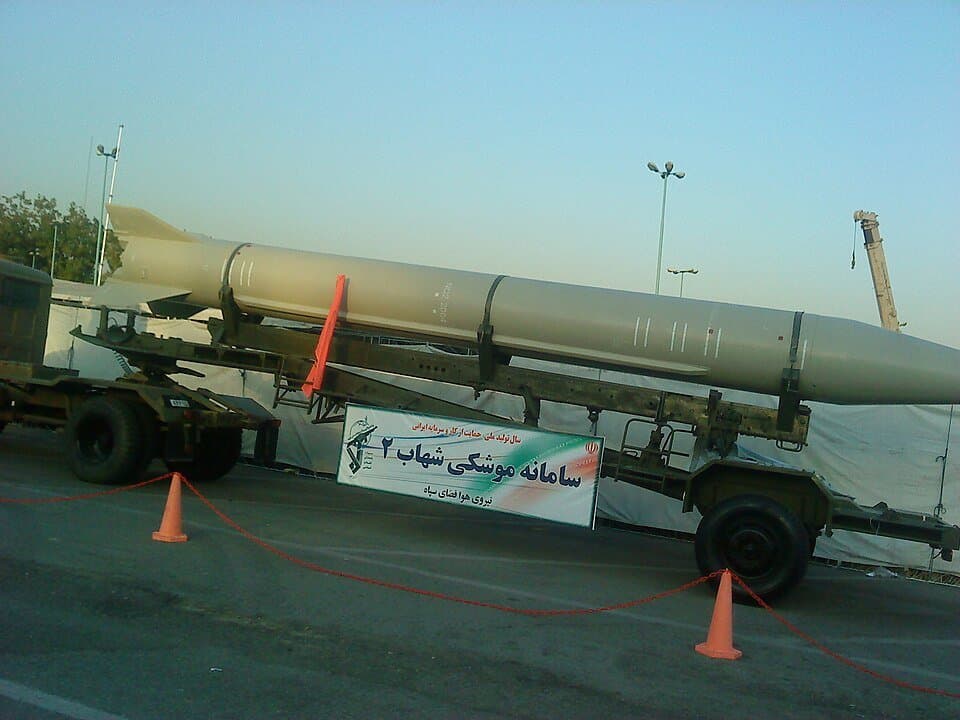
Shahab-2larger figure on 0 of 4
Measured figures
Length
Single source20 - 40.00 m[source]
Length
Single sourceConfiguration
| Specification | Agni-VI | Shahab-2 |
|---|---|---|
| Type | ICBM[source] | Tactical SRBM[source] |
| Place of origin | India[source] | — |
| In service | Under development[source] | 1990–2016 (in Iran); present (in Syria)[source] |
| Used by | Indian Armed Forces[source] | See § Operators[source] |
| Designer | Defence Research and Development Organisation |
Counts only measures both sources give with the same scope. A larger figure is not a better system.
11.37–12.29 m[source]
Maximum; 8.17 km/s
Single sourceMaximum; Mach 24 (
Single sourceMach 24 (29,400 km/h; 18,300 mph; 8.17 km/s)[source]
Warhead weight
Single source3 tonnes[source]
Bars compare reported quantities only. A larger figure does not make a system better; configurations and test conditions differ.
| — |
| Manufacturer | Bharat Dynamics Limited[source] | Iran[source] |
|---|
| Warhead | Strategic nuclear weapon with 10-11 MIRV capability[source] | 770kg[source] |
|---|
| Engine | Four stage rocket + MaRV[source] | Liquid[source] |
|---|
| Propellant | Solid[source] | — |
|---|
| Transport | Road mobile[source] | — |
|---|
| Source measurement | In June 2011, for the first time then IAF Chief Marshal Pradeep Vasant Naik vehemently argued in favour of broadening India's nuclear strike capabilities beyond the immediate neighbourhood. Naik, who was also the head of the Chiefs of Staff committee, stated, "India should pursue an ICBM programme to acquire ranges of 10,000 km or more. Breaking out of the regional context is important as the country's sphere of influence grows. We have no territorial designs on any country, but India needs the capability to match its sphere of influence."[source]Agni-VI · History / Preliminary research; only the objects and conditions stated in this passage In October 2011, The Pioneer published a report questioning DRDO 's ability to independently develop seeker technology (guidance technology) suitable for ICBMs , that could enable the missile to traverse long distances in excess of 10,000 km. The same report also asserted Russia's willingness to help India with seeker technology. The authenticity of the pioneer report is disputed by at least one foreign newspaper, with the counter-claim that the involvement of Russia is probably inflated out of proportion, because if the report about Russian involvement is true, Russia may be suspected of violating the Missile Technology Control Regime . In response to the scepticism, a top DRDO scientist asserted that India has all the equipment and technology needed to develop ICBMs, "but where the warhead should go or what the range should be will have to be a political call."[source]Agni-VI · History / Preliminary research; only the objects and conditions stated in this passage On 20 June 2011, Indian Defence News published an article titled India Serious About 10,000 km ICBM which stated that India is seriously contemplating to enhance the reach of its strategic missiles and that the Ministry of Defense is considering a DRDO proposal to develop intercontinental ballistic missile (ICBM) capable of hitting targets 10,000 km away. Building an ICBM has international ramifications and the ultimate decision to go ahead with the proposal would be taken by the Cabinet Committee on Security (CCS).[source]Agni-VI · History / Preliminary research; only the objects and conditions stated in this passage In May 2018, reports confirmed the development of another ICBM in the Agni series, a three-stage Agni VI missile. It was proposed that the missile will be developed in 2024 or so and will have an even longer range, up to 8,000 km to 12,000 km. The Agni VI will be sleeker than the Agni-V and capable of carrying at least 10 nuclear warheads, capable of targeting multiple targets at the same time.[source]Agni-VI · History / Recent developments; only the objects and conditions stated in this passage As per people related to Agni VI development, government officials carefully watched 2022 Russian invasion of Ukraine and how ICBM played its role in geopolitics. It is speculated that India might go ahead with a technology demonstrator by 2025 in order to validate computer simulations aiming to reach even the farthest corner of China from a safer survival distance. The Agni VI programme is already on track and DRDO is simultaneously working on SLBM variant.[source]Agni-VI · History / Recent developments; only the objects and conditions stated in this passage It is reported to be the latest and most advanced version among the Agni missiles . According to sources, Agni-VI missile is likely to carry up to 10 MIRV warheads and will have a strike range of 12,000 km, though DRDO has refused to confirm the missile's range. A senior DRDO scientist was quoted as saying that the new generation Agni-VI missile will be sleeker, easily transportable and would be readily deployed. It will have the capability to be launched from submarine and from land-based launchers.[source]Agni-VI · Missile Description; only the objects and conditions stated in this passage | On November 2, 2006, Iran fired unarmed missiles to begin 10 days of military simulations . Iranian state television reported "dozens of missiles were fired, including Shahab-2 and Shahab-3 missiles. The missiles ranged from 300 km to up to 2,000 km. Iranian experts have made some changes to Shahab-3 missiles, installing cluster warheads in them with the capacity to carry 1,400 bombs."[source]Shahab-2 · History; only the objects and conditions stated in this passage |
|---|
| Guidance system | — | inertial[source] |
|---|
| Accuracy | — | 500m CEP[source] |
|---|
| Role | — | tactical short-range ballistic missile[source] |
|---|
| Country of origin | — | Iran[source] Iran[source] |
|---|
| Reported operators | — |
|
|---|