
FORCETALLY
Loading the evidence…
Preparing your view.


Preparing your view.

At a glance
Agni-Plarger figure on 3 of 4
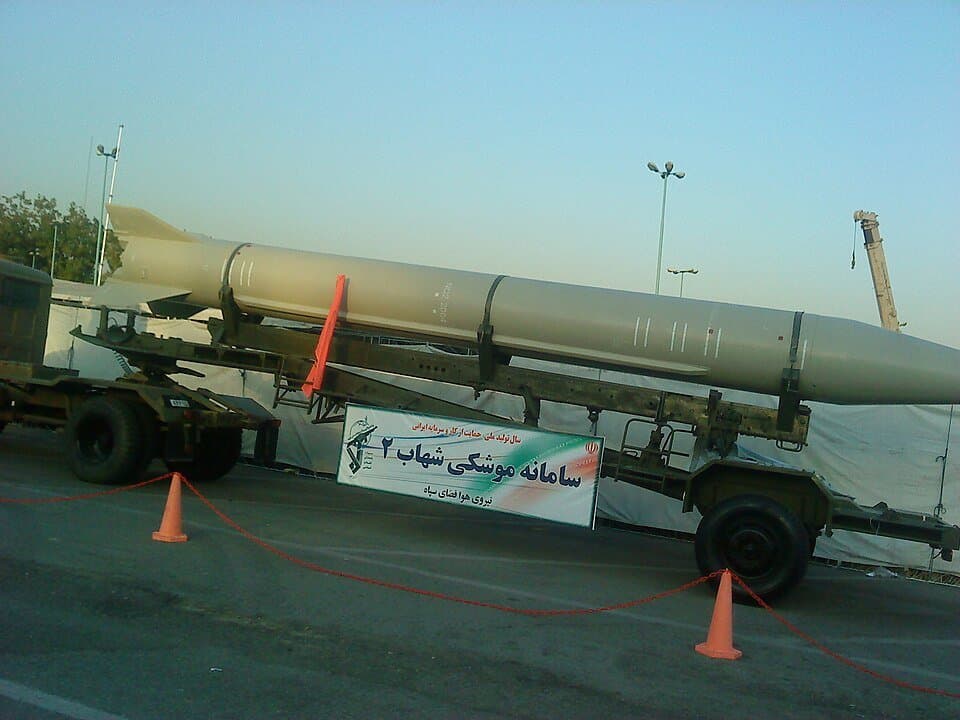
Shahab-2larger figure on 1 of 4
Counts only measures both sources give with the same scope. A larger figure is not a better system.
Measured figures
Length
Single source10.5 m (34 ft 5 in)[source]
Length
Single sourceConfiguration
| Specification | Agni-P | Shahab-2 |
|---|---|---|
| Type | Medium-range ballistic missile[source] | Tactical SRBM[source] |
| Place of origin | India[source] | — |
| In service | Pre-induction Trials[source] | 1990–2016 (in Iran); present (in Syria)[source] |
| Used by | Strategic Forces Command[source] | See § Operators[source] |
| Designer |
11.37–12.29 m[source]
Warhead weight
Single source1,500 kg (3,300 lb) – 3,000 kg (6,600 lb)[source]
Bars compare reported quantities only. A larger figure does not make a system better; configurations and test conditions differ.
Defence Research and Development Organisation[source] |
| — |
| Manufacturer | Bharat Dynamics Limited[source] | Iran[source] |
|---|
| Warhead | 2 × Maneuverable reentry vehicle (planned) or MIRV ( high explosive , thermobaric and nuclear )[source] | 770kg[source] |
|---|
| Engine | Two stage rocket motor[source] | Liquid[source] |
|---|
| Propellant | Solid fuel[source] | — |
|---|
| Guidance system | RLG - INS + redundant micro-INS and digital control + multi- GNSS[source] | inertial[source] |
|---|
| Accuracy | 10 m CEP[source] | 500m CEP[source] |
|---|
| Launch platform | Mobile rail-launcher Transporter erector launcher[source] | — |
|---|
| Source measurement | The missile can cover a maximum distance of 2000 km with 1.5 ton payload. According to analysts, Agni-P is primarily aimed at countering Pakistan's forces as its range is insufficient to reach all parts of mainland China. Given the missile's range, analysts at the International Institute for Strategic Studies believe that Agni-P primarily counters Pakistan and intends to replace older and less compact short-range ballistic missiles such as the Agni-I and Agni-II .[source]Agni-P · Description / Range and mobility; only the objects and conditions stated in this passage DRDO has developed a number of missiles for the Indian Armed Forces. These include the K Missile family , the Prithvi series , the Agni series , Pralay , Prahaar and Shaurya . With the exception of the Pralay and Prahaar missiles, which carry conventional warheads with a restricted range of up to 150–500 km (93–311 mi) and are intended for tactical battlefield assistance, the majority of the long-range missiles have nuclear warheads . The development of a conventionally armed missile with a range of more than 1,500 km (930 mi) was therefore deemed necessary in order to counter ship-based threats in the Indian Ocean , Bay of Bengal , and Arabian Sea , as well as land-based threats from beyond the Line of Actual Control (LAC) in the provinces of Xinjiang , Tibet , and Yunnan . To address this requirement, by September 2022, DRDO had completed design work of another land-based 1,500 km (930 mi) range missile to attack targets across Line of Actual Control with an anti ship variant against aircraft carriers to cover Indian fleets in Bay of Bengal and Arabian Sea.[source]Agni-P · Further development / BM-04 / Background; only the objects and conditions stated in this passage On 5 November 2023, a report suggested that the Indian Armed Forces were considering the induction of a 1,500 km range-class conventional ballistic missile for the proposed Integrated Rocket Force . The design of the missile could be inherited from an existing ballistic missile of the Strategic Forces Command . As reported in April 2024, the missile was under development.[source]Agni-P · Further development / BM-04 / Development; only the objects and conditions stated in this passage The DRDO introduced a full-scale model of the BM-04 ballistic missile at the Vigyan Vaibhav 2025 defence exhibition in Hyderabad in March. The missile design closely resembled Agni Prime missile with a 10.2 m (33 ft) length, 1.2 m (3 ft 11 in) diameter and weight of 11,500 kg (25,400 lb). The missile would be two staged solid propulsion with a range of 400–1,500 km (250–930 mi). The missile guided by IRNSS or GPS . The reentry vehicle of the missile was designed to be a boostglide vehicle with an expected terminal speed of over Mach 5 (1.7 km/s ). The reentry vehicle featured fixed wings in the middle and control fins in the rear and is to be equipped with over 500 kg (1,100 lb) conventional warhead. The BM-04 will be tasked to "neutralise enemy anti-access/area denial (A2/AD) capabilities and ensure that the Indian defence forces do not face any operational restrictions in a highly contested battlefield".[source]Agni-P · Further development / BM-04 / Development; only the objects and conditions stated in this passage | On November 2, 2006, Iran fired unarmed missiles to begin 10 days of military simulations . Iranian state television reported "dozens of missiles were fired, including Shahab-2 and Shahab-3 missiles. The missiles ranged from 300 km to up to 2,000 km. Iranian experts have made some changes to Shahab-3 missiles, installing cluster warheads in them with the capacity to carry 1,400 bombs."[source]Shahab-2 · History; only the objects and conditions stated in this passage |
|---|
| Role | — | tactical short-range ballistic missile[source] |
|---|
| Country of origin | — | Iran[source] Iran[source] |
|---|
| Reported operators | — |
|
|---|